
A user experience audit is a structured, diagnostic review of a digital product that identifies usability problems affecting user satisfaction and business outcomes. Unlike a redesign proposal, a UX audit produces specific findings tied to measurable behaviors, heuristic violations, or analytics data. Product managers and UX designers who run these reviews consistently find that the process surfaces issues invisible to internal teams. The most widely used framework is Nielsen's 10 usability heuristics, and the most defensible audits combine that qualitative lens with quantitative metrics like Net Promoter Score, task success rate, and error rate.
What methodologies are used in user experience audits?
A UX audit draws from two distinct evidence streams: expert heuristic evaluation and quantitative behavioral data. Neither stream alone produces a complete picture. Relying solely on qualitative review or quantitative analytics leads to incomplete conclusions. The strongest audits layer both.
Heuristic evaluation
Nielsen's 10 usability heuristics remain the industry standard for expert review. They cover principles like visibility of system status, error prevention, and consistency of interface conventions. Expert evaluators identify an average of 53 usability problems per software product using this method. That number matters because it shows how much friction accumulates invisibly before anyone runs a formal review.

Concurrence between evaluators ranges from 21% to 44%, which means no single expert catches everything. Running heuristic reviews with two or three evaluators and then reconciling findings produces a far more complete issue list than relying on one person's judgment.
Quantitative and behavioral metrics
Behavioral metrics track what users actually do: task success rate, time on task, and error rate. Attitudinal metrics capture how users feel: NPS, satisfaction scores, and System Usability Scale (SUS) ratings. Differentiating behavioral from attitudinal metrics prevents false positives where users complete tasks yet feel frustrated. A checkout flow with a 90% completion rate but a low NPS delta signals a friction problem that raw completion data alone would miss.
Multi-layer audit scope
Comprehensive UX audits for high-traffic platforms analyze six layers: design, information architecture (IA), monetization, technical performance, SEO, and analytics. Real audits have uncovered over 29,000 broken images and mobile PageSpeed scores as low as 47/100. Those are not design problems. They are technical failures with direct business consequences.
Pro Tip: Start your audit scope definition by listing every layer your product touches. A SaaS dashboard with a public marketing site needs both a product UX review and a website usability review. Treating them as one audit misses layer-specific issues.
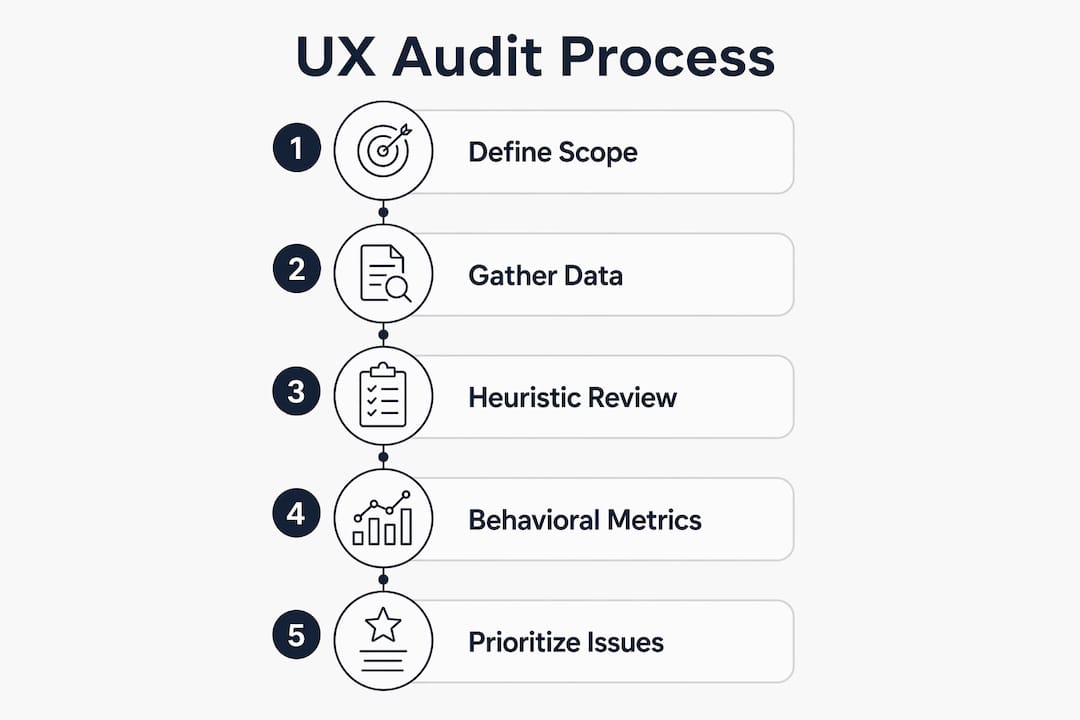
How to measure and prioritize issues found in a UX audit
Prioritization separates a useful audit from an overwhelming list of complaints. The goal is not to document every imperfection. The goal is to direct limited product resources toward the issues with the highest business value.
Severity rating scales
Severity scales rate issues from 0 (not a usability problem) to 4 (usability catastrophe that must be fixed before launch). Applying a severity score to every finding forces evaluators to make a judgment call backed by evidence, not instinct. A severity 4 issue on a payment confirmation screen carries more weight than a severity 1 inconsistency in icon sizing.
Impact tier classification
- Strength. A design element that works well and should be preserved or replicated elsewhere.
- Friction. A problem that slows users down but does not stop them from completing a task.
- Blocker. A failure that prevents task completion entirely.
- Opportunity. A gap where a new feature or pattern could improve the experience.
Classifying issues by impact tiers prevents audits from becoming directionless problem lists. A product team that sees 12 Blockers, 30 Friction points, and 8 Opportunities can immediately sequence work by business risk.
Linking findings to evidence
A UX audit produces specific, actionable findings rather than subjective opinions about aesthetics. Every finding must trace back to a heuristic violation, a measurable user behavior, or an analytics anomaly. "The navigation is confusing" is not a finding. "Users abandon the onboarding flow at step 3 at a rate consistent with a violation of Nielsen's heuristic 6 (recognition rather than recall), because the interface requires memorizing prior selections" is a finding.
Pro Tip: Write every finding in this structure: observation, evidence, heuristic or metric link, and recommended next step. This format makes findings defensible in stakeholder reviews and ready to feed directly into a design backlog.
What metrics and analytics enhance UX audit accuracy?
Metrics give audit findings their credibility. Without them, a report reads as opinion. With them, it reads as diagnosis.
Core metrics for software products
| Metric | What it measures | Why it matters |
|---|---|---|
| Task success rate | Percentage of users completing a defined task | Reveals whether core flows actually work |
| Time on task | Average time to complete a task | Flags friction even when success rates look healthy |
| Error rate | Frequency of user mistakes per session | Identifies confusing UI patterns |
| SUS score | System Usability Scale (0–100 rating) | Provides a standardized usability benchmark |
| NPS delta | Change in Net Promoter Score after a redesign | Measures perceived experience improvement |
Successful redesigns show an increase of 8 or more NPS points in user cohorts exposed to the change within 30 days. That benchmark gives product teams a concrete target when validating audit-driven improvements.
Behavioral vs. attitudinal data
Behavioral metrics show what happens. Attitudinal metrics explain why. Combining both types provides a clearer picture of the user experience and helps predict churn risk before it shows up in revenue data. A SaaS product with strong task completion but declining NPS is losing users emotionally before it loses them contractually.
Instrumentation matters here. If your analytics platform does not track task-level events, you cannot calculate task success rate or time on task. Audit planning should include a tracking audit to confirm that the right events fire before the review begins.
What best practices should product teams follow for effective UX audits?
The audit process fails most often not during data collection but during reporting and handoff. A technically thorough review that produces a 60-page document with no prioritization does not move products forward.
- Structure reports with an executive summary first. Audit reports should start with an executive summary outlining overall UX health and the top high-impact actions. Stakeholders read the summary. Designers read the detail. Both need what they came for.
- Treat the audit as input, not output. Final audit reports are inputs to a design backlog. Each finding must lead to a dedicated design exploration, not an immediate redesign command. Skipping that step produces solutions that fix the symptom but miss the root cause.
- Keep the audit separate from the redesign. Auditors who simultaneously propose solutions bias their own findings. The diagnostic phase and the design phase are distinct. Mixing them produces a report that defends a predetermined direction rather than objectively mapping the current state.
- Include accessibility and SEO in scope. UX audit layers compound. Design and IA issues affect SEO rankings and monetization outcomes. An audit that ignores technical performance or accessibility misses the interdependencies that drive real business impact.
- Avoid vague feedback. Phrases like "the interface feels cluttered" or "users might find this confusing" do not belong in an audit report. Every observation needs evidence. Every recommendation needs a rationale tied to user behavior or a recognized standard.
Pro Tip: Run a UX audit checklist review with a cross-functional group before finalizing findings. A developer, a product manager, and a designer each catch different classes of issues. The overlap reveals your highest-confidence findings.
Key Takeaways
Effective user experience audits combine heuristic evaluation with behavioral and attitudinal metrics, classify findings by impact tier, and feed prioritized results into a design backlog rather than immediate redesign decisions.
| Point | Details |
|---|---|
| Use two evidence streams | Combine Nielsen's heuristics with behavioral metrics like task success rate and NPS. |
| Rate every finding by severity | Apply a 0–4 severity scale so stakeholders can sequence fixes by business risk. |
| Classify issues by impact tier | Label findings as Strength, Friction, Blocker, or Opportunity to direct team effort. |
| Separate audit from redesign | Keep the diagnostic phase distinct from design proposals to avoid biased findings. |
| Report with an executive summary | Lead with big-picture UX health and top actions before presenting detailed findings. |
Why I think most UX audits fail before they start
The audits I have seen fail share one trait: the team treated the audit as a deliverable rather than a decision-making tool. They produced thorough reports, held review meetings, and then watched the findings sit in a shared drive for six months.
The problem is framing. When a UX audit is positioned as a project milestone, it gets completed and archived. When it is positioned as a diagnostic that feeds directly into sprint planning, it gets acted on. The difference is not methodology. It is how the findings connect to the product roadmap from day one.
I have also seen teams over-index on heuristic expertise and under-invest in instrumentation. An evaluator who flags 53 usability problems but cannot link any of them to a drop in task success rate or a spike in support tickets will struggle to get engineering time. Data does not replace judgment. It makes judgment credible to people who control resources.
The most effective audits I have worked with treat improving user experience as a continuous diagnostic practice, not a one-time event. They run lightweight reviews quarterly, track metric deltas after each change, and build a living issue register rather than a static report. That cadence turns audit findings into institutional knowledge instead of forgotten documents.
— Gregory
How Saaslaunchpad supports product teams running UX audits
Product teams that want structured, multi-discipline analysis of their SaaS applications can use Saaslaunchpad to get exactly that. Saaslaunchpad analyzes your application across twenty-one disciplines, the way an entire elite product team would, and delivers a Product Excellence Blueprint with prioritized findings and a copy-paste-ready Master Transformation Prompt tailored to your platform.
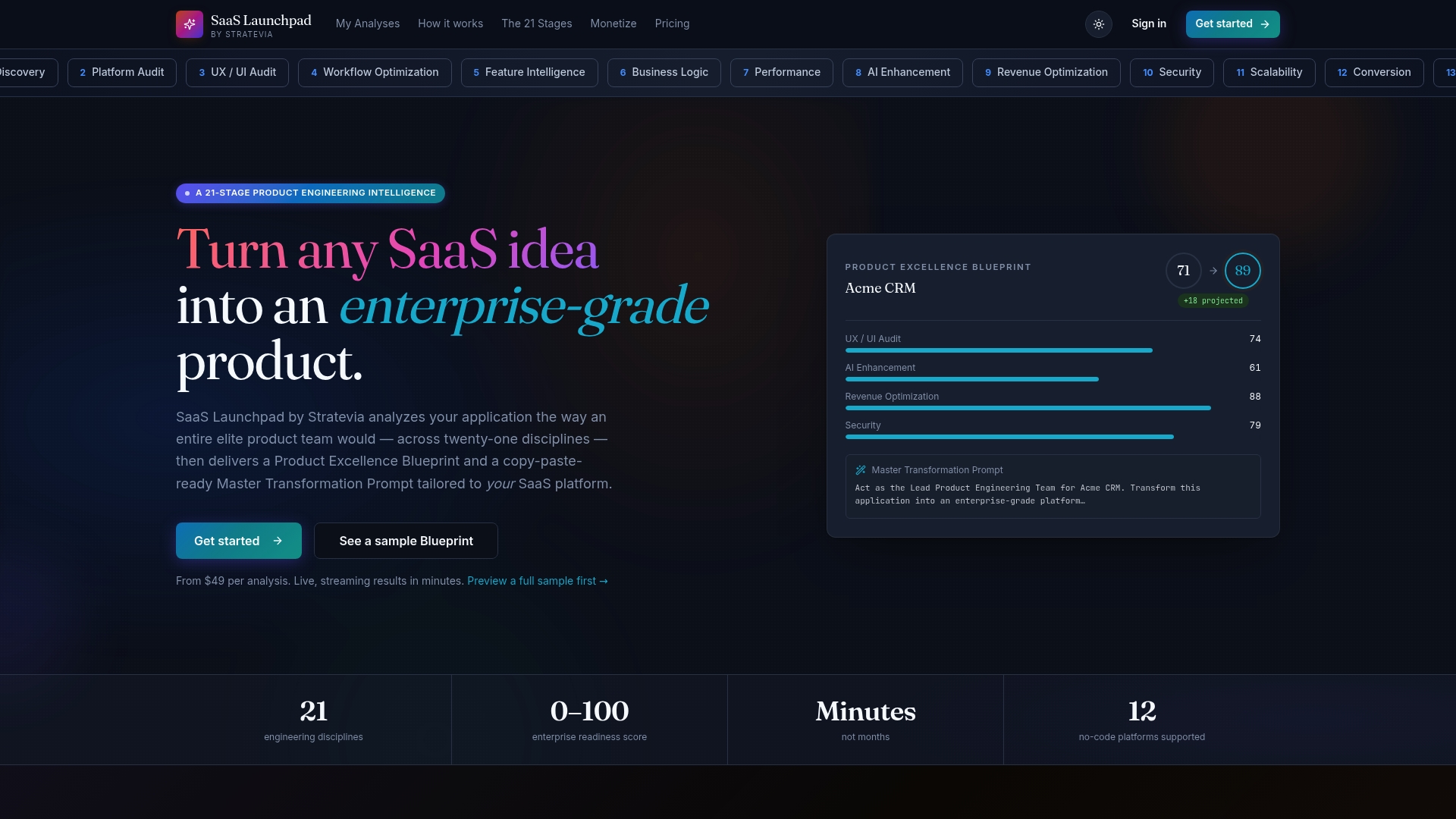
For product managers and UX designers who need a rigorous starting point for their next audit cycle, Saaslaunchpad provides the structure, the methodology, and the output format to move from diagnosis to action without building the process from scratch.
FAQ
What is a UX audit?
A UX audit is a structured diagnostic review of a digital product that identifies usability problems tied to measurable user behaviors, heuristic violations, or analytics data. It produces specific, prioritized findings rather than general design opinions.
How many issues does a typical UX audit find?
Expert evaluators identify an average of 53 usability problems per software product using Nielsen's heuristics. Concurrence between evaluators ranges from 21% to 44%, so multi-evaluator reviews produce more complete results.
What metrics should a UX audit track?
The core metrics are task success rate, time on task, error rate, SUS score, and NPS delta. Behavioral metrics show what users do; attitudinal metrics explain why they feel the way they do.
How should UX audit findings be prioritized?
Classify findings into four impact tiers: Strength, Friction, Blocker, and Opportunity. Apply a severity scale from 0 to 4 to each issue, then sequence fixes by business risk and available engineering capacity.
How often should product teams run UX audits?
Lightweight UX evaluations work best on a quarterly cadence, with deeper reviews tied to major product releases or significant drops in key metrics like NPS or task success rate.