A product risk assessment for a SaaS platform is a structured audit that finds the technical, security, UX, and business gaps standing between your product and an enterprise buyer's signature. Run properly, it covers 21 disciplines and outputs a Product Excellence Blueprint plus a copy-paste Master Transformation Prompt you hand straight to engineering.
The deliverable isn't a report you file away. It's a prioritized list of risks, a phased remediation roadmap, and a sprint plan your team can start executing the same week. Run one when:
- Enterprise prospects start asking about your security posture unprompted
- A security questionnaire lands in your inbox and half the answers are guesses
- You're planning a deliberate push upmarket and need to know what's actually missing
Key Takeaways
A prioritized, phased remediation roadmap built from a 21-discipline audit closes enterprise deals faster than an unstructured list of security fixes.
| Point | Details |
|---|---|
| Scope before you audit | Cluster findings into identity, security, data, reliability, and commercial domains to avoid blind spots. |
| Rank by three factors | Multiply severity, customer impact, and remediation cost to decide what gets fixed first. |
| Phase, don't dump | Split fixes into pre-pitch trust items, procurement blockers, and post-signature operational work. |
| Budget for compliance lag | SOC 2 Type II needs a months-long observation window that can't be rushed once a deal is in motion. |
| Buy when signals appear | SaaS LaunchPad's on-demand 21-discipline audit turns real findings into a Product Excellence Blueprint and Master Transformation Prompt once enterprise interest is real. |
Table of Contents
- What a Product Risk Assessment Covers (and What It Doesn't)
- Which Risk Categories Actually Block Enterprise Deals?
- How Does an On-Demand 21-Discipline Audit Actually Run?
- How Do You Prioritize and Sequence the Fixes?
- Templates You Can Use This Week
- Buy the Audit, Skip the Guesswork
- When Should You Buy an Audit vs. Run One Yourself?
- Sources
- FAQ
What a Product Risk Assessment Covers (and What It Doesn't)
A proper assessment spans seven domains: identity and access, security and compliance, data and privacy, reliability and operations, UX and activation, integrations, and commercial or legal readiness. Each domain breaks into disciplines, roughly 21 in total, and each discipline gets scored independently before the scores roll up into an overall enterprise-readiness rating.
That clustering matters because it prevents blind spots. A team fixated on encryption might miss that their status page doesn't exist, or that their onboarding flow quietly assumes every user has admin rights. The 25-item enterprise-ready checklist from Hoff Digital groups requirements the same way, which is useful for sanity-checking your own audit's coverage:
- Identity & access: SSO, SCIM provisioning, role-based permissions
- Security & compliance: SOC 2, encryption standards, subprocessor disclosure
- Data & privacy: residency, export, deletion guarantees
- Reliability & ops: SLAs, backups, incident response
- Commercial: MSAs, insurance certificates, procurement paperwork
One clarification worth stating plainly: this is a software product risk assessment. It has nothing to do with physical-product safety evaluations, injury-scenario testing, or recall risk. Different discipline entirely.
Which Risk Categories Actually Block Enterprise Deals?
Enterprise procurement teams check the same handful of categories every time, and each one can stall a deal cycle on its own.
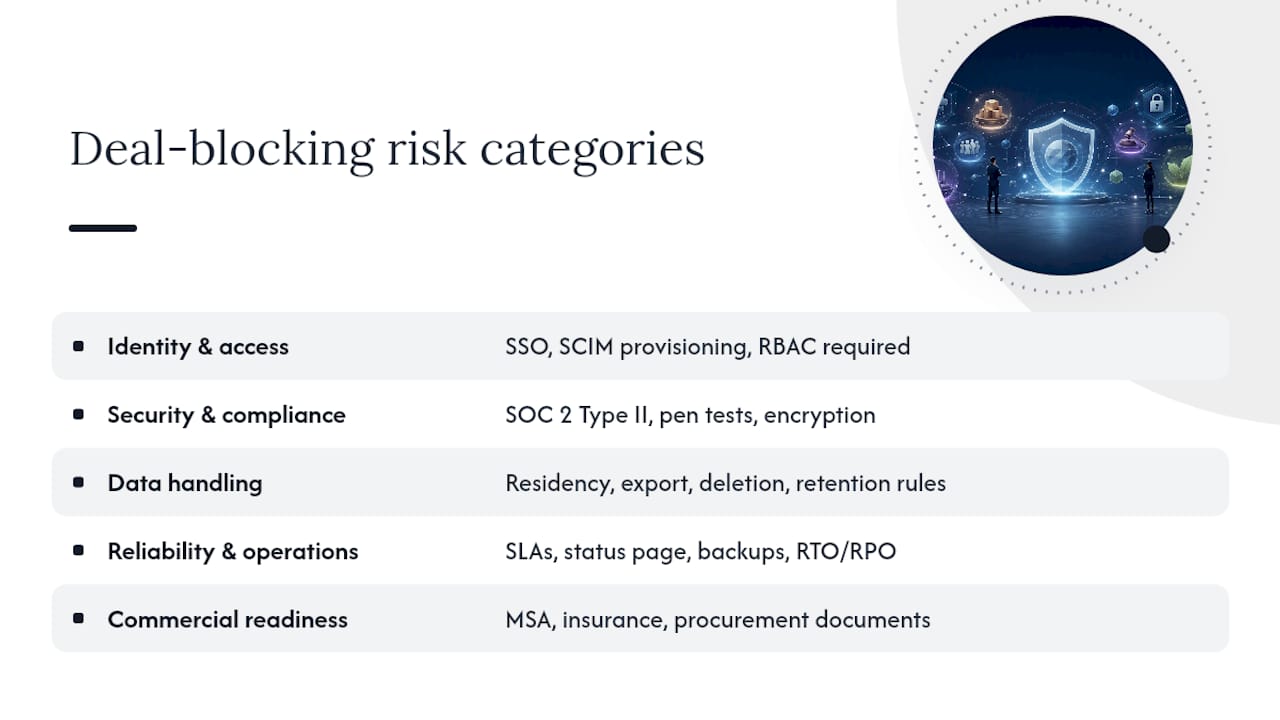
Identity and access comes first because it's non-negotiable for any buyer with an IT department. Without single sign-on (SSO), SCIM-based user provisioning, and role-based access control (RBAC), a security team simply won't route your app to their employees, no matter how good the product is.
Security and compliance is where SOC 2 Type II certification, third-party penetration test results, encryption-at-rest and in-transit, and a published subprocessor list all live. This is also where most SaaS teams get caught flat. Missing capabilities here can add 60 to 90 days to a procurement timeline, and that's assuming the deal doesn't die outright while legal waits on paperwork that doesn't exist yet.
Data handling covers residency commitments, export rights, deletion guarantees, and retention policies, all of which get written directly into a Data Processing Agreement or, for healthcare buyers, a Business Associate Agreement.
Reliability and operations means SLAs with teeth, a public status page, documented backup cadence, and defined recovery time and recovery point objectives.
Commercial readiness rounds it out: a real MSA, proof of insurance, and the procurement documents a Fortune 500 legal team expects on day one, not day sixty.
How Does an On-Demand 21-Discipline Audit Actually Run?
An on-demand audit follows a repeatable sequence, and knowing the steps helps you judge whether a report you're handed is rigorous or cosmetic.
- Intake. The audit team pulls your architecture docs, existing security policies, and access to a staging or production environment.
- Evidence review. Every discipline gets checked against artifacts, not claims. If you say you encrypt data at rest, someone verifies the configuration.
- Targeted sampling. Instead of testing every feature exhaustively, the audit samples the highest-risk flows, usually authentication, billing, and data export.
- Interviews. Short conversations with engineering and product leads fill gaps that documentation can't answer, especially around incident history and operational habits.
- Scoring. Each discipline gets a severity and likelihood score, rolled into a composite enterprise-readiness rating.
- Prioritization. Findings get sorted into phases based on procurement impact, not engineering preference.
The output isn't a single document. You get a Product Excellence Blueprint that maps every finding to a discipline and severity score, a Master Transformation Prompt formatted for direct use in your build environment (including major no-code platforms), and a phased execution roadmap that translates findings into sprint-sized tickets.
A well-run audit like this can be timeboxed to days rather than the weeks a from-scratch internal review usually takes, largely because the discipline structure eliminates the guesswork of deciding what to check first. "Done" means every discipline has a score, every high-severity finding has an owner, and the roadmap has phase boundaries your engineering team actually agrees with.

Pro Tip: Ask any audit provider what evidence they sampled versus what they took on your word. A report built entirely on self-reported answers is a questionnaire, not an assessment.
How Do You Prioritize and Sequence the Fixes?
Findings are worthless until they're ranked, and ranking by gut feeling is how teams end up rebuilding their permission system in month one while their status page sits dark for a year.
The workable formula multiplies three variables: risk severity, customer impact, and cost or effort to remediate. A finding that's severe but only affects one prospective logo ranks below a moderate finding that blocks every enterprise deal in your pipeline.
Phase the roadmap instead of treating it as one giant backlog:
- Phase 0, immediate trust items: a public security page, basic RBAC, MFA enforcement. Cheap, fast, and often what pre-pitch prospects check first.
- Phase 1, procurement blockers: SSO, SCIM, audit logging, SOC 2 Type I. These surface once a real deal is in motion and legal starts asking questions.
- Phase 2, optimization: SOC 2 Type II, advanced data residency options, refined SLAs. These matter for scale, not for closing the next deal.
This phasing mirrors the structure in Hoff Digital's checklist, which splits requirements into pre-pitch trust items, procurement-cycle blockers, and post-signature operational work.
Enterprise readiness is stage-dependent. Build the minimum trust items before your first pitch, tackle procurement blockers during the sales cycle itself, and leave the fully operational items for after the contract is signed. Trying to deliver all three at once is how teams burn a quarter of engineering time on features no prospect asked for yet.
Timeline estimates should account for the fact that some Phase 2 items, like SOC 2 Type II, require a months-long observation window that can't be compressed no matter how many engineers you throw at it.
Templates You Can Use This Week
Turning an audit finding into work your team can actually schedule requires a consistent format, not a paragraph of prose in a shared doc that everyone reads differently.
A risk-rating entry needs five fields: discipline (e.g., "Identity & Access"), finding (e.g., "No SCIM support"), severity (High/Medium/Low), customer impact (number of deals or logos affected), and remediation cost (engineering days estimated).
A remediation ticket template should include:
- Finding summary — one sentence, no jargon
- Discipline and severity score — pulled straight from the audit
- Acceptance criteria — what "fixed" looks like, testable
- Estimated effort — in days, not story points nobody outside engineering understands
- Dependency notes — does this block or get blocked by another Phase item?
For the executive or procurement-facing one-pager, keep it to four elements: the top three risks by severity, the phase each sits in, the estimated cost to remediate, and the revenue or deal size at stake if nothing changes. That structure echoes the approach in Cledara's SaaS audit framework, which pairs every finding with a risk rating and a prioritized action plan rather than a wall of raw findings. A one-pager built this way gets budget approved because it answers the only question executives actually ask: what does it cost us if we do nothing?
Buy the Audit, Skip the Guesswork
Running this audit internally means pulling your best engineers off product work for weeks to build a scoring framework from scratch, then hoping you didn't miss a discipline that matters to your next enterprise prospect. SaaS LaunchPad by Stratevia replaces that with a paid analysis credit that runs the full 21-discipline audit on demand and hands back a Product Excellence Blueprint and a Master Transformation Prompt built for your specific platform.
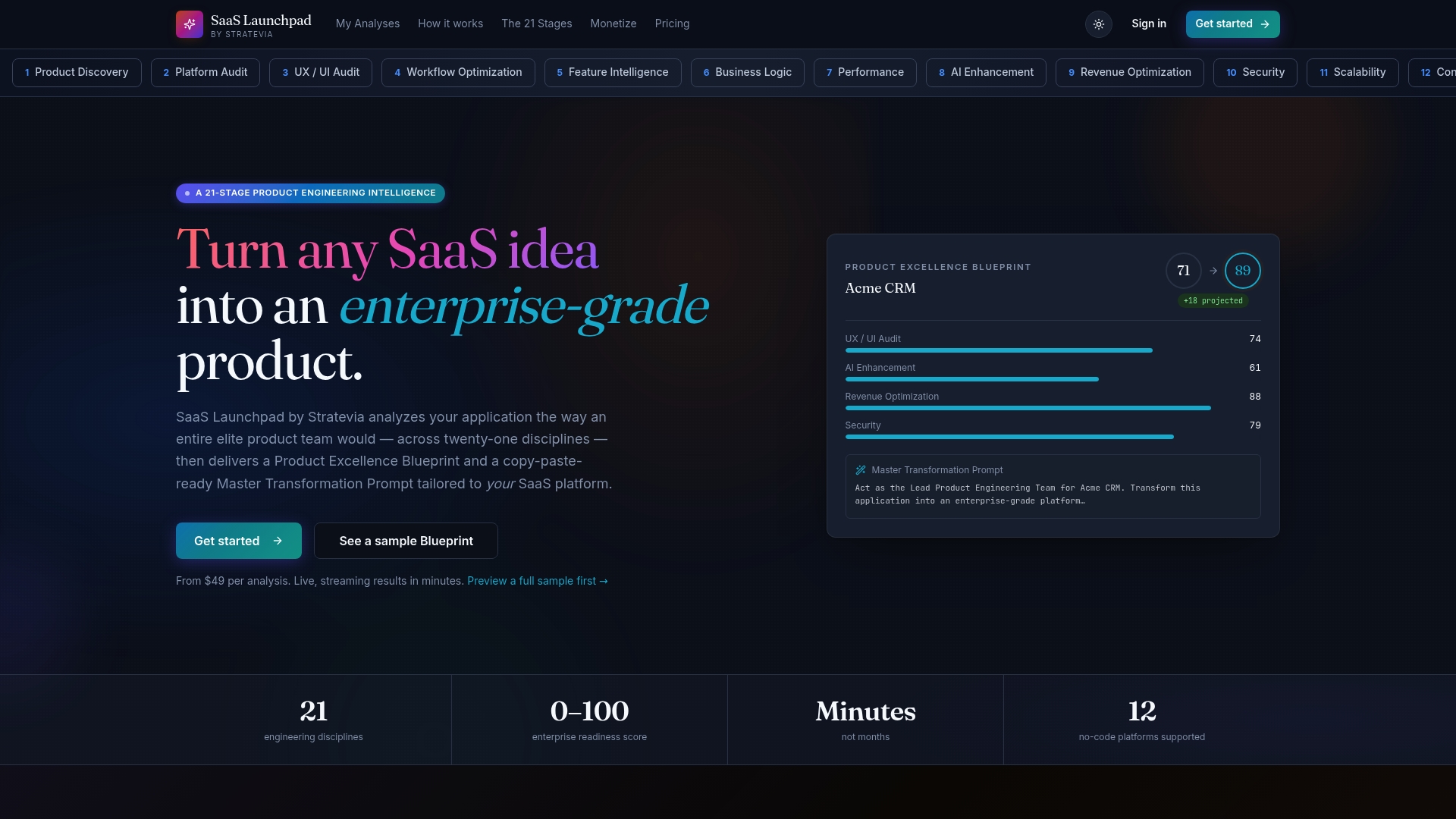
Every finding maps to a discipline, a severity score, and a phase, so your engineering team gets a ready-to-execute roadmap instead of a static PDF. The Master Transformation Prompt is copy-paste ready for major no-code platforms, which matters if your stack was assembled fast and never had a dedicated security review. Credits never expire, there's no subscription commitment, and volume packs get a discount if you're running audits across multiple products or a portfolio.
If you've got a security questionnaire sitting half-answered right now, that's the signal to act on. Start with the 21-discipline product engineering audit or browse how the process works before you buy your first credit.
When Should You Buy an Audit vs. Run One Yourself?
Skip the paid audit if you're pre-revenue and no enterprise prospect has asked you anything yet. A lightweight internal premortem, run four to six weeks before a launch, usually surfaces the two or three risks that actually matter.
Buy the full audit once inbound enterprise interest turns into a real security questionnaire, or once you're deliberately building an upmarket motion. The mistake isn't waiting too long to start. It's shipping every enterprise item simultaneously once you decide to act, which burns months of engineering time on Phase 2 work nobody asked for yet. Fix what blocks the deal in front of you first, and remember that product risk and market risk pull in different directions, so know which one is actually threatening you before you spend the sprint.
Sources
- The B2B SaaS Enterprise-Ready Checklist: 25 Things You Need Before You Sell to a Fortune 500 | Hoff Digital
- Enterprise Readiness for B2B Startups: The 2026 Checklist
- Premortem for a SaaS product launch — Framework
- How to Run a SaaS Audit in 5 Steps | Cledara
- Product Risk vs. Market Risk: How to Know Which One Will Kill You | SaaS Club
FAQ
What Is Included in a Product Risk Assessment?
A product risk assessment for SaaS covers identity and access, security and compliance, data handling, reliability, UX, integrations, and commercial readiness, scored across roughly 21 disciplines.
How Long Does an Enterprise-Readiness Audit Take?
An on-demand audit can be completed in days rather than weeks, since the discipline structure removes the need to decide what to check first from scratch.
What's the Difference Between SOC 2 Type I and Type II?
Type I checks whether controls are designed correctly at a point in time; Type II requires an observation window of several months to a year, verifying those controls actually operated correctly over time.
Do I Need SSO and SCIM Before My First Enterprise Deal?
You generally need SSO early since IT teams often refuse to route employees to apps without it; SCIM provisioning tends to surface as a requirement once procurement gets involved.
Should I Run a Premortem Instead of a Full Audit?
If no enterprise prospect has asked you anything yet, a short premortem run four to six weeks before launch often finds the handful of risks that actually matter, without the cost of a full audit.
How Does SaaS LaunchPad's Audit Differ From a Manual Checklist?
SaaS LaunchPad runs the full 21-discipline audit on demand and returns a scored Product Excellence Blueprint with a phased roadmap and a Master Transformation Prompt, instead of a static checklist you have to interpret yourself.