Use RICE when you're ranking features and the deciding factor is how many users something touches. Use WSJF when you're sequencing epics, platform work, or anything with a ticking clock, because it's built to answer one question RICE ignores: what does waiting cost you?
The split comes down to what each framework was built to measure. RICE scores reach and impact against effort, which makes it excellent at comparing a pile of unrelated feature ideas for a single product team. WSJF scores Cost of Delay against job size, which makes it excellent at answering a harder question: given limited capacity, what should we build first when some items lose value the longer they sit?
Most teams don't have to pick one and abandon the other.
- Feature backlog, single team, steady value over time? RICE.
- Epics, program-level sequencing, or anything with a deadline, compliance risk, or decaying opportunity? WSJF.
- Mixed backlog? Many product organizations run RICE during discovery to shortlist bets, then apply WSJF to sequence what actually makes the roadmap.
Key Takeaways
RICE ranks features by reach and impact per unit of effort, while WSJF ranks epics by how much delay actually costs, and mature teams often use both at different levels of their backlog.
| Point | Details |
|---|---|
| Match the framework to the constraint | Use RICE when value is steady and reach is measurable; use WSJF when delay itself destroys value. |
| RICE formula | (Reach × Impact × Confidence) ÷ Effort, best applied to feature-level, single-team decisions. |
| WSJF formula | Cost of Delay (Value + Time Criticality + Risk Reduction) ÷ Job Duration, best for epics and program-level sequencing. |
| Guard against blind spots | Score infrastructure work separately from feature RICE lists, and require justification for high Time Criticality scores. |
| Better inputs beat a better formula | SaaS LaunchPad's 21-discipline audit supplies usage, revenue, and readiness data that sharpen both frameworks' Reach, Impact, and Risk Reduction inputs. |
Table of Contents
- RICE vs WSJF at a Glance
- How RICE Works: Inputs, Scales, and a Worked Example
- How WSJF Works: Cost of Delay and a Worked Epic Example
- Where Each Framework Breaks Down
- A Three-Question Test for Choosing Between RICE and WSJF
- Running a Prioritization Workshop That Doesn't Drag On
- Why Better Inputs Beat a Better Formula
- A Practical Note on Picking One (Or Both)
- Get Better RICE and WSJF Inputs Before You Score Anything
- Sources
- FAQ
RICE vs WSJF at a Glance
The two frameworks look similar on the surface. Both take multiple inputs, multiply and divide them, and spit out a number you can sort a spreadsheet by. Underneath, they're solving different problems.
RICE's formula is:
RICE = (Reach × Impact × Confidence) ÷ Effort
WSJF's formula is:
WSJF = Cost of Delay ÷ Job Duration
Where Cost of Delay itself is a sum of three inputs: User/Business Value, Time Criticality, and Risk Reduction/Opportunity Enablement. Teams following SAFe's WSJF guidance typically score each of those three on a relative scale, add them up, then divide by job size.
The difference in what they optimize for is the whole story. RICE optimizes for user-impact-per-effort, treating value as roughly constant over time, while WSJF optimizes for economic throughput when delay actively erodes value. That's not a minor technical distinction. It changes which items win.
| Dimension | RICE | WSJF |
|---|---|---|
| Formula | (Reach × Impact × Confidence) ÷ Effort | Cost of Delay ÷ Job Duration |
| Optimizes for | Total user impact per unit of effort | Economic throughput under time pressure |
| Best granularity | Feature or experiment | Epic, initiative, program-level work |
| Team-size fit | Single product team | Multi-team, program, or portfolio |
| Time sensitivity | Not modeled directly | Built into the formula (Time Criticality) |
| Learning curve | Low; intuitive for most PMs | Moderate; requires Cost of Delay literacy |
| Origin | Built at Intercom for feature prioritization | Rooted in Reinertsen's flow economics, standardized in SAFe |
A few things jump out once you put them side by side. RICE assumes you can reasonably estimate how many people a feature touches over a fixed window, which works fine for a single product with a defined user base. WSJF assumes your biggest risk isn't picking the wrong feature. It's picking the right feature too late.
Team size matters more than people expect. RICE was designed for a product team ranking its own backlog, which is why it stays legible with four or five inputs per item. WSJF was built for SAFe environments where multiple teams need a shared, fast way to compare epics that don't share a common unit of "reach." Relative Fibonacci scoring solves that, but it also means WSJF scores are coarser by design. Two items scoring 8 and 9 aren't meaningfully different; two scoring 3 and 15 are.
How RICE Works: Inputs, Scales, and a Worked Example
RICE breaks a prioritization decision into four questions, and answering them honestly is most of the work.
Reach asks how many users or accounts a feature will touch within a fixed time window, typically 90 days. Pick a window and use it consistently across every item you score in a session. Switching windows mid cycle, scoring one feature on a 30-day reach and another on a 12-month reach, is one of the most common ways teams quietly corrupt their own rankings.
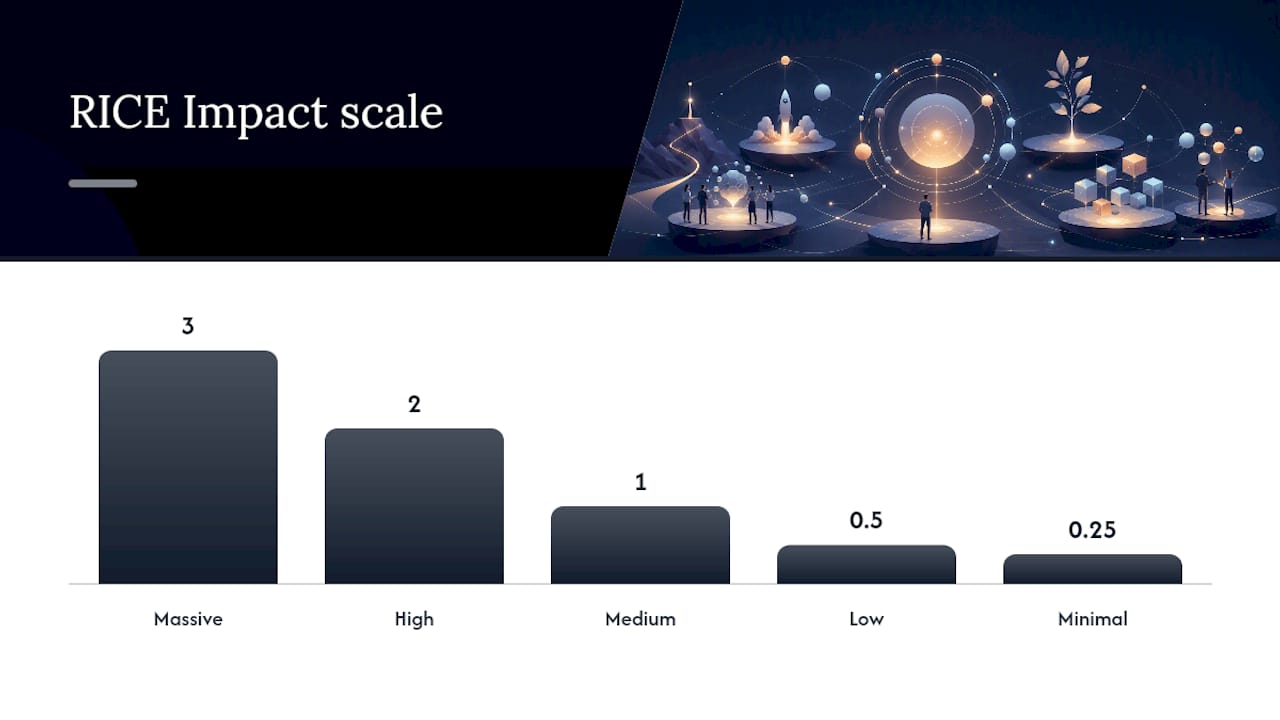
Impact asks how much a feature moves the needle for each user it reaches. Most teams use a discrete scale rather than a continuous one: 3 for massive impact, 2 for high, 1 for medium, 0.5 for low, 0.25 for minimal. The scale is intentionally non-linear, because a feature that transforms a workflow shouldn't score twice as high as one that mildly improves it. It should score meaningfully higher.
Confidence exists because Reach and Impact are often educated guesses, not measurements. Confidence functions as a discount rate on your own optimism.
Effort is measured in person-months or story points, the total work required to ship the feature, including design, engineering, and QA.
Here's the arithmetic on a real-shaped example: a self-serve onboarding flow.
- Reach: A defined number of new signups within the chosen time window will hit this flow.
- Impact: 2 (high impact, since this directly affects activation).
- Confidence: 80% (strong signal from support tickets and funnel drop-off data, but no A/B test yet).
- Effort: 3 person-months.
RICE score = (Reach × Impact × Confidence) ÷ Effort, calculated per your specific inputs.
RICE score = (40 × 1 × 1.0) ÷ 0.5 = 80. The onboarding flow wins by a wide margin, which matches intuition, but now you have a number to defend that intuition in a roadmap review instead of just a gut feeling.
Pro Tip: Attach every feature request to the account or ticket it came from before you score Reach. When someone challenges your number in a planning meeting, you want to point at a list, not a memory.
Three habits keep RICE scores honest over time. First, pull Reach from product telemetry instead of guessing, since analytics tools already track exactly how many accounts touch a given workflow. Third, grounding every input in real usage data rather than intuition measurably reduces scoring drift across scoring sessions, which matters more as your backlog and your team both grow.
How WSJF Works: Cost of Delay and a Worked Epic Example
WSJF starts from a different premise: effort alone doesn't tell you what to build next, because effort says nothing about what happens if you wait.
The formula breaks Cost of Delay into three components, per SAFe's own definition:
- User/Business Value: how much value this delivers relative to other items, on a relative scale (commonly 1, 2, 3, 5, 8, 13, 20).
- Time Criticality: how much that value decays if you delay, whether from a hard deadline, seasonal window, or competitive pressure.
- Risk Reduction/Opportunity Enablement: how much shipping this reduces future risk or unlocks other work, which is where platform investments and technical debt paydown earn credit that RICE tends to miss entirely.
Add those three together to get Cost of Delay, then divide by Job Duration (also scored relatively) to get the WSJF score.
Take a compliance deadline as the worked example: a new data-residency requirement takes effect in four months, and non-compliance risks losing access to a regulated market.
- Business Value: a high relative score reflecting protection of existing regulated revenue.
- Time Criticality: a high relative score indicating a hard external deadline.
- Risk Reduction/Opportunity Enablement: a moderate relative score reflecting unblocking other strategic initiatives.
- Cost of Delay: the sum of these relative scores.
- Job Duration: a relative sizing estimate of effort.
WSJF score is calculated by dividing Cost of Delay by Job Duration, resulting in a prioritization metric.
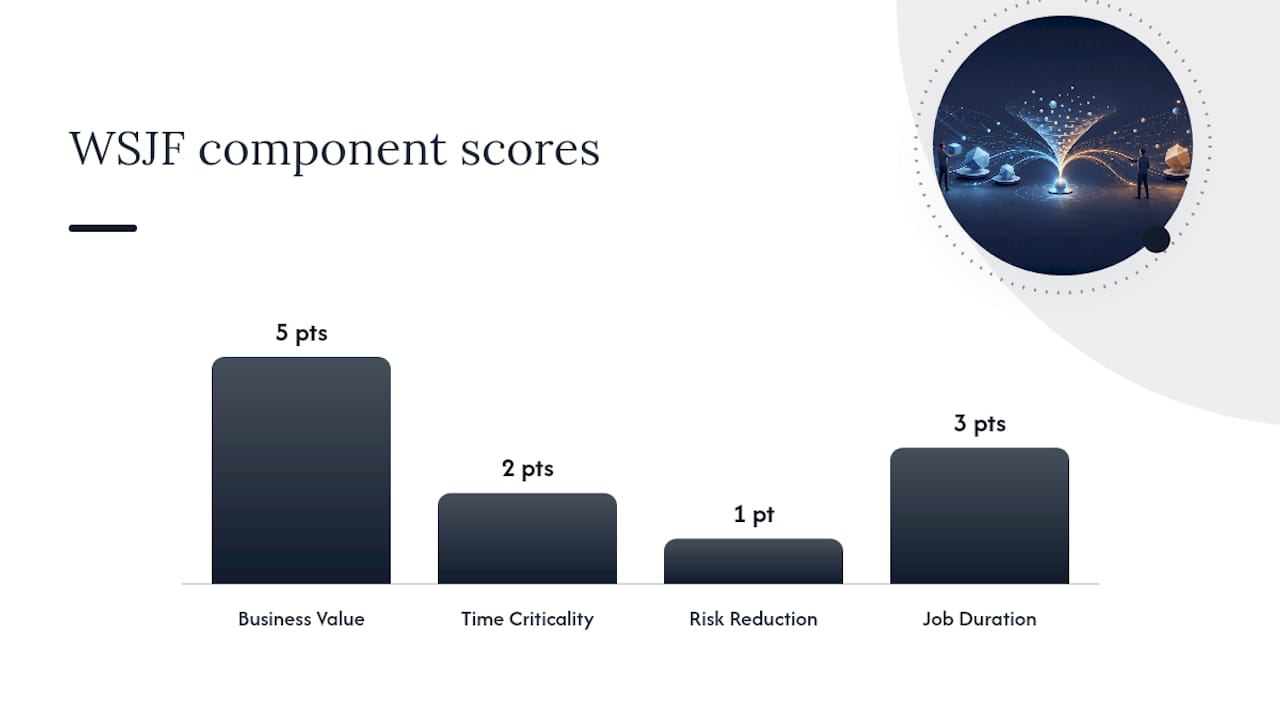
Compare that to a nice-to-have integration with Business Value of 5, Time Criticality of 2, Risk Reduction of 1, and Job Duration of 3. Cost of Delay = 8, WSJF = 8 ÷ 3 = 2.67. The compliance item wins clearly, even though it might touch far fewer end users than a flashy feature would under RICE. That's the entire point of WSJF: it protects work that RICE structurally undervalues because Reach alone can't capture "this stops us from getting shut out of a market."
Relative sizing is what makes WSJF workable across multiple teams. Nobody agrees on what "50,000 users" means in absolute terms across a marketing team and a platform team, but most teams can agree that one epic's business value looks roughly twice as large as another's. Fibonacci-like relative scales trade precision for speed, which is exactly the tradeoff a program-level backlog review needs.
Pro Tip: When two epics land within a point of each other on Cost of Delay, don't agonize over the tiebreak. The relative scale isn't precise enough to justify it. Move on and revisit both at the next re-score.
Three things stabilize Cost of Delay estimates in practice. Calibrate your Fibonacci scale once with a cross-team workshop using two or three known reference epics, so "8" means the same thing to every team scoring it. Separate Time Criticality from Business Value explicitly. Teams that blend them tend to inflate everything to "urgent." And revisit Risk Reduction scores whenever a dependency changes, since an epic that unblocks three other initiatives today might unblock zero after a reorg.
Where Each Framework Breaks Down
RICE's biggest strength is also its blind spot. It's genuinely good at surfacing high-reach, low-effort wins from a noisy backlog, and it forces a team to attach numbers to what would otherwise be a debate about opinions. But RICE has no concept of time. A feature worth building this quarter and one worth building next year score identically if their Reach, Impact, Confidence, and Effort match, which means RICE routinely undervalues anything with a deadline: compliance work, security patches, seasonal features, or a competitive response window that's closing.
RICE also struggles with platform and infrastructure work. Reach is hard to define for a database migration or an API rewrite, since the "users" affected are often other engineers, not customers. Teams that force infrastructure work through RICE tend to systematically underrate it and watch technical debt pile up.
WSJF's strength is the mirror image. It bakes time sensitivity directly into the score and gives real credit to risk-reduction work, which is why platform teams and SAFe organizations lean on it. But WSJF's relative scales are coarse by design, and that coarseness invites gaming: a team that wants its epic prioritized can inflate Time Criticality with a soft, self-imposed deadline. Cost of Delay is also inherently more subjective than Reach, since "how much value decays if we wait" rarely has a clean data source behind it the way user counts do.
A few guardrails handle both failure modes:
- Score infrastructure and platform work on its own list rather than mixing it into a feature-only RICE backlog.
- Run a quick cost-of-delay gut check before defaulting to RICE on any mixed backlog: does value actually decay here, or is it steady?
- Require a one-line justification for any Time Criticality score above the middle of your scale, so "urgent" has to be earned.
- Re-score periodically. Both frameworks drift as market conditions and team composition change.
A Three-Question Test for Choosing Between RICE and WSJF
Before you pick a framework, ask three questions about the work sitting in front of you.
- Is there a real deadline? Not an internally imposed one, but an external one: a regulation, a contract, a seasonal window, a competitor's launch. If yes, lean WSJF.
- Does value decay if you wait? Some features are just as valuable in six months as they are today. Others lose value every week they're delayed, because a competitor ships first or a market window closes. Decay favors WSJF; stability favors RICE.
- Does delay compound into a bigger loss later? Platform debt and security gaps often start small and get exponentially more expensive to fix. If the item is one of those, WSJF's Risk Reduction component captures that in a way RICE simply doesn't.
Map the answers to your backlog by scope, not by preference:
- Individual stories and features within a single team's backlog: RICE. It's fast, it's intuitive, and reach data is usually available.
- Epics, initiatives, and anything spanning multiple teams: WSJF. It handles cross-team comparison and time pressure better.
- A backlog that genuinely mixes both: split it into two lists, score each with its native framework, then reconcile at the roadmap level, or run the three-question test item by item and route accordingly.
Team size and cadence matter too. A single product team of six engineers rarely needs WSJF's overhead; RICE scored monthly is plenty. A multi-team SAFe environment doing quarterly program increment planning benefits from WSJF specifically because it gives every team a shared language for comparing epics that otherwise share nothing in common. Whichever you pick, assign an owner for re-scoring, set a cadence (monthly for RICE, per program increment for WSJF is typical), and treat the first few cycles as calibration, not gospel.
Running a Prioritization Workshop That Doesn't Drag On
Neither framework requires a heavyweight process. The failure mode is usually the opposite: teams spend three hours debating a single Impact score because nobody agreed on the scale beforehand.
Set a hard cap of two to three minutes per item once your team is calibrated. If you're scoring more than 20 items, batch them: score the top 10 candidates in detail and give the rest a rough pass.
A workable 60 to 90 minute workshop agenda looks like this:
- First 10 minutes: Confirm the scale definitions (what does Impact = 2 mean? What's a Job Duration of 5?) so nobody scores against a different mental model.
- Next 50 to 60 minutes: Score each item live, capturing Reach, Impact, Confidence, Effort (or Cost of Delay components and Job Duration) in a shared spreadsheet or your backlog tool.
- Final 15 to 20 minutes: Sort by score, sanity-check the top five against gut instinct, and flag anything where the number and the intuition disagree sharply. That disagreement is usually where a scoring assumption is wrong.
Build a simple template with dedicated fields for Reach, Impact, Confidence, Effort, or Business Value, Time Criticality, Risk Reduction, Job Duration, plus one text field for "reasoning" per item. Add these as custom fields directly in your Jira backlog or equivalent tool so scores live next to the work itself instead of in a spreadsheet nobody opens again.
Pro Tip: Automate what you can. Pull Reach directly from your analytics pipeline instead of estimating it by hand, and schedule a recurring monthly re-score so priorities don't quietly go stale between planning cycles.
Why Better Inputs Beat a Better Formula
Neither framework fixes a bad guess. RICE and WSJF are only as good as the Reach, Impact, Confidence, and Cost of Delay numbers you feed them, and most teams are estimating those numbers from partial information: a support ticket count here, a gut feeling about "time criticality" there.
SaaS LaunchPad's 21-discipline product audit exists to close exactly that gap. Usage analysis and revenue-impact findings translate directly into Reach and Impact numbers instead of guesses. A documented enterprise readiness score gives WSJF's Risk Reduction component something concrete to point to, rather than a subjective "feels risky" judgment call. And a competitive intelligence pass raises or lowers Confidence with actual evidence instead of hope.
The gap between RICE and WSJF working well and working poorly usually isn't the formula. It's whether Reach, Impact, and Cost of Delay are backed by real usage and revenue data or by a product manager's best guess in a planning meeting.
The deliverables are concrete: a Product Excellence Blueprint that documents where a platform actually stands, and a Master Transformation Prompt that turns findings into a build-ready plan. That's the difference between scoring a backlog on vibes and scoring it on evidence.
A Practical Note on Picking One (Or Both)
Pick the framework that matches your primary constraint, not the one that sounds more sophisticated. If your backlog is a pile of feature ideas and the real question is which ones touch the most users, RICE gets you there faster and with less debate. If you're staring at epics where waiting has a cost, a compliance deadline, a competitor closing a gap, a platform risk compounding quietly, WSJF is the honest tool for the job.
In practice, the two pair well. Use RICE during discovery to shortlist which bets are worth exploring, then apply WSJF once those bets become epics that need sequencing against everything else competing for the same sprint capacity. Don't treat either score as final. Baseline your inputs, re-score monthly or per program increment, and let the numbers get sharper as your data does.
— Gregory Cornelius
Get Better RICE and WSJF Inputs Before You Score Anything
Most teams don't fail at RICE vs WSJF because they picked the wrong formula. They fail because the numbers going into either formula were guesses dressed up as data. SaaS LaunchPad's 21-discipline audit hands you the evidence instead: real usage patterns for Reach, revenue and competitive findings for Impact and Confidence, and a documented enterprise readiness score that gives WSJF's Risk Reduction component something real to stand on.

The output isn't a vague report. You get a Product Excellence Blueprint that maps exactly where your platform stands across discovery, performance, security, and scalability, plus a Master Transformation Prompt built to hand straight to your development team or no-code platform of choice. Instead of debating whether an epic's Time Criticality is a 5 or an 8 with no data behind either number, you're scoring against findings that already exist. Run your platform through the SaaS LaunchPad audit and get a backlog built on evidence instead of estimation guesswork.
Sources
FAQ
What Is the Best Prioritization Framework?
There isn't a single best framework; the right choice depends on whether your work is reach-driven and steady in value (RICE) or time-sensitive with a real cost of delay (WSJF). Many teams use both at different levels of the same backlog.
What Is the WSJF Score and How Is It Calculated?
WSJF equals Cost of Delay divided by Job Duration, where Cost of Delay is the sum of User/Business Value, Time Criticality, and Risk Reduction/Opportunity Enablement, each typically scored on a relative Fibonacci-like scale.
What Is the Difference Between RICE and MoSCoW Prioritization?
RICE produces a numeric score from Reach, Impact, Confidence, and Effort, while MoSCoW sorts items into four qualitative buckets: Must have, Should have, Could have, and Won't have. RICE works better when you need to rank items precisely; MoSCoW works better for quick stakeholder alignment on scope.
What Are the 5 Levels of Priority?
Priority-level schemes vary by team and tool, so there's no single universal five-tier standard; common versions run from Critical or Blocker down to Low or Trivial. RICE and WSJF both replace fixed priority tiers with a continuous numeric score, which avoids the ambiguity of deciding what counts as "High" versus "Critical."
Can I Use RICE and WSJF Together?
Yes, and many product organizations do exactly that. A common pattern uses RICE to shortlist promising features during discovery, then applies WSJF to sequence the resulting epics against everything else competing for delivery capacity.
How Does SaaS LaunchPad Improve My Prioritization Inputs?
SaaS LaunchPad's 21-discipline product audit delivers usage, revenue, and enterprise readiness findings that replace guesswork in your Reach, Impact, Confidence, and Risk Reduction scores with documented evidence.