A SaaS competitive analysis is a structured process that produces three things your team can act on immediately: a short competitor dossier for each rival you're tracking, a ranked gap map showing where you're exposed or ahead, and a 90-day recommendation set tied to specific product, pricing, or positioning moves. You know it worked when it changes at least one decision your team was about to make on instinct.
The deliverables to aim for in a first pass:
- Competitor dossiers covering product, pricing, positioning, and key review themes for your top 5–8 rivals
- A ranked gap map that scores each gap by impact, evidence strength, and cost to close (without specifying exact numbers)
- A near-term action plan with named experiments, owners, and success metrics
BetterCloud's SaaS market data shows how fast category signals move, which is exactly why a quarterly cadence without a clear decision framework tends to produce reports that sit unread. Build the analysis around the decisions first.
Key Takeaways
A SaaS competitive analysis produces three immediate deliverables: competitor dossiers, a ranked gap map, and a 90-day action plan tied to specific product, pricing, or positioning experiments.
| Point | Details |
|---|---|
| Start with decisions | Define the 3–5 choices your team needs to make before collecting any data. |
| Tier your watchlist | Track 5–10 rivals across direct, indirect, and aspirational tiers; cap active dossiers at 8–10. |
| Combine OSINT and primary research | Public signals miss what buyers value; win-loss interviews and trial signups fill the gap. |
| Run a 30-minute snapshot | Use the 5-step checklist (pricing, homepage, G2 reviews, LinkedIn, Ads Library) for quick updates. |
| SaaS LaunchPad | The 21-discipline audit covers competitive intelligence as a scored stage, delivering a prioritized roadmap. |
Table of Contents
- Why competitive analysis changes your product, pricing, and positioning
- What every competitor dossier must include
- How to find the right competitors to track
- A repeatable 6-step framework you can run as a sprint or a quarterly audit
- Which tools give you the most reliable competitive signals?
- How to turn competitive findings into product, pricing, and positioning moves
- Ready templates and a 30-minute competitor snapshot
- How a 21-discipline SaaS audit structures competitive insights into scored recommendations
- How often to update the analysis and who should own it
- Top mistakes that invalidate a competitive analysis
- How to incorporate customer feedback and market trends
- Evaluating competitor marketing strategies and digital presence
- How emerging technologies are reshaping competitive positioning in SaaS
- Competitive analysis is a capability, not a project
- Get a scored competitive baseline with SaaS LaunchPad
- Sources
- FAQ
Why competitive analysis changes your product, pricing, and positioning
Most SaaS teams treat competitive research as a one-time slide deck. The teams that actually improve win rates treat it as a decision-acceleration tool. When you know a rival has recently lowered their entry tier price significantly, you can respond before your sales team starts losing deals to it. When you see a pattern of negative reviews about a competitor's onboarding across G2, you have a positioning angle your marketing team can use this week.
The business outcomes are concrete. Better roadmap prioritization comes from knowing which features your competitors are shipping versus which ones buyers are actually asking for. Defensible pricing comes from mapping what each tier buys across the category. Higher win rates come from arming sales with specific objection responses grounded in real product differences.
The most effective competitive programs are decision-led: start with the choices you need to make, then collect only the signals that would change those choices. A 40-page report that nobody reads is not competitive intelligence. A two-page brief that shifts a pricing decision is.
— Octopus Intelligence, Your Six-Step Competitive Analysis For SaaS Success
What every competitor dossier must include
A dossier is only useful if it maps to who reads it. Product managers need feature gaps and roadmap signals. Pricing owners need tier structures and packaging logic. Sales needs objection handles and differentiators. Marketing needs messaging angles and channel data.
Fields to collect for each competitor:
- Product: Core feature set, notable gaps vs. your product, recent changelog entries, integrations, and any publicly announced roadmap items
- Pricing: Published tiers, usage metrics (seats, API calls, records), free trial or freemium structure, enterprise pricing signals (opaque vs. transparent), and any recent changes
- Positioning and messaging: Primary headline, ICP signals from their homepage and case studies, key differentiators they claim, and tone of voice
- GTM and channels: Primary acquisition channels (SEO, paid, PLG, outbound), content cadence, partner ecosystem, and event presence
- User experience: Onboarding flow (from free trial or demo), time-to-value signals, and any publicly documented UX friction
- Customer reviews: G2 and Capterra ratings, recurring praise themes, recurring complaint themes, and NPS proxies from review text
- Business metrics proxies: Estimated ARR range (from funding data on Crunchbase), headcount growth (LinkedIn), and review velocity as a growth signal
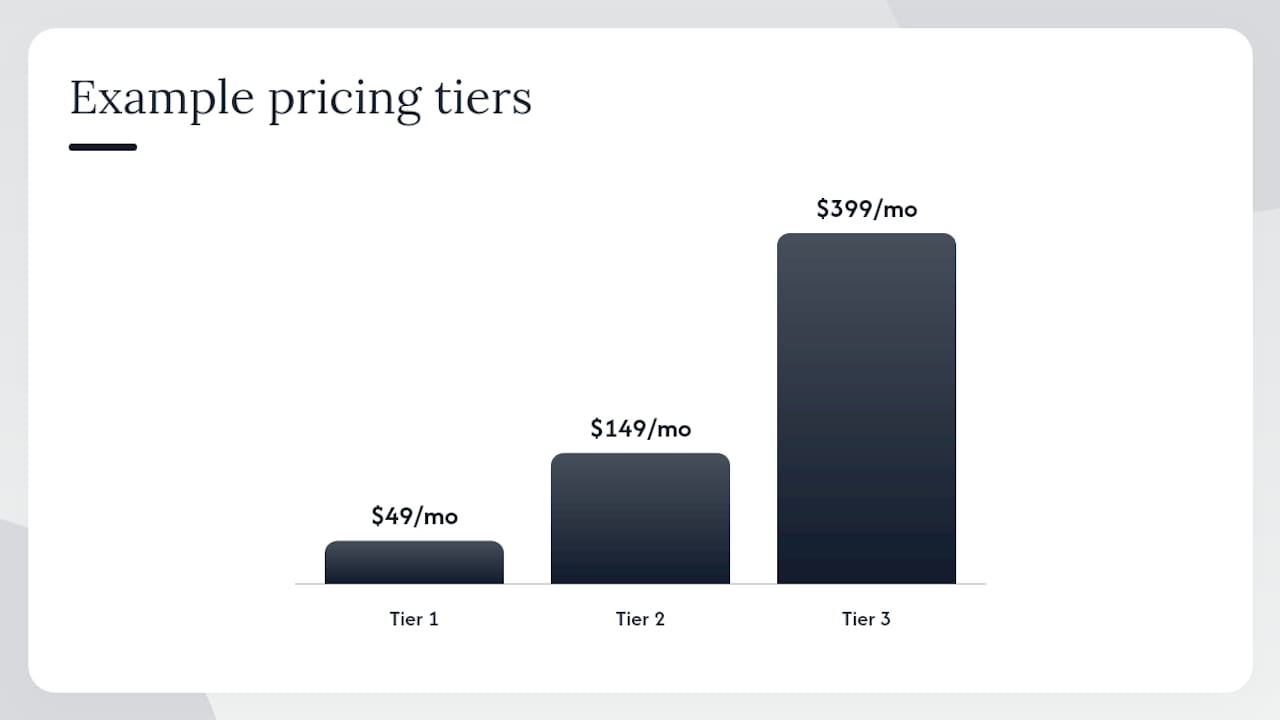
Example mini-dossier entry (3 lines): Pricing: Three tiers at $49/$149/$399/mo; seat-based; no free tier; enterprise pricing on request. Positioning: "The only [category] tool built for compliance teams." Reviews: 4.3/5 on G2 (312 reviews); top complaint is slow support response; top praise is depth of reporting.
Fields like pricing and review themes are fully public. Roadmap signals and onboarding flows require primary research: sign up for their trial, run a mystery-shop, or pull win-loss interview data from your own sales team. TripleDart's guide recommends mining competitor websites, G2 reviews, Reddit threads, and sales materials together to surface messaging and pricing gaps that no single source reveals alone.
Pro Tip: Set a Google Alert and a page-change monitor (Visualping or Distill.io) on each competitor's pricing page the day you build the dossier. You'll catch tier changes and packaging moves without having to manually re-check.
How to find the right competitors to track
Tracking every competitor wastes effort. The goal is a prioritized watchlist of 5–10 rivals that actually affect your win rate, roadmap, and pricing decisions.
Three tiers to map:
- Direct competitors share your core buyer, solve the same problem, and compete for the same budget. These are the rivals your sales team loses deals to. They belong in every dossier.
- Indirect competitors solve a related problem or serve an adjacent buyer. A project management tool competing with a purpose-built product ops platform is indirect. They matter for positioning and for watching where the category is heading.
- Aspirational competitors are the category leaders you're not yet competing with directly but whose product decisions set buyer expectations. If your buyers reference them in demos, they belong on your watchlist.
Discovery sequence:
- Pull your last 20–30 win-loss records and note every competitor mentioned by name.
- Search G2 and Capterra in your category; sort by review count and rating. The top 10 are your direct tier.
- Run a SimilarWeb traffic analysis on the top 3–5 direct competitors. Check their "also visited" and referral sources for indirect rivals you may have missed.
- Search Crunchbase for companies in your category that raised funding in the last 18 months. A well-funded indirect competitor can become direct fast.
- Ask 5–10 customers: "What else did you consider before choosing us?" This surfaces aspirational and indirect rivals your SERP research won't find.
- Check the Google Ads Library for your primary category keywords. Whoever is spending on those terms is competing for the same buyer attention.
Score each candidate on three dimensions: how often they appear in your win-loss data, how much traffic they pull in your category (SimilarWeb), and how recently they raised capital (Crunchbase). The top scorers get full dossiers. The rest get a lighter monthly pulse check.
A repeatable 6-step framework you can run as a sprint or a quarterly audit
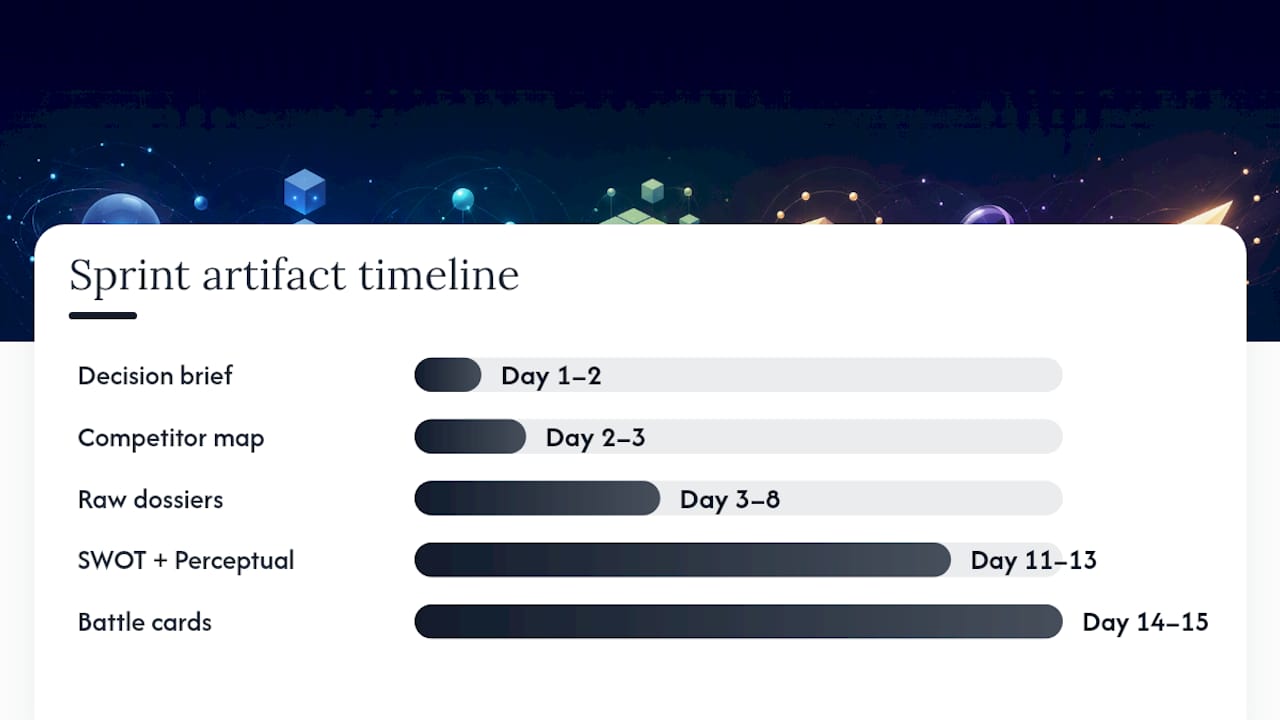
This framework runs in 10–15 days as a focused sprint or expands to a 4–6 week deep audit. The sprint is right for a new market entry or a pricing reset. The deep audit fits an annual planning cycle or a major product pivot. Appcues outlines the six core components that make a competitive analysis actionable instead of decorative.
Step 1: Define the decisions (Day 1–2) Write down the 3–5 decisions your team needs to make in the next 90 days. Pricing change? Feature prioritization? New ICP? Every subsequent step collects only the signals that change those decisions. Artifact: a one-page decision brief with named owners.
Step 2: Map competitors and segments (Day 2–3) Apply the three-tier model above. Assign each competitor to a tier and confirm the segments they target. Artifact: a tiered competitor map with ICP notes.
Step 3: Collect OSINT (Day 3–8) Pull public signals: pricing pages, changelogs, job postings, G2/Capterra reviews, SimilarWeb traffic, Crunchbase funding, and Google Ads Library ad copy. Use page-change monitors for pricing pages. Artifact: raw dossiers for each tracked competitor.
Step 4: Run primary research (Day 8–11) Sign up for competitor trials. Pull win-loss interview notes from sales. Run 3–5 customer interviews asking what alternatives they considered and why. Artifact: annotated trial notes and interview summaries.
Step 5: Synthesize narratives and risks (Day 11–13) Convert raw dossiers into SWOT summaries. Build a perceptual map (satisfaction vs. market share, or price vs. feature depth) to visualize your position. Identify the top 3 risks and the top 3 opportunities. Artifact: SWOT cards, perceptual map, and a ranked gap list.
Step 6: Enable teams with battle cards (Day 13–15) Translate findings into one-page battle cards for sales (objection handles, differentiators, landmines to avoid) and a messaging brief for marketing. Brief the product team on the ranked gap list. Artifact: battle cards, messaging brief, and a 90-day recommendation set.
Octopus Intelligence's 15-day runbook maps each day to a specific deliverable and emphasizes pace over perfection. A 70% complete brief delivered on day 15 beats a perfect report delivered on day 45.
| Artifact | Sprint (10–15 days) | Deep Audit (4–6 weeks) |
|---|---|---|
| Decision brief | Day 1–2 | Week 1 |
| Competitor map | Day 2–3 | Week 1 |
| Raw dossiers | Day 3–8 | Weeks 1–3 |
| SWOT cards | Day 11–13 | Weeks 3–4 |
| Perceptual map | Day 13 | Week 4 |
| Battle cards | Day 14–15 | Weeks 5–6 |
Pro Tip: Compttr's framework templates include a ready-made feature matrix and SWOT format you can copy directly into your sprint. Classical frameworks still work; the only change in SaaS is the pace at which you need to apply them.
Which tools give you the most reliable competitive signals?
You don't need a paid CI platform to run a solid first analysis. Most of the highest-value signals are free. Here's where to look and what each source is actually good for.
- G2: Buyer-sourced reviews with star ratings, feature scores, and open-text complaints. Best for: extracting recurring pain themes and NPS proxies. Quick query: filter by your category, sort by "most recent," and read the 3-star reviews first.
- Capterra: Similar to G2 with slightly different buyer demographics. Best for: SMB-focused categories and pricing sentiment. Cross-reference with G2 to spot patterns that hold across both platforms.
- SimilarWeb: Traffic estimates, channel mix, and "also visited" data. Best for: sizing a competitor's organic vs. paid investment and spotting referral partners. Free tier gives monthly visits and top channels.
- Crunchbase: Funding rounds, investor names, headcount, and founding date. Best for: assessing a competitor's runway and growth trajectory. A Series B raise in your category is a signal to update your dossier immediately.
- Google Ads Library: Live ad copy and creative for any advertiser. Best for: reading a competitor's current messaging hypothesis. Search your category keywords and download the top 5–10 ads.
- Page-change monitors (Visualping, Distill.io): Alerts when a specific URL changes. Best for: catching pricing page updates, new feature announcements, and terms-of-service changes without manual checking.
- Reddit and community forums: Unfiltered buyer sentiment. Best for: surfacing frustrations that buyers won't write in a formal review. Search "[competitor name] alternative" or "[competitor name] problems."
- LinkedIn job postings: Hiring signals reveal where a competitor is investing. A cluster of ML engineer postings signals a product direction before any announcement.
For paid tools, Crayon automates signal collection across all these sources and converts insights into battle cards your sales team can use directly. PulseSignal delivers severity-coded daily deltas so your team sees only the signals that matter, not a firehose of noise. Both are worth evaluating once your manual process is running and you want to scale it. For a broader view of SaaS tools for product managers, the catalog at SaaS LaunchPad covers the full toolkit.
How to turn competitive findings into product, pricing, and positioning moves
Findings without experiments are just observations. The goal is to convert each gap or opportunity into a testable move with a named owner and a success metric.
Prioritization checklist for each finding:
- Impact: If you close this gap or exploit this opportunity, how much does it affect win rate, retention, or revenue?
- Evidence strength: Is this based on one review or a pattern across 50? One win-loss interview or a consistent theme across 20?
- Cost to execute: Is this a messaging change (days), a pricing adjustment (weeks), or a feature build (quarters)?
- Defensibility: If you make this move, can a competitor copy it in 30 days? If yes, deprioritize unless it's a quick win.
Three experiment examples:
-
Pricing change experiment. A competitor drops their entry tier. You test a 14-day free trial extension (vs. your current 7-day) for the same ICP segment. Success metric: trial-to-paid conversion rate at 30 days. Baseline from your current cohort; target a 15% lift.
-
Onboarding A/B test. G2 reviews show a competitor's users consistently complain about slow time-to-value. You test a guided setup checklist against your current blank-slate onboarding. Success metric: percentage of users completing a "first value action" within 48 hours of signup.
-
Messaging reposition test. A competitor's homepage leads with "enterprise security." Your win-loss data shows buyers in your ICP care more about speed of deployment. You test a homepage headline change emphasizing setup time. Success metric: demo request rate over 30 days vs. the control.
Record outcomes in a shared competitive log alongside the original finding. When a test confirms a gap, escalate it to the product roadmap. When it doesn't, note why and update the dossier. Crayon's approach to CI activation shows how battlecards and seller-facing enablement close the loop between intelligence and revenue outcomes.
For pricing experiments specifically, usage-based pricing models offer a flexible structure worth testing when competitive pressure is compressing your entry-tier margins.
Ready templates and a 30-minute competitor snapshot
When you don't have time for a full sprint, a 30-minute snapshot gives you enough to brief a sales rep or update a battle card.
30-minute snapshot checklist:
- Open the competitor's pricing page. Screenshot it. Note tiers, prices, and any recent changes (5 min).
- Read their homepage headline and the first three feature bullets. Write down their claimed differentiator in one sentence (5 min).
- Pull their last 10 G2 reviews. Note the top praise theme and top complaint theme (10 min).
- Check their LinkedIn for headcount and any job postings in product or engineering (5 min).
- Search Google Ads Library for their brand name. Note the current ad headline (5 min).
That's your snapshot. It won't replace a full dossier, but it's enough to walk into a competitive deal with current information.
Feature matrix template (rows):
| Feature | Your product | Competitor A | Competitor B |
|---|---|---|---|
| Core workflow | Full | Full | Partial |
| Native integrations | 40+ | 20+ | 15+ |
| Free tier | Yes (limited) | No | Yes (limited) |
| SSO / SAML | All tiers | Enterprise only | Enterprise only |
| API access | All tiers | Pro+ | Pro+ |
Compact SWOT template:
| Strengths | Weaknesses | |
|---|---|---|
| Internal | What you do better than this rival | Where they outperform you |
| External | Opportunities their gaps create for you | Threats their strengths pose |
After a 30-minute scan, three quick-win actions are worth doing immediately: update the battle card for that competitor with the new pricing data, flag any messaging change to your marketing lead, and add a note to the product backlog if a feature gap showed up in the reviews.
How a 21-discipline SaaS audit structures competitive insights into scored recommendations
Most competitive analyses stop at the dossier. A structured audit goes further: it scores each finding against your own product's current state and converts the gap into a prioritized sprint item.
SaaS LaunchPad's 21-discipline product audit covers the full stack of dimensions that affect competitive position:
- Product discovery and feature evaluation map what you're building against what the market is buying
- UX/UI audit and workflow optimization surface friction points that show up in competitor reviews as their weaknesses
- Pricing and revenue optimization assess your packaging against the competitive tier structures you've mapped
- Competitive intelligence stage scores your position on each dimension relative to the field
- Enterprise readiness scoring identifies gaps that matter to buyers evaluating multiple vendors
- Prioritized improvement roadmap and phased execution strategy convert scored gaps into a sequenced sprint plan
The output is a Product Excellence Blueprint with a copy-paste-ready Master Transformation Prompt. Rather than a static report, it gives your team a scored recommendation set they can act on in the next sprint cycle.
Appcues' competitive analysis framework recommends converting findings into templates and recommendations. The 21-discipline approach takes that one step further by scoring each finding so prioritization is built into the output, not left to a separate meeting. See the full audit stages for how each discipline feeds the final roadmap.
How often to update the analysis and who should own it
Competitive intelligence goes stale fast. A pricing page can change overnight. A competitor can announce a major integration on a Tuesday. The cadence needs to match the pace of your category.
Three-tier cadence:
A daily pulse (15 minutes) covers severity-coded alerts from page-change monitors and review platforms. The owner is whoever manages the CI tool or alert inbox, typically a product marketing manager. PulseSignal's approach of dispatching only high-impact deltas keeps this from becoming a full-time job.
A monthly monitoring pass (2–3 hours) covers a full review of each competitor's G2 and Capterra ratings, any new funding or hiring signals from Crunchbase and LinkedIn, and a traffic trend check on SimilarWeb. The owner is product marketing, with a brief to the product lead.
A quarterly deep audit (the full 6-step sprint) produces updated dossiers, a refreshed perceptual map, and a new 90-day recommendation set. The owner is the competitive intelligence lead or, in smaller teams, the head of product or CMO.
Ownership by function:
- Product: owns the feature matrix and gap list; updates the roadmap based on findings
- Marketing: owns positioning, messaging briefs, and the perceptual map
- Sales: owns battle cards and objection handles; feeds win-loss data back into the process
- CI owner (or PM/CMO in smaller teams): coordinates the quarterly sprint and holds the master dossier
Triggers for an out-of-cycle refresh:
- A competitor announces a major pricing change or new tier
- A competitor closes a funding round above $10M
- A competitor's review velocity on G2 spikes (sudden influx of reviews signals a product launch or a PR event)
- A competitor posts 10+ job openings in a single function within 30 days
- A competitor's platform goes down publicly (an opportunity signal, not just a risk signal)
Top mistakes that invalidate a competitive analysis
Getting the process wrong doesn't just waste time. It produces conclusions that actively mislead your team.
- Tracking too many competitors. Monitoring 20 rivals means shallow dossiers on all of them. Cap your active watchlist at 8–10 and do the rest as quarterly snapshots only.
- Relying only on public pricing pages. Pricing pages show list prices. Enterprise deals, annual discounts, and bundled services are invisible. Cross-reference with win-loss data and customer interviews.
- Treating G2 ratings as ground truth. A 4.5-star rating with 30 reviews tells you less than a 4.2-star rating with 800 reviews. Weight review volume alongside score.
- Skipping primary research. OSINT alone misses what buyers actually value. Win-loss interviews and customer conversations reveal gaps that no public source surfaces.
- Confirmation bias in synthesis. If you go in expecting a competitor to be weak on integrations, you'll find evidence for it. Assign a skeptic to challenge every conclusion before it goes into the brief.
- No feedback loop. If competitive findings never make it into the product roadmap or sales enablement, the analysis was theater. Every sprint should produce at least one named experiment with a success metric.
Red flags that invalidate a conclusion:
- The finding comes from a single source with no corroboration
- The review data is more than 12 months old
- The pricing data hasn't been verified against a live trial signup
- The "insight" is something your team already believed before the research started
How to incorporate customer feedback and market trends
Customer feedback is the fastest way to validate whether a competitive gap actually matters to buyers. A feature your competitor is missing only becomes an opportunity if your buyers care about it. The two sources to combine are your own customer data and public review platforms.
Start with your support tickets and NPS verbatims. Tag them by theme and look for patterns that map to competitor weaknesses you've already identified. If 30% of your support tickets mention a workflow your competitor's reviews also flag as painful, that's a confirmed gap worth prioritizing.
For market trends, BetterCloud's SaaS market statistics provide category-level context on adoption rates and tool proliferation. Pair that with Google Trends data on your category keywords and with analyst reports from your vertical. When a trend (AI-native workflows, usage-based pricing, compliance requirements) shows up in both buyer conversations and competitor product announcements, it's a signal to act on, not just monitor.
The practical step: add a "market trend" column to your quarterly dossier update. For each trend you're tracking, note which competitors are already addressing it and which are not. That gap is your window.
Evaluating competitor marketing strategies and digital presence
GTM positioning is what a competitor says they do. Their actual digital presence shows what they're investing in. The two often diverge, and the gap between them is where your opportunity lives.
Start with organic search. A SimilarWeb traffic breakdown shows whether a competitor is winning on SEO, paid, direct, or referral. A competitor pulling 60% of their traffic from organic search has a content moat that takes 12–18 months to replicate. One pulling 60% from paid is vulnerable the moment their ad spend drops.
Content cadence matters too. Check their blog publish frequency, their YouTube channel (if any), and their LinkedIn post volume. HubSpot's inbound research consistently shows that content and thought leadership programs shape buyer perception before a sales conversation ever happens. A competitor publishing three in-depth guides per week is building category authority you'll need to counter with your own program or with a tighter niche focus.
Ad creative from the Google Ads Library tells you their current messaging hypothesis. If they're testing "fastest setup" against "most integrations," they're uncertain about their primary differentiator. That's a positioning opening.
Finally, check their backlink profile using a free tool like Ahrefs' free tier or Moz's Link Explorer. A competitor with strong backlinks from industry publications has earned distribution you can't buy overnight. Note which publications they're featured in and whether those outlets would cover your story too.
How emerging technologies are reshaping competitive positioning in SaaS
AI integration has become the fastest-moving competitive variable in SaaS. A competitor that ships a native AI feature changes buyer expectations for the entire category, not just their own product. When one project management tool added AI-generated task summaries, buyers started asking every competitor in the space whether they had the same capability, regardless of whether it was relevant to their workflow.
The practical implication: your competitive dossier needs an "AI and emerging tech" row. For each competitor, note which AI features they've shipped, which they've announced, and which they're hiring for. LinkedIn job postings for ML engineers or "AI product manager" roles are a 6–9 month leading indicator of what's coming to market.
Beyond AI, watch for platform consolidation plays. When a competitor acquires a complementary tool or builds a native integration with a dominant platform (Salesforce, HubSpot, Slack), they're extending their moat. That move changes the competitive calculus for buyers who are already embedded in that ecosystem.
The right response isn't to chase every technology trend. It's to assess each one against your ICP's actual workflow. If your buyers are in a regulated industry, an AI feature that processes sensitive data without clear compliance documentation is a liability, not an advantage. Competitive positioning in emerging tech is as much about what you choose not to build as what you ship.
Competitive analysis is a capability, not a project
The teams that consistently win on competitive positioning treat it as an ongoing capability, not a quarterly deliverable. Here's what that looks like in practice.
First, make it concise. A two-page brief that sales can read in five minutes beats a 40-slide deck that nobody opens. The goal is decision speed, not comprehensiveness. If a finding doesn't change a decision, cut it.
Second, instrument the outcomes. Every experiment that comes out of a competitive finding should have a named metric and a review date. If the pricing test didn't move conversion, that's a finding too. Feed it back into the dossier so the next sprint starts with better hypotheses.
Third, brief sales fast. The window between a competitor's pricing change and your first sales conversation about it can be 24 hours. A one-paragraph Slack update with the key fact and the recommended response is more valuable than a polished battle card delivered three weeks later.
When your team lacks the bandwidth for a full sprint, or when you're entering a new market and need an enterprise-grade baseline fast, an external audit is worth the investment. SaaS LaunchPad's 21-discipline product analysis covers competitive intelligence as one of its scored stages, giving you a structured starting point rather than a blank spreadsheet.
Get a scored competitive baseline with SaaS LaunchPad
Running a competitive analysis manually takes time your team may not have, especially when you're also building, selling, and supporting a product. SaaS LaunchPad gives you a faster path to a scored, enterprise-grade baseline.
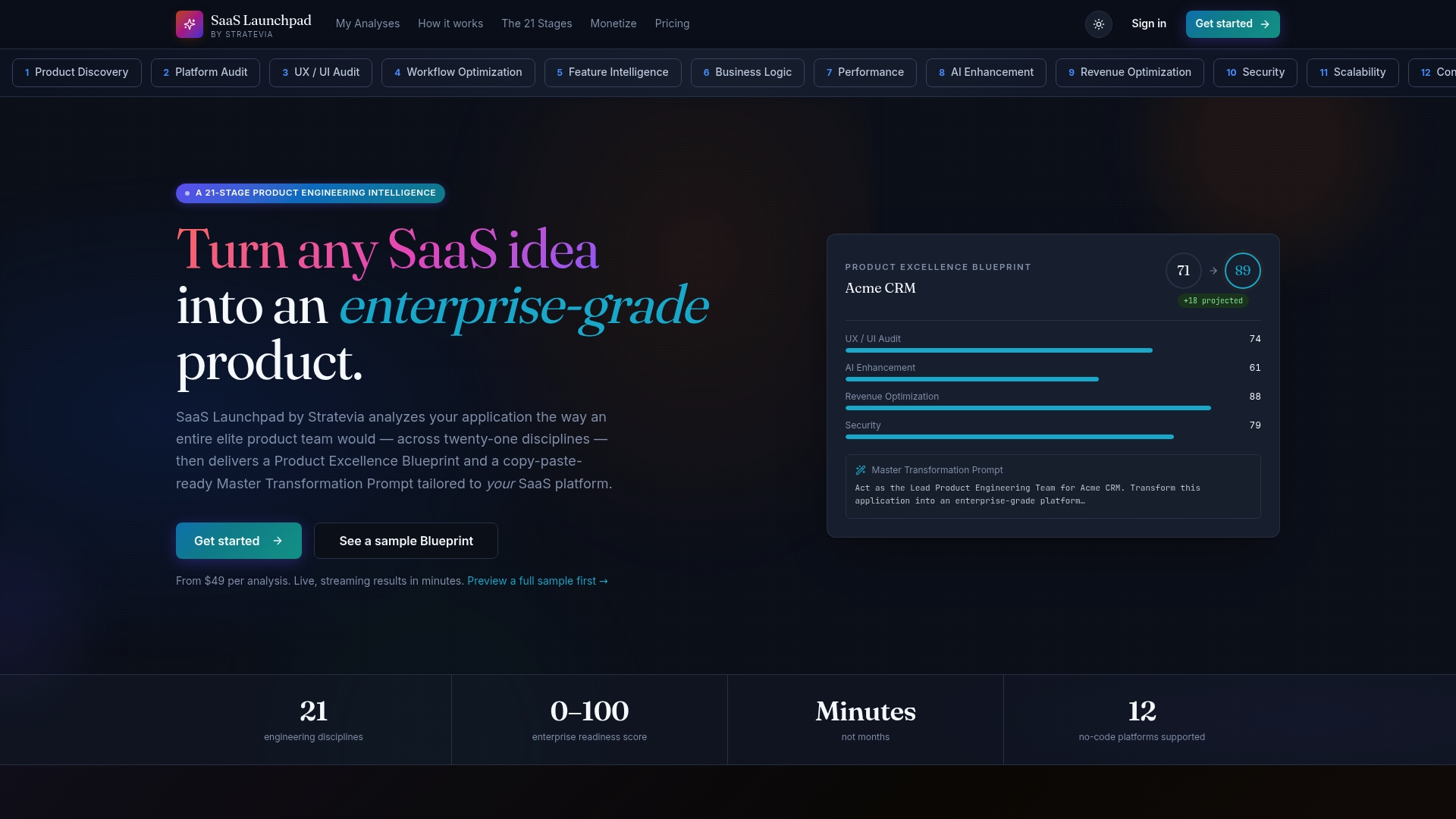
The 21-discipline product analysis covers competitive intelligence as one of its scored stages alongside product discovery, UX audit, pricing optimization, and enterprise readiness. You get a Product Excellence Blueprint that maps your gaps against the field, plus a copy-paste-ready Master Transformation Prompt tailored to your platform. No subscription, no retainer. You purchase a credit, run the analysis, and receive a prioritized roadmap you can take into your next sprint. For SaaS founders and product teams who need a defensible starting point rather than a blank spreadsheet, start your analysis at SaaS LaunchPad.
Sources
- How to do a competitive analysis
- Your Six-Step Competitive Analysis For SaaS Success
- SaaS Competitor Analysis: A Step-by-Step Guide
- PulseSignal | Competitive intelligence you don't miss
- Crayon | Competitive Intelligence Software
- 7 Competitive Analysis Frameworks That Actually Work (With Templates) · Compttr
- G2
- Bettercloud
FAQ
What is a SaaS competitive analysis?
A SaaS competitive analysis is a structured process that produces competitor dossiers, a ranked gap map, and a 90-day action plan so your team can make better product, pricing, and positioning decisions based on evidence rather than assumption.
What are the key steps in a competitive analysis for SaaS?
The core steps are: define the decisions you need to make, map competitors by tier, collect OSINT signals, run primary research (win-loss interviews, trial signups), synthesize findings into SWOTs and a perceptual map, then enable teams with battle cards and a recommendation set. A focused sprint takes 10–15 days.
What are the 4 P's of competitor analysis?
The 4 P's are Product, Price, Place (distribution and channels), and Promotion (messaging and marketing). In SaaS, "Place" typically covers acquisition channels and ecosystem integrations, while "Promotion" covers content, paid ads, and positioning.
How often should a SaaS team update its competitive analysis?
A daily alert for high-severity signals (pricing changes, major launches), a monthly monitoring pass covering reviews and traffic trends, and a full quarterly sprint producing updated dossiers and a new 90-day recommendation set. Out-of-cycle refreshes are triggered by competitor funding rounds, major pricing moves, or a spike in review velocity on G2.
Why is SaaS competitive analysis worth doing regularly?
Category signals in SaaS move fast. A competitor's pricing change or new AI feature can shift buyer expectations across the entire category within weeks. Teams that monitor continuously and brief sales within 24 hours of a major move consistently outperform those that rely on annual reviews.