For most B2B SaaS products, the right answer is a hybrid model: a base subscription plus consumption charges, not pure pay-as-you-go. Usage-based pricing aligns cost with value and lowers acquisition friction, but pure consumption billing creates revenue volatility and bill shock without guardrails. Stripe, Nalpeiron, and SaaS LaunchPad all point to the same pragmatic starting point.
Three steps to act on now:
- Pick a value metric hypothesis. Choose one measurable unit that scales with customer success (API calls, analysis credits, reports generated).
- Run a credits-based pilot. Backtest historical usage data against your candidate metric before any customer sees a new invoice.
- Add caps and commits. Protect customers from surprise bills and protect your revenue from volatility before you go live.
Table of Contents
- What is usage-based pricing in SaaS?
- When does usage-based pricing fit your SaaS product?
- Benefits and risks of usage-based pricing for B2B SaaS
- Hybrid and variant pricing patterns that work in practice
- How to choose and validate a value metric
- Technical and operational checklist before you launch
- How to forecast usage revenue and the KPIs to monitor
- How to pilot and roll out usage pricing without causing bill shock
- Common mistakes and warning signs to stop the rollout
- SaaS LaunchPad turns pricing hypotheses into tested blueprints
- Key Takeaways
- The case for going hybrid before going pure usage
- Useful sources
- FAQ
What is usage-based pricing in SaaS?
Consumption-based billing charges customers for a measurable unit of consumption rather than a flat monthly fee. Instead of paying $500/month regardless of activity, a customer pays per API call, per token processed, per storage gigabyte, or per analysis credit consumed.
Common value metrics include API calls (Twilio), compute hours (AWS), emails sent (Brevo), contacts stored (Mailchimp), and on-demand analysis credits (SaaS LaunchPad). Each metric works because it correlates with the value the customer actually receives.
The contrast with seat-based or tiered pricing is practical. A seat model charges per user whether they log in daily or once a quarter. A tiered model locks customers into a plan ceiling. Usage pricing lets a small team pay almost nothing in a slow month and scale spend naturally as they grow, with no forced upgrade conversation.
When does usage-based pricing fit your SaaS product?
Four signals suggest UBP is a natural fit:
- Usage intensity varies widely across your customer base. If one customer uses 10× what another does, a flat fee overcharges the light user and undercharges the heavy one.
- The value metric is measurable and auditable. You can count it, log it, and show it to a customer who disputes a bill.
- Marginal cost per unit is low. Delivering one more API call or one more analysis run costs you almost nothing, so usage revenue is high-margin.
- Your buyers prefer pay-for-results. Developer tools, analytics APIs, AI inference platforms, and on-demand product analysis buyers often resist annual commitments until they've proven ROI.
On-demand analysis credits map cleanly to this profile. A founder running three product audits in a quarter pays for three. A team running twenty pays for twenty. No wasted budget, no upgrade friction.
Benefits and risks of usage-based pricing for B2B SaaS
What you gain:
- Price-to-value alignment: customers pay proportionally to what they get.
- Lower acquisition friction: a $0 or near-zero entry point removes the "is it worth the monthly fee?" objection.
- Natural expansion revenue: as customers grow, their bills grow without a sales conversation.
What to watch for:
- Revenue unpredictability: a slow customer month hits your MRR directly.
- Bill shock: a customer who underestimates usage gets a surprise invoice and churns.
- Procurement friction: enterprise finance teams need predictable numbers for budget approval.
Mitigations that actually work:
- Hybrid models (base + usage) protect your revenue floor.
- Spending caps and mid-cycle alerts prevent bill shock.
- Pre-bundled credits smooth both customer spend expectations and your cash flow.
- Committed-use discounts give enterprise buyers the predictability they need.
Hybrid and variant pricing patterns that work in practice
Hybrid pricing mixes a fixed recurring fee with variable usage charges. It is the most widely adopted pattern among successful SaaS companies because it solves the core tension: predictable base revenue plus upside as accounts scale.

Four patterns worth knowing:
Subscription + overage. A base plan includes a usage allowance; consumption above that threshold bills at a per-unit rate. Good for products with a clear "normal" usage band and occasional spikes.
Credits bundles. Customers buy prepaid credits that draw down as they consume. SaaS LaunchPad uses this model: purchase analysis credits, run audits, credits never expire. It smooths revenue, reduces bill anxiety, and keeps the usage signal intact.
Tiered allowances with overage. Each pricing tier includes a higher usage ceiling. Customers self-select based on expected volume. Works well for analytics and API products with distinct customer segments.
Committed-use discounts. Customers commit to a minimum annual spend in exchange for a lower per-unit rate. Chargebee and Nalpeiron both recommend this pattern for enterprise procurement, where budget predictability is non-negotiable.
For self-serve SMB buyers, credits bundles or subscription + overage are the lowest-friction options. For enterprise, committed-use with overage is the standard.
How to choose and validate a value metric
- List candidate metrics. Write down every measurable unit your product produces: reports, API calls, scans, scores, seats, storage bytes.
- Map each metric to a customer outcome. A metric only works if customers can feel the value it represents. "Analysis credits consumed" maps to "product insights received." "API calls" maps to "features delivered to end users."
- Compute per-unit economics. Divide your fully-loaded cost to serve by the unit count. If one analysis credit costs you $X to deliver, your floor price is clear.
- Sanity-check customer bill expectations. Model what a light, average, and heavy user would pay. If the heavy-user bill looks alarming, the metric or the price needs adjustment before launch.
- Validate against four criteria: Is the metric predictable enough for customers to budget? Do customers understand it without a support call? Does it correlate with perceived value? Can you measure and audit it reliably?
Pro Tip: Before committing to a metric, run a backtest: take 90 days of historical usage data and calculate what each customer's bill would have been. Compare that to what they actually paid. The gap tells you whether your metric is fair.
Technical and operational checklist before you launch
Metering: Capture events at the source with idempotency keys so duplicate events don't inflate bills. Store raw event logs with timestamps for audit and dispute resolution. Define aggregation windows (hourly, daily, monthly) before writing a single line of billing code.
Rating and billing: Build price tables that handle volume tiers, graduated pricing, and proration for mid-cycle changes. Define your refund and dispute workflow before the first invoice goes out. Stripe Billing supports usage-based metering natively, including tiered and graduated pricing.
Integrations: Connect your metering pipeline to your CRM, finance/ERP, and revenue recognition system. Nalpeiron notes that most hybrid implementations require two distinct systems: an entitlement engine (what the customer is allowed to consume) and a monetization engine (what they actually consumed and owe). Missing either one causes billing errors.
Revenue recognition: Operational complexity is consistently underestimated by teams moving from subscriptions. Usage revenue recognized at delivery differs from subscription revenue recognized ratably. Involve your finance team before launch, not after.
Pro Tip: Build a billing-preview endpoint and a customer-facing spend dashboard before the first invoice runs. Customers who can see their running total in-product dispute bills far less often.
How to forecast usage revenue and the KPIs to monitor
KPIs that matter for consumption-based revenue: ARPU, MRR split between fixed and variable components, expansion MRR from overage, churn segmented by usage cohort, billing dispute rate, and gross margin on usage.
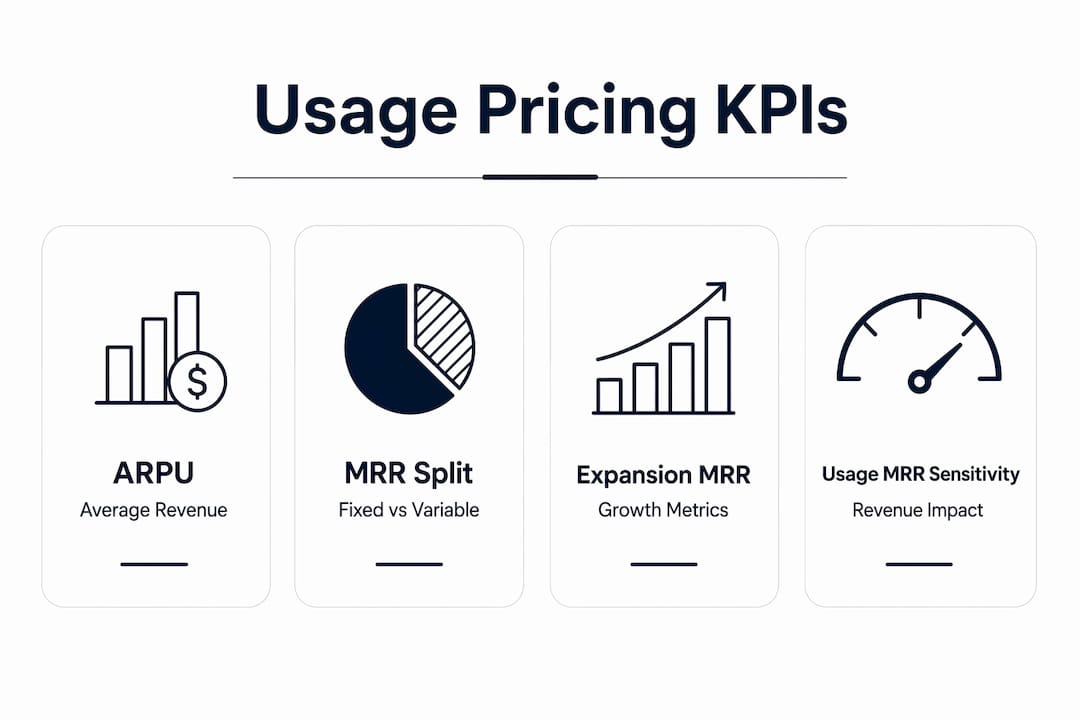
The scenario model below maps per-unit price against three usage distributions to show MRR sensitivity.
| Scenario | Monthly units (avg customer) | Customers | Per-unit price | Usage MRR |
|---|---|---|---|---|
| Conservative | 3 credits | 50 | — | — |
| Expected | — | 50 | — | — |
| Aggressive | — | 50 | — | — |
The gap between conservative and aggressive is 5×. That spread is why hybrid models with a base fee matter: a $99/month base across those same 50 customers adds $4,950 in fixed MRR regardless of usage variance.
How to pilot and roll out usage pricing without causing bill shock
Start with an internal dry-run: run the billing pipeline against your own team's usage for 30 days. Fix every edge case before a customer sees it.
Then run a limited cohort pilot. Pick 10–20 customers who are already heavy users and likely to benefit from the new model. Backtest their historical bills, show them the comparison, and get explicit buy-in before switching them over.
Customer communication needs three things: name the metric clearly, show example bills at low, medium, and high usage, and give customers controls (a spending cap, a mid-cycle alert, a commit option). Enterprise buyers in particular need the commit option before they can get budget approval.
In-product UX: a spend meter on the dashboard, an alert at 75% of expected usage, and an invoice preview before the billing date. These three controls cut billing disputes significantly.
Common mistakes and warning signs to stop the rollout
Top execution mistakes:
- Choosing a metric customers can't estimate in advance.
- Launching without spending caps or usage alerts.
- Migrating all customers simultaneously instead of running a phased cohort pilot.
- Under-investing in metering accuracy. Inaccurate metering destroys customer trust faster than any other billing failure.
Red flags that the model needs rework:
- Billing disputes spike above your baseline within the first two billing cycles.
- Refund requests cluster around a specific usage threshold (a sign the metric is confusing).
- High-usage customers churn at a higher rate than low-usage customers.
- Finance cannot produce a 90-day cash flow forecast because usage variance is too wide.
Quick fixes: Reintroduce a commit option for customers who want predictability. Shorten the pilot window and add prepay credits with hard caps. If the metric itself is the problem, pause and run the value metric validation checklist again before re-launching.
SaaS LaunchPad turns pricing hypotheses into tested blueprints
Designing a credits-based pricing model is faster when you already know which of your 21 product dimensions are ready for monetization and which are liabilities. SaaS LaunchPad runs a full 21-discipline product analysis across your platform and delivers a Product Excellence Blueprint plus a copy-paste Master Transformation Prompt, so your team can act on findings immediately.
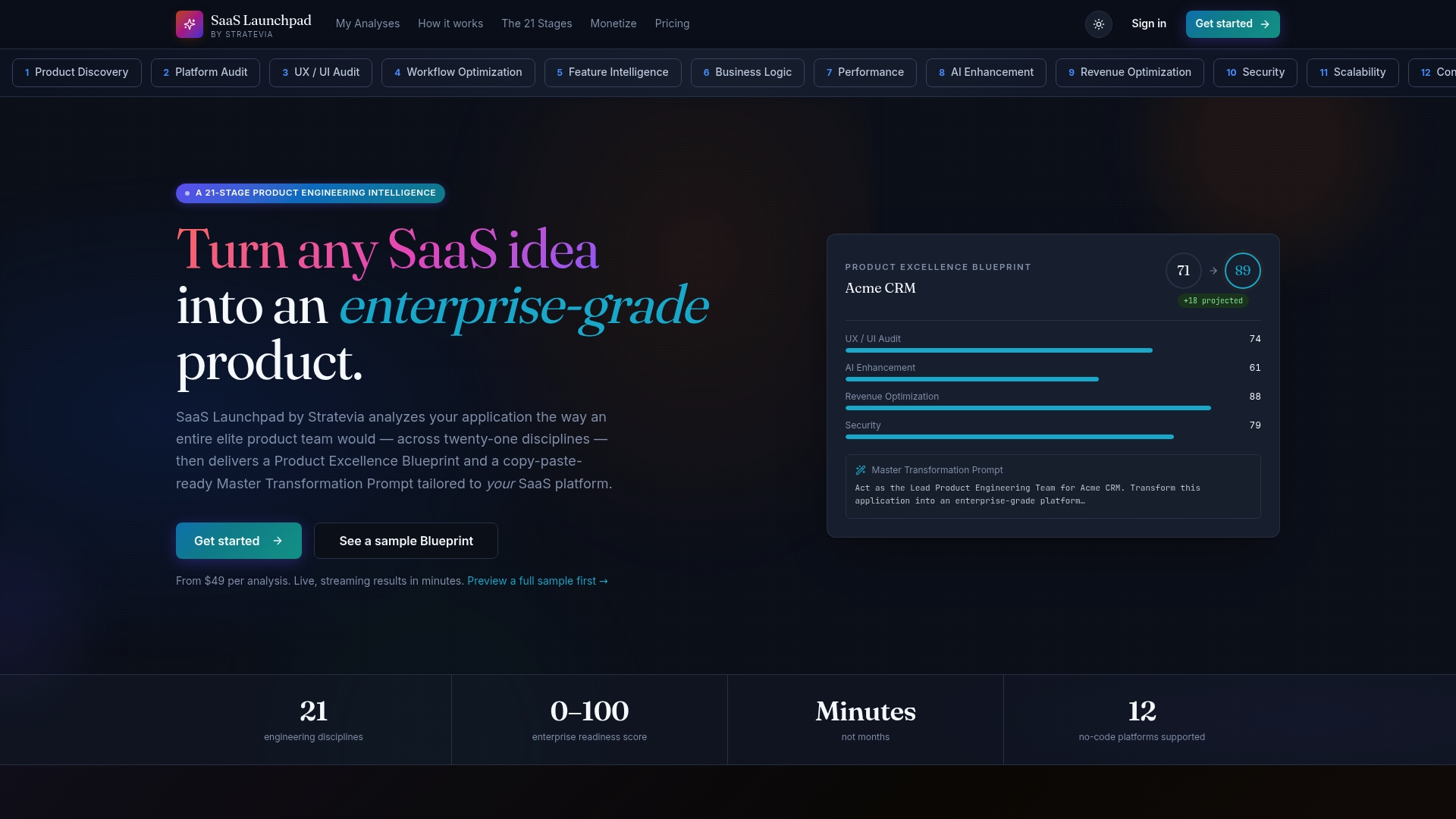
For pricing specifically, the analysis covers revenue optimization, business logic verification, and a prioritized improvement roadmap that maps directly to the value metric design steps in this guide. You buy analysis credits on demand, credits never expire, and volume packs are available. No subscription required.
Key Takeaways
Hybrid pricing is the practical default for B2B SaaS: a base fee protects revenue floor while usage charges capture expansion.
| Point | Details |
|---|---|
| Start with a value metric | Pick one measurable unit that scales with customer success before choosing a billing model. |
| Hybrid beats pure PAYG | A base subscription plus usage charges reduces revenue volatility and customer bill anxiety. |
| Backtest before launch | Run 90 days of historical usage through your candidate metric to validate unit economics. |
| Build UX guardrails first | Spend meters, 75% alerts, and invoice previews cut billing disputes before they start. |
| SaaS LaunchPad accelerates validation | An on-demand analysis credit delivers a 21-discipline blueprint and Master Transformation Prompt to validate your pricing hypothesis fast. |
The case for going hybrid before going pure usage
The conventional wisdom in SaaS pricing circles is that usage-based models are the future and that founders should move toward them as quickly as possible. That framing is mostly right, but it glosses over the part that actually breaks teams: the operational infrastructure required to do it well.
Most product teams underestimate metering by a factor of three. They build a counter, call it metering, and ship. Then the first disputed invoice arrives and they discover they have no audit log, no idempotency, and no way to reconstruct what happened. The customer churns. The team spends two sprints rebuilding what should have been there on day one.
The smarter path is to treat the hybrid model as a forcing function. A base subscription gives you time. It buys you the runway to instrument metering properly, validate your value metric with real data, and build the billing UX before usage charges are the only thing standing between you and a customer's renewal. Pure pay-as-you-go is a destination, not a starting point, and the teams that get there fastest are the ones who took the hybrid ramp.
Useful sources
| Source | What it covers |
|---|---|
| State of usage-based pricing (Metronome) | Industry adoption data on consumption-based models across SaaS |
| Usage-based pricing for SaaS (Stripe) | Practical guide to UBP advantages, drawbacks, and implementation |
| Hybrid pricing models (Stripe) | Base + usage patterns, trade-offs, and billing platform support |
| Hybrid pricing model in SaaS (Chargebee) | Adoption rationale and implementation complexity for hybrid billing |
| Hybrid pricing models: implementation notes (Nalpeiron) | Entitlement + monetization engine architecture for hybrid models |
| Revenue recognition and pricing velocity (RightRev) | Revenue recognition complexity and finance readiness for usage billing |
| Hybrid pricing strategy and automation (Alguna) | Metering accuracy, rating engines, and end-to-end billing automation |
| SaaS LaunchPad by Stratevia | 21-discipline product analysis and credits-based pricing validation |
FAQ
What is usage-based pricing in SaaS?
Usage-based pricing charges customers per unit of consumption (API calls, credits, storage, tokens) rather than a flat fee. Cost scales with value received, which lowers acquisition friction and enables natural expansion revenue.
Is pure pay-as-you-go or hybrid pricing better for B2B SaaS?
Hybrid pricing is the practical default for most B2B SaaS products. A base subscription stabilizes revenue while usage charges capture growth, reducing both vendor volatility and customer bill anxiety compared with pure pay-as-you-go.
How do you prevent bill shock with consumption-based billing?
Add a spending cap, a mid-cycle alert at 75% of expected usage, and an in-product spend meter before the first invoice runs. Offering prepaid credits bundles is the most effective single control.
Which billing platforms support usage-based metering natively?
Stripe Billing, Chargebee, Recurly, and Zuora all support usage-based metering, graduated tiers, and overage billing natively. Stripe and Chargebee are the most common starting points for early-stage SaaS teams.
How does SaaS LaunchPad help with usage pricing design?
SaaS LaunchPad runs a 21-discipline product analysis and delivers a Product Excellence Blueprint that covers revenue optimization and value metric validation, giving your team a tested pricing hypothesis and a copy-paste Master Transformation Prompt to act on immediately.