
TL;DR:
- SaaS RevOps unifies sales, marketing, and customer success to drive predictable revenue growth through organizational authority. It relies on core pillars of operations, analytics, and strategy, with direct reporting to the CRO or CEO to ensure impactful influence. Building an effective RevOps function requires discipline, integrated technology, and a cultural shift toward cross-team accountability.
SaaS RevOps is defined as the centralized function that unifies sales, marketing, and customer success under a single operational structure to drive predictable revenue growth in subscription software businesses. Unlike traditional sales operations, which serve only the sales team, Revenue Operations spans the full customer lifecycle from first marketing touch through renewal and expansion. Companies that build a true RevOps function report 36% more revenue growth compared to those running siloed go-to-market teams. The difference is not technology. It is organizational design and authority.
What are the core pillars of SaaS RevOps?
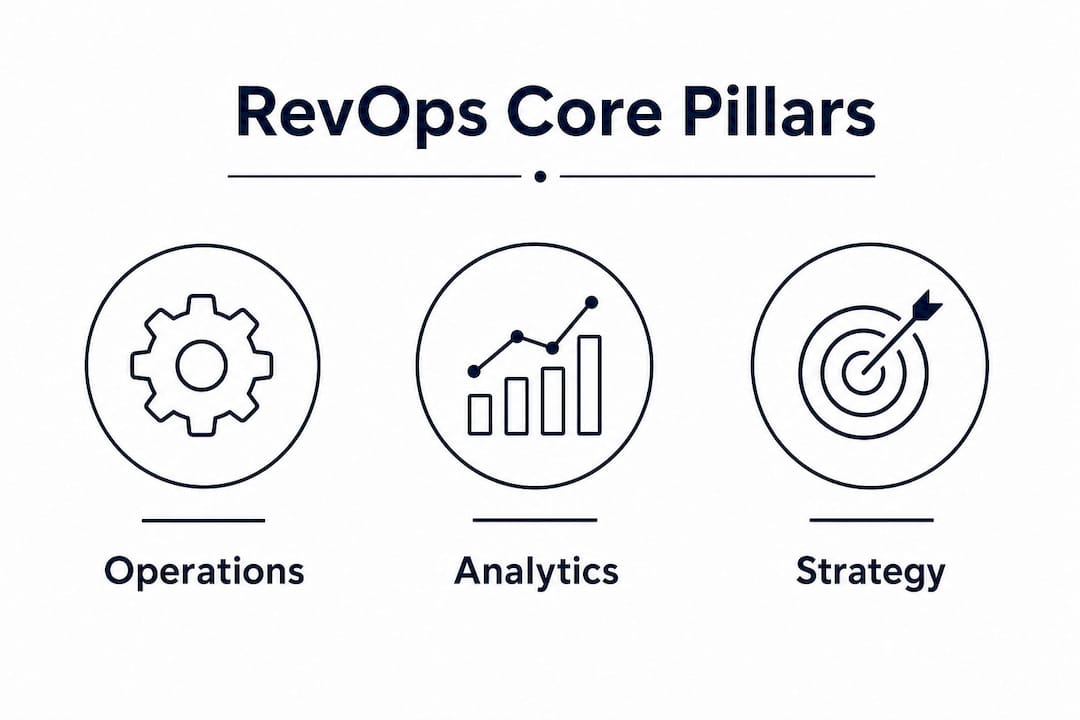
SaaS revenue operations rests on three pillars: operations, analytics, and strategy. Operations covers process design, tool administration, and data governance. Analytics translates raw pipeline and retention data into decisions. Strategy aligns the go-to-market plan with financial targets and board-level reporting. Remove any one pillar and the function collapses into a support role rather than a revenue driver.

Reporting structure determines whether RevOps has real authority or just a new title. Direct reporting to a CRO or CEO is the structural requirement that lets RevOps reset lead definitions, enforce handoff workflows, and hold all three teams accountable. A RevOps leader who reports to the VP of Sales will always prioritize sales requests over cross-functional alignment. That is the most common way RevOps fails before it starts.
Two organizational models dominate growth-stage SaaS companies today. The Sales Reporting model places RevOps under the VP of Sales, which limits scope but is common at early stages. The CRO Reporting model gives RevOps authority over marketing, sales, and customer success operations simultaneously. 48% of growth-stage SaaS companies have adopted the CRO Reporting model as of Q2 2026, with that figure projected to reach 61% by end 2027.
Staffing benchmarks follow ARR milestones. The industry standard is one RevOps FTE per $8M–$12M ARR, with lead compensation ranging from $185K–$295K base plus bonuses according to the Pavilion 2026 Compensation Report. Hiring too early wastes budget. Hiring too late means your CRO is making decisions from incomplete data.
Pro Tip: Before hiring your first RevOps leader, document your current lead-to-close process in full. A new hire who inherits an undocumented process spends the first six months auditing instead of building.
- Operations lead: Owns CRM administration, data hygiene, and tool integrations
- Analytics lead: Builds dashboards, forecasting models, and attribution reports
- Strategy lead: Runs governance meetings, aligns GTM plans, and reports to the CRO
Which key metrics should SaaS RevOps own?
RevOps must own the metrics that cross team boundaries. Individual teams track their own KPIs, but only RevOps can own the numbers that require all three functions to cooperate.
The most critical metric in SaaS is Net Revenue Retention. NRR above 120% signals that existing customers are expanding faster than they churn, meaning the business grows even without a single new logo. NRR is the metric that most directly influences SaaS company valuation at Series B and beyond. RevOps must own NRR because it requires coordination between customer success, product, and sales.
- ARR and MRR accuracy by segment: RevOps must reconcile ARR across product lines, customer tiers, and geographies monthly. Inaccurate ARR is the fastest way to lose board confidence.
- CAC and CAC payback period: Customer acquisition cost measures efficiency. Payback period under 12 months is the benchmark for capital-efficient SaaS growth.
- Logo churn and revenue churn: Logo churn counts the percentage of customers lost. Revenue churn weights those losses by contract value. Both matter, but revenue churn drives valuation.
- Pipeline velocity: Calculated as (number of opportunities × average deal value × win rate) divided by average sales cycle length. A drop in pipeline velocity predicts a revenue miss 60–90 days before it shows up in bookings.
- Forecast accuracy: Dedicated forecasting tools improve accuracy by 17 points over spreadsheet-only methods. That gap directly influences company valuation and investor confidence.
The root cause of most forecast misses is not a bad sales team. 41% of forecast misses trace back to misaligned lead definitions between the CMO and CRO. RevOps fixes this by co-owning the MQL-to-SQL-to-Opportunity definition with both leaders.
What technology stack supports SaaS RevOps?
The RevOps tech stack has five layers, and the rule is simple: one tool per core layer, with every layer integrated to maintain a single source of truth. Overspending on point solutions without integration is the most common and expensive failure mode in RevOps technology.
| Layer | Function | Example tools |
|---|---|---|
| CRM | Contact, deal, and account management | Salesforce, HubSpot |
| Marketing automation | Lead capture, nurture, and attribution | HubSpot, Marketo |
| Data warehouse / BI | Centralized analytics and reporting | Snowflake, BigQuery |
| Forecasting | Pipeline prediction and scenario modeling | Clari, Aviso |
| Revenue intelligence | Call recording, deal coaching, and signal detection | Gong, Chorus |
Integration quality matters more than brand choice. A Salesforce instance that does not sync cleanly with your data warehouse produces dashboards that contradict each other. When sales, marketing, and finance pull numbers from different systems, every board meeting becomes a debate about whose data is correct rather than what to do about it.
Data hygiene is not a one-time project. It is an ongoing process enforced through codified exit criteria per deal stage using frameworks like MEDDPICC or Sandler. RevOps owns the rules, trains the reps, and audits compliance weekly. Without that discipline, even the best tech stack produces garbage forecasts.
Pro Tip: Audit your CRM for duplicate accounts and missing close dates before evaluating any new forecasting tool. A clean CRM produces better forecasts than an expensive tool fed dirty data.
How can SaaS companies build a RevOps function?
The signal to hire dedicated RevOps staff is when your CRO or VP of Sales spends more than 30% of their time on operational tasks instead of strategy. At that point, the absence of RevOps is costing you more than the hire.
Building RevOps follows a clear sequence. Start with foundational data and process work before adding advanced forecasting or AI-driven intelligence. Teams that skip the foundation and buy expensive tools first end up with sophisticated dashboards built on unreliable data.
- Month 1–3: Audit existing data, document the lead-to-close process, and establish a single CRM as the system of record
- Month 3–6: Define shared metrics (NRR, CAC payback, pipeline velocity) and build the first cross-functional dashboard
- Month 6–12: Implement forecasting tools, launch governance meetings, and begin quarterly revenue architecture reviews
- Year 2+: Add revenue intelligence, prescriptive analytics, and expansion revenue tracking
Governance meetings are the operating system of RevOps. Weekly pipeline councils, monthly RevOps meetings, and quarterly revenue architecture reviews create the cadence that keeps all three teams aligned between planning cycles. Without this cadence, alignment decays within weeks as each team reverts to its own priorities.
The most common implementation mistake is incomplete unification. Many SaaS companies rename their sales ops team "RevOps" without giving the new leader authority over marketing or customer success operations. Without real authority across all GTM functions, RevOps cannot reset lead definitions or enforce handoff workflows. The result is a function with a new title and the same old silos.
Balancing technology investment with operational discipline is the ongoing tension in RevOps. The discipline side almost always delivers more value per dollar than the next tool purchase. Fix the process first. Then buy the tool that automates the fixed process.
What advanced strategies are shaping SaaS RevOps in 2026?
The most significant shift in SaaS revenue operations is the move from transactional bookings to lifecycle revenue. Shifting focus to Net Revenue Retention and expansion revenue changes how RevOps allocates resources, sets targets, and measures success. A company with strong NRR can grow 30% year over year with a smaller sales team than one chasing only new logos.
Prescriptive analytics is replacing descriptive reporting as the standard for mature RevOps functions. Descriptive analytics tells you what happened. Prescriptive analytics tells you which deals to prioritize today to hit next quarter's number. AI-driven revenue intelligence tools now surface deal risk signals from email sentiment, call frequency, and stakeholder engagement patterns before a rep recognizes the problem.
"A CRO without a dedicated RevOps function will make decisions based on incomplete and misaligned data. The RevOps function is not a support role. It is the operating system for revenue growth." The implication is direct: boards and investors increasingly evaluate RevOps maturity as a proxy for execution quality, not just operational efficiency.
RevOps is also becoming a recognized career path from analyst to CRO. Leaders who build cross-functional authority, own forecasting accuracy, and demonstrate NRR improvement are the most promotable executives in growth-stage SaaS. The function that was once considered back-office is now the fastest path to the C-suite.
Key Takeaways
SaaS RevOps delivers measurable growth only when it holds real authority over sales, marketing, and customer success, owns the metrics that cross team boundaries, and enforces operational discipline through consistent governance cadences.
| Point | Details |
|---|---|
| Authority determines impact | RevOps must report to the CRO or CEO to enforce cross-functional processes and break silos. |
| NRR is the north star metric | Net Revenue Retention above 120% signals healthy SaaS growth without relying solely on new customers. |
| One tool per tech stack layer | Integrate CRM, marketing automation, data warehouse, forecasting, and revenue intelligence before adding more tools. |
| Governance drives alignment | Weekly pipeline councils and quarterly revenue architecture reviews prevent teams from reverting to siloed priorities. |
| Sequence the build correctly | Audit data and document processes before investing in forecasting tools or AI-driven revenue intelligence. |
Why most RevOps implementations stall before they start
I have seen this pattern repeat across growth-stage SaaS companies more times than I can count. A company hires a sharp RevOps leader, gives them a budget for tools, and then wonders why nothing changes six months later. The answer is almost always the same: the leader had no authority over marketing or customer success. They could see the problems clearly. They just could not fix them.
The uncomfortable truth about RevOps is that technology is the easy part. Salesforce, Gong, and Clari are well-documented. The hard part is getting a CMO and a CRO to agree on what an MQL actually means and then holding both teams to that definition every single week. That requires organizational authority, not just analytical skill.
I have also watched teams invest heavily in revenue intelligence platforms before their CRM data was clean enough to trust. The result is expensive dashboards that contradict each other and a leadership team that stops trusting the data entirely. Clean data and documented processes are the foundation. Every tool you buy before that foundation is solid will underperform.
The companies that get RevOps right treat it as a cultural shift, not a technology project. They give their RevOps leader a seat at the executive table, fund the governance cadence, and measure success by forecast accuracy and NRR improvement, not by the number of tools in the stack. That mindset is rarer than it should be, but it is the only one that produces results worth talking about. You can read more about common SaaS operational pitfalls before committing to a build sequence.
— Gregory Cornelius
SaaS LaunchPad and your RevOps architecture
Building a RevOps function from scratch is one of the highest-leverage decisions a SaaS company can make. Getting the architecture right from the start saves months of rework and prevents the misaligned authority problems that stall most implementations.
SaaS LaunchPad analyzes your SaaS product across twenty-one disciplines, including revenue operations architecture, process design, and technology stack alignment. The result is a Product Excellence Blueprint that maps exactly where your current GTM structure breaks down and what to fix first. If you are ready to build a RevOps function that actually holds authority and drives NRR improvement, start your analysis with SaaS LaunchPad. You can also review how the methodology works before committing.
FAQ
What is SaaS RevOps?
SaaS RevOps is the unified function that aligns sales, marketing, and customer success under shared processes, metrics, and technology to drive predictable revenue growth in subscription software businesses.
How is RevOps different from sales ops?
Sales ops serves only the sales team, while RevOps owns operations, analytics, and strategy across the full customer lifecycle including marketing and customer success.
What metrics does RevOps own in a SaaS company?
RevOps owns cross-functional metrics including Net Revenue Retention, CAC payback period, pipeline velocity, forecast accuracy, and both logo and revenue churn rates.
When should a SaaS company hire a dedicated RevOps leader?
Hire a dedicated RevOps leader when your CRO or VP of Sales spends more than 30% of their time on operational tasks rather than strategy and pipeline management.
What reporting line makes RevOps most effective?
RevOps is most effective when it reports directly to the CRO or CEO, which gives the function the authority to enforce cross-team processes and reset shared definitions like MQL and SQL.