TL;DR:
- Customer journey mapping visualizes every customer interaction to identify friction and improvement opportunities.
- It helps align teams and informs targeted, data-driven improvements across all touchpoints and stages.
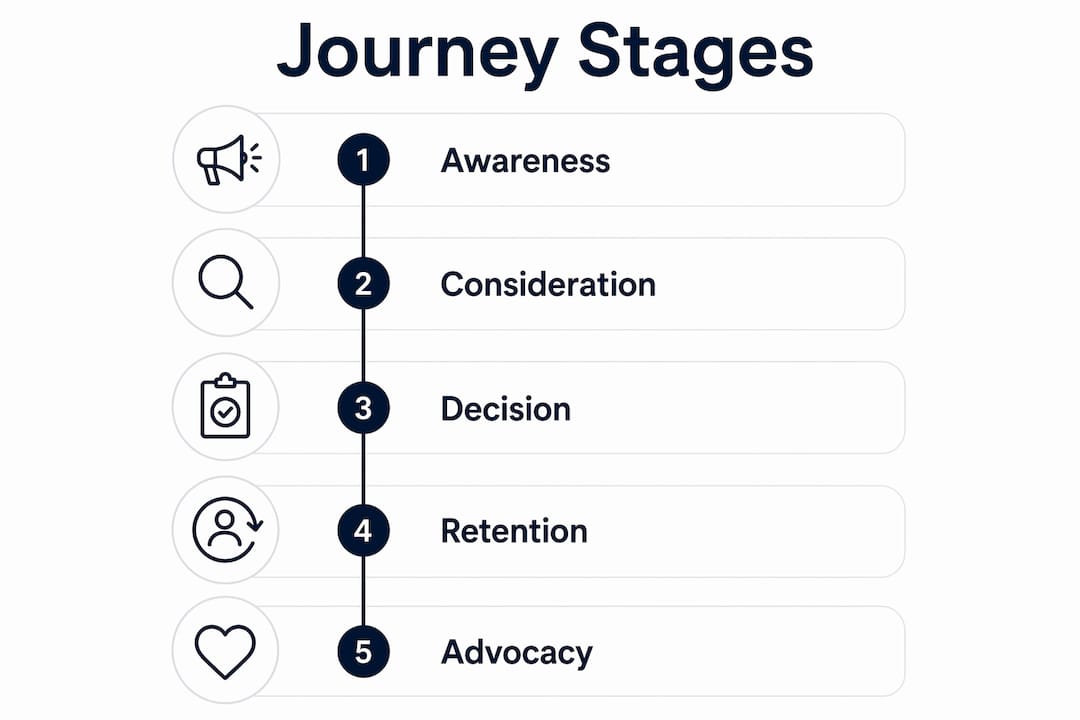
Customer journey mapping is defined as the process of creating a visual representation of every interaction a customer has with your brand, capturing actions, emotions, and pain points across all touchpoints. The goal is not documentation for its own sake. The goal is to reveal where customers struggle, where they disengage, and where your business can do better. A well-built map covers five core stages: awareness, consideration, decision, retention, and advocacy. Marketers and business strategists who treat this as a living practice, rather than a one-time workshop output, consistently find more opportunities to improve engagement and drive loyalty.

What is customer journey mapping, and why does it matter?
Customer journey mapping is the practice of diagramming every customer interaction with your brand to identify friction, unmet needs, and opportunities for improvement. Touchpoints include website visits, support calls, in-store visits, onboarding emails, and every channel in between. The map captures not just what customers do, but what they think and feel at each step. That emotional layer is what separates a useful map from a simple flowchart.
The strategic value is direct. Mapping the current state of a customer's experience creates a data-backed foundation for meaningful improvements. Without that foundation, CX decisions rely on internal assumptions rather than real behavior. Teams end up fixing the wrong problems, or worse, investing in features customers never asked for.
Customer experience mapping also forces alignment. When marketing, product, sales, and support each hold a different mental model of the customer, decisions conflict. A shared visual map gives every department the same reference point.
What are the typical stages and elements of a customer journey map?
A standard customer journey map follows five core stages: awareness, consideration, decision, retention, and advocacy. Each stage represents a distinct phase in the customer's relationship with your brand. Awareness is when a potential customer first encounters your product. Advocacy is when a loyal customer recommends you to others. Everything in between is where most businesses either win or lose the relationship.
Core elements every map must include
Each stage of the map should document the following:
- Customer actions: What the customer actually does at this stage (searches, clicks, calls, cancels)
- Thoughts: What questions or concerns are running through their mind
- Emotions: How they feel, from curious to frustrated to confident
- Pain points: Where friction slows them down or pushes them away
- Touchpoints: The specific channels and moments where they interact with your brand
These elements work together. A touchpoint without an emotion attached to it tells you nothing useful. A pain point without a corresponding action gives you no place to intervene.
Journey maps vs. service blueprints
Journey maps and service blueprints are related but distinct tools. A journey map focuses on the customer's perspective: what they experience and feel. A service blueprint goes one layer deeper, documenting the internal processes, systems, and staff actions that support each customer interaction. For most marketing and strategy teams, the journey map is the right starting point. Service blueprints become relevant when you need to redesign the operational infrastructure behind the experience.
Why data-driven personas matter
Generic personas produce generic maps. A persona built from CRM records, behavioral analytics, and support ticket data reflects how real customers actually behave. That specificity is what makes a map useful for decision-making. When you know that a specific segment of customers drops off during onboarding because they never complete a key setup step, you have a concrete problem to solve. Vague personas give you vague insights.
How do you build a customer journey map step by step?
A high-impact mapping process typically follows 7–8 systematic steps, starting with clear objectives and data-driven personas. Skipping the early steps is the most common reason maps end up unused.
- Define your objective. Without a clear goal, maps become too broad to act on. Specific objectives like "reduce onboarding friction" or "improve post-purchase support" keep the effort focused.
- Build data-backed personas. Pull from CRM records, behavioral analytics, and support tickets. Avoid building personas from internal opinions.
- Identify all touchpoints. List every channel and moment where customers interact with your brand, from paid ads to renewal emails.
- Gather cross-functional input. Bring in marketing, product, sales, and support. Each team sees a different slice of the customer experience.
- Map actions, emotions, and pain points. For each touchpoint, document what the customer does, thinks, and feels. Flag every friction point.
- Create the visual map. Choose a format that your team will actually use and reference. Clarity matters more than visual complexity.
- Assign a map owner. One person or role must be responsible for keeping the map current. Without ownership, maps go stale within months.
- Schedule review cycles. Formal review cycles after major product releases or significant market shifts keep the map relevant.
Pro Tip: Start with your highest-friction stage, not the full journey. Mapping the moment where the most customers drop off gives you faster, more concrete results than trying to map everything at once.
The cross-functional step deserves more attention than most teams give it. Marketing knows what brings customers in. Support knows what drives them away. Product knows what they struggle to use. None of those perspectives alone gives you the full picture. A map built without all three will have blind spots.
Why is customer journey mapping important for business strategy?
Customer journey maps serve as communication and collaboration tools that unify fragmented customer perspectives across departments. That alignment function is often undervalued. When every team operates from the same map, resource allocation decisions become clearer and faster. You stop debating whose data is right and start acting on a shared view of reality.
The strategic benefits extend beyond alignment:
- Targeted CX improvements: Maps reveal specific friction points rather than vague dissatisfaction, making it possible to fix the right things.
- Personalization at scale: When you know what customers need at each stage, you can tailor messaging, offers, and support to match.
- Smarter resource allocation: Maps show where investment will have the most impact on customer experience and retention.
- Competitive advantage: Businesses that understand their customers' actual experience can differentiate on service, not just features.
Journey analytics act as feedback loops that reveal what is working and what is not, enabling continuous improvement of the customer experience. Automatic refinements can be made based on customer profiles and buying history. That means the map is not just a diagnostic tool. It becomes an engine for ongoing CX improvement.
"Customer journey maps transform vague challenges into concrete opportunities for data-backed customer experience improvements. Mapping the 'as-is' journey uncovers pain points across channels that no single team could see on its own."
The importance of the customer journey also shows up in how teams prioritize. Without a map, every department advocates for its own initiatives. With a map, the conversation shifts to where customers actually need help. That shift changes which projects get funded and which get deprioritized.
What are the common challenges in customer journey mapping?
The most frequent failure mode is treating journey mapping as a one-time project. Assigning clear ownership to a specific role is the single most important factor in keeping a map operational and relevant over time. Map ownership should be an explicit responsibility, not a side task added to someone's existing workload.
Other common challenges include:
- Scope creep: Trying to map every customer type and every scenario at once produces maps too complex to use. Start with one persona and one journey.
- Assumption-based mapping: Using actual data rather than assumptions prevents creating "happy path" maps that miss real friction. CRM records, behavioral analytics, and support tickets are your primary sources.
- Siloed input: Maps built by a single department reflect that department's blind spots. Cross-functional participation is not optional.
- No update cadence: Customer behavior changes. A map that was accurate 18 months ago may now reflect a product or market that no longer exists.
Pro Tip: Pair your journey map with a user experience audit to validate what the map reveals. Audits surface usability issues that behavioral data alone may not capture.
Well-scoped objectives ensure that maps stay focused and connect directly to business goals. A map scoped to "the full customer lifecycle" is rarely actionable. A map scoped to "the first 30 days after signup" gives you something you can actually improve.
Key Takeaways
Customer journey mapping works only when it is treated as a continuous, data-driven practice with clear ownership, cross-functional input, and regular review cycles tied to specific business objectives.
| Point | Details |
|---|---|
| Start with a clear objective | Scope your map to a specific problem, like reducing onboarding friction, to keep it actionable. |
| Use real data, not assumptions | Pull from CRM records, behavioral analytics, and support tickets to capture authentic friction points. |
| Assign explicit map ownership | One role must own the map; without it, maps become outdated and unused within months. |
| Cross-functional input is required | Marketing, product, sales, and support each see different parts of the customer experience. |
| Treat maps as living documents | Schedule formal review cycles after major releases to keep the map current and relevant. |
Journey mapping is a discipline, not a deliverable
Most teams I have worked with approach customer journey mapping as a project with a finish line. They run a workshop, produce a beautiful map, present it to leadership, and then file it away. Six months later, the product has changed, the market has shifted, and the map reflects a customer experience that no longer exists.
The teams that get real value from journey mapping treat it the way engineers treat monitoring dashboards. The map is always on. It gets updated when behavior changes. It informs decisions in real time, not just at the moment it was created. That requires assigning ownership, building a review cadence, and connecting the map to the analytics tools that show you what customers are actually doing.
The other thing I have seen consistently: the emotional layer of the map gets skipped. Teams document actions and touchpoints with precision, then leave the "emotions" row blank or fill it with guesses. That row is where the real insight lives. A customer who completes every onboarding step but feels confused and anxious the entire time is a churn risk, even if the behavioral data looks clean. Capturing that emotional reality requires talking to customers directly, not just analyzing clickstream data.
Journey mapping done well is one of the highest-leverage activities a marketing or strategy team can invest in. Done poorly, it produces expensive wall art.
— Gregory Cornelius
How SaaS LaunchPad supports your product and CX strategy
Building a customer journey map reveals what needs to change. Acting on those insights requires a product team that can move fast and think across disciplines.
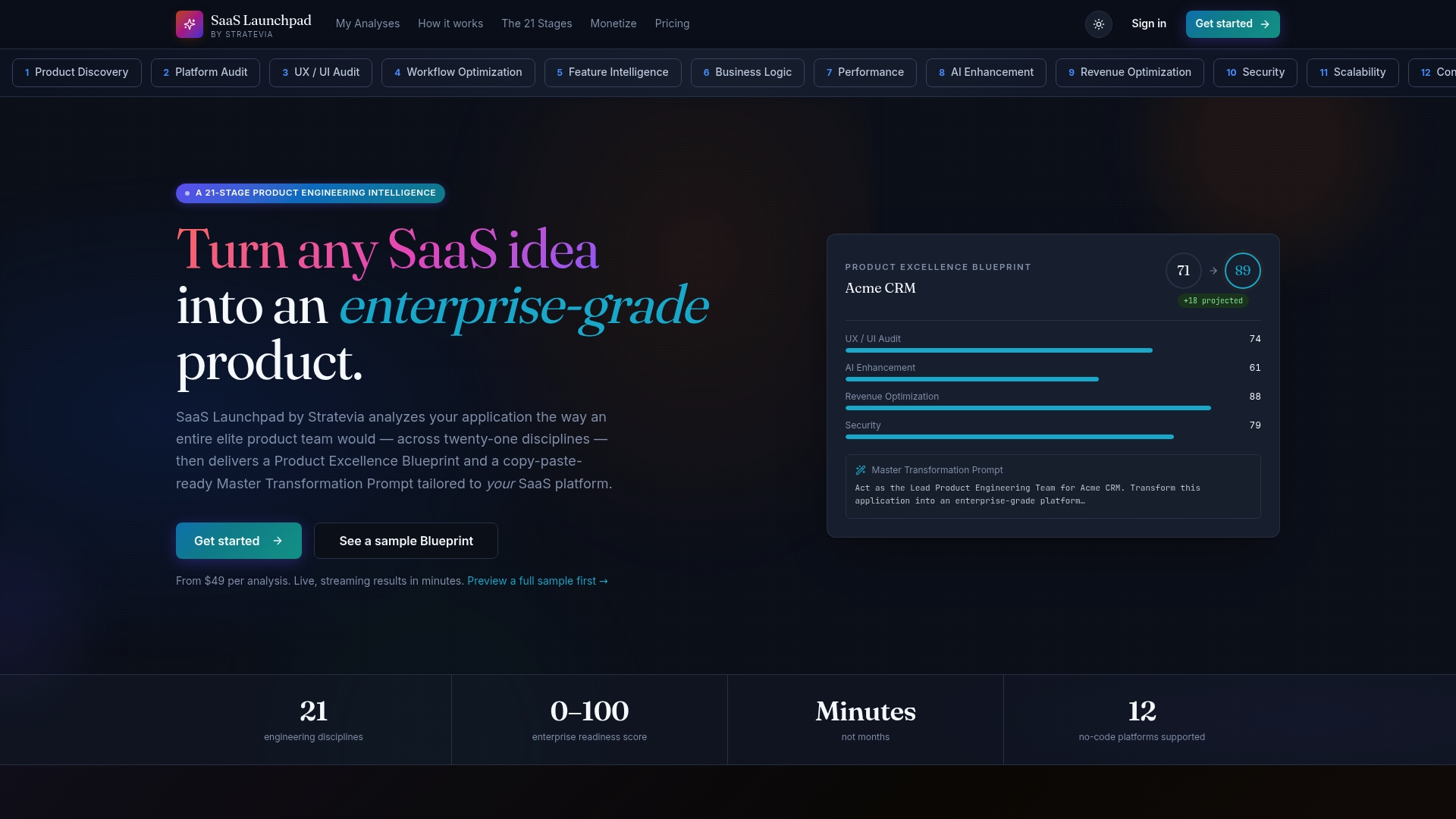
SaaS LaunchPad analyzes your SaaS application across twenty-one product disciplines, covering everything from user experience and onboarding flows to retention mechanics and feature prioritization. The result is a Product Excellence Blueprint that translates journey mapping insights into concrete product improvements. If your map has identified friction points but your team is unsure how to address them at the product level, SaaS LaunchPad gives you the structured analysis and ready-to-use guidance to act. See how it works and put your journey insights to work.
FAQ
What is the customer journey mapping definition?
Customer journey mapping is the process of creating a visual representation of a customer's experience, capturing actions, emotions, and pain points across all touchpoints from awareness through advocacy.
How many stages does a customer journey map typically cover?
A standard map covers five core stages: awareness, consideration, decision, retention, and advocacy. Each stage documents what customers do, think, and feel.
What data sources should I use to build a journey map?
CRM records, behavioral analytics, and support tickets are the primary sources. Using real data rather than assumptions prevents "happy path" maps that miss actual friction points.
How often should a customer journey map be updated?
Journey maps should be reviewed after major product releases and whenever significant shifts in customer behavior occur. Assigning a dedicated map owner is the most reliable way to keep updates on schedule.
What is the difference between a journey map and a service blueprint?
A journey map captures the customer's perspective, including their actions and emotions. A service blueprint documents the internal processes and systems that support each customer interaction, making it more useful for operational redesign.