TL;DR:
- Most SaaS products are not yet FedRAMP-ready, but knowing your current state is essential for progress. Achieving FedRAMP Ready status involves documented controls, a clear system boundary, and auditable evidence, typically within three to six months, with preparation time increasing if controls are missing. Treating FedRAMP as an engineering process and engaging a structured playbook can streamline compliance, reduce costs, and accelerate federal and state government opportunities.
Most SaaS products are not FedRAMP-ready today, and that is fine — the goal right now is knowing exactly where you stand. If you have documented controls, a defined system boundary, and auditable evidence flows, you are likely 3–6 months from a FedRAMP Ready designation. If those pieces are missing, plan for several months of structured preparation before a third-party assessor (a 3PAO) can submit your Readiness Assessment Report (RAR) to the FedRAMP Marketplace.
Three actions to take this week:
- Assign an SSP owner — one named person responsible for the System Security Plan
- Schedule a gap assessment with a FedRAMP-recognized 3PAO to get a written gap list
- Run an evidence collection sprint to locate and version your existing logging, MFA, and encryption artifacts
A readiness assessment typically costs $3,000–$15,000 for the 3PAO engagement; full authorization budgets run $200,000–$500,000 or more depending on scope and impact level. The FedRAMP Ready designation itself is issued by the FedRAMP Program Management Office after a 3PAO submits an accepted RAR, and it places your product on the FedRAMP Marketplace for agencies to discover.
Table of Contents
- What does FedRAMP readiness actually mean?
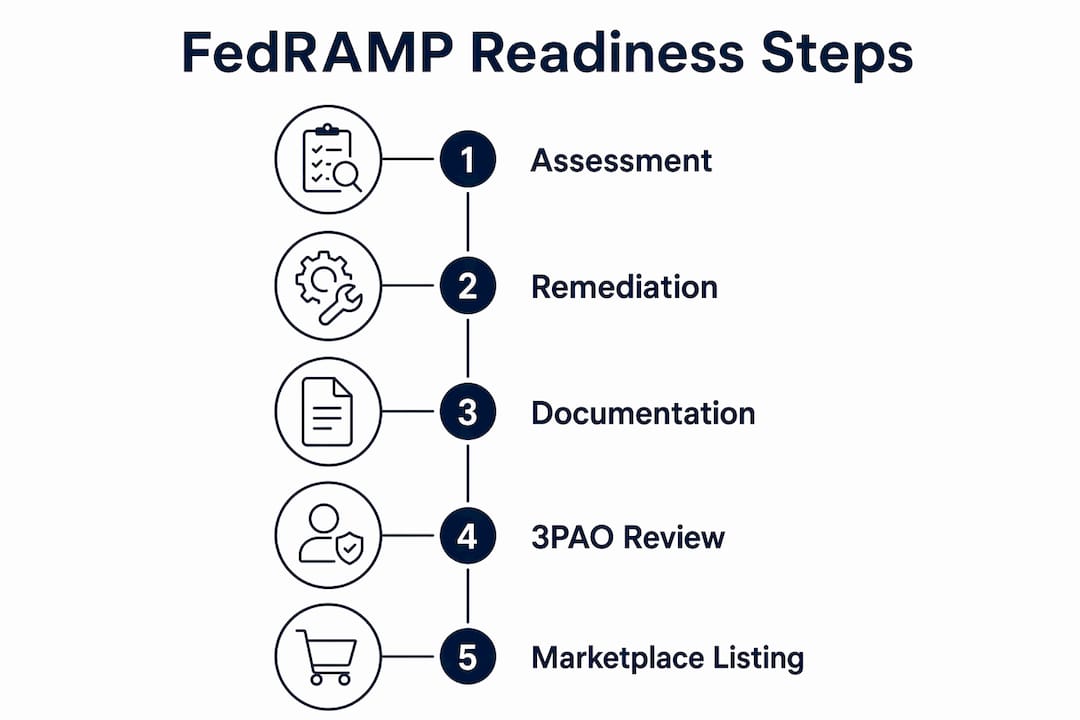
- How do you build a FedRAMP readiness playbook step by step?
- What artifacts and evidence do assessors actually request?
- What gaps do SaaS products most commonly have?
- Who should you involve and when?
- What do realistic timelines and costs look like?
- Why does FedRAMP readiness matter beyond federal sales?
- How does a product-grade readiness audit work in practice?
- Key Takeaways
- What most product teams get wrong about FedRAMP
- Your FedRAMP readiness starts with the right product audit
- Useful sources
- FAQ
What does FedRAMP readiness actually mean?
"FedRAMP readiness" is not the same as FedRAMP authorization, and conflating the two is one of the most common mistakes product teams make. Readiness refers to a documented, 3PAO-attested state: your product meets the technical and procedural requirements to pursue authorization. The FedRAMP Ready designation is available only at Moderate and High impact levels, requires a 3PAO to complete and submit a RAR, and lists your product on the FedRAMP Marketplace for one calendar year. No agency sponsor is required to achieve it.

Authorization is a separate, longer process. After FedRAMP Ready, a product moves to "In Process" (which requires an agency partner) and eventually to "Authorized" status.
| Stage | Purpose | Agency Sponsor Required? | Key Output |
|---|---|---|---|
| FedRAMP Ready | Attest capability to meet federal security requirements | No | RAR accepted; Marketplace listing |
| In Process | Active authorization with agency partner | Yes | Draft SSP, SAR in progress |
| Authorized | Full ATO granted | Yes | ATO letter, continuous monitoring active |
How do you build a FedRAMP readiness playbook step by step?
A structured sequence keeps product and engineering teams from chasing compliance in circles.
- Define your system boundary and data categorization. Identify every component in scope: application servers, databases, CI/CD pipelines, third-party integrations. Categorize data using FIPS 199 to select your impact level (Low, Moderate, or High).
- Create or update your System Security Plan (SSP). Map each FedRAMP control to a specific product feature, configuration, or policy. The SSP is the central artifact assessors read first.
- Implement missing controls and instrument evidence flows. This is where engineering work lives: enable phishing-resistant MFA per NIST SP 800-63B, configure SIEM logging with defined retention, enforce encryption at rest and in transit, and wire CI/CD pipelines to produce auditable build artifacts.
- Engage a 3PAO for the RAR. Involving an assessor early reduces the risk of expensive restarts. The 3PAO reviews your SSP, samples evidence, and produces a gap list and POA&M.
- Build your continuous monitoring plan. Define how you will track vulnerabilities, patch cadence, and configuration drift after authorization. The FedRAMP Continuous Monitoring Playbook is the reference document for this.
Pro Tip: If your 3PAO finds gaps and you remediate them within a short time period, the same assessor can apply retesting toward a Type I-equivalent report, reducing incremental fees and compressing your timeline.
What artifacts and evidence do assessors actually request?
The artifact list is longer than most teams expect. Organize it into three buckets before your 3PAO kicks off.
| Artifact Category | Specific Items |
|---|---|
| Core documents | SSP, SAR (if applicable), POA&M, Configuration Management (CM) plan |
| Policies and procedures | Access control policy, incident response plan, change management procedure, vendor management policy |
| Operational evidence | Vulnerability scan reports, patch records, SIEM log exports, MFA enrollment logs, encryption key management records, system diagrams |
Evidence sourcing matters as much as the evidence itself. Pull vulnerability scans directly from your cloud provider console (AWS Security Hub, Azure Defender) and export them with timestamps. CI/CD pipeline logs from GitHub Actions or similar tools serve as build-integrity proof. SIEM output from tools like Splunk or Datadog should cover at least 90 days of retention before the assessment opens. Version every artifact with a date and owner — assessors reject undated screenshots.
What gaps do SaaS products most commonly have?
The most frequent failures are not missing technology. They are missing documentation and missing evidence for controls that already exist in practice.
High priority (fix these first):
- Undocumented policies — controls that work in practice but have no written procedure. Effort: medium. Fix: assign a policy owner and use FedRAMP SSP templates to draft within two weeks.
- Missing access reviews — no formal quarterly review of who has production access. Effort: small. Fix: schedule a recurring review and export the log as evidence.
- Incomplete vendor management — third-party integrations with no documented security assessment. Effort: medium. Fix: create a vendor inventory and attach each vendor's SOC 2 report or equivalent.
Medium priority:
- Logging coverage gaps — some services not forwarding events to SIEM. Effort: medium.
- Inconsistent encryption proof — encryption configured but no documented key rotation schedule. Effort: small.
- Vulnerability management cadence — scans run ad hoc rather than on a defined schedule. Effort: small.
Lower priority (common but not audit-blockers):
- Undocumented configuration management for infrastructure-as-code. Effort: large.
- Onboarding and offboarding procedures not tied to access provisioning records. Effort: medium.
Who should you involve and when?
Getting the right people in the room at the right stage prevents the most expensive mistakes.
| Role | Responsibility | When to Engage |
|---|---|---|
| SSP Owner (internal) | Drafts and maintains the SSP; coordinates control evidence | Day one of readiness work |
| Engineering Lead | Implements missing controls; instruments CI/CD evidence flows | Immediately after gap list |
| Security Lead | Owns vulnerability management, SIEM, and incident response artifacts | Day one |
| Product Manager | Translates controls into feature and sprint requirements | After SSP mapping begins |
| FedRAMP-recognized 3PAO | Conducts RAR; submits to FedRAMP PMO | 4 weeks into preparation |
| FedRAMP consultant | Accelerates SSP drafting and control mapping; advises on scope | Optional; useful if team is new to NIST 800-53 |
| Agency sponsor | Required for "In Process" and Authorized stages only | After FedRAMP Ready is achieved |
Red flags when selecting a 3PAO: any firm that cannot show prior FedRAMP RAR submissions, quotes a fixed price before reviewing your system boundary, or promises authorization timelines under six months from a standing start.
What do realistic timelines and costs look like?
| Milestone | Timeline | Estimated Cost | Owner |
|---|---|---|---|
| Gap assessment and SSP draft | Weeks 1–6 | $3,000–$15,000 (3PAO RAR) | SSP owner + 3PAO |
| Control implementation sprints | Weeks 4–20 | Internal engineering time | Engineering lead |
| 3PAO RAR submission | Month 3–6 | Included in RAR fee | 3PAO |
| FedRAMP Ready designation | Month 4 | PMO review (no fee) | FedRAMP PMO |
| Full authorization (In Process → Authorized) | 6 months post-Ready | $200,000–$500,000+ total | Agency + 3PAO |
Teams starting from scratch typically need several months to reach audit-ready state. Products with existing SOC 2 or ISO 27001 programs can often shorten that preparation time because most policy and evidence infrastructure already exists.
Why does FedRAMP readiness matter beyond federal sales?
State and local governments are the clearest example. Mississippi's procurement guidance instructs agencies to use FedRAMP Low or Moderate controls as the baseline when evaluating cloud and offsite hosting providers. That pattern is spreading: state procurement offices increasingly treat FedRAMP alignment as a proxy for enterprise-grade security rather than building their own control frameworks from scratch.
For enterprise SaaS sales, the effect is similar. A FedRAMP Ready listing shortens security review cycles because procurement teams can point to a 3PAO-attested RAR instead of running their own vendor questionnaire. That alone can cut weeks from a deal cycle. Packaging FedRAMP readiness as a market signal — in your security page, RFP responses, and enterprise procurement conversations — positions your product above competitors who cannot show third-party attestation.
How does a product-grade readiness audit work in practice?
A product-grade audit translates FedRAMP controls into product workstreams rather than treating compliance as a separate project. The compliance checks SaaS LaunchPad runs map controls to feature owners, CI/CD evidence, and infrastructure configuration — not just to a policy binder.
| Phase | What Happens | Output |
|---|---|---|
| Kickoff and scoping | System boundary defined; impact level confirmed; evidence request list issued | Scoped SSP outline |
| Documentation review | SSP draft, policies, and procedures reviewed against FedRAMP control families | Gap list with severity ratings |
| Evidence sampling | Logs, scan reports, MFA records, and CI artifacts tested for completeness | Evidence gap register |
| Gap report and POA&M | Prioritized remediation plan with owner assignments and effort estimates | POA&M ready for 3PAO |
| Remediation verification | Spot-check of closed gaps before RAR submission | Updated evidence package |
Product teams speed this process by pre-staging evidence folders organized by control family, assigning a named owner to each control before kickoff, and running a self-assessment against the 21-discipline audit framework to surface product-level issues before the 3PAO clock starts.
Key Takeaways
FedRAMP readiness requires a 3PAO-submitted RAR, a documented SSP, and auditable evidence across logging, MFA, encryption, and vendor management before your product can appear on the FedRAMP Marketplace.
| Point | Details |
|---|---|
| Readiness vs. authorization | FedRAMP Ready is a 3PAO-attested Marketplace listing; full authorization requires an agency sponsor and takes 6 months beyond that. |
| Start with the SSP | Assign one named SSP owner on day one — every other artifact flows from the system boundary and control mapping it defines. |
| Cost baseline | A readiness assessment typically costs $3,000–$15,000 for the 3PAO engagement; full authorization budgets run $200,000–$500,000 or more depending on scope and impact level. |
| Fix documentation first | Undocumented policies and missing access reviews are the most common audit-blockers, and both are low-engineering-effort fixes. |
| SaaS LaunchPad | The Product Excellence Blueprint maps FedRAMP controls to product workstreams, giving teams a prioritized remediation roadmap before a 3PAO engagement begins. |
What most product teams get wrong about FedRAMP
The conventional wisdom says FedRAMP is a compliance project. Assign it to a security consultant, collect some documents, and hand it off. That framing is why so many readiness efforts stall.
The real problem is that FedRAMP controls touch product architecture. Multi-tenancy boundaries, CI/CD pipeline integrity, logging instrumentation, MFA enforcement at the feature level — these are product decisions, not policy checkboxes. When a 3PAO asks for evidence that your system enforces least-privilege access, they are asking about your authorization model, not your HR policy. When they ask for encryption proof, they want key rotation logs from your infrastructure, not a sentence in a document.
Product teams that treat FedRAMP as an engineering problem from the start move faster and spend less. They wire evidence collection into their release process early, so by the time the 3PAO arrives, the evidence already exists. Teams that bolt compliance on afterward spend months reconstructing proof of things they were already doing correctly.
The FedRAMP controls baseline is also a living document. NIST released 800-53 Rev 5.2.0 in August 2025, and the FedRAMP Consolidated Rules for 2026 will carry those updates forward through December 31, 2028. Treating your SSP and control mappings as a one-time artifact is a mistake that will cost you at your next annual assessment.
Your FedRAMP readiness starts with the right product audit
A 3PAO will tell you what is missing. SaaS LaunchPad tells you what to build first. The Product Excellence Blueprint maps your product across 21 disciplines — including security, enterprise readiness scoring, and a prioritized improvement roadmap — so your engineering team has a concrete workstream before the 3PAO clock starts running.
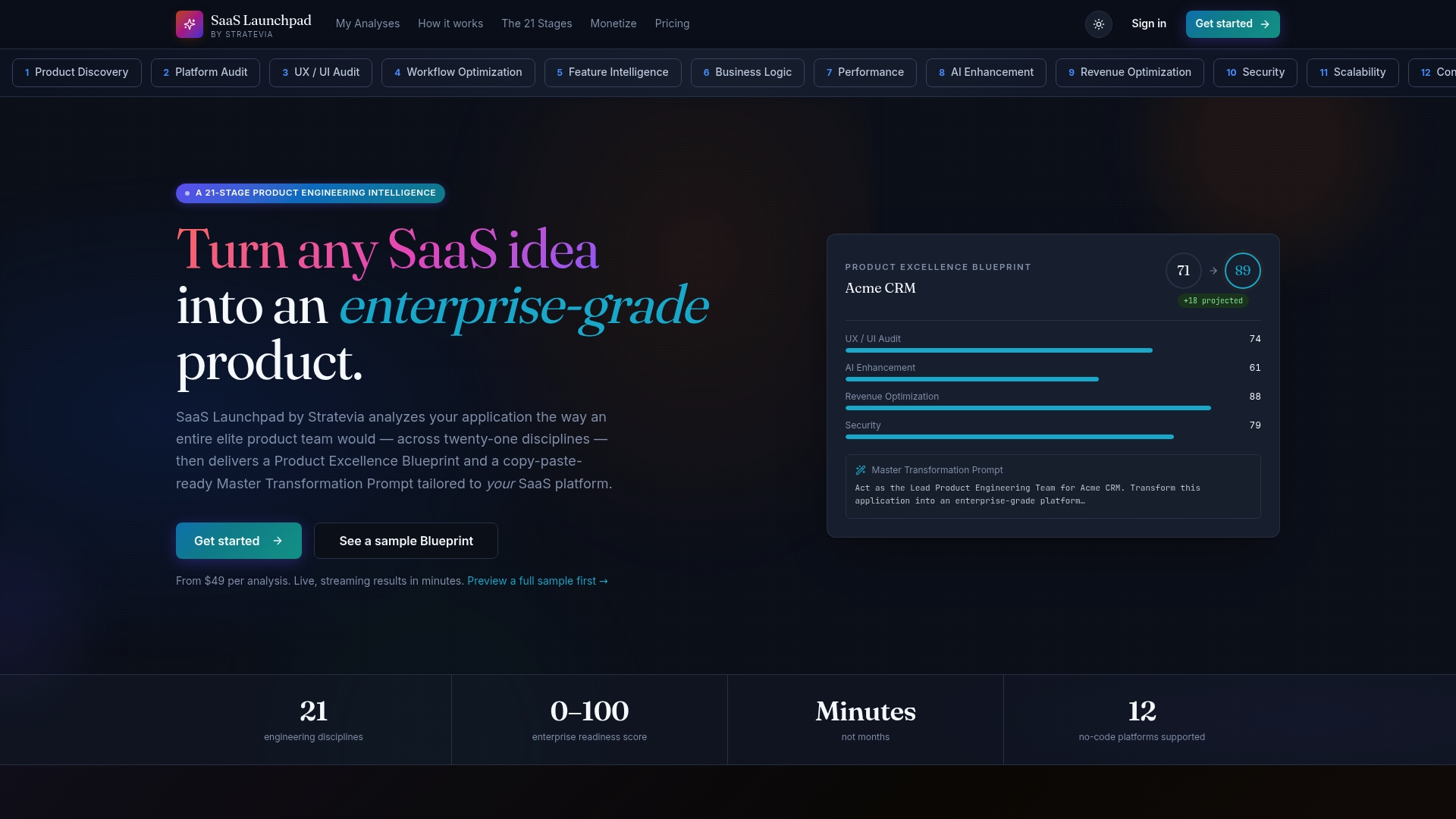
For FedRAMP readiness specifically, SaaS LaunchPad delivers a control-to-feature mapping tied to your actual product architecture, an evidence playbook identifying where to source logging, MFA, and encryption artifacts from your existing stack, and a phased remediation roadmap your team can execute in sprints. No subscription. Credits never expire. Pricing is transparent at saaslaunchpad.org/pricing. Run your product analysis at saaslaunchpad.org and get your Blueprint before your first 3PAO conversation.
Useful sources
| Document | What to use it for |
|---|---|
| FedRAMP Rev5 Agency Authorization | RAR process, FedRAMP Ready mechanics, Marketplace listing requirements |
| RFC-0028 FedRAMP Rev5 Security Controls Baseline Update | Current control baseline changes, MFA requirements (IA-2), 2026 Consolidated Rules transition |
| RFC-0030 FedRAMP Rev5 Controls Update (RA, SA, SC, SI, SR) | Risk assessment, system and communications protection, supply chain controls |
| RFC-0027 FedRAMP Rev5 Controls Update (AC, AT, AU, CA, CM) | Access control, audit and accountability, configuration management, continuous monitoring |
| State of Mississippi Baseline Security Controls | State procurement baseline example; reference when positioning FedRAMP alignment for non-federal buyers |
Save these as authoritative references in your SSP document library. Assessors will ask which version of the control baseline your SSP maps to — having the RFC and baseline documents linked directly in your SSP demonstrates rigor before the first interview.
FAQ
What is the difference between FedRAMP Ready and FedRAMP Authorized?
FedRAMP Ready means a 3PAO has submitted an accepted RAR and your product is listed on the FedRAMP Marketplace; it requires no agency sponsor. FedRAMP Authorized means a federal agency has granted an ATO after a full assessment.
How long does FedRAMP readiness take for a typical SaaS product?
Teams with existing security programs typically reach FedRAMP Ready in a few months; products starting from scratch usually need several months before a 3PAO can submit a RAR.
What does a readiness assessment cost?
A readiness assessment typically costs $3,000–$15,000 for the 3PAO engagement; full authorization budgets run $200,000–$500,000 or more depending on scope and impact level.
Do state and local agencies require FedRAMP authorization?
Not always, but many state procurement policies — including Mississippi's — use FedRAMP Low or Moderate controls as their baseline for cloud providers, making FedRAMP alignment a practical requirement even without a federal contract.
Can SaaS LaunchPad help prepare for a FedRAMP readiness assessment?
Yes. The Product Excellence Blueprint maps FedRAMP controls to your product's specific features and infrastructure, producing a prioritized remediation roadmap your team can execute before engaging a 3PAO.