TL;DR:
- A SaaS audit checklist guides companies through security, compliance, access, and governance evaluations for enterprise approval. Having documented controls, continuous evidence collection, and regular governance reviews is essential for audit success. Building architectural controls first and maintaining quarterly reviews helps SaaS companies prepare for enterprise and regulatory demands.
A SaaS audit checklist is a structured framework that guides founders and product managers through evaluating their application across security, compliance, access control, and operational evidence. 72% of companies struggle with evolving regulations, making a proactive audit program the difference between winning enterprise deals and stalling in procurement. Standards like SOC 2, GDPR, and CCPA now define the baseline that enterprise buyers expect before signing. This article breaks down the exact controls, evidence requirements, and sequencing decisions that make a SaaS audit checklist work in practice.

1. Core security controls every SaaS audit checklist must include
Security controls are the foundation of any SaaS audit. Enterprise buyers evaluate these first, and gaps here kill deals faster than any other category.
Role-based access control (RBAC) and privileged access management are non-negotiable. Every user account must carry the minimum permissions required for their role. Privileged accounts, such as database admins or infrastructure engineers, need separate credentials, multi-factor authentication (MFA), and session logging.
Encryption must cover data at rest and in transit. The accepted standards are AES-256 for stored data and TLS 1.2 or higher for data in transit. Auditors will ask for your encryption configuration documentation, not just a policy statement.
Vulnerability management requires continuous scanning, not quarterly checks. Your process should include automated scanning on every code deployment, a defined remediation SLA by severity (critical: 24 hours, high: 7 days), and documented evidence of past remediations.
Audit logging is one of the most scrutinized controls. Enterprise buyers require tenant-facing audit logs with at least 12 months of data retention, covering logins, permission changes, and data exports. Those logs must be accessible via your product's UI or API, not just your internal dashboards.
- RBAC with documented role definitions and quarterly access reviews
- MFA enforced on all admin and privileged accounts
- AES-256 encryption at rest, TLS 1.2+ in transit
- Automated vulnerability scanning with remediation SLAs
- Tenant-accessible audit logs with 12-month retention
- Security monitoring with documented incident detection procedures
- Penetration testing at least annually, with reports available on request
Pro Tip: Auditors favor system-generated exports and ticket logs over screenshots. Build your evidence collection process around exports from your SIEM, ticketing system, and cloud provider console from day one.
2. Compliance and governance controls that hold up under scrutiny
Governance is where most early-stage SaaS products fall short. Having controls is not enough. You need documented policies, regular reviews, and a clear chain of accountability.
An Information Security Management System (ISMS) is the formal structure that ties your controls to your policies. You do not need ISO 27001 certification to build one. A well-organized set of living documents covering access management, incident response, change management, and data classification is a functional ISMS.
Policy documentation must be current and version-controlled. Auditors check the last-reviewed date on every policy. A policy last updated two years ago signals that your program is not actively managed.
Access reviews must happen on a schedule, not just when someone leaves. Quarterly reviews of all user accounts, including service accounts and third-party integrations, are the standard enterprise buyers expect. One-time reviews fail SOC 2 Type 2 audits because auditors look for repeated evidence across the entire observation period.
Vendor and sub-processor management is a compliance requirement under GDPR and CCPA. Maintain a register of every third-party vendor that touches customer data. Each vendor should have a completed security review and a signed Data Processing Agreement (DPA).
- Maintain a version-controlled policy library with annual review dates
- Conduct quarterly access reviews and document results
- Run annual security awareness training with completion tracking
- Keep a sub-processor register with DPAs and security review dates
- Build a compliance calendar with control due dates and owners
- Store evidence in a centralized repository organized by control
Pro Tip: Build your evidence repository before you start a formal audit. Auditors work faster when evidence is pre-organized by control, and you avoid the scramble of collecting months of logs under deadline pressure.
3. How to handle security questionnaires and due diligence requests
62% of enterprise deal delays come from missing or outdated answers on security questionnaires. That statistic represents real revenue sitting in procurement limbo.
The three most common questionnaire frameworks are the Cloud Security Alliance's CAIQ (Consensus Assessment Initiative Questionnaire), the Shared Assessments SIG (Standardized Information Gathering), and custom Due Diligence Questionnaires (DDQs). 70% of custom DDQs borrow directly from CAIQ or SIG. Preparing thorough answers to those two frameworks covers most of what any enterprise buyer will ask.
The CAIQ-Lite version contains 124 questions. The full SIG framework can exceed 800 questions. Typical DDQs range from 50 to 300 questions. The overlap across all three is high, which means one well-maintained response library serves most requests.
| Framework | Question count | Primary use case |
|---|---|---|
| CAIQ-Lite | 124 | Cloud vendor assessments |
| Full SIG | 800+ | Enterprise third-party risk programs |
| Typical DDQ | 50–300 | Custom buyer due diligence |
The topics that appear in nearly every questionnaire are encryption standards, MFA enforcement, incident response procedures, penetration testing cadence, and data residency. Prepare detailed, evidence-linked answers for each of these before your first enterprise conversation.
A quarterly-updated response library compresses DDQ response time from weeks to hours. Consistency across deals also prevents red flags. When two buyers receive slightly different answers to the same question, procurement teams notice.
- Build a master response document organized by control category
- Link each answer to a specific evidence artifact (scan report, policy, log export)
- Assign one owner to update the library every quarter
- Flag answers that depend on a control you have not yet implemented
4. SOC 2 audit readiness as part of your checklist
SOC 2 is the most requested third-party audit report in B2B SaaS. Understanding the two types and their requirements prevents expensive surprises.
SOC 2 Type 1 is a point-in-time assessment. An auditor reviews whether your controls are designed correctly as of a specific date. Type 1 typically costs $20,000–$50,000 and takes 8–16 weeks. It is the right starting point for companies entering the enterprise market for the first time.
SOC 2 Type 2 covers an observation period, usually 6–12 months. The auditor samples evidence across that entire period to confirm controls operated consistently. Type 2 costs $40,000–$150,000, and for organizations with 200 or more controls, costs can reach $150,000–$300,000. Enterprise buyers almost always require Type 2 before signing large contracts.
| Audit type | Cost range | Timeline | Evidence requirement |
|---|---|---|---|
| SOC 2 Type 1 | $20,000–$50,000 | 8–16 weeks | Point-in-time design review |
| SOC 2 Type 2 | $40,000–$150,000 | 6–12 months observation | Repeated evidence across period |
The most common audit findings in first-time SOC 2 Type 2 reports are infrequent access reviews, shared admin accounts, and gaps in vulnerability remediation documentation. First-time exceptions with documented management responses do not prevent enterprise deals. Buyers read audit reports carefully. Honest exception reporting with a clear remediation plan signals maturity, not failure.
Pro Tip: Start collecting SOC 2 evidence on day one of your observation period. Auditors require evidence from multiple points in time. A single access review log from the last week of the period will not satisfy a 12-month observation window.
5. SaaS risk assessment and ongoing monitoring controls
A SaaS risk assessment is the process of identifying, rating, and tracking risks across your product and infrastructure. It feeds directly into your audit checklist by telling you which controls need the most attention.
Your risk register should cover at least four categories: data security risks, availability risks, third-party risks, and regulatory risks. Each risk entry needs a likelihood rating, an impact rating, a current control, and a named owner. Without an owner, risks do not get addressed.
Ongoing monitoring is what separates a living compliance program from a one-time audit exercise. Compliance checklists must link controls to verifiable evidence. Auditors favor system exports and logs over screenshots because exports are harder to fabricate and easier to reproduce.
Schedule monthly reviews of your monitoring dashboards and quarterly reviews of your full risk register. Tie these reviews to your compliance calendar so they happen on a fixed cadence, not when someone remembers.
Key Takeaways
A SaaS audit checklist works only when controls are documented, evidence is collected continuously, and governance reviews happen on a fixed schedule.
| Point | Details |
|---|---|
| Security controls come first | RBAC, encryption, and tenant-accessible audit logs are the first things enterprise buyers check. |
| Evidence must be continuous | SOC 2 Type 2 requires repeated evidence across months, not a single snapshot before the audit. |
| Questionnaire libraries save deals | A quarterly-updated response library cuts DDQ response time from weeks to hours. |
| Governance needs owners | Every policy, access review, and vendor DPA must have a named owner and a review date. |
| Exceptions are not disqualifying | First-time SOC 2 findings with documented management responses build buyer trust, not doubt. |
Why most SaaS founders sequence their controls backwards
I have reviewed audit readiness programs at dozens of SaaS companies, and the same mistake appears repeatedly. Founders build monitoring dashboards and incident response runbooks before they have tenant isolation or session management in place. That is backwards.
Architectural controls like tenant isolation are exponentially costlier to retrofit after customers are already on the platform. Build them before you onboard your first enterprise account. Operational controls like security monitoring and formal incident response procedures can come later, once your enterprise pipeline justifies the investment.
The other mistake I see constantly is treating access reviews as a one-time event. A founder runs a full access review in January, feels good about it, and does not run another one until the auditor asks for evidence in December. That single review fails a SOC 2 Type 2 observation period every time. Quarterly reviews, documented and stored, are what auditors actually want to see.
My honest advice: start your SaaS compliance program with the controls that are hardest to change later, then layer in the operational and documentation controls as your team grows. That sequence protects your architecture and your sales pipeline at the same time.
— Gregory Cornelius
How SaaS LaunchPad helps you build audit-ready products from the start
Audit readiness is not a project you bolt on before a big deal. It is a product engineering discipline that needs to be built in from the beginning.
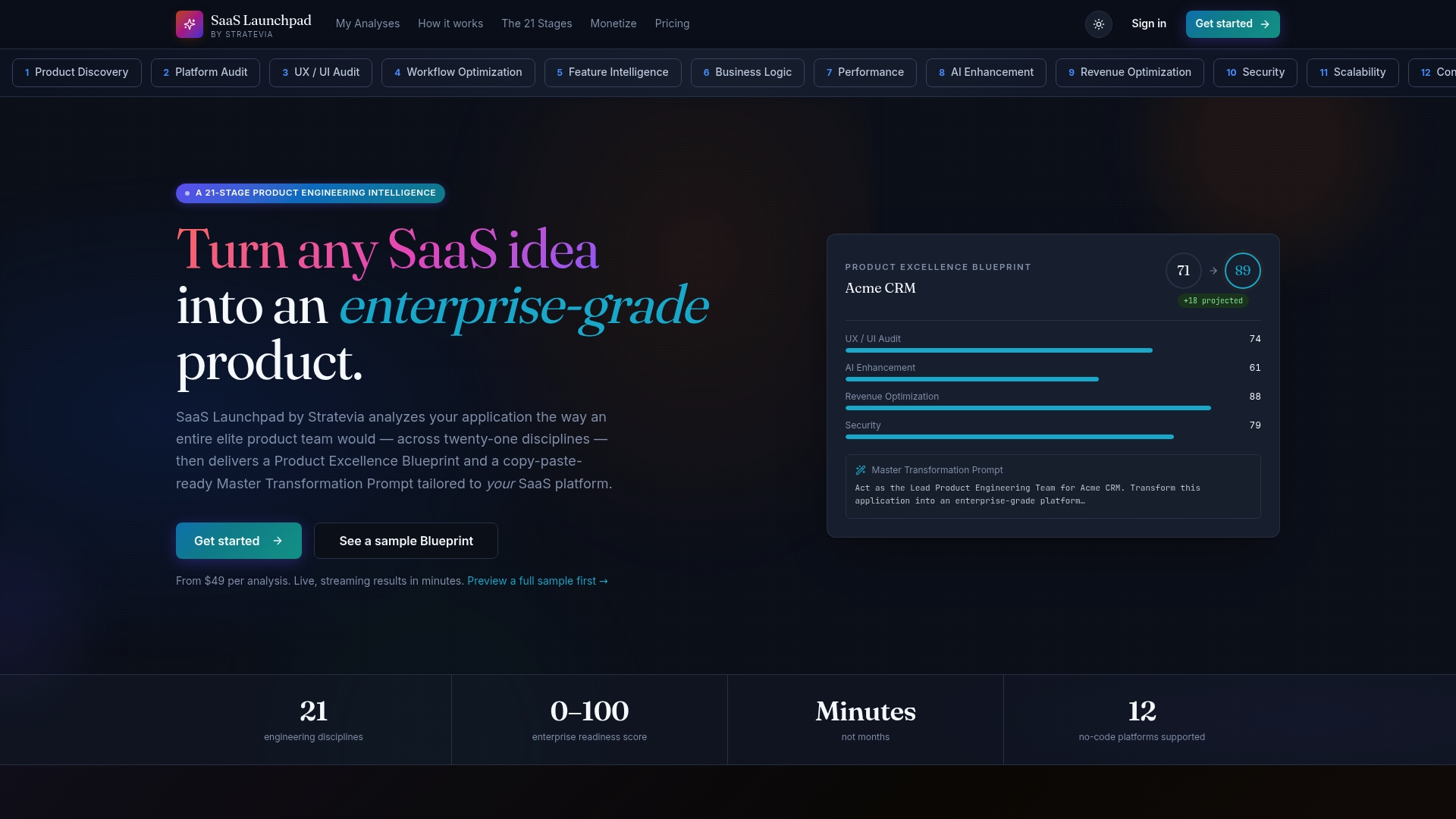
SaaS LaunchPad analyzes your application across 21 product engineering disciplines, including security architecture, compliance controls, access management, and governance frameworks. It delivers a Product Excellence Blueprint that maps exactly where your product stands against enterprise audit expectations, and a Master Transformation Prompt you can use immediately to close the gaps. Founders and product managers use it to get an honest, structured view of their audit readiness before an enterprise buyer asks the hard questions. If you are preparing for a SOC 2 audit or your first enterprise security questionnaire, SaaS LaunchPad gives you the full picture in one place.
FAQ
What is a SaaS audit checklist?
A SaaS audit checklist is a structured list of security, compliance, access, and governance controls that founders and product managers use to evaluate their application against enterprise buyer and regulatory requirements.
How often should you run a SaaS security audit?
Run a full internal audit at least annually, with quarterly reviews of access controls and vendor security. SOC 2 Type 2 requires continuous evidence collection across a 6–12 month observation period.
What is the difference between SOC 2 Type 1 and Type 2?
SOC 2 Type 1 is a point-in-time design review costing $20,000–$50,000. SOC 2 Type 2 covers an observation period of 6–12 months and costs $40,000–$150,000, with enterprise buyers almost always requiring Type 2.
What frameworks do enterprise buyers use in security questionnaires?
Enterprise buyers most commonly use CAIQ, SIG, and custom DDQs. Since 70% of DDQs borrow from CAIQ or SIG, preparing thorough answers to those two frameworks covers the majority of questions you will receive.
What evidence do auditors accept for SaaS compliance controls?
Auditors favor system-generated exports, log files, and ticketing system records over screenshots. Evidence must come from multiple points in time across the audit period, not a single snapshot collected before the audit begins.