Use a heuristic evaluation for fast, expert checks on a prototype or a tight deadline. Run a UX audit when you need evidence-backed, prioritized recommendations to justify a redesign, report to stakeholders, or fix a metric that's dropping. Both methods examine usability, but they answer different research questions, so the choice comes down to timeline, budget, and what decision the findings need to support.
TL;DR:
- Heuristic evaluation is suitable for quick, targeted assessments on prototypes or specific screens, typically completed within a few days.
- UX audits provide comprehensive, evidence-backed insights by combining analytics, user testing, accessibility checks, and benchmarking, often taking one to four weeks.
- For decision-making, use heuristic evaluation to validate new features rapidly and audits to justify large redesign budgets or diagnose critical metric drops.
- Audit severity ratings are weighted against business metrics like drop-off or churn, unlike heuristic severity which relies solely on usability principles.
- Most teams should scope their evaluation method based on the specific decision, timeline, and product stage rather than habit, combining both approaches for optimal results.
Table of Contents
- Heuristic Evaluation vs UX Audit: What Each One Actually Covers
- What Heuristic Evaluation Is (and Where It Falls Short)
- UX Audit vs Heuristic Evaluation: A Side-by-Side Comparison
- Choosing the Right Method: A Decision Framework for UX Teams
- From Findings to Fixes: A Practical Audit Workflow
- How Publisher Playbooks Turn Audit Standards Into Action
- What Most Teams Get Backwards About Choosing a Method
- Getting a Full Audit Done Without Building a Research Team
- Sources
- FAQ
Heuristic Evaluation vs UX Audit: What Each One Actually Covers
A UX audit is a structured, evidence-backed review that layers heuristic analysis on top of real behavioral data: analytics, session replays, accessibility scans, and often moderated usability testing. It doesn't rely on one reviewer's opinion. It triangulates a problem across multiple data sources before recommending a fix, which is why Idealogic's process breakdown treats heuristics as just one input among several rather than the whole exercise.
A typical audit covers:
- Funnel and analytics review — where users drop off, and whether the drop correlates with a specific screen or step.
- Task-flow audits — onboarding, checkout, pricing pages, and other high-stakes flows walked through step by step.
- Accessibility checks — contrast, keyboard navigation, screen reader compatibility against WCAG criteria.
- Content and visual review — copy clarity, visual hierarchy, and consistency across the product.
- Benchmarking — comparing your flows against category leaders or a scored standard.
The deliverable is rarely a simple bug list. Baymard's own audit framework for SaaS products scores products against 230 weighted UX performance parameters, producing a scorecard alongside prioritized, severity-rated recommendations. That level of depth takes time. A full audit on a mid-sized SaaS product typically runs somewhere between one and four weeks, depending on how many flows are in scope and whether primary user testing is included. It's not something you spin up the day before a board meeting, but it's exactly what you want in hand before that meeting happens.
What Heuristic Evaluation Is (and Where It Falls Short)
Heuristic evaluation is an expert-led inspection where one or more reviewers walk through an interface and flag violations of established usability principles, most commonly Jakob Nielsen's ten heuristics: visibility of system status, match between system and the real world, user control and freedom, consistency and standards, error prevention, recognition over recall, flexibility and efficiency of use, aesthetic and minimalist design, error recovery, and help documentation.
The process is deliberately lean:
- Two or more evaluators review the interface independently, so findings aren't colored by groupthink.
- Each reviewer logs violations against the heuristic set, usually with a screenshot and a short note.
- Findings get merged and cross-checked, then rated by severity, from cosmetic to catastrophic.
- Recommendations get drafted for each flagged issue.
The whole cycle can finish in a few days with two or three experienced reviewers, which is exactly why teams reach for it under deadline pressure. But it has a real ceiling. Heuristic evaluation is subjective by design. It runs on professional judgment and pattern recognition, not on how your actual users behave, which means it can miss audience-specific friction that only shows up when someone unfamiliar with the product tries to use it. An evaluator with SaaS pricing-page experience will catch different issues than one who's spent years on healthcare workflows. The method is only as sharp as the people running it.
UX Audit vs Heuristic Evaluation: A Side-by-Side Comparison
The two methods diverge on almost every axis that matters for planning research, and Baymard's own guidance on method selection makes a point worth repeating: teams often default to the method they already know how to run, not the one the question actually requires.
| Dimension | Heuristic evaluation | UX audit |
|---|---|---|
| Scope/depth | Targeted, usually a handful of screens or a single flow | Broad, often the full product or several revenue-critical flows |
| Evidence base | Expert judgment against a heuristic set | Analytics, session data, testing, plus heuristics |
| Timeline | Days | One to four weeks |
| Cost/effort | Low, minimal tooling required | Higher, needs data access and often user recruitment |
| Output type | Severity-rated issue list | Prioritized roadmap tied to business metrics |
| Best stage | Early design, prototypes, quick sanity checks | Pre-redesign, post-launch metric drops, investment decisions |
Three things follow from that table:
- If a stakeholder wants a quick sanity check on a new prototype before it ships to engineering, a heuristic pass answers that in a couple of days.
- If a stakeholder needs to justify a six-figure redesign budget, an issue list from two reviewers won't hold up in the room. That decision needs the evidence trail an audit produces.
- Severity scoring looks similar on the surface in both methods, but an audit's severity rating is usually weighted against a business metric (drop-off rate, support ticket volume, churn correlation), while a heuristic evaluation's severity is closer to a straightforward usability judgment: how bad is this, and how many users will hit it.
Practitioners describe the output gap bluntly: heuristics hand you a list with severity tags, audits hand you a roadmap tied to activation or retention numbers. Neither output is wrong, they're built for different rooms. A list gets a design team unstuck. A roadmap gets a VP to sign off on a quarter of engineering time.
Choosing the Right Method: A Decision Framework for UX Teams
Start with the question you're actually trying to answer, not the method your team happens to be comfortable running. Baymard's guidance on choosing research methods puts this plainly: heuristic evaluation and full audits answer different questions, and picking based on habit rather than fit is one of the more common planning mistakes UX teams make.
Ask these before scoping anything:
- What decision will this research support? A go/no-go on a prototype needs speed. A redesign budget needs evidence.
- What's the timeline? Under a week, heuristic evaluation is close to the only realistic option.
- Who needs to be convinced? Internal design team, or a CFO who wants numbers tied to revenue?
- Has a metric already moved? A drop in activation or a spike in churn calls for an audit that can trace the cause, not just flag surface issues.
- Is this pre-launch or post-launch? Pre-launch prototypes favor heuristics; live products with traffic favor audits, since there's real behavioral data to pull from.
Run a heuristic evaluation when you're reviewing a prototype, working against a tight sprint deadline, or doing a low-stakes sanity check before something ships. Run a UX audit when you're heading into a major redesign, a key metric has dropped and you need to know why, or you need benchmarked, stakeholder-ready evidence to secure budget.
Pro Tip: Don't treat this as an either/or decision for the whole product. Run a heuristic pass on new features as they ship, and reserve full audits for revenue-critical flows on a fixed cadence, maybe twice a year, or whenever a major metric shifts unexpectedly.
From Findings to Fixes: A Practical Audit Workflow
A credible audit report doesn't just list problems. It typically includes a scored benchmark comparison, somewhere in the range of 20 to 30 prioritized recommendations, and concrete implementation examples showing what the fix should look like, not just what's broken. Baymard's own SaaS and subscription audits produce a 120-page report with 30 prioritized suggestions benchmarked against category leaders, which gives a sense of the depth a full engagement can reach.
A workflow that turns findings into shipped fixes usually runs in this order:
- Heuristic pass first. A quick expert review flags the obvious violations before anyone touches analytics, saving the deeper audit from spending time on issues that don't need data to confirm.
- Layer in analytics and targeted testing. Session replays and a handful of moderated tests validate which heuristic flags are actually costing conversions versus which are cosmetic.
- Build the prioritized roadmap. Rank fixes by severity and by the business metric they touch, not just by how easy they are to implement.
- Convert findings into sprint-ready tickets. Each ticket carries the issue, the business impact, the recommended fix, and a way to validate the fix once shipped.
For SaaS products specifically, the highest return usually comes from auditing the revenue path first, onboarding, pricing, and activation, before spreading effort across every screen in the product. A pricing page with a confusing toggle costs more in lost revenue than a slightly cluttered settings menu ever will. Internal teams can usually run the heuristic pass themselves; the analytics and testing layer often benefits from an outside set of eyes, since internal teams tend to test the flows they built the way they intended them to be used, not the way a confused new user actually clicks through them. A practical guide to end-user testing covers how to structure that validation step so it doesn't just confirm what the team already believed.
How Publisher Playbooks Turn Audit Standards Into Action
Standards only matter if a team can actually apply them. Baymard's audit framework is one of the more rigorous public benchmarks in UX research, and its weight comes from breadth as much as rigor.
Assessing a SaaS product against 230 weighted performance parameters isn't a checklist exercise. It's a way of making sure a prioritized recommendation is grounded in a comparable standard across categories, not just one reviewer's opinion of what looks broken.
Gregory Cornelius's guide for product teams running their own UX audits translates that kind of standard into something a mid-sized team can run without a research department. SaaS Launchpad's own approach mirrors the logic: instead of a generic pass over the whole interface, it maps audit effort to the disciplines that touch revenue directly, onboarding, pricing, and activation among them, so findings arrive already tied to a business outcome rather than sitting as an isolated design critique.
What Most Teams Get Backwards About Choosing a Method
Most usability debates treat heuristic evaluation and audits as competing camps, one fast and cheap, one slow and thorough, pick your side. That framing misses the actual failure mode I see repeated across product teams: they run a heuristic evaluation, get a list of issues, and then try to use that list to justify a redesign budget it was never built to support. The mismatch isn't the method, it's asking a fast diagnostic to do a slow diagnostic's job.
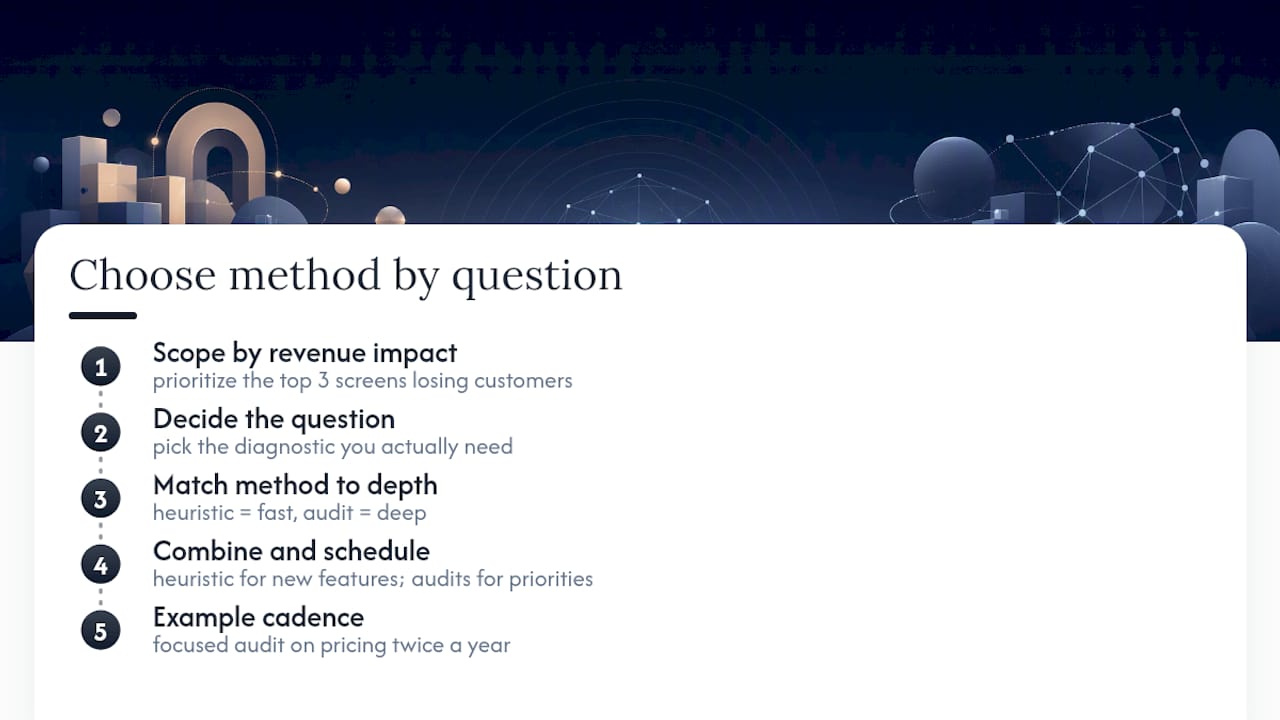
The conventional advice to "just audit everything before a redesign" is its own kind of waste. Auditing a settings page nobody visits burns budget that should go toward the three screens actually losing you customers. The teams that get the most out of this work scope by revenue impact first, then let the timeline and the audience for the findings dictate which method, or which combination, actually fits. A heuristic pass on a new feature, followed by a focused audit on the pricing flow twice a year, will outperform either method run in isolation on the whole product.
Pick the method by the question you're answering, not by which one your team already knows how to run.
— Gregory Cornelius
Getting a Full Audit Done Without Building a Research Team
An alternative to hiring or assembling an internal audit team offers a full product analysis covering multiple disciplines such as UX and UI, workflow, and conversion, delivered as a Product Excellence Blueprint with a copy-paste-ready Master Transformation Prompt tailored to your platform.

This fits best for SaaS founders and product teams heading into a major redesign, prepping a stakeholder pitch, or needing a benchmarked, prioritized roadmap rather than a loose pile of usability notes. There's no subscription. You buy credits, run the full 21-discipline audit, and the credits never expire, so you can scope a small pass now and a deeper one later without losing what you already paid for. If you want to see what each stage of the engagement actually covers before committing, the breakdown of audit stages and deliverables walks through the full process. Start by checking your product against the full audit framework to see where your revenue path is actually losing users.
Sources
- UX-RAY progress 2026 — Baymard
- Heuristic evaluation — Interaction Design Foundation
- UX audit: process, checklist & tools — Idealogic
FAQ
What is a UX audit?
A UX audit is a structured, evidence-backed review of a product's usability that combines heuristic inspection with analytics, session data, and often user testing, producing severity-scored, prioritized recommendations tied to business outcomes.
What are the 10 heuristics for UX design?
Jakob Nielsen's ten heuristics are visibility of system status, match between system and the real world, user control and freedom, consistency and standards, error prevention, recognition rather than recall, flexibility and efficiency of use, aesthetic and minimalist design, helping users recognize and recover from errors, and help documentation.
What are the four types of heuristics commonly grouped in UX work?
There's no single standardized "four types" framework in UX practice; definitions vary by source, and most teams instead group Nielsen's ten heuristics by theme (visibility, consistency, error handling, and flexibility) rather than treating four categories as canonical.
Can you give an example of a heuristic evaluation?
A reviewer checking a SaaS sign-up flow might flag that the error message on an invalid password doesn't explain what's wrong, a violation of "error prevention" and "recognition rather than recall," and rate that finding as moderate to severe depending on how often users hit it.
Is a UX audit the same as a product audit?
No. A UX audit focuses specifically on usability, interaction design, and user flows, while a product audit typically covers a broader scope, including business logic, performance, security, and competitive positioning alongside the user experience layer.