JTBD tells you which outcome to pursue; user stories tell you how to slice that outcome into shippable work. Use Jobs to Be Done during discovery, when you're deciding what problem is worth solving. Switch to user stories once that outcome is chosen and you're breaking it into sprints. Running both without knowing which altitude you're operating at is how roadmaps drift and backlogs fill with tickets nobody can defend.
TL;DR:
- Conduct JTBD discovery when entering new markets, prioritizing jobs based on importance versus satisfaction to guide strategic resource allocation.
- Use validated job statements to create a hierarchy of job stories and derive sprint-ready user stories with clear acceptance criteria for incremental delivery.
- Ensure all user stories are traced back to actual customer interviews, linking them to specific validated jobs to prevent scope creep and misaligned work.
- Reserve JTBD work for quarterly strategic decisions and use user stories for routine sprint planning to maintain clarity and focus at each level.
- Implement structured audits to map existing backlog items to real customer jobs, enabling quick, evidence-based prioritization and efficient handoff from research to development.
Table of Contents
- What Is Jobs to Be Done (JTBD)?
- What Are User Stories?
- Key Differences Between JTBD and User Stories
- When to Use JTBD vs User Stories: A Decision Checklist
- The Job-to-Story Ladder: From JTBD to User Stories
- Job Story to User Story: Templates and SaaS Examples
- Implementation Pitfalls: Where Teams Go Wrong
- How a Structured Audit Turns JTBD Into a Prioritized Backlog
- One Thing to Do This Week
- Turn Validated Jobs Into a Sprint-Ready Backlog
- Further Reading and Primary Sources
- Sources
- FAQ
What Is Jobs to Be Done (JTBD)?
Jobs to Be Done starts from a simple idea popularized by Clayton Christensen and later sharpened by Tony Ulwick: customers don't buy products, they hire them to make progress on a specific job. A commuter doesn't want a playlist app. She wants to make a boring train ride feel shorter. That distinction changes what you build.

JTBD research typically produces a job statement, something like "When [situation], I want to [motivation], so I can [expected outcome]." Teams validate these statements through switch interviews, structured conversations that trace the moment a customer switched from one solution to another, and the four forces that drove it, push, pull, anxiety, and habit. That method surfaces switching behavior other research methods tend to miss, which is why it's considered close to the gold standard for deciding whether a job is even worth chasing.
The main JTBD outputs feed strategy, not sprints:
- Job statements that define the outcome customers are trying to achieve
- Job maps that break the job into sequential steps, from defining the need to confirming success
- Opportunity scores that rank jobs by importance versus current satisfaction
Product strategists or researchers usually own this work, and it happens on a quarterly or roadmap cadence, not every sprint. Microsoft's own research group treats JTBD as a framework for linking customer outcomes to product design decisions, which is the right scope for it: strategic input, not a backlog item.
What Are User Stories?
A user story is a small, testable slice of functionality written from the user's point of view. The canonical template, popularized in agile circles, reads: "As a [user role], I want [goal], so that [benefit]." A real example: "As a billing admin, I want to export invoices as CSV, so that I can reconcile them in our accounting software."
Stories exist to make backlog work concrete and estimable. Here's how they function inside a delivery team:
- They act as backlog units. Each story is small enough to fit inside one sprint, with a clear definition of done.
- They carry acceptance criteria. Conditions like "CSV includes invoice ID, date, and amount" turn a vague ask into something QA can actually verify.
- They feed velocity tracking. Story points estimate relative effort, and completed points per sprint become a planning input.
- They get refined continuously. Product owners and engineers rewrite and split stories during backlog refinement, often the same story evolves across several sprints before it ships.
Product owners and engineering leads typically write and refine stories, and they do it every sprint cycle, not once a quarter. That refinement cadence is the biggest practical difference from JTBD work, which happens in bursts around discovery, not continuously.
Key Differences Between JTBD and User Stories
The cleanest way to separate these two tools is altitude. JTBD lives at the strategy layer, answering "what outcome matters?" User stories live at the delivery layer, answering "what do we build this sprint?" Confusing the two is how teams end up writing job statements that read like tickets, or tickets that try to justify an entire product direction.
Practitioners increasingly frame the comparison as a false debate rather than a rivalry, since the two formats solve different problems and were never meant to compete.
- Altitude: JTBD operates at the strategic level (what to pursue); user stories operate at the tactical level (what to ship next).
- Lifespan: A validated job statement can stay relevant for years, since customer motivations shift slowly. A user story is disposable, it's marked done and archived once shipped.
- Assumptions encoded: JTBD surfaces assumptions about customer motivation and context. User stories encode assumptions about implementation and scope, which is why they need acceptance criteria and the job stories often skip that step entirely.
- Ownership: Research or strategy leads typically own JTBD artifacts. Product owners and delivery teams own the story backlog.
- Stakeholder expectations: Executives read job maps to approve direction. Engineers read stories to estimate and build.
Mixing these up creates a specific failure mode: a story with no traceable job behind it, built because it seemed reasonable in a planning meeting rather than because a customer asked for it.
When to Use JTBD vs User Stories: A Decision Checklist
Before writing anything, ask one question: are we choosing an outcome, or slicing work we've already chosen? That single check resolves most format confusion.
- Are we entering a new market or segment? Run JTBD discovery. You need to understand what job customers are hiring a solution for before you design anything.
- Are we deciding what to build next quarter across a portfolio of features? Use JTBD opportunity scoring to rank jobs by importance versus satisfaction, then commit resources to the highest-scoring gaps.
- Are we trying to understand why customers switched to or from a competitor? Run switch interviews. This is JTBD's strongest use case and one user stories can't replicate.
- Are we planning the next two sprints? Write user stories. The outcome is already decided; now it's about scope and sequencing.
- Is this a bug fix or a regulatory deadline? Skip JTBD entirely and go straight to a story with acceptance criteria. Nobody needs a job map to fix a broken checkout button.
Airfocus and other product-practice guides land on the same sequencing advice: JTBD for research and prioritization, user stories for sprint-level execution. The order matters more than the tools themselves.
The Job-to-Story Ladder: From JTBD to User Stories
Every user story worth building should trace back to a validated job. The ladder that connects them has three rungs, and skipping one is where most teams lose the thread.
Layer 1: The job. The core statement of customer progress, validated through interviews, not assumed in a workshop.
Layer 2: The job story. A situational bridge that adds context: "When [situation], I want to [motivation], so I can [outcome]." This format, borrowed from JTBD practice, keeps the customer's circumstances attached to the need instead of collapsing straight into a feature request.
Layer 3: The user story. The delivery-ready slice, written against the job story, with acceptance criteria a developer can build against.
The step sequence in practice:
- Run switch interviews to surface real jobs
- Draft job statements from the interview data, never from a whiteboard guess
- Convert validated jobs into job stories that preserve situational context
- Decompose each job story into two or three user stories, each shippable within a sprint
During backlog refinement, run a traceability check: pick any story in the sprint and ask whether it links upward to a job story and, from there, to a validated job statement. If it doesn't, the story either needs a source or needs cutting.
Pro Tip: Keep a simple traceability tag, even just a job ID pasted into the story description, so anyone reviewing the backlog six months later can see exactly which customer need justified the work.
Job Story to User Story: Templates and SaaS Examples
Here's how the ladder looks with real SaaS scenarios, from job story down to a shippable ticket.
-
Job story: "When my team misses a renewal deadline, I want to be warned automatically, so I can save the account before it churns." Derived user stories: "As an account manager, I want a dashboard alert 30 days before renewal, so that I can start outreach early" (acceptance criteria: alert fires at day 30, 14, and 3; visible on dashboard home). A second story handles the email digest version of the same alert.
-
Job story: "When I onboard a new hire, I want them productive within a day, so I can avoid slowing down my team." Derived user stories: "As an admin, I want a guided setup checklist for new users, so that onboarding takes under 60 minutes" (acceptance criteria: checklist has five steps max, completion tracked in analytics).
Measure outcome improvement about four to six weeks after shipping, long enough to see real usage patterns, not just initial curiosity clicks.
Implementation Pitfalls: Where Teams Go Wrong
The most common mistake is inventing job stories in a conference room instead of pulling them from actual customer interviews. A job story built on a guess isn't research, it's a hypothesis wearing a research costume, and it tends to fall apart the first time someone asks for the interview transcript backing it up.
- Mistake: Writing job stories from internal opinion. Fix: Source every job story from a documented interview, even a rough one.
- Mistake: Treating user stories as disposable with no upward link. Fix: Require a job ID or job story reference on every story before it enters the sprint.
- Mistake: Running JTBD discovery every sprint. Fix: Reserve JTBD for quarterly or roadmap-level decisions; let stories handle weekly cadence.
- Mistake: No one owns the job map after research wraps. Fix: Assign a single owner, usually a product lead, responsible for updating job priority as the market shifts.
Pro Tip: After shipping a batch of stories tied to one job, track the specific behavior the job statement predicted, not just feature adoption. If the job was about reducing time-to-resolution, measure resolution time, not click-through rate.
How a Structured Audit Turns JTBD Into a Prioritized Backlog
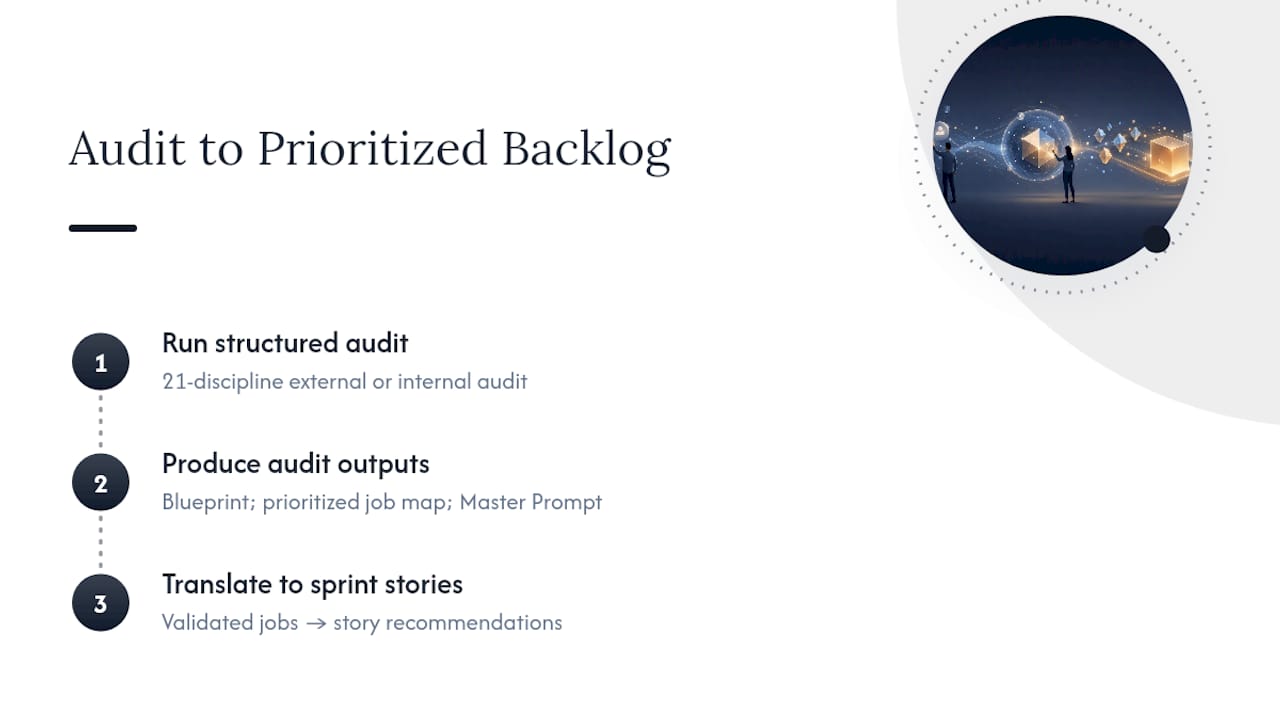
Running switch interviews, building job maps, and translating validated jobs into sprint-ready stories takes real discipline, and most internal teams do it inconsistently between roadmap cycles. A structured 21-discipline product audit forces that discipline by producing a Product Excellence Blueprint, a prioritized job map, and a Master Transformation Prompt that ties directly to specific stories.
Bringing in an external audit makes sense when internal discovery has stalled or when leadership needs an outside, evidence-based case for what to build next. The output is traceable: validated job statements paired with story recommendations a team can drop straight into its backlog.
One Thing to Do This Week
Pick one epic sitting in your backlog right now, one that's been vaguely justified as "customers want this." Map it to a single, specific job statement. If you can't write that statement from actual interview notes, that's your answer: the epic isn't ready. If you can, derive three user stories from it with acceptance criteria attached. That's the whole exercise. Teams that run this check regularly, rather than as a one-time cleanup, tend to catch scope creep before it costs a sprint. A structured audit like the 21-discipline product engineering process applies this same traceability logic across an entire platform, which is a useful reference point even if you're doing the exercise by hand.
— Gregory Cornelius
Turn Validated Jobs Into a Sprint-Ready Backlog
Most teams have JTBD interviews sitting in a folder somewhere and a backlog full of stories nobody can trace back to them. SaaS LaunchPad closes that gap directly: instead of guessing which epics matter, you get a Product Excellence Blueprint that maps validated job statements to prioritized stories, plus a Master Transformation Prompt built for your specific platform, so the handoff from research to sprint planning takes hours, not weeks of internal alignment meetings.
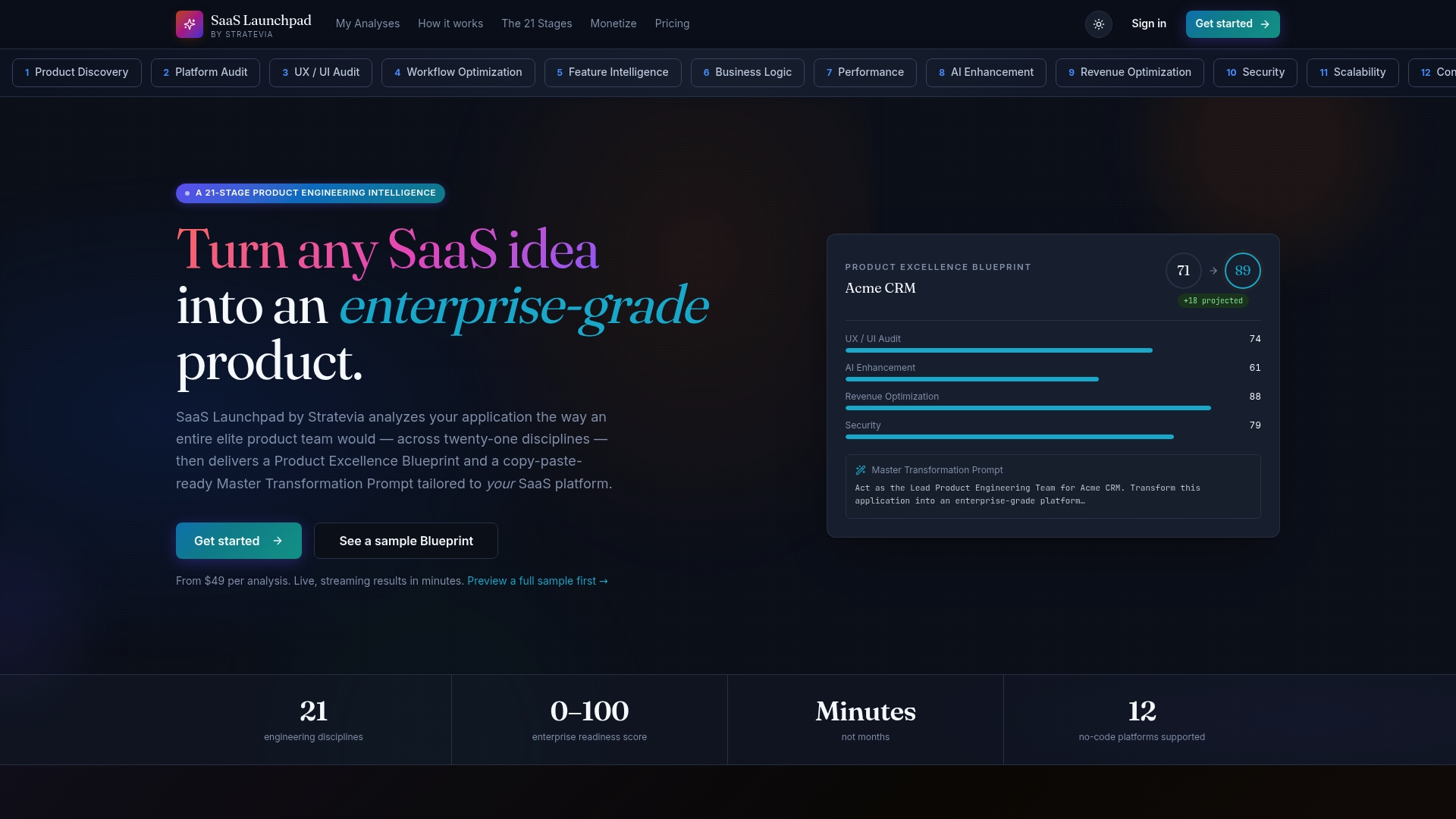
The audit covers all 21 disciplines, from product discovery through enterprise readiness scoring, so the job-to-story mapping comes with acceptance-criteria guidance and measurable outcome targets attached, not just a list of feature ideas. Founders and product teams who run the full product engineering audit get a roadmap they can hand straight to engineering. If your backlog is full of stories nobody can justify, start there and see what maps back to a real job and what doesn't.
Further Reading and Primary Sources
- Harvard Business Review: JTBD purpose and switch-interview method
- Microsoft Research: JTBD applied to product design
- IIBA: job stories and design thinking
- FrameworkList: the job-to-story ladder
Sources
- Know Your Customers’ “Jobs to Be Done” — Harvard Business Review
- Jobs-to-be-done: A useful framework for driving customer value — Microsoft Research
- Jobs-to-be-Done vs User Stories: Which to Use When — FrameworkList
- Where JTBD meets design thinking — IIBA
FAQ
What are the key differences between user stories and JTBD?
JTBD defines the customer outcome worth pursuing and lives at the strategy level, while user stories break that outcome into small, shippable increments for a sprint. JTBD artifacts last for years; user stories are archived once shipped.
What are the three C's of user stories?
The three C's are Card, Conversation, and Confirmation, referring to the story written on a card, the discussion it sparks between the team, and the acceptance criteria that confirm it's done.
What does JTBD mean in business?
JTBD, or Jobs to Be Done, means understanding the underlying progress a customer is trying to make, rather than the product features they ask for, and using that insight to guide product design decisions.
What is a job story in SaaS product work?
A job story is a situational bridge between a validated job and a user story, formatted as "When [situation], I want to [motivation], so I can [outcome]," and it should always be sourced from real customer interviews rather than invented internally.
How do I know if I should run JTBD or write a user story?
Ask whether you're choosing an outcome or slicing work you've already chosen. Choosing an outcome calls for JTBD discovery; slicing chosen work calls for a user story with acceptance criteria.