A product teardown is a systematic breakdown of a live product into its working parts (onboarding, monetization, business logic, growth loops) to extract lessons you can reuse. It differs from a review, which judges quality, and from an audit, which checks compliance against a standard. A teardown reverse-engineers why something was built the way it was.
You can start one in the next hour. Pick a single product and a narrow goal. Record your first 60 seconds using it, uninterrupted. Then capture three quick pieces of evidence: one screenshot of friction, one metric or claim you can verify, and one quote or reaction from a real user if you can find one.
- Select scope: one flow, one competitor, one moment
- Record: your unfiltered first 60 seconds
- Capture: three evidence points before you form any opinion
Do this consistently and you get sharper product sense, a portfolio piece, and at least one experiment worth pitching.
Key Takeaways
A product teardown works when it anchors on a real user moment, ties every recommendation to a measurable experiment, and matches its depth to a stated goal.
| Point | Details |
|---|---|
| Define the scope first | Pick feature-level, workflow-level, design-level, or hardware scope before you start recording. |
| Anchor in a moment | Capture your unfiltered first 60 seconds before checking metrics or reviews. |
| Rank by impact and effort | Prioritize recommendations that pair high impact with low implementation cost. |
| Use a consistent toolkit | Figma, Notion, Miro, dev tools, and LogRocket cover nearly every evidence-gathering need. |
| Scale up with SaaS LaunchPad | For a full 21-discipline audit and a ready-to-use transformation prompt, run an on-demand analysis through SaaS LaunchPad. |
Table of Contents
- What Counts as a Product Teardown?
- Why Run a Teardown, and When?
- The Step-by-Step Teardown Playbook
- Which Tools Speed Up Evidence Collection?
- A Worked Example: Tearing Down a Trial Signup Flow
- The 21-Discipline Advanced Checklist
- How Do You Present a Teardown to Stakeholders?
- Common Mistakes and Practical Tips
- Turn a DIY Teardown Into a Full Product Audit
- Sources
- FAQ
What Counts as a Product Teardown?
Teardowns come in four common scopes: feature-level (one flow, like checkout), workflow-level (a multi-step journey, like trial to paid), design-level (visual and interaction patterns), and physical disassembly for hardware products.
A teardown overlaps with a UX audit but goes further. Bloomberg tears apart usability and asks how the business model, growth loop, and technical constraints shaped what you're looking at. A product review just tells you if something is good. A teardown tells you why it works or doesn't, then how you'd fix it.
- Shallow (1 hour): one moment, one journey, quick recommendations
- Deep (2 to 5 days): full funnel, competitive set, technical inspection, stakeholder-ready report
Pick shallow for interview prep or quick competitive scans. Go deep when the output feeds a real roadmap decision.
Why Run a Teardown, and When?
The objective you pick determines everything else. Practitioners agree that goal-oriented teardowns drive different depth, different artifacts, and different structure than a generic "let's look at this app" exercise.
- Competitive benchmarking: produces a scorecard you can revisit quarterly
- Onboarding improvements: produces a prioritized list of activation blockers
- Portfolio case studies: produces a polished slide deck or write-up for hiring managers
- Interview prep: produces talking points that show structured thinking, fast
- Roadmap discovery: produces experiment candidates ranked by expected impact
Doing this repeatedly is what actually builds product judgment over time, not any single teardown on its own.
| Goal | What you walk away with |
|---|---|
| Benchmarking | A comparison scorecard across 3 to 5 competitors |
| Onboarding audit | A ranked list of drop-off points with proposed fixes |
| Portfolio piece | A shareable report with before/after mockups |
| Interview prep | 2 to 3 minutes of structured, defensible commentary |
The Step-by-Step Teardown Playbook
Run these seven steps in order. Skipping straight to "list the features" is the single fastest way to produce a shallow, forgettable teardown.
- Select the product and lock a single goal. Write the goal in one sentence before you open the app.
- Map the first 60 seconds. Anchor the entire analysis in a real user moment rather than a feature list. What did you feel confused about? What made you trust or distrust it?
- Walk the core user journey. Follow one path end to end (signup to first value, or browse to purchase) and note every screen, decision point, and dead end.
- Inspect growth and monetization mechanics. Where does the product nudge you to upgrade, invite others, or come back tomorrow? Note pricing tiers, paywalls, and referral loops.
- Check technical and implementation signals. Load times, error states, API calls in dev tools, and how gracefully the product degrades under bad input.
- Map the business model. Who pays, who doesn't, and how does that shape which users get the best experience?
- Synthesize recommendations. Convert observations into three to five ranked suggestions, each tied to a metric.
For each step, capture concrete evidence, not impressions:
- Screenshots of the exact screen you're critiquing, timestamped
- DOM notes from browser dev tools (element states, hidden fields, API responses)
- Metrics you can find publicly (app store ratings, review counts, pricing pages)
- Direct user quotes from reviews, forums, or your own test session
- A note on what required special access or a paid account to observe
Rank your final recommendations using a simple impact times effort matrix: high impact, low effort items go first, always. Every recommendation should map to a validation metric and a minimal experiment that could confirm or kill it before a team invests real engineering time.
Pro Tip: Write your first-60-seconds notes before you touch analytics or reviews. If you read other people's opinions first, you'll unconsciously repeat them instead of forming your own read on the product.
Which Tools Speed Up Evidence Collection?
A thorough teardown layers functionality, usability, technical implementation, and business alignment, and a handful of tools cover nearly all of it.
- Figma: recreate flows, annotate friction points, redline proposed fixes directly on screenshots
- Notion: house the full teardown as a living document, sections for each playbook step
- Miro: map journeys and flowcharts when a linear document can't capture branching paths
- Browser developer tools (Inspect Element): check load times, hidden form fields, API payloads, and accessibility markup
- LogRocket: review session replays and heatmaps when you have access to a product's own instrumentation, or reference public case studies to understand what signals matter
For artifacts, aim for a repeatable skeleton: annotated screenshots, a redrawn flow diagram, three or four micro-metrics (time to first value, click depth, error rate), and at least one experiment proposal per major finding.
Pro Tip: Build one Notion template once, with headers for each playbook step, and reuse it for every teardown. Consistency across teardowns is what makes your portfolio look like a body of work instead of scattered notes.

A Worked Example: Tearing Down a Trial Signup Flow
Picture a project management tool with a free trial. The first 60 seconds: a five-field signup form, no social login, and a redirect straight into an empty workspace with zero guidance.
- Moment captured: confusion in the empty workspace, no clear first action
- Journey mapped: signup to empty dashboard to a small "create your first project" button buried in the corner
- Recommendation: replace the empty state with a pre-filled sample project and a single, obvious next action
- Experiment: A/B test the sample project against the current empty state, track activation rate within 24 hours
- Artifacts produced: one annotated Figma mockup of the proposed empty state, a one-page Notion report, a five-slide summary
- Time spent: roughly 90 minutes for this shallow pass
That single fix, tied to one metric, is a stronger deliverable than ten pages describing every button on the screen.
The 21-Discipline Advanced Checklist
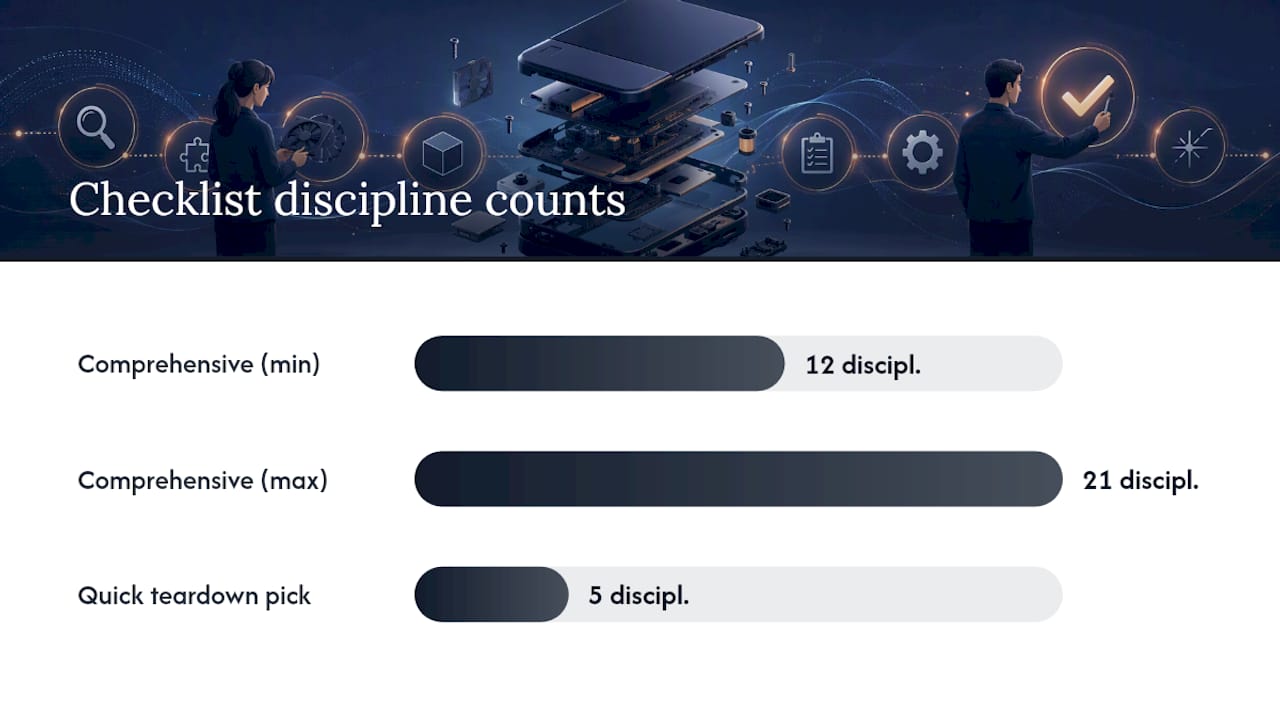
Once you've run a handful of shallow teardowns, scale up with a broader checklist. A comprehensive teardown can span 12 to 21 disciplines, from UX and workflow to revenue mechanics and competitive intelligence. Score each discipline 0 to 5 based on how strong the evidence and execution appear:
- Product discovery and problem framing
- Platform architecture
- UX and UI consistency
- Workflow efficiency
- Feature completeness
- Business logic correctness
- Performance under load
- AI or automation usage
- Revenue mechanics
- Security posture
- Scalability signals
- Conversion flow design
- Customer journey mapping
- Quality assurance evidence
- Competitive positioning
- Enterprise readiness
- Onboarding activation
- Retention mechanics
- Pricing structure
- Support and documentation
- Roadmap prioritization clarity
Add up scores by category, then flag anything under 2 as a priority recommendation. Map each low score to one experiment: a security gap points to a penetration test proposal, a weak onboarding score points to an activation A/B test.
Pro Tip: Don't score all 21 on a one-hour teardown. Pick the five most relevant to your goal and note the rest as "out of scope" so stakeholders know what you deliberately skipped.
How Do You Present a Teardown to Stakeholders?
Structure your slides around a thesis, not a feature tour: one-line takeaway, product context, three or four journey slices, strengths, weaknesses, ranked recommendations, an experiment plan, and expected metrics.
- Anonymize sensitive data before sharing publicly (blur user names, obscure real revenue figures)
- Show evidence, not adjectives: a screenshot beats "the onboarding feels clunky"
- Lead with impact for executives, lead with technical detail for engineers, lead with process for hiring managers reviewing your portfolio
A ten-slide deck with one clear recommendation outperforms a forty-page report nobody finishes reading.
Common Mistakes and Practical Tips
The most frequent failure is feature-listing: describing every button instead of judging whether the product achieves its goal. Confirmation bias is close behind, where you go looking for flaws in a competitor you already dislike. A close third is overweighting visual polish while ignoring whether onboarding actually activates users or just looks clean.
- Anchor every teardown in a real user moment before touching metrics
- Test your activation assumptions instead of trusting the marketing copy
- Log dependencies that fail silently, like a manual approval step nobody mentions
For hardware teardowns, document assembly order, adhesives, and battery access before you disassemble anything, since these failure points define the safety and repairability record for the whole write-up. Respect terms of service, never disclose confidential data without permission, and stop disassembly if you hit a battery cell or capacitor you can't safely discharge.
A Personal Note on Teardown Discipline
Frequent teardowns build product taste faster than any course. I trust a repeatable framework over a gut impression, because impressions fade and frameworks compound.
Turn a DIY Teardown Into a Full Product Audit
Running your own teardown builds judgment. Running twenty-one of them across every discipline, in one pass, is a different job. SaaS LaunchPad exists for exactly that gap: it analyzes your live SaaS platform the way a full product team would, across all 21 disciplines from UX to revenue mechanics, then hands you a Product Excellence Blueprint you didn't have to assemble yourself.

You get three things a manual teardown rarely produces on your own: a scored audit across every discipline instead of the five you had time for, a prioritized roadmap ranked by impact instead of a gut-feel list, and a copy-paste-ready Master Transformation Prompt built for your specific platform. Check the 21-discipline breakdown to see how the analysis maps to the checklist above, or visit SaaS LaunchPad to purchase a credit and run your first full audit.
Sources
- How To Do Product Teardowns Without Feeling Like An Imposter | Medium
- What is a product teardown? | Hellopm
- Product teardown process, tools, and other insights | LogRocket Blog
- Galaxy Z Fold8 Teardown: Samsung’s Best Foldable Still Has a Hinge Problem | iFixit
FAQ
Can you provide an example of a product teardown?
A short example: tearing down a trial signup flow, spotting an empty onboarding state, and proposing a pre-filled sample project tested against the current design, with activation rate as the success metric.
What is a teardown?
A teardown is a structured breakdown of a product's components, whether digital screens or physical hardware, aimed at understanding why it works the way it does and extracting reusable lessons.
What are the 7 stages of product management?
Common frameworks include discovery, definition, design, development, testing, launch, and iteration, though exact naming varies by team and methodology.
What are the 7 steps of product launch?
A typical sequence covers market research, positioning, beta testing, go-to-market planning, internal readiness, public launch, and post-launch measurement, adapted to fit the product and company size.