TL;DR:
- SaaS product management focuses on retention metrics that determine business growth or decline. Building a prioritized roadmap around Net Revenue Retention and conducting thorough discovery help prevent costly rework and accelerate growth. Emphasizing retention and expansion activities yields more sustainable success than solely chasing new customer acquisition.
SaaS product management is the discipline that owns the why and what of a subscription product, measured primarily by retention metrics. Your job as a SaaS PM is not to ship features. It is to move the numbers that determine whether your business compounds or decays.
Start your audit here:
- Activation: What percentage of new users reach your product's core value moment within the first session or week?
- Retention: Are cohorts flattening or continuing to drop after month three?
- Expansion: Is your Net Revenue Retention (NRR) above 100%? Top-performing SaaS companies achieve NRR in the 120–130% range.
NRR above 100% means your existing customer base grows revenue without a single new sale. That is the primary signal of product-market fit for a subscription business, and it is the number your roadmap should be built around.
Table of Contents
- What SaaS product management means for your role
- How the SaaS product life cycle actually unfolds
- Metrics every SaaS PM must track
- How to build a SaaS product strategy that actually holds
- How your team should be structured and what tools to standardize
- Common SaaS product management pitfalls and how to fix them
- How SaaS LaunchPad's Product Excellence Blueprint maps to this playbook
- How to segment your SaaS users and build personas that drive decisions
- How to manage stakeholders without losing your roadmap
- Key Takeaways
- The metric most product leaders are optimizing for the wrong reasons
- What a 21-discipline product analysis gives you that internal audits miss
- Useful sources
- FAQ
What SaaS product management means for your role
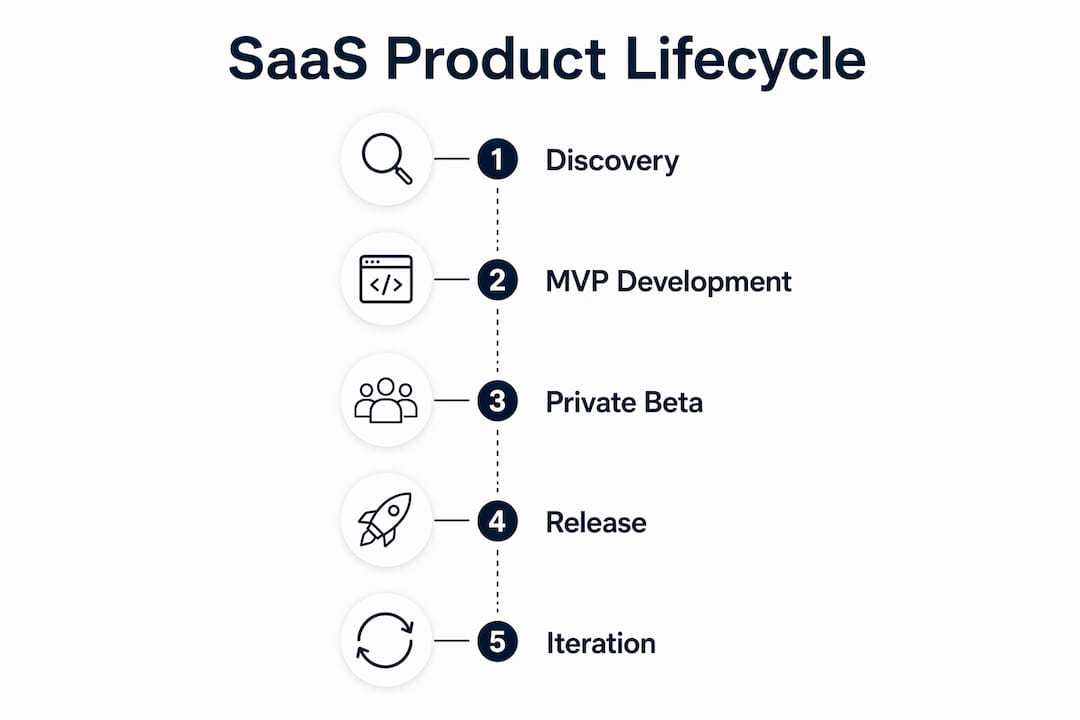
SaaS product management covers discovery, roadmap decisions, release, adoption, and continuous iteration, with faster cycles than traditional software. The PM owns outcomes. The project manager owns delivery mechanics.
What you own: the product vision, success metrics (activation, retention, expansion), stakeholder trade-offs, and roadmap sequencing. What you delegate: sprint execution, ticket tracking, and release coordination.
Where PMs should insert themselves: sales calls (to hear objections before they become churn), customer success reviews (to catch retention signals early), engineering planning (to protect scope), and analytics reviews (to catch metric regressions before they compound). The SaaS PM's handbook is clear that strategic planning and product health measurement belong to the PM, not the delivery team.

Pro Tip: Allocate a significant portion of your roadmap capacity to retention and expansion work. Acquisition fills the top of the funnel; retention determines whether the bucket holds water. Subscription products must re-earn customer trust every billing cycle, and retention-centric decision-making is what separates compounding SaaS businesses from ones that churn their way to stagnation.
How the SaaS product life cycle actually unfolds
Discovery is the highest-leverage stage and the most commonly skipped. Skipping it increases rework and inflates development costs downstream.
Discovery (2–4 weeks): Interview real users. Produce jobs-to-be-done (JTBD) maps, two or three user personas, and an outcome hypothesis. The artifact that matters most is a prioritized feature matrix: must-have for MVP, V1.1 candidates, and explicit backlog.
MVP development (8–16 weeks): A focused MVP typically ships in a few months. A full-featured growth-stage platform requires several additional months. Scope discipline is the single biggest driver of how fast you reach paying customers.
A well-scoped MVP includes:
- User registration, login, and password reset
- Subscription billing (monthly and annual plans)
- The one core feature that delivers the primary value proposition
- A minimum viable onboarding flow (three to five steps)
- Basic admin panel for your team
Defer integrations beyond the most critical one, advanced reporting, API access, and white-labeling to V1.1, informed by what real paying customers actually request.
Private beta (4–8 weeks): Track activation rate, Day 7 and Day 30 retention, and support ticket themes. These signals shape V1 before public launch.
| Stage | Duration | Key Output |
|---|---|---|
| Discovery | 2–4 weeks | JTBD map, personas, feature matrix |
| MVP development | 8–16 weeks | Live product with core value loop |
| Private beta | 4–8 weeks | Retention data, refined onboarding |
| Growth-stage release | Several additional months | Full feature set, instrumented analytics |
Pro Tip: When scoping integrations and API work, estimate the full project scope before committing. A software integration scope estimate done upfront prevents the most common mid-sprint budget overruns.
Metrics every SaaS PM must track
| Metric | What it measures | Benchmark signal |
|---|---|---|
| NRR | Revenue retained and expanded from existing customers | 120–130% range for top performers |
| Gross churn | Customers or revenue lost in a period | a low churn rate typical for mature SaaS |
| MRR/ARR | Monthly and annual recurring revenue | Tracks growth trajectory |
| Activation rate | Users reaching core value moment | Varies; track cohort over cohort |
| LTV:CAC | Customer lifetime value vs. acquisition cost | a healthy range |
| ARPU | Average revenue per user | Tracks expansion effectiveness |
NRR is the primary indicator. When NRR drops below 100%, your existing base is shrinking regardless of new sales. Use cohort analysis to detect regressions early: segment by acquisition month, plan tier, and customer segment, then watch retention curves for inflection points.
Measurement checklist: instrument every key action in your product (not just page views), set alert thresholds on weekly active user counts and activation rates, and build a dashboard that surfaces churn risk signals before the billing cycle closes.
When NRR drops, prioritize retention work. When activation is low, prioritize onboarding. When LTV:CAC is below 3:1, examine pricing and expansion revenue before increasing acquisition spend.
How to build a SaaS product strategy that actually holds
Prioritization is where most roadmaps break down. The RICE framework (Reach, Impact, Confidence, Effort) and ICE scoring (Impact, Confidence, Ease) both work. The key is weighting: retention items with low reach but high LTV impact should score higher than acquisition features with broad reach but shallow impact on revenue.
Product-led growth (PLG) makes the product the primary vehicle for acquisition, activation, and retention. For PMs, PLG means embedding feedback loops directly into the product development lifecycle (PDLC): in-app surveys at the moment of value, usage-triggered prompts, and automated cohort alerts that surface disengagement before it becomes churn.
Experimentation cadence:
- Write a hypothesis with a measurable success metric and a guardrail metric.
- Define minimum detectable effect and required sample size before running.
- Set a fixed run duration; do not stop early on positive signals.
- Document results, including failed experiments, in a shared log.
- Roll out winning variants with a feature flag, not a full deploy.
Pro Tip: When scoring retention items in RICE or ICE, apply a multiplier to LTV impact rather than raw reach. A feature that saves your top 10% of accounts from churning is worth more than a feature that mildly improves activation for 80% of free users.
How your team should be structured and what tools to standardize
| Role | Core Responsibility |
|---|---|
| Product Manager | Roadmap, success metrics, stakeholder alignment |
| Engineering Lead | Technical architecture, sprint execution, release quality |
| UX Designer | User research synthesis, flow design, usability testing |
| Data/Analytics | Instrumentation, cohort analysis, experiment measurement |
| Customer Success | Retention signals, expansion plays, churn early warning |
| RevOps | LTV:CAC tracking, pricing analysis, revenue forecasting |
Standardize tooling across four categories: product analytics (for instrumentation and cohort analysis), feature flags (for controlled rollouts), CI/CD pipelines (for reliable releases), and issue tracking (for cross-functional visibility). Meeting rhythm matters: a weekly metrics review, a bi-weekly roadmap sync, and a monthly stakeholder update prevent the misalignment that kills execution speed.
Common SaaS product management pitfalls and how to fix them
- Rising churn with no clear cause: Root cause is usually poor onboarding or a gap between what marketing promises and what the product delivers. Immediate fix: map the activation flow and identify where users drop off in the first 72 hours.
- Falling activation rates: Often signals a scope creep problem. The product has added complexity without adding clarity. Fix: run a UX audit on the onboarding sequence and cut steps.
- Slow experiments: Usually a tooling or process gap. If you cannot ship a feature flag in under a day, your experimentation infrastructure needs work before your experiment backlog matters.
- Technical debt blocking releases: Pause feature work when debt is causing more than one unplanned incident per sprint. Allocate one sprint in four to debt reduction as a standing policy.
- API and integration failures: Integration scope is routinely underestimated. Define integration contracts (inputs, outputs, error handling) before development starts, not after.
Risk management for SaaS releases: use staged rollouts via feature flags, define rollback criteria before launch, and instrument the release with real-time error monitoring from day one.
How SaaS LaunchPad's Product Excellence Blueprint maps to this playbook
The 21-discipline Product Excellence analysis by SaaS LaunchPad covers every stage of the PM playbook above: product discovery, platform audit, UX/UI review, workflow optimization, feature evaluation, business logic verification, performance analysis, AI enhancement, revenue optimization, security, scalability, conversion, customer journey mapping, quality assurance, competitive intelligence, and enterprise readiness scoring.
The Master Transformation Prompt converts the analysis into copy-pasteable implementation steps tailored to major no-code platforms, so your team can act on findings without a translation layer between strategy and execution.
Pro Tip: Use the Product Excellence Blueprint as your discovery artifact when entering a growth or scale stage. It replaces weeks of internal audit work with a structured, 21-point external view of your platform's actual state, not the state you believe it to be in.
How to segment your SaaS users and build personas that drive decisions
Customer segmentation for SaaS goes beyond firmographics. Segment by behavior: which users activate quickly, which expand to higher tiers, and which go silent after week two. Those three cohorts have different problems and need different product responses.
Build personas around jobs-to-be-done, not demographics. A "VP of Operations at a 200-person company" is not a persona. "A team lead who needs to close the books faster without adding headcount" is. The difference is that the second version tells you what the product must do, not just who uses it.
Revisit personas after every major cohort analysis. Segments shift as your product matures and your customer mix changes.
How to manage stakeholders without losing your roadmap
SaaS product management requires a specific communication discipline: translate every roadmap decision into a metric impact. "We are building X" is a feature announcement. "We are building X because activation is at 34% and our cohort data shows users who complete this step retain at 2x the rate" is a business case.
Stakeholder alignment breaks down when PMs present features instead of outcomes. Run a monthly roadmap review that shows current metric performance, the hypothesis behind each initiative, and the expected impact. This format forces stakeholders to engage with evidence rather than preferences.
For cross-functional handoffs, document the definition of done before development starts: what metric moves, by how much, measured how, and by when.
Key Takeaways
SaaS product management is fundamentally a retention discipline: the roadmap decisions that move NRR from below 100% to the 120–130% range of top performers determine whether a subscription business compounds or stalls.
| Point | Details |
|---|---|
| NRR is the primary signal | Top-performing SaaS companies hit NRR in the 120–130% range; build your roadmap around it. |
| Discovery prevents rework | Skipping discovery inflates development costs; produce JTBD maps and personas before writing a line of code. |
| MVP scope discipline | A focused MVP typically ships within a few months; defer integrations, API access, and advanced reporting to V1.1. |
| Retention outweighs acquisition | Allocate a significant portion of your roadmap capacity to retention and expansion work. |
| SaaS LaunchPad accelerates audits | The 21-discipline Product Excellence Blueprint delivers a prioritized roadmap and Master Transformation Prompt ready to execute on day one. |
The metric most product leaders are optimizing for the wrong reasons
Most SaaS product teams track NRR but optimize for MRR growth. The two are not the same objective, and conflating them is where roadmaps go wrong. MRR growth rewards acquisition. NRR rewards the product itself. A team that chases MRR will consistently underfund retention work, because retention improvements are slower to show up in the top-line number and harder to attribute to a single feature.
The more uncomfortable truth: a SaaS product with 115% NRR and flat new customer growth is a healthier business than one with 95% NRR and 30% new logo growth. The first compounds. The second is running on a leaky treadmill. Product leaders who understand this build roadmaps that look different from their peers, and they are usually right.
The 21-discipline analysis framework that SaaS LaunchPad uses is built around this logic. It does not start with "what features should we add." It starts with "where is value leaking, and what is the cost of that leak." That sequencing changes everything about what ends up on the roadmap.
What a 21-discipline product analysis gives you that internal audits miss
Running a product audit internally is like proofreading your own writing. You see what you intended, not what is actually there. SaaS LaunchPad analyzes your platform across 21 disciplines, from UX/UI and business logic to security, scalability, and enterprise readiness, and delivers a Product Excellence Blueprint with a prioritized improvement roadmap, phased execution plan, and a Master Transformation Prompt your team can act on immediately.
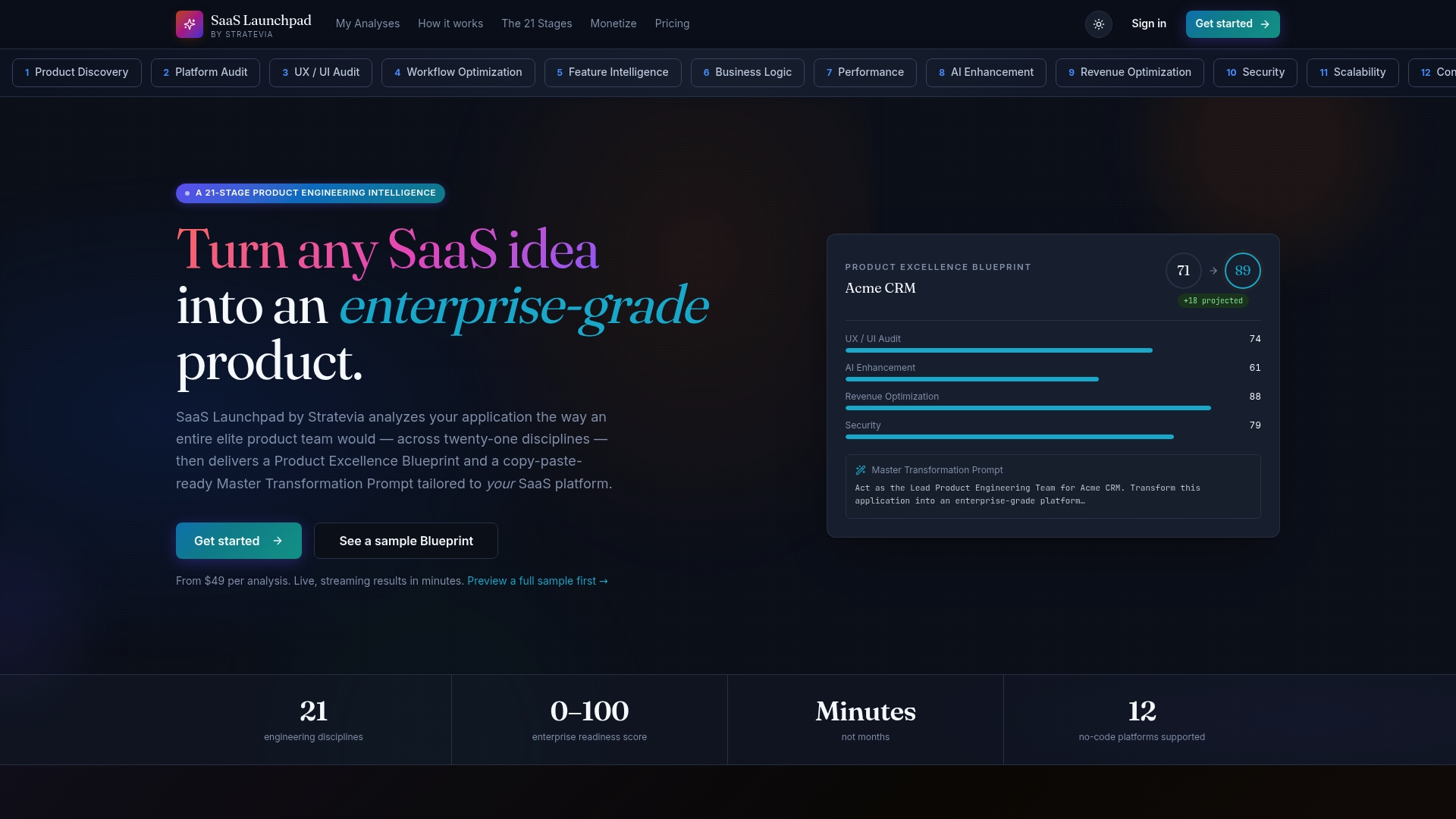
Platform owners at the growth or scale stage get the most from this analysis: you have real users, real churn signals, and real technical debt, but no structured view of which problems to fix first and in what order. The Blueprint answers that question across every discipline at once.
No subscription required. Credits never expire. Run your product analysis and receive your Product Excellence Blueprint, prioritized roadmap, and Master Transformation Prompt within your first session.
Useful sources
The sources below informed the benchmarks, frameworks, and timelines in this guide:
- Net Revenue Retention and SaaS valuation — m3ter. Primary benchmark source for NRR ranges (a strong range for top performers) and the role of NRR in SaaS valuation.
- SaaS product management overview — AnnounceKit. Grounding for the end-to-end PM role definition and lifecycle scope.
- SaaS PM handbook — Railsware. Frameworks for role distinction, lifecycle stages, and governance.
- PLG and SaaS product management — Usersnap. Opinion and experience piece on embedding feedback loops into the PDLC.
- Retention-centric SaaS PM playbook — IdeaPlan. Experience-based perspective on retention trade-offs and acquisition vs. retention prioritization.
- MVP and growth-stage timing — Zulbera. Benchmark timing for MVP vs. full-featured platform development.
- SaaS tools for product managers — SaaS LaunchPad blog. Internal reference for instrumentation and tooling categories.
- SaaS product development guide — Seven Solvers. Detailed phase-by-phase development process with MVP scope guidance.
Use the NRR benchmark and cohort analysis guidance as your internal audit baseline. For a structured external view, the SaaS LaunchPad product analysis covers all 21 disciplines in a single session.
FAQ
What is SaaS product management in one sentence?
SaaS product management is the discipline that owns the strategy, roadmap, and success metrics for a subscription software product, with retention and NRR as the primary measures of success.
How does SaaS product management differ from project management?
Product management owns outcomes and the roadmap; project management owns delivery mechanics, sprint execution, and release coordination. The PM defines what to build and why; the project manager ensures it ships on time.
What NRR should a SaaS product target?
Top-performing SaaS companies hit NRR in the 120–130% range. NRR above 100% means existing customers are expanding revenue faster than others churn.
How long does a focused SaaS MVP take to build?
MVP development typically runs 8–16 weeks for the core build, with discovery, design, and beta adding several additional weeks before public launch.
What does SaaS LaunchPad's Product Excellence Blueprint deliver?
The Blueprint covers 21 disciplines and delivers a prioritized improvement roadmap, phased execution plan, before/after impact projection, and a copy-paste-ready Master Transformation Prompt tailored to your platform.