Qualitative feedback analysis is the process of turning open-ended customer comments, interview transcripts, and support tickets into coded themes you can act on. The best approach for most teams is a phased workflow: prepare and clean the data, code it against a living codebook, group codes into validated themes, then link those themes to metrics like NPS before writing recommendations. Done right, it tells you not just what customers said, but which of it actually moves your numbers.
TL;DR:
- Most teams should implement a structured five-phase workflow to ensure qualitative feedback analysis is reproducible and actionable.
- Combining inductive, deductive, or hybrid coding approaches with regular reliability checks helps maintain theme consistency and accuracy.
- Automated AI analysis scales well for theme detection and trend spotting but requires human validation to manage shifts in language and complex sentiment nuances.
- Driver analysis identifies which themes most strongly correlate with NPS or CSAT changes, guiding prioritization beyond simply addressing the most frequent complaints.
- External audits can deliver a prioritized, buildable product roadmap by linking customer feedback themes directly to business impact and structural platform insights.
Table of Contents
- What Is Qualitative Feedback Analysis and Why Does It Matter?
- Where Qualitative Feedback Comes From and How to Collect It Well
- How Do You Systematically Analyze Qualitative Feedback?
- Inductive, Deductive, or Hybrid: Which Coding Approach Fits?
- What Can AI Actually Do at Scale, and Where Does It Fail?
- How Do You Link Themes to NPS and CSAT Movement?
- How Do You Turn Themes Into a Report Product and Ops Teams Will Actually Use?
- How Do You Keep the Analysis Defensible and Ethical?
- How SaaS LaunchPad Puts Qualitative Analysis Into a Product Audit
- The Gap Between Coding Feedback and Acting on It
- Get a Structured Audit Instead of Doing This Analysis Alone
- Sources
- FAQ
What Is Qualitative Feedback Analysis and Why Does It Matter?
Qualitative feedback is any customer response captured in someone's own words rather than a number on a scale: survey verbatims, support tickets, call transcripts, app store reviews, sales call notes, social mentions. It's the raw material behind the score, and it's usually where the real story lives.
Quantitative metrics like CSAT and NPS tell you that satisfaction dropped four points last quarter. They almost never tell you why. A score is a symptom. The open-ended comment attached to it is the diagnosis, and thematic analysis frameworks exist precisely to extract that diagnosis systematically rather than by skimming a spreadsheet at 6 p.m. on a Friday.
The two data types are complementary, not competitive. NPS gives you a trend line and a way to segment respondents into promoters, passives, and detractors. Qualitative feedback analysis tells you which specific workflow, price point, or onboarding step is driving each group's score. Neither one replaces the other; a team that only tracks the number is flying with half the instrument panel dark.
You should invest in structured qualitative analysis when you hit one of three triggers: a quantitative metric moves and nobody can explain why, you're about to make a roadmap bet that affects thousands of users, or you have a research question specific enough that a survey scale can't answer it ("why do trial users churn in week two?" is a qualitative question dressed up as a quant one). If none of those apply, a lighter read-through of recent tickets might be enough. If one does, you need a real process, not a skim.
Where Qualitative Feedback Comes From and How to Collect It Well
Every channel shapes the analysis that follows, so the collection choice isn't neutral. A one-line NPS comment box produces terse, reactive verbatims. A 45-minute user interview produces nuanced, context-rich narrative that needs a different coding depth entirely.
The main sources worth tracking:
- Surveys and NPS/CSAT comment fields — high volume, low depth, good for spotting frequency patterns across a large base.
- Support tickets and live chat logs — problem-dense and time-stamped, ideal for catching emerging issues before they show up in survey data.
- Call transcripts and sales notes — rich context but inconsistent structure, since reps phrase things differently call to call.
- App store and third-party reviews — public, unprompted, and skewed toward extremes (very happy or very frustrated customers write reviews; the quietly satisfied majority usually doesn't).
- Social mentions and community forum threads — useful for catching sentiment shifts in real time, though attribution to a specific feature or release can be fuzzy.
- User interviews and usability sessions — the deepest source, best for exploratory research questions rather than volume tracking.
Prompt design matters more than most teams admit. "How was your experience?" produces mush. "What almost stopped you from completing setup?" produces something codable. Whatever the channel, capture metadata alongside the verbatim: customer segment, plan tier, product version, and the touchpoint that triggered the feedback. Without that context, a theme like "confusing pricing" is unusable, because you won't know if it's coming from free-tier users, enterprise renewals, or both.
Sampling moment introduces its own bias. Feedback collected right after a support interaction skews negative; feedback collected after a successful onboarding skews positive. If you're doing voice of customer analysis across multiple channels, note the collection moment for each so you don't accidentally compare apples to a very different kind of apple.
How Do You Systematically Analyze Qualitative Feedback?
A five-phase workflow, adapted from established thematic analysis practice, keeps qualitative data analysis reproducible instead of vibes-based. Skipping a phase is the single most common reason two analysts reach different conclusions from the same dataset.
- Preparation. Pull all verbatims into one structure, strip duplicates and bot-generated noise, and segment by the metadata you captured (plan tier, cohort, region, product version). This step is unglamorous and gets rushed constantly, which is exactly why messy datasets produce messy themes later.
- Initial coding. Read a representative sample and assign short descriptive labels, called open codes, to chunks of text. "Slow load time," "confusing navigation," and "can't find export button" might all start as separate open codes before you know if they belong together.
- Theme development. Group related codes into broader themes. "Slow load time" and "app crashes on upload" might both roll into a theme called "performance reliability," which is a more actionable unit than either code alone.
- Pattern validation. Have a second coder independently apply the codebook to a sample, then compare results. This is where inter-rater reliability checks and disagreement resolution happen, catching themes that are too vague or too overlapping to code consistently.
- Synthesis and reporting. Quantify each theme's frequency and estimated business impact, attach representative quotes, and translate the pattern into a specific recommendation with an owner attached.
Pro Tip: Draft your codebook after reading roughly 50 to 100 verbatims, not after reading three. A codebook built too early tends to mirror whatever the first handful of comments happened to say, and you'll spend the rest of the project retrofitting outliers into categories that don't fit.
Field research methodology backs this same sequence from a different angle: data management, condensation, display, and conclusion verification, each step designed to make findings checkable by someone who wasn't in the room. That's the same discipline the CDC's field epidemiology guidance applies to health data, and it transfers cleanly to customer feedback. The goal in both cases is the same: a stranger should be able to audit your themes and reach the same conclusion you did.
Inductive, Deductive, or Hybrid: Which Coding Approach Fits?
Inductive coding builds categories from the data itself, letting themes emerge without a predetermined structure. It's the right call for exploratory research, a new product area, or any situation where you genuinely don't know what you'll find. Deductive coding starts from an existing framework, like a taxonomy of known feature complaints, and sorts new feedback into those pre-set buckets. It's faster and more consistent, but it can blind you to something genuinely new sitting outside the framework.
Most mature teams end up running a hybrid: a deductive skeleton for known categories (billing, performance, onboarding) with room for inductive codes to capture anything that doesn't fit. That combination is what lets tagging customer feedback stay both fast and honest.
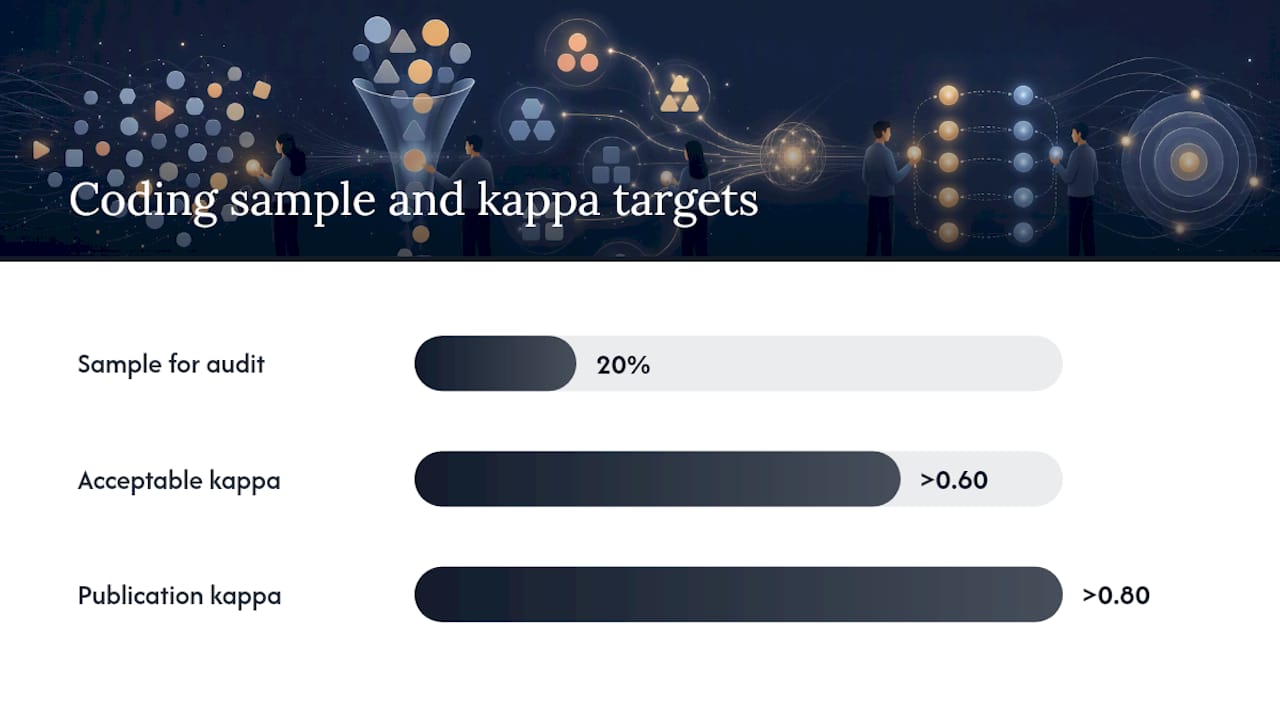
Consistency is the real test of any coding scheme, and it's measurable, not a matter of opinion. The standard method has two coders independently code a random sample, typically 20% of the dataset, then compute Cohen's kappa on their agreement.
A commonly cited target is a kappa above 0.60 for general research use, and above 0.80 when the analysis needs publication-level rigor. Below that, the codebook itself usually needs revision before you trust the themes it produces.
When kappa comes in low, the fix isn't retraining the coders. It's almost always the codebook: definitions too vague, categories that overlap, or edge cases nobody anticipated. The practical loop looks like this:
- Two coders independently code a representative random sample.
- Calculate Cohen's kappa on that sample.
- Reconcile every disagreement and note why each one happened.
- Update the codebook definitions to close the gap.
- Reapply the revised codebook to the full dataset.
Version every codebook change with a date and a reason to maintain an audit trail. This helps ensure consistent interpretation over time.
What Can AI Actually Do at Scale, and Where Does It Fail?
Automated text analysis can code thousands of verbatims for theme and sentiment in the time it takes a human analyst to finish a single coffee. That's the honest case for AI in this workflow: consistency at a volume no manual team can sustain, applying the same rule to comment 10,000 that it applied to comment 1.
Modern tools handle theme detection, topic co-occurrence (which complaints tend to show up together), and trend detection across time reasonably well. Sentiment scoring works best when it's tied to the specific topic inside a comment rather than applied as one blanket score for the whole verbatim, since a single comment routinely praises one feature while criticizing another in the same breath. Score the whole comment as one unit and you'll average away exactly the signal you were trying to capture. Tools like the sentiment analyzers built by Summit Studio illustrate what topic-level sentiment scoring looks like in practice.
Failure modes show up predictably in three places:
- Mixed-sentiment comments get flattened into a single misleading score if sentiment isn't tied to the topic mentioned.
- Theme fragmentation happens when a model splits one real theme into three near-duplicate labels because it wasn't given a stable taxonomy to work against.
- Training data drift creeps in as language changes: a new feature launch introduces vocabulary the model hasn't seen, and accuracy quietly degrades until someone checks.
Pro Tip: Pull a random 5 to 10% sample of AI-coded verbatims every reporting cycle and have a human re-code them blind. If agreement between the model and the human coder drops below your established threshold, that's your signal to retrain or adjust the taxonomy before the next report goes out, not after.
AI compresses the mechanical part of coding. It does not replace the judgment call about which theme actually matters to the business, and that prioritization step still needs a human who understands the strategic stakes, not just the word frequency.
How Do You Link Themes to NPS and CSAT Movement?
Frequency is a trap. The theme mentioned most often in your feedback isn't automatically the one worth fixing first, and treating volume as a proxy for importance is one of the most common mistakes in this entire discipline.
Driver analysis solves that by statistically testing which themes correlate with movement in your target metric, rather than which themes simply get mentioned the most. A theme brought up in only 8% of verbatims might explain a disproportionate share of detractor scores, while a theme mentioned in 30% of comments might have almost no relationship to whether someone promotes or criticizes you. Driver analysis surfaces that difference, which frequency counts alone never will.
Two prioritization tools turn that statistical signal into a decision:
- Importance-performance mapping plots each theme by how strongly it drives the outcome metric against how well you currently perform on it, flagging high-importance, low-performance themes as the priority.
- Impact-effort matrices add engineering cost into the same picture, surfacing the themes that combine strong metric impact with a genuinely achievable fix.
A concrete example: if "onboarding confusion" shows a strong statistical link to detractor scores and the fix is a two-day copy change, it beats a "add dark mode" theme that's mentioned constantly but shows almost no correlation with NPS movement. That's the difference driver analysis makes visible, and it's the difference between a roadmap built on customer analysis and one built on whoever complained loudest this week.
How Do You Turn Themes Into a Report Product and Ops Teams Will Actually Use?
A theme without a template is just a good observation nobody can act on. Document every theme the same way, every time:
- Name and one-line definition — clear enough that someone outside the project understands it immediately.
- Inclusion and exclusion criteria — what counts, and just as important, what doesn't, to keep the theme from drifting.
- Frequency — how often it appears, and in which segment.
- Impact estimate — its statistical relationship to the metric you're driving, from the driver analysis step.
- Representative quotes — two or three verbatims that capture the theme in the customer's own words.
Executive audiences need a different cut than the engineering team building the fix. A one-page summary with the top three themes ranked by impact, each with a single recommended action, serves leadership. An operational ticket needs the full inclusion criteria, the raw quote sample, and a proposed owner, because that's what an engineer or designer needs to actually build something.
Before committing engineering time to a theme-driven fix, a lightweight test can confirm the signal is real. Cheap experiments, like a landing page or an ad test measuring actual purchase intent, catch the cases where qualitative interest doesn't translate into willingness to pay. Track every shipped fix against the metric it was meant to move, and revisit the theme in the next collection cycle to confirm the change actually worked, not just that it shipped.
How Do You Keep the Analysis Defensible and Ethical?
Verbatim quotes carry real identity risk even when a name is stripped out. A quote that says "as the only enterprise customer on the East Coast team, I found the API rate limits frustrating" is functionally identifying even without a name attached, so review quotes for indirect identifiers before they go into any report that leaves your analysis team.
Get consent where your feedback collection process requires it, and default to paraphrasing sensitive details rather than quoting them verbatim when a paraphrase preserves the point just as well.
Governance is what keeps a codebook from becoming twelve different, quietly incompatible versions across twelve analysts. Version every change with a date and rationale, keep an audit sample from each coding round so a disagreement six months from now can be traced back to its source, and schedule a periodic revalidation, quarterly is reasonable for most teams, to confirm old themes still hold up against new language and new product features.
Sampling bias deserves the same scrutiny you'd apply to a formal research study. If your qualitative sample skews toward power users who file support tickets, or toward the customers angry enough to leave a review, check that against your actual customer demographics before you generalize a theme to "customers" as a whole. A theme that's real for your loudest 10% isn't automatically real for the other 90%.
How SaaS LaunchPad Puts Qualitative Analysis Into a Product Audit
Qualitative signal is only half the audit unless it gets connected to something a product team can actually build against. SaaS LaunchPad's 21-discipline analysis treats customer feedback interpretation as one input among many, cross-referencing coded themes against a platform's UX, workflow, and business logic to see where the qualitative complaint and the structural weakness are the same problem described two different ways.
The output isn't a raw theme list. It's a Product Excellence Blueprint that ranks findings by business impact, paired with a copy-paste-ready Master Transformation Prompt built for the platform's specific stack. A founder gets a prioritized roadmap where a theme like "onboarding confusion," once validated, shows up as a concrete, sequenced fix rather than another line item in a backlog nobody revisits.
The Gap Between Coding Feedback and Acting on It
Most teams get good at collecting comments and bad at deciding what to do with them. My honest read, after seeing how these frameworks actually play out: the coding phase gets the most attention in guides like this one, and it deserves less of it than it gets. Coding is mechanical. Prioritization is the hard part, and it's the part most teams skip straight past.
Two principles matter more than any tool choice. First, validate a theme with a small experiment before you commit real engineering time to it. A pattern in verbatims is a hypothesis, not a verdict. Second, report findings with an explicit confidence level attached, not a flat list of themes that all look equally certain. AI earns its place doing the coding at volume. Humans earn theirs deciding which coded pattern is actually worth building against.
— Gregory Cornelius
Get a Structured Audit Instead of Doing This Analysis Alone
There are alternatives to hiring a research consultant or assembling an in-house analysis team from scratch, including on-demand audits run against your platform. If you've read this far and realized your team has the feedback but not the hours to code it properly, that gap is exactly what the audit closes.
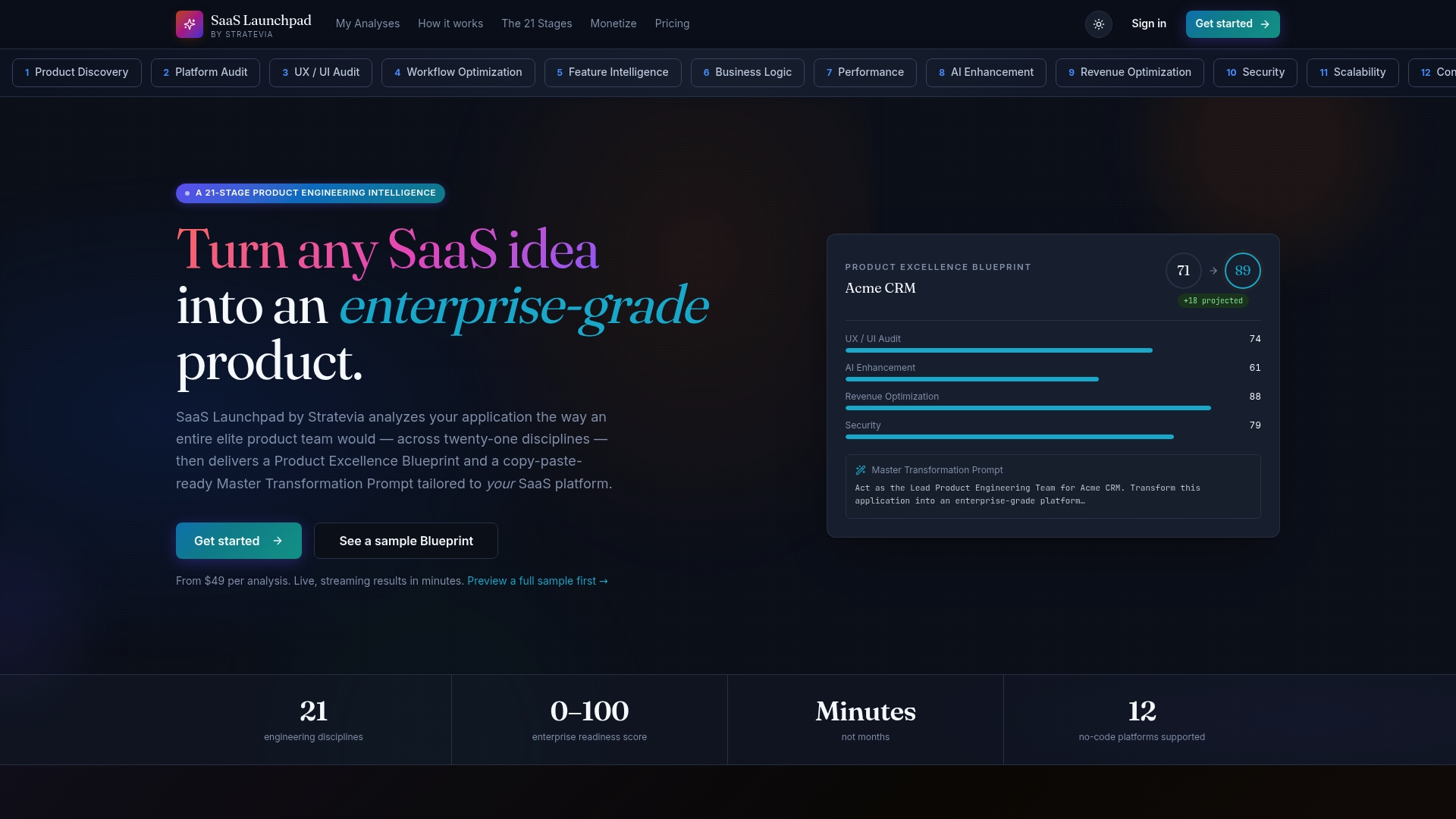
The audit doesn't just theme your customer comments. It runs qualitative signal alongside a full platform audit across 21 disciplines, including UX, performance, security, and conversion, then delivers a Product Excellence Blueprint that ranks every finding by impact and a Master Transformation Prompt written for your specific stack. Instead of a slide deck of themes, you get a prioritized, buildable roadmap. Check the available analysis packages and run your first audit today.
Sources
- Qualitative Feedback Analysis: Extract Customer Insights
- How to Analyze Open-Ended Survey Responses: Complete Thematic Analysis Guide (2026)
- Otter
- Collecting and Analyzing Qualitative Data | Field Epi Manual
FAQ
What Is an Example of Qualitative Feedback?
A customer writing "the export button is buried three menus deep and I almost gave up" in a support ticket is qualitative feedback. It captures a specific problem and emotional context that a satisfaction score alone never would.
What Are the Main Methods to Analyze Qualitative Data?
The core methods are thematic analysis, content analysis, narrative analysis, discourse analysis, and grounded theory, though most business teams use a thematic analysis workflow built on the preparation, coding, theme development, validation, and synthesis phases covered above.
Can You Use ChatGPT for Qualitative Data Analysis?
Yes, generative AI tools can draft initial codes, summarize themes, and flag sentiment at scale, but every AI-coded output needs human validation on a sample before you trust it in a report, since models can miss mixed sentiment and drift as product language changes.
What Is Qualitative Feedback?
Qualitative feedback is any customer response captured in open-ended, unstructured language rather than a numeric rating, including survey comments, interview transcripts, support tickets, and reviews. It explains the "why" behind a quantitative score like NPS or CSAT.
How Does SaaS LaunchPad Use Qualitative Feedback in a Product Audit?
SaaS LaunchPad codes qualitative signal alongside structural findings from its 21-discipline platform analysis, then ranks the combined findings by business impact in a Product Excellence Blueprint delivered with a customized transformation prompt.