TL;DR:
- Building a canonical answer library and organizing evidence shortens vendor security questionnaire responses to hours. Most Tier 3 buyers accept structured evidence packages instead of full SOC 2 audits, emphasizing organization over perfection. A dedicated security or compliance lead should own the process, focusing on consistency, quality, and a clear response roadmap.
You can cut a vendor security questionnaire from a lengthy ordeal to a matter of hours. The method: build a canonical answer library of several dozen pre-approved responses, pair it with a client-ready evidence room, and assign one security or compliance lead to own the whole process. That's the entire program. Everything below is how to build it.
Two things make this work faster than any tool or certification shortcut. First, a large majority of every questionnaire is standard security questions your library can answer automatically. Second, as of early 2026, most Tier 3 enterprise buyers will accept a well-structured evidence package — a DAST report, security headers export, and basic policies — instead of a full SOC 2 audit. You don't need to be perfect. You need to be organized.
- Build a 40–60 answer library covering encryption, IAM, incident response, vulnerability management, sub-processors, and BCP
- Create a dated evidence room with a README index
- Assign a single security/compliance lead as owner (not sales)
- Use the standard remediation format for every "No" answer
- Target SIG Lite responses in under 24 hours once the library is live
Table of Contents
- What does your vendor security questionnaire readiness look like right now?
- Who should own the questionnaire process and what does the workflow look like?
- How do you build a 40–60 answer library that actually holds up?
- What does a client-ready evidence room look like?
- How should you structure every answer, including the ones where the answer is "No"?
- Copy-paste answer templates for the 10 most common question categories
- What does the intake-to-delivery timeline look like in practice?
- How do you prioritize security fixes before the next enterprise deal?
- How do you QA responses and share evidence securely?
- How do you handle follow-ups and negotiate around gaps?
- Key Takeaways
- Treat questionnaires as product work, not sales firefighting
- SaaS LaunchPad can get you questionnaire-ready faster
- Sources and further reading
- FAQ
What does your vendor security questionnaire readiness look like right now?
Before the next questionnaire lands, gather these artifacts. If any are missing or stale, that's your gap list.
Non-negotiables to have on hand:
- External DAST scan report (recent, showing OWASP Top 10 coverage and severity breakdown)
- Security headers screenshot or export (from SecurityHeaders.com or equivalent)
- Incident response policy summary (one page, current year)
- Subprocessor list (named vendors, data categories, locations)
- Vulnerability disclosure policy (public URL preferred)
- README index for your evidence room (see Section 5)
- SOC 2 Type II report or a written self-assessment with gap status
Freshness rules: DAST scans older than a few months raise flags with Tier 3 buyers. Policies should carry an annual review date. An indexed README with dated filenames eliminates most procurement follow-up questions before they're asked.
Store everything in one place: a Trust portal with gated access, a structured ZIP with a README, or a gated PDF package delivered under NDA. The format matters less than the consistency.
Who should own the questionnaire process and what does the workflow look like?
Sales should not own questionnaire responses. They move fast, they want to say yes, and they don't know which "yes" will come back to haunt you in a contract audit. Centralize ownership under a security or compliance lead whose job is accuracy, not deal velocity.
Role responsibilities:
- Security/compliance lead: owns the library, final QA, and sign-off
- Sales/CS: intake form submission and deadline communication
- Engineering SME: validates technical answers outside the library
- Legal: reviews any contractual commitments before delivery
Operational workflow:
- Intake: sales submits the questionnaire with deal value, buyer tier, deadline, and format (SIG Lite, CAIQ, SIG Core, custom)
- Triage: security lead maps questions to the answer library; flags the 10–15% needing SME input
- SME routing: technical questions go to the right engineer with a 24-hour response window
- QA: security lead or CISO delegate reviews all answers for consistency and evidence references
- Delivery: formatted response returned to sales with a copy archived for audit records
SLA targets (post-library):
- SIG Lite (several hundred questions): under 24 hours
- CAIQ (a few hundred questions): under 48 hours
- SIG Core (over a thousand questions): under 5 business days
How do you build a 40–60 answer library that actually holds up?
Start by mapping the question domains that appear in SIG Lite, SIG Core, CAIQ, and custom formats — these four formats cover roughly 90% of enterprise asks. The core domains: encryption at rest and in transit, identity and access management, incident response, threat and vulnerability management, sub-processor disclosures, and business continuity.

Draft answers at three maturity levels: startup (controls in place but not formally audited), growth (documented policies, partial automation), and enterprise (SOC 2 Type II, formal change management). Each answer gets a direct lead sentence, 2–3 supporting bullets, an evidence reference (file name or README path), and a tagged owner with a review date.
Store the library in a single source of truth — Notion, Confluence, or a managed spreadsheet. Organize by control domain, not by prospect, so one update to your encryption answer improves responses across every future questionnaire.
Governance:
- Quarterly review cadence with a change log
- Sign-off workflow: draft → SME review → security lead approval
- Expiry dates on answers tied to evidence freshness
Pro Tip: Use AI tools like ChatGPT or Claude to draft initial answers, then require human validation before any response is submitted. Auto-submit without review is how "Yes" answers get sent without an evidence path.
What does a client-ready evidence room look like?
The evidence room is a folder (or portal) a procurement team can navigate without asking you a single question. Structure it by control domain, name every file with a date and scope, and lead with a one-page README.
Minimum Tier 3 evidence package:
| Artifact | What it proves | Freshness requirement |
|---|---|---|
| External DAST scan report | OWASP Top 10 coverage, severity counts, remediation status | Under 90 days |
| Security headers export | Transport security, CSP, HSTS configuration | Under 90 days |
| Vulnerability disclosure policy | Responsible disclosure process exists | Annual review |
| Incident response summary | IR plan is documented and tested | Annual review |
| Subprocessor list | Third-party data flows are tracked | Updated on change |
| README index | Maps every artifact to what it proves and its validity date | Updated on each release |
Naming convention example: acme-dast-report-owasp-2026-03-15.pdf, acme-subprocessor-list-2026-04-01.xlsx
A single vendor-security-package-index-2026.pdf listing each artifact, its scope, and validity date can eliminate the majority of buyer follow-ups. Organize by control domain rather than by prospect so one artifact update carries forward to all future packages.
Pro Tip: Deliver the evidence room under a mutual NDA or via a Trust portal with gated access. Never email raw technical reports without an NDA in place — redact internal IP ranges and infrastructure details before sharing.
How should you structure every answer, including the ones where the answer is "No"?
Every answer follows the same shape: a direct lead (Yes / No / N/A), a concise supporting sentence, and an explicit evidence reference. No ambiguity, no hedging, no walls of text.
Answer structure:
- Lead: "Yes. Acme encrypts all data at rest using AES-256."
- Support: "Encryption is enforced at the database layer via AWS KMS with automatic key rotation enabled."
- Evidence: "See:
acme-encryption-policy-2026.pdf, Section 3.2."
For "No" answers, follow the standard remediation format: state the gap, describe any compensating controls currently in place, and give a specific, time-bound milestone.
Remediation template:
- Gap: "Acme does not currently hold a SOC 2 Type II certification."
- Compensating controls: "Annual external penetration test completed March 2026; DAST scans run quarterly; access control policies reviewed annually."
- Milestone: "SOC 2 Type II audit initiated Q2 2026; report expected by September 30, 2026. Responsible owner: Head of Engineering."
Procurement teams treat a "No" with a clear roadmap as a sign of maturity — often more credible than an unverifiable "Yes." Never answer "Yes" without an evidence path. Procurement will follow up, and they will ask for the file.
Pro Tip: Audit every "Yes" in your library against your actual evidence room before submitting. If you can't point to a specific file or policy section, change the answer or add the evidence first.
Copy-paste answer templates for the 10 most common question categories
Use these as starting points. Label each with your maturity level, then update the evidence references to match your actual file names.
1. Encryption at rest (startup posture)
"Yes. Data at rest is encrypted using AES-256 via AWS KMS. Key rotation is enabled. See: acme-encryption-policy-2026.pdf."
2. Encryption in transit (startup posture)
"Yes. All data in transit is encrypted using TLS 1.2 or higher. See: acme-security-headers-2026-03.png and acme-tls-config-2026.pdf."
3. MFA and access control (growth posture)
"Yes. MFA is enforced for all internal systems via Okta. Role-based access control is documented and reviewed quarterly. See: acme-iam-policy-2026.pdf."
4. Incident response (startup posture)
"Yes. An incident response plan is documented and reviewed annually. Last review: January 2026. See: acme-ir-summary-2026.pdf."
5. Vulnerability management (growth posture)
"Yes. External DAST scans are run quarterly against OWASP Top 10. Last scan: March 15, 2026. Critical findings: 0. See: acme-dast-report-2026-03-15.pdf."
6. Sub-processors (all postures)
"Yes. A current subprocessor list is maintained and updated on change. See: acme-subprocessor-list-2026-04-01.xlsx."
7. Penetration testing (growth posture)
"Yes. Annual external penetration test completed by [Firm Name], March 2026. Executive summary available under NDA. See: acme-pentest-summary-2026.pdf."
8. SOC 2 status (startup — No answer) "No. SOC 2 Type II audit is in progress. Compensating controls: quarterly DAST, annual pen test, documented access control policies. Expected completion: September 30, 2026."
What does the intake-to-delivery timeline look like in practice?
Recommended intake form fields:
- Deal name and ACV
- Buyer tier (Tier 1 / 2 / 3)
- Questionnaire format (SIG Lite, CAIQ, SIG Core, custom)
- Hard deadline from procurement
- Primary procurement contact and email
- Requested artifacts (list any specific documents named)
- Preferred delivery format (portal, email, ZIP)
Timeline by questionnaire type:
- Hour 0: Intake form submitted by sales
- Hours 1–2: Security lead triages, maps to library, flags SME questions
- Hours 2–6: SME input collected (SIG Lite); up to 2 days for SIG Core
- Hours 6–8: QA review by security lead; evidence references verified
- Hour 8 (or Day 5 for SIG Core): Delivery to procurement with archived copy
QA checklist before delivery:
- All "Yes" answers have a named evidence file
- All "No" answers follow the remediation format with a specific date
- Dates on all referenced artifacts are current
- Reviewer initials on the response document
- Copy saved to the questionnaire archive folder
Pro Tip: Publish a Trust portal or gated page with your README, subprocessor list, and vulnerability disclosure policy. Buyers who can self-serve 80% of the initial request arrive at the formal questionnaire with fewer questions.
How do you prioritize security fixes before the next enterprise deal?
Not every gap needs to close before you respond. Prioritize by two axes: how many deals the fix unlocks, and how long it takes to implement.
High-impact, low-effort fixes to do first:
- Run and export a DAST scan (unlocks Tier 3 buyers immediately)
- Publish security headers and export a screenshot
- Write a one-page IR summary if you don't have one
- Build the README index for your evidence room
Medium-effort, high-value items:
- Document your subprocessor list formally
- Draft and publish a vulnerability disclosure policy
- Start the SOC 2 readiness process (even a gap assessment counts as a roadmap item)
When you commit to a roadmap item in a questionnaire response, give a specific milestone: responsible owner, deliverable, and calendar quarter. "We plan to complete SOC 2 Type II by Q3 2026, owned by [Name], Head of Engineering" is credible. "We are working toward SOC 2" is not.
Pro Tip: If a buyer requires FedRAMP, PCI Level 1, or HIPAA BAA and you cannot deliver within the deal timeline, say so early. Qualifying out of an unwinnable deal protects your team's time and your credibility with that buyer for a future cycle.
How do you QA responses and share evidence securely?
QA checklist (run before every submission):
- Evidence file names match what's in the README index
- Dates on referenced artifacts are within freshness windows
- "No" answers include compensating controls and a milestone date
- No internal IP addresses, infrastructure diagrams, or unreacted credentials in shared files
- Reviewer initials and submission date logged in the archive
Secure sharing options:
- Trust portal with gated access (preferred for repeat buyers)
- Mutual NDA before sharing pen test reports or DAST details
- Time-limited signed URLs for large file packages
- Redact internal hostnames, IP ranges, and employee names from technical reports before sharing
Keep a copy of every submitted questionnaire and the exact evidence files referenced. When a buyer's security team follows up six months later, you need to produce the same version you submitted, not a newer one.
How do you handle follow-ups and negotiate around gaps?
Most follow-up questions fall into three categories: requests for more detail on a "No" answer, requests for additional artifacts, and requests for contractual commitments.
For detail requests on "No" answers:
"Thank you for the follow-up. To clarify our SOC 2 status: our audit is formally initiated with [Firm Name] as of April 2026, with a target completion date of September 30, 2026. We're happy to provide a letter of engagement under NDA if that supports your review."
For artifact requests:
"We can provide [artifact] under a mutual NDA. Please confirm your preferred NDA format or use ours, attached."
For contractual commitments:
- Offer a contract milestone tied to a specific date rather than an immediate certification promise
- Propose an escrowed deadline: "We commit to delivering SOC 2 Type II by [date] as a contract condition, with a 30-day cure period."
- Never promise a certification you don't control the timeline for
Numbered negotiation steps:
- Identify which gaps are blockers versus preferences for this buyer
- Offer compensating controls for blockers you can't close before signing
- Propose contract milestones for gaps the buyer treats as must-haves
- Qualify out early if a required control (FedRAMP, PCI Level 1) is genuinely out of scope for your current roadmap
Key Takeaways
A canonical answer library is the single highest-ROI investment in your security questionnaire program, cutting response time from roughly 16 hours to 2–3 hours per request after the initial setup.
| Point | Details |
|---|---|
| Centralize ownership | Assign one security/compliance lead to own the library, QA, and final sign-off — never sales. |
| Build the answer library | Target 40–60 canonical responses covering encryption, IAM, IR, TVM, sub-processors, and BCP. |
| Create a dated evidence room | Use a README index with dated filenames; Tier 3 buyers often accept this package instead of SOC 2. |
| Use the "No" remediation format | State the gap, list compensating controls, and give a specific milestone date and owner. |
| SaaS LaunchPad enterprise readiness | SaaS LaunchPad's 21-discipline product analysis covers security, compliance readiness, and a prioritized fix roadmap. |
Treat questionnaires as product work, not sales firefighting
The teams that handle vendor security questionnaires well aren't the ones with the most certifications. They're the ones who treated the answer library like a product backlog: owners assigned, acceptance criteria defined, quarterly grooming scheduled.
What most founders miss is that the questionnaire is a forcing function. Every "No" answer with a deadline is a prioritized roadmap item in disguise. The enterprise buyer just handed you a ranked list of what to fix next, with a deal on the line as the sprint goal. That's more useful than most product planning sessions.
The honest-answer culture matters more than people expect. A "Yes" that procurement can't verify in a follow-up destroys trust faster than a "No" with a clear plan. Consistent, evidence-backed answers — even imperfect ones — signal that your security program is real and managed, not assembled the night before the questionnaire arrived.
One more thing: organize your evidence room by control domain, not by prospect. When you update your DAST report, it improves your answer across every future questionnaire automatically. That's the compounding return on the initial two days of setup.
SaaS LaunchPad can get you questionnaire-ready faster
Most SaaS teams spend weeks assembling evidence after a questionnaire arrives. SaaS LaunchPad flips that: its 21-discipline product analysis covers security controls, compliance readiness, and enterprise readiness scoring as part of a single structured audit — so you know exactly what's missing before procurement asks.
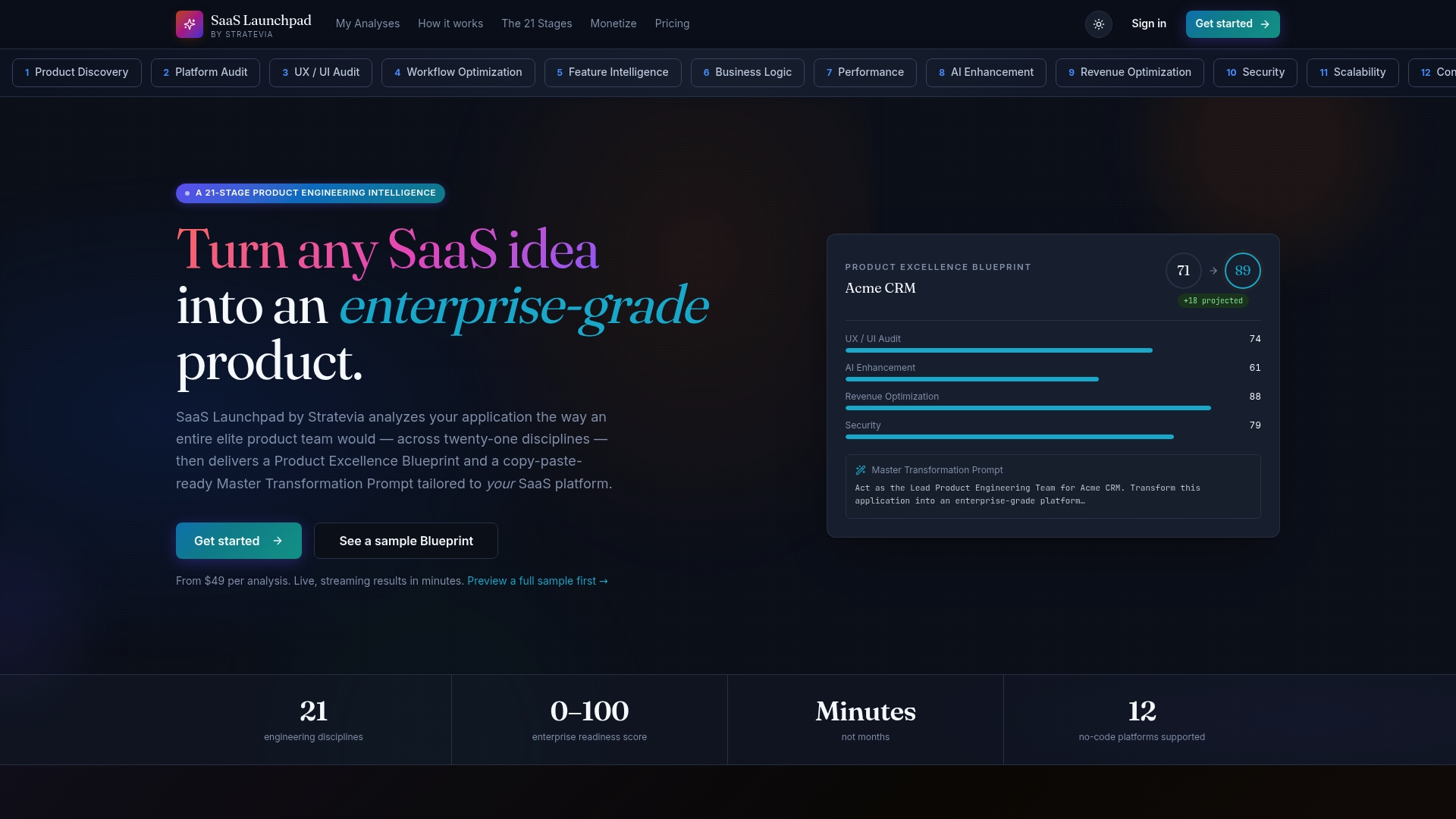
The output is a Product Excellence Blueprint with a prioritized fix roadmap, copy-paste-ready answer templates, and an implementation sprint plan your team can execute immediately. No retainer, no long engagement. You purchase an analysis credit, run the audit, and get a complete picture of your security posture alongside every other product dimension that enterprise buyers evaluate.
If your next enterprise deal is 60 days out and your evidence room doesn't exist yet, that's the right moment to run a full product analysis and close the gaps before procurement sends the spreadsheet.
Sources and further reading
Start with these resources based on your situation:
- How to Answer Security Questionnaires 2026: Vendor Templates — practical response guidance and evidence path requirements; read first if you're responding to your first questionnaire
- SaaS Audit Checklist: What Enterprise Clients Actually Check — the exact items enterprise buyers evaluate; use to validate your evidence room
- SaaS Enterprise Explained: A Product Team's Guide — background on enterprise buyer tiers and expectations; useful for prioritization decisions
FAQ
How long does it take to build a vendor security questionnaire answer library?
Initial setup typically takes roughly two days of drafting and review. Efficiency gains — dropping response time from about 16 hours to 2–3 hours per request — are usually realized by the third or fourth questionnaire.
What do Tier 3 enterprise buyers accept instead of SOC 2 in 2026?
Most Tier 3 buyers will accept a structured evidence package: a recent external DAST report with OWASP Top 10 coverage, a security headers export, basic documented policies, and a README index. A full SOC 2 audit is not required at this tier.
Who should own the vendor security questionnaire process?
A security or compliance lead should own it — not sales. This person manages the answer library, routes technical questions to SMEs, runs QA, and signs off on every submission.
How should you answer "No" on a security questionnaire?
State the gap plainly, describe any compensating controls currently in place, and provide a specific milestone with a responsible owner and a calendar date. Procurement treats a "No" with a clear roadmap as more credible than an unverifiable "Yes."
Can SaaS LaunchPad help with security questionnaire readiness?
Yes. SaaS LaunchPad's 21-discipline product analysis includes a security and enterprise readiness audit that identifies control gaps, produces a prioritized fix roadmap, and delivers copy-paste-ready answer templates your team can use immediately.