TL;DR:
- Enterprise SaaS must demonstrate security, compliance, and scalable architecture to meet large organizational requirements. Meeting core controls like SSO, SOC 2 certification, and documented SLAs is essential for enterprise procurement success. Achieving full readiness often takes six to twelve months, involving technical, operational, and organizational changes.
Enterprise SaaS is cloud software engineered, operated, and governed to meet the scale, security, and procurement requirements of large organizations. If your product team is asking whether your platform is enterprise-ready, the honest answer almost always involves three parallel tracks: security and compliance readiness, architecture and scale, and procurement and SLA readiness. Miss any one of them and you will not clear the first vendor evaluation gate.
Before anything else, here is what your platform needs at minimum to be taken seriously by enterprise procurement:
- SSO and RBAC with support for SAML 2.0 or OIDC, plus role-based access control down to the resource level
- SOC 2 Type II or ISO 27001 certification (or a credible roadmap with a named auditor and a target date)
- Documented SLAs covering uptime, incident response times, and financial remedies for breaches
Pro Tip: Ask your first enterprise prospect's procurement team: "What security questionnaire do you use, and which compliance certifications are required before a pilot?" Their answer will surface every gap you have not yet found on your own.
Table of Contents
- What is SaaS enterprise, and how does it differ from SMB SaaS?
- What security and compliance controls do enterprise buyers actually require?
- How does architecture and scalability separate enterprise platforms from the rest?
- What service-level commitments do enterprise customers expect?
- What integration and data governance requirements will enterprise buyers impose?
- How do you score your platform's enterprise readiness?
- How long does it take to reach enterprise readiness, and what does it cost?
- What organizational changes does enterprise readiness require?
- How should your product team prepare in the next 60–90 days?
- Key Takeaways
- The gap most product teams never see coming
- What SaaS LaunchPad does that a checklist alone cannot
- Useful sources
- FAQ
What is SaaS enterprise, and how does it differ from SMB SaaS?
Enterprise SaaS is cloud-based software engineered to meet the scale, security, and governance needs of large organizations, with advanced security, scalability, and detailed role-based access control built into the product's core. That definition from GetStream's glossary is accurate as far as it goes, but it undersells the operational and contractual weight of the term.
The real distinction between enterprise SaaS and general B2B SaaS is not feature count. It is the buyer. Enterprise procurement teams are not evaluating your product the way a startup founder does. They involve legal, security, IT, finance, and sometimes a dedicated vendor governance committee. Each of those stakeholders has a checklist, and your product either passes or it does not.
How enterprise buyers differ from SMB buyers
SMB buyers typically evaluate a SaaS product on three axes: does it solve the problem, is the price reasonable, and can we get started quickly? Enterprise buyers add at least five more: can we audit it, can we integrate it with our existing stack, does it meet our regulatory obligations, what happens when it goes down, and who owns the relationship long-term?
PTC's industry analysis captures this well: enterprise SaaS delivers rapid deployment, automatic updates, and easy scalability, reducing the need for on-premises IT maintenance and enabling faster time-to-value, as detailed in this cloud based communication platform guide for small business. But that value only lands if the vendor has already done the governance work. A product that deploys fast but cannot produce a SOC 2 report will not survive procurement.
Enterprise SaaS vs. SMB SaaS: the key differences
| Dimension | SMB SaaS | Enterprise SaaS |
|---|---|---|
| Procurement cycle | Days to weeks, often self-serve | Months; involves legal, security, and finance |
| Customization | Limited; standard tiers | Workflow-level configuration, custom roles |
| Compliance evidence | Rarely required | SOC 2, ISO 27001, DPA, security questionnaire |
| Support | Email/chat, business hours | Named TAM, 24/7 critical-incident coverage |
| SLA | Best-effort or informal | Contractual uptime with financial remedies |
| Integration | Webhooks, basic API | Versioned APIs, SCIM, SSO, ERP/CRM connectors |
| Data governance | Shared infrastructure | Data residency options, audit logs, subprocessor lists |
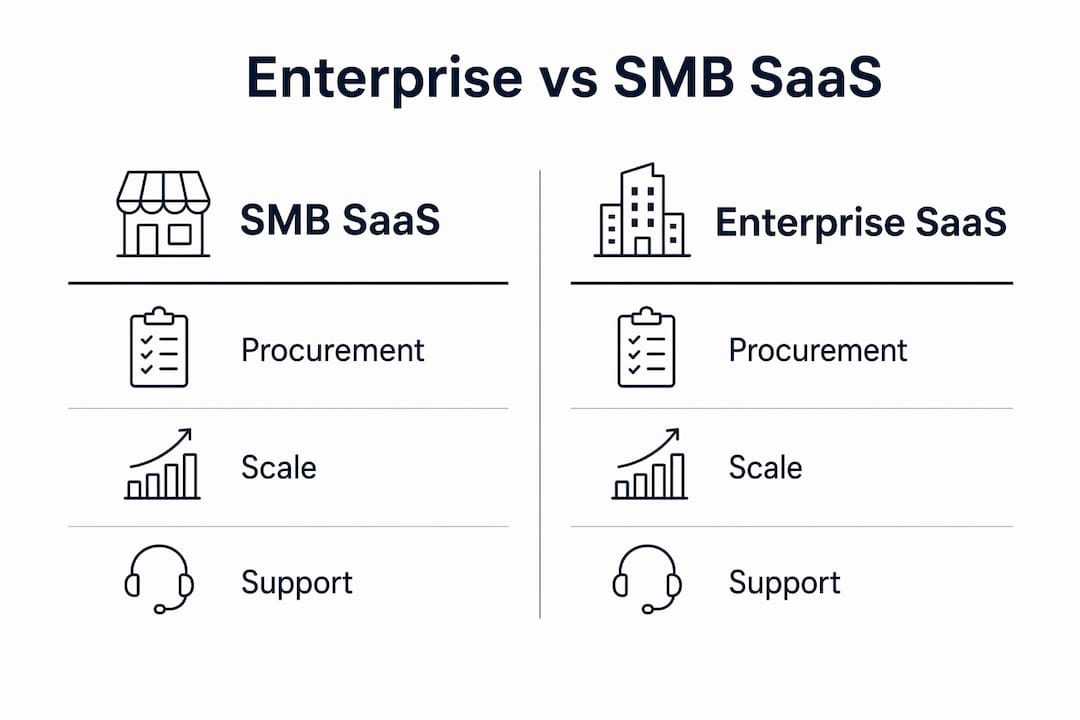
The practical implication for product teams: if you are selling to enterprises but your product was designed for SMBs, you are not just missing features. You are missing an entire operating model.
Who your product is actually for: a quick market-fit check
Before investing in enterprise readiness, confirm the fit. Your product belongs in the enterprise category if:
- Your buyers involve a security or legal review before signing
- Deals take more than 60 days to close
- Customers ask about data residency, audit logs, or SSO before asking about pricing
- Your average contract value exceeds a substantial amount annually
- Customers require a custom data processing agreement (DPA)
If fewer than two of those apply today but you want them to apply in 12 months, the sections below are your roadmap.
What security and compliance controls do enterprise buyers actually require?
Security is not a feature you add at the end. Enterprise procurement teams treat it as a gate: if you cannot produce the right documentation, the deal stops before a demo. Oracle's SaaS framework describes a modern enterprise SaaS suite as built on a single, standards-based platform with shared security levels and synchronized release schedules. That consistency is what procurement teams are looking for.
Core security controls
Your platform needs these in place before any serious enterprise evaluation:
- Encryption at rest and in transit: AES-256 for stored data, TLS 1.2 or higher for all data in transit. Document which cipher suites you support.
- Key management: Clarify whether you manage keys, the customer manages keys, or a hybrid model (bring-your-own-key) is available. Enterprise buyers in regulated industries often require BYOK.
- Vulnerability management: A documented patch cadence, a process for critical CVEs, and evidence that you run it. Quarterly scans at minimum; monthly for anything customer-facing.
- Audit logs: Immutable, tamper-evident logs covering authentication events, data access, configuration changes, and administrative actions. Logs must be exportable and retained for a period your customers can specify.
Identity and access management
SSO is table stakes. SAML 2.0 and OIDC support covers the vast majority of enterprise identity providers. Beyond SSO, enterprise buyers expect:
- RBAC with least-privilege defaults: Roles should be granular enough that a department head cannot access another department's data by accident.
- SCIM provisioning: Automated user provisioning and deprovisioning tied to the customer's identity provider. When an employee leaves, their access should disappear within minutes, not days.
- MFA enforcement: The ability for the enterprise admin to mandate MFA for all users in their tenant, not just recommend it.
Compliance certifications that actually move deals
Enterprises often require documented evidence, including compliance reports, SOC 2 or ISO 27001 certificates, and penetration test summaries, before running pilots or finalizing contracts. The hierarchy looks like this:
| Certification | When it matters | What it covers |
|---|---|---|
| SOC 2 Type II | Most U.S. enterprise deals | Security, availability, confidentiality over a 6–12 month audit period |
| ISO 27001 | Global enterprises, especially EU and APAC | Information security management system |
| NIST CSF | Federal, defense, and regulated industries | Risk management framework alignment |
| HIPAA BAA | Healthcare buyers | Protected health information handling |
| GDPR/CCPA compliance | Any buyer with EU or California data subjects | Data privacy obligations |
SOC 2 Type II is the most common first requirement in U.S. enterprise deals. If you have only Type I, be honest about it and provide a timeline for Type II. Procurement teams have seen every version of "we're working on it" and will ask for specifics.
Operational evidence
Beyond certifications, buyers want:
- Annual penetration test reports (executive summary at minimum; full report under NDA)
- A named subprocessor list with update notification commitments
- A security incident notification timeline (72 hours is the GDPR standard; many U.S. enterprises now expect the same)
- A business continuity and disaster recovery plan with tested RTO and RPO targets
How does architecture and scalability separate enterprise platforms from the rest?
Architecture is where most SMB-origin SaaS products hit their first hard wall. The product works fine at 50 users per tenant. At 5,000 users across 200 tenants, the cracks show fast.

Microsoft Azure's SaaS documentation notes that SaaS commonly uses multitenant architecture to serve multiple customers from a single application instance, optimizing resources while maintaining configuration isolation and separate data stores where needed. The phrase "where needed" is doing a lot of work there. Enterprise buyers need to know exactly where your isolation boundaries are.
Multi-tenancy models and their trade-offs
Shared tenancy with logical isolation is the most common model. All tenants share the same database and application layer, with row-level security or schema-level separation enforcing data boundaries. It is cost-efficient and easy to operate, but a misconfigured query can expose one tenant's data to another. For most enterprise buyers, this model is acceptable only if you can demonstrate that your isolation controls have been independently tested.
Schema-per-tenant gives each customer a dedicated database schema within a shared server. Isolation is stronger, but schema migrations become operationally complex at scale. This model suits mid-market enterprise buyers who need stronger isolation without the cost of dedicated infrastructure.
Dedicated instances give each enterprise customer their own application and database stack. Maximum isolation, maximum cost. Buyers in regulated industries (financial services, healthcare, defense) often require this. If you offer it, price it accordingly and document the operational overhead.
Performance expectations enterprises will test
Enterprise buyers do not take your word for performance. They run load tests, and they expect you to have already run them. Document:
- Peak concurrent user benchmarks and the infrastructure configuration that produced them
- P95 and P99 latency for your most critical API endpoints
- Autoscaling behavior: how quickly does your platform scale out, and what triggers it?
- Capacity planning methodology: how do you forecast and provision for a customer adding 10,000 users?
Pro Tip: Run a 30-minute load test at 2x your largest current tenant's peak load using a tool like k6 or Locust. Export the P95 latency and error rate. That single data point, presented in a one-page performance summary, will answer 80% of the architecture questions a procurement team asks.
Observability and SRE practices
Enterprise customers expect you to know about problems before they do. That means:
- Distributed tracing (OpenTelemetry is the current standard) so you can diagnose latency spikes across service boundaries
- Defined SLIs and SLOs for your critical user journeys, not just infrastructure uptime
- Runbooks for every known failure mode, with clear escalation paths
- Alerting thresholds tied to SLO burn rates, not just raw error counts
Observability is also a sales asset. A product team that can show a prospect their SLO dashboard during a technical evaluation stands out from one that says "we monitor everything."
Architecture features to document for procurement
- Isolation model (shared, schema-per-tenant, or dedicated) and the security controls that enforce it
- Peak-user benchmarks with methodology
- Autoscaling configuration and tested scale-out time
- Data backup frequency, retention period, and tested restore time
- Geographic redundancy and failover architecture
What service-level commitments do enterprise customers expect?
An SLA is not just a number in a contract. It is a set of operational commitments that your product team has to be able to actually meet, every month, for every enterprise customer simultaneously. Getting this wrong is expensive in two directions: financially, through penalty credits, and reputationally, through churn.
SLA components that matter
- Uptime commitment: 99.9% is the floor for most enterprise deals. Many buyers in financial services or healthcare require 99.95% or higher. Know your actual trailing 12-month uptime before you commit to a number.
- Incident response time: Distinguish between acknowledgment (how fast you confirm you know about the problem) and resolution (how fast you fix it). Enterprise buyers want both, with different targets by severity level.
- Financial remedies: Service credits tied to SLA breaches. A common structure is 10% of monthly fees for each percentage point of uptime below the committed level, capped at one month's fees. Know what you can afford before you sign.
- Maintenance windows: Define them, notify customers in advance (typically 72 hours for planned maintenance), and honor them. Unplanned downtime during business hours is a contract violation in most enterprise agreements.
Support tiers and escalation paths
Pro Tip: Before signing your first enterprise deal, draft a one-page support matrix that defines severity levels (P1 through P4), response time commitments for each, and the escalation path from tier-1 support to engineering. Share it with the prospect during negotiation. It signals operational maturity and often accelerates legal review.
Enterprise support is not a help desk. It typically includes:
- A named technical account manager (TAM) who knows the customer's environment
- A dedicated Slack channel or shared communication space for critical incidents
- 24/7 coverage for P1 incidents (complete outage or data loss risk)
- Post-incident reports (PIRs) delivered within 48–72 hours of resolution, covering root cause, timeline, and remediation steps
Release management and change control
Enterprise customers run change advisory boards (CABs). They need to know what is changing in your product, when, and what the rollback plan is. Your release process should include:
- Advance notification of breaking changes (30 days minimum; 90 days for API changes)
- Backward compatibility guarantees for a defined deprecation window
- Release notes published before deployment, not after
- A documented rollback procedure and tested rollback time
Incident response playbooks should be customer-facing documents, not internal-only. Enterprise buyers will ask to see them. A playbook that covers your top five failure modes, with clear communication templates and escalation contacts, is a procurement differentiator.
What integration and data governance requirements will enterprise buyers impose?
Integration is where enterprise deals die quietly. A product can pass security review, clear compliance, and still lose the deal because it cannot connect to the buyer's existing systems without a six-month custom development project.
Oracle's enterprise SaaS framework describes a modern enterprise suite as built on a unified data model with synchronized release schedules to support cross-business workflows. That is the standard your integration layer is being measured against.
API maturity requirements
Enterprise buyers evaluate APIs the way engineers evaluate code: they look for stability, documentation, and evidence of long-term support. Your API program needs:
- Versioned endpoints with a clear deprecation policy (v1, v2, not "latest")
- OpenAPI/Swagger documentation that is accurate and kept in sync with the actual API
- SDKs for at least the two most common languages your buyers use (Python and JavaScript cover most cases)
- Rate limit documentation with per-tenant limits and a process for requesting increases
- Webhook reliability: delivery guarantees, retry logic, and event log access for debugging
Data model and exportability
Enterprise buyers need to own their data. That means:
- A documented data schema that does not change without notice
- Bulk export in standard formats (CSV, JSON, or Parquet for analytics use cases)
- A data migration toolkit or documented migration path if the customer ever wants to leave
- Data contracts: formal agreements about what fields exist, what they mean, and how long they will be supported
Data residency and sovereignty
This is the requirement that catches the most product teams off guard. Enterprise buyers in regulated industries, or with EU or California data subjects, will ask:
- Where is our data stored, physically?
- Can we choose a specific region?
- Who are your subprocessors, and where do they process data?
- Can we hold our own encryption keys?
If you cannot answer these questions with a one-page data residency document, you will lose deals to vendors who can. Cloud providers like AWS, Google Cloud, and Azure all offer region-specific deployments. The engineering work to support data residency is real, but the commercial upside is significant.
Integration readiness checklist
- Versioned, documented API with a published deprecation policy
- OpenAPI spec published and kept current
- SCIM 2.0 support for user provisioning
- SSO via SAML 2.0 and OIDC
- Webhook delivery with retry logic and event logs
- Bulk data export in at least one standard format
- Named subprocessor list with update notification process
- Data residency documentation covering storage regions and processing locations
- Data processing agreement (DPA) template ready for legal review
API health metrics enterprise buyers will ask for:
- API uptime percentage (trailing 90 days)
- P95 latency for your top five endpoints
- Error rate by endpoint (4xx and 5xx separately)
- Rate limit hit frequency by tenant
- Webhook delivery success rate
How do you score your platform's enterprise readiness?
A readiness audit does not need to take a month. A focused team can complete a first-pass score in one to two days using a structured rubric. The goal is not perfection; it is knowing exactly where you stand before a prospect's security team tells you.
Scoring rubric
Score each item 0, 1, or 2:
- 0 = Not in place, no plan
- 1 = Partially in place or in progress with a documented timeline
- 2 = Fully in place with evidence available
Enterprise readiness checklist by domain
Security (max 16 points)
- Encryption at rest (AES-256 or equivalent)
- Encryption in transit (TLS 1.2+)
- Key management documented (vendor-managed or BYOK option)
- Vulnerability management program with documented patch cadence
- Annual penetration test with report available under NDA
- Immutable audit logs with configurable retention
- Security incident response plan with tested notification timeline
- Subprocessor list published with update notification commitment
Identity and access (max 8 points)
- SSO via SAML 2.0 or OIDC
- RBAC with least-privilege defaults
- SCIM 2.0 provisioning
- MFA enforcement at tenant-admin level
Architecture and performance (max 8 points)
- Documented tenancy model with isolation controls
- Load test results at 2x peak load available
- Autoscaling configured and tested
- Backup and restore tested with documented RTO/RPO
Operations (max 8 points)
- SLA with uptime commitment and financial remedies
- Support tiers with documented response times by severity
- Release notification process (30-day advance for breaking changes)
- Post-incident report template and process
Integrations and data (max 8 points)
- Versioned API with OpenAPI documentation
- SCIM and SSO integration tested with at least one enterprise IdP
- Bulk data export in a standard format
- Data residency documentation and DPA template ready
Legal and compliance (max 8 points)
- SOC 2 Type II (or Type I with Type II roadmap)
- GDPR and CCPA compliance documentation
- Data processing agreement template
- Vendor security questionnaire responses pre-drafted
What your score means
| Score range | Readiness level | Recommended action |
|---|---|---|
| 0–20 | Pre-enterprise | Address security and identity gaps before any enterprise outreach |
| 21 | Pilot-eligible | Sufficient for a limited pilot with a tolerant buyer; document gaps openly |
| 48 | Enterprise-ready | Suitable for full procurement; maintain evidence packages |
| — | Mature | Differentiated; use audit results as a sales asset |
Pro Tip: When presenting audit results to a procurement team or internal steering committee, lead with your score and the three highest-priority gaps, each with a remediation timeline and owner. Procurement teams respect transparency about known gaps far more than they respect a vendor who claims everything is perfect.
The SaaS audit checklist from SaaS LaunchPad covers security, data sovereignty, compliance, and governance in the same structured format, and is worth running alongside your internal audit to catch anything your team has normalized.
How long does it take to reach enterprise readiness, and what does it cost?
The honest answer: most SaaS products built for SMBs need six to twelve months and a meaningful engineering investment to reach genuine enterprise readiness. The range is wide because it depends almost entirely on how much technical debt you are carrying and how far your current architecture is from the requirements above.
CDW's enterprise SaaS migration analysis notes that large-scale SaaS adoption has accelerated enterprise migrations, with vendors and service partners helping plan migration, optimize subscriptions, and manage secure deployment at scale. That partner ecosystem exists because the work is genuinely complex.
Typical phases and timelines
| Phase | Typical duration | Key deliverables |
|---|---|---|
| Discovery and audit | 2–4 weeks | Gap analysis, prioritized remediation backlog, cost estimate |
| Security and identity remediation | 6–12 weeks | SSO, RBAC, SCIM, audit logs, encryption controls |
| Compliance certification | 3–6 months | SOC 2 Type II audit period plus auditor review |
| Architecture hardening | 4–8 weeks | Tenancy model documentation, load testing, autoscaling |
| Integration and data governance | 4–8 weeks | Versioned API, DPA template, data residency documentation |
| Pilot with first enterprise customer | 4–8 weeks | Validated SLAs, support process, incident response |
| Scale rollout | Ongoing | Governance cadence, customer success alignment |
The compliance certification phase is the longest and least controllable. SOC 2 Type II requires a minimum six-month observation period before the auditor can issue a report. Starting that clock early, ideally before you have a live enterprise prospect, is the single highest-leverage scheduling decision you can make.
What lengthens the timeline
- Legacy debt: Monolithic architectures that were not designed for multi-tenancy require significant refactoring before isolation controls can be added.
- Integration scope: Every enterprise system your product needs to connect to (Salesforce, Workday, SAP, ServiceNow) adds engineering time.
- Regulatory scope: HIPAA, FedRAMP, or PCI-DSS requirements add months and specialized auditor costs on top of SOC 2.
- Team capacity: A two-person engineering team cannot run a compliance program and ship product simultaneously. Staffing is a real constraint.
Primary cost drivers
- Engineering remediation: The largest variable cost. Security and identity work alone can run 3–6 months of one senior engineer's time.
- Compliance audit fees: SOC 2 Type II audits from reputable firms typically run in the range of tens of thousands of dollars, varying by scope and auditor. ISO 27001 certification adds similar costs.
- Penetration testing: Annual third-party pen tests from credible firms are a recurring cost.
- Additional infrastructure: Data residency, dedicated instances, and higher availability architectures increase cloud spend, often by 20–40% depending on the isolation model chosen.
- Support staffing: 24/7 P1 coverage requires either a follow-the-sun team or an on-call rotation with meaningful compensation. This is a recurring operational cost, not a one-time investment.
Fixed costs (audit fees, pen testing, certification) are predictable. Variable costs (engineering time, infrastructure) depend on your starting point. Teams that run a thorough discovery audit before committing to a budget consistently spend less than teams that discover gaps mid-remediation.
What organizational changes does enterprise readiness require?
The technical work gets most of the attention, but the organizational changes are where enterprise deals actually succeed or fail. Moving to enterprise SaaS transfers responsibility for maintenance, patching, and security from the buyer's IT team to the vendor. That shift is not just a technical handoff; it changes the governance model on both sides of the contract.
ServiceNow's enterprise SaaS analysis highlights a real tension here: enterprise SaaS shifts costs from capital expenditure to operational expenditure, but can introduce SaaS sprawl, requiring centralized IT asset management to control subscription proliferation. Your product is one of potentially hundreds of SaaS tools the buyer is managing. Their governance team needs to know you are running a tight ship.
What changes inside the buyer organization
When a large organization adopts enterprise SaaS, their IT team stops managing the software and starts managing the vendor relationship. That means:
- A vendor governance committee that reviews your security posture annually
- An internal owner (often a business unit leader, not IT) who is accountable for the tool's adoption and outcomes
- A procurement team that manages contract renewals, SLA reviews, and audit rights
Your product team needs to support all three of those stakeholders, not just the end users.
What changes inside your product team
- Cross-functional steering: Enterprise accounts need a named owner on your side, typically a customer success manager with technical depth, who can coordinate between your engineering, security, and support teams.
- Runbooks become customer-facing: Internal runbooks need to be cleaned up and shared with enterprise customers as part of your operational transparency commitment.
- Release governance: Your engineering team's release process needs to accommodate enterprise change advisory board cycles, which may mean longer notice windows than you are used to.
Governance artifacts buyers will request
- SOC 2 Type II report (or equivalent)
- Data processing agreement (DPA)
- Security questionnaire responses (CAIQ, SIG, or custom)
- Proof of cyber liability insurance
- Subprocessor list with update notification process
- Audit rights clause in the master services agreement
- Business continuity and disaster recovery plan
Pro Tip: Before signing your first enterprise pilot, prepare a vendor security package: a folder containing your SOC 2 report, pen test executive summary, DPA template, subprocessor list, and insurance certificate. Sharing it proactively at the start of legal review cuts weeks off the negotiation cycle and signals that you have done this before.
How should your product team prepare in the next 60–90 days?
Knowing what enterprise readiness requires is useful. Having a sprint-level plan to get there is what actually moves the needle. The following roadmap is structured around a 90-day window, which is enough time to close the most critical gaps and reach pilot eligibility even if you are starting from a low readiness score.
90-day roadmap to pilot readiness
Days 1–14: Discovery and audit
- Run the enterprise readiness checklist above and score every item honestly.
- Pull your trailing 12-month uptime data and calculate your actual SLA performance.
- Identify your three highest-risk gaps (typically audit logs, SSO, and compliance documentation).
- Estimate engineering effort for each gap and assign owners.
- Engage a SOC 2 auditor for a readiness assessment (this starts the clock on your observation period).
Days 15–45: Security and identity sprint
- Implement or harden SSO (SAML 2.0 and OIDC) and RBAC.
- Add SCIM provisioning for your top two target identity providers (Okta and Azure AD cover most U.S. enterprise buyers).
- Build or harden audit logging to cover authentication, data access, and configuration changes.
- Document your encryption controls and key management approach.
- Draft your subprocessor list and data residency documentation.
Days 46–75: Operational and integration sprint
- Draft your SLA template with uptime commitment, severity levels, and financial remedies.
- Build your support tier matrix and escalation path.
- Publish versioned API documentation (OpenAPI spec).
- Prepare your DPA template with legal review.
- Run a load test at 2x your largest tenant's peak load and document the results.
Days 76–90: Procurement readiness
- Assemble your vendor security package (SOC 2 roadmap, pen test summary, DPA, subprocessor list, insurance certificate).
- Draft your release notification process and change management policy.
- Prepare a one-page performance summary for technical evaluations.
- Schedule your first enterprise pilot conversation with a prospect who has agreed to a structured evaluation.
Quick wins vs. foundational work
Security and API work are foundational. They take longer, cost more, and cannot be shortcut. Everything else, including documentation, templates, and process artifacts, is a quick win that can be completed in days. Prioritize the foundational work first; the quick wins will not save you if the foundation is missing.
Packaging the internal business case
Pro Tip: Frame the enterprise readiness investment as risk reduction plus revenue unlock, not just a cost. Calculate the average contract value of your target enterprise segment, multiply by the number of deals you expect to close in 12 months, and present that as the revenue at risk if you do not complete the work. Add the cost of a single security incident (legal fees, notification costs, churn) as the risk reduction component. That framing gets budget approved faster than a feature roadmap.
The 21-discipline product analysis from SaaS LaunchPad maps directly to this 90-day structure, covering product discovery, platform audit, security, scalability, enterprise readiness scoring, and a phased execution strategy in a single structured engagement. Teams that start with a thorough audit consistently build better roadmaps than teams that start with assumptions.
For teams working on enterprise software vs. SaaS positioning decisions, the tradeoffs between deployment models and customization depth are worth reviewing before committing to an architecture direction.
Key Takeaways
Enterprise SaaS requires simultaneous progress on security, architecture, operations, and governance: product teams that treat any one of these as optional will not clear enterprise procurement.
| Point | Details |
|---|---|
| Run the readiness audit first | Score your platform across security, architecture, operations, integrations, and compliance before any enterprise outreach. |
| Start SOC 2 early | The Type II observation period takes at least six months; delaying the audit start delays every enterprise deal behind it. |
| SSO, RBAC, and audit logs are non-negotiable | These three controls appear on virtually every enterprise security questionnaire and must be in place before a pilot. |
| Governance artifacts close deals | A vendor security package (SOC 2 report, DPA, subprocessor list, insurance certificate) shared proactively cuts weeks from legal review. |
| SaaS LaunchPad accelerates the path | SaaS LaunchPad's 21-discipline product analysis delivers a scored gap report and a prioritized remediation roadmap, so teams know exactly where to start. |
The gap most product teams never see coming
The conventional wisdom on enterprise readiness focuses on the obvious: get SOC 2, add SSO, write an SLA. That advice is correct but incomplete, and the teams that follow it to the letter still lose deals. Here is why.
The gap that kills more enterprise pilots than any missing certification is incomplete audit trails. Not the absence of logging, but logging that is technically present but practically useless: events that are captured but not exportable, logs that cover authentication but not data access, retention periods that do not match what the buyer's compliance team requires. A security team reviewing your audit log architecture will find this in about 20 minutes. Your team may not have noticed it in two years of building.
The second blind spot is undocumented integration contracts. Most SaaS products have APIs that work. Far fewer have APIs with formal contracts: documented schemas, versioning policies, deprecation timelines, and SLAs for API availability separate from application uptime. Enterprise buyers who run critical workflows on your API need to know that a breaking change will not arrive without warning. If your API documentation is a Notion page that someone updates when they remember to, that is a gap.
The third, and the one that surprises teams the most, is the cultural assumption that enterprise readiness is a product milestone. It is not. It is an ongoing operational commitment. The SOC 2 report expires. The pen test needs to be repeated. The subprocessor list changes when you add a new vendor. Enterprise customers expect you to maintain all of this continuously, not just pass a one-time audit. Teams that treat enterprise readiness as a project rather than a program tend to lose their first renewal.
What actually works is treating enterprise readiness the same way you treat your core product: with owners, metrics, and a cadence. Assign a security program owner. Set a quarterly review of your compliance posture. Build the governance artifacts into your standard operating procedures, not your sprint backlog.
What SaaS LaunchPad does that a checklist alone cannot
A checklist tells you what is missing. What most product teams need is a scored analysis of their entire platform, a prioritized remediation plan, and a ready-to-use implementation prompt they can hand directly to their engineering team.
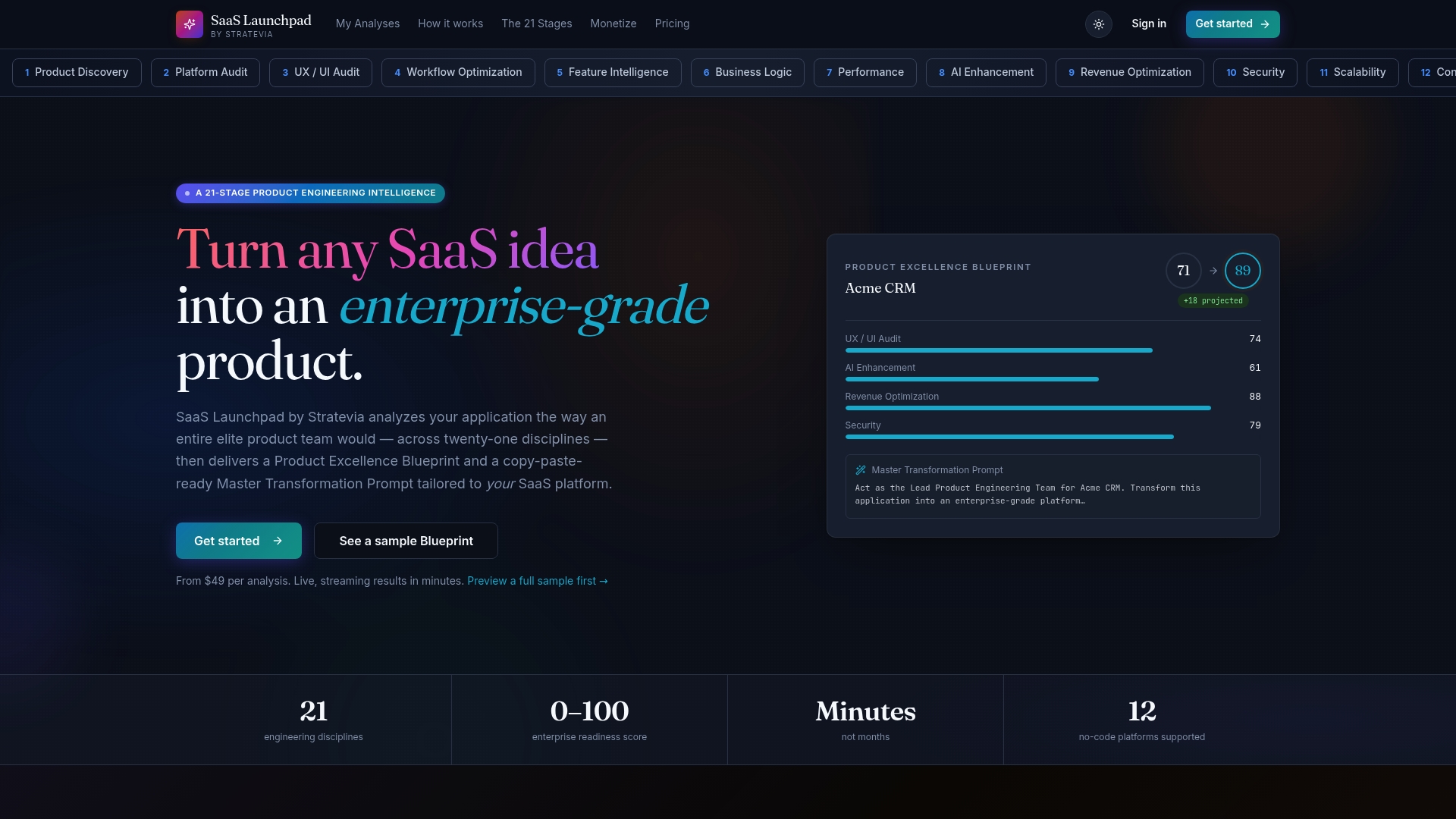
SaaS LaunchPad's 21-discipline product analysis covers every dimension covered in this guide, from security and compliance to scalability, integration maturity, enterprise readiness scoring, and a phased execution strategy, and delivers two outputs: a Product Excellence Blueprint and a copy-paste-ready Master Transformation Prompt tailored to your platform. There is no subscription and no retainer. You purchase credits, run the analysis, and get a blueprint your team can act on immediately. If you are preparing for your first enterprise pilot or trying to close a deal that stalled at security review, the compliance check for cybersecurity is a practical starting point. Run the full analysis at saaslaunchpad.org and have your Product Excellence Blueprint in hand before your next procurement conversation.
Useful sources
The following sources informed this guide and are worth consulting directly depending on your immediate need.
For security and compliance foundations:
- NIST Cybersecurity Framework — the authoritative U.S. framework for risk management; start here if you are preparing for federal or regulated-industry buyers
- SOC 2 overview via AICPA — the primary source for understanding SOC 2 Trust Services Criteria
- SaaS LaunchPad compliance check for cybersecurity — practical guide for preparing compliance evidence and security questionnaire responses
For architecture and integration:
- Microsoft Azure: What is SaaS? — covers multitenancy models and cloud delivery architecture
- Oracle: What Is SaaS? — describes unified data models and standards-based enterprise SaaS architecture
For enterprise readiness and procurement:
- SaaS LaunchPad enterprise readiness audit checklist — structured checklist covering security, data sovereignty, compliance, and governance
- CDW: Enterprise SaaS Software Solutions — migration planning and deployment partner context
- PTC: Enterprise SaaS industry insights — operational benefits and enterprise SaaS definition
- ServiceNow: What is enterprise SaaS? — OpEx trade-offs and SaaS sprawl governance
For operational and go-to-market planning:
- SaaS LaunchPad: Enterprise Software vs. SaaS guide — deployment model trade-offs and large-organization positioning
- SaaS LaunchPad: 21-discipline product analysis — full breakdown of the analysis stages and deliverables
Start here based on your immediate need:
- Security gaps blocking a deal: begin with the NIST CSF and the SaaS LaunchPad compliance check
- Integration or API maturity: start with the Oracle and Microsoft Azure sources
- Procurement and governance: begin with the CDW and ServiceNow sources, then run the SaaS LaunchPad audit checklist
FAQ
What is enterprise SaaS in simple terms?
Enterprise SaaS is cloud software built to meet the security, scale, and governance requirements of large organizations, including features like SSO, RBAC, SOC 2 compliance, contractual SLAs, and data residency controls that typical SMB SaaS products do not offer.
How long does it take to make a SaaS product enterprise-ready?
Most products need six to twelve months, with the longest phase being SOC 2 Type II certification, which requires a minimum six-month audit observation period before a report can be issued.
What is the difference between SOC 2 Type I and Type II?
SOC 2 Type I is a point-in-time assessment of your controls; Type II covers a six-to-twelve-month period and provides evidence that controls operated effectively over time. Enterprise buyers almost always require Type II.
What does SaaS LaunchPad do for enterprise readiness?
SaaS LaunchPad runs a 21-discipline product analysis that scores your platform across security, architecture, compliance, integrations, and more, then delivers a Product Excellence Blueprint and a Master Transformation Prompt your team can act on immediately.
What is the minimum an enterprise buyer requires before a pilot?
At minimum, enterprise buyers typically require SSO support, documented RBAC, a SOC 2 report or credible roadmap, a signed DPA, and a contractual SLA with uptime and incident response commitments before approving a pilot.