SaaS revenue is the income your company has earned by delivering contracted subscription services during a specific period — not the cash you collected, not the contracts you signed. Under GAAP and ASC 606, revenue is recognized only when a performance obligation is satisfied, which for most subscriptions means ratably over the service period.
Two distinctions every founder must internalize:
- Bookings are signed contract values. Recognized revenue is what you've actually earned and can report on your P&L.
- Cash collected (billings) can arrive months before you've earned a dollar of revenue — that gap lives on your balance sheet as deferred revenue until you deliver the service.
The rest of this guide covers ASC 606 mechanics, the metric formulas (MRR, ARR, Net Revenue Retention), a worked $120,000 prepayment example, and an audit-ready checklist.
Table of Contents
- What does SaaS revenue actually include?
- How does ASC 606 apply to SaaS subscriptions?
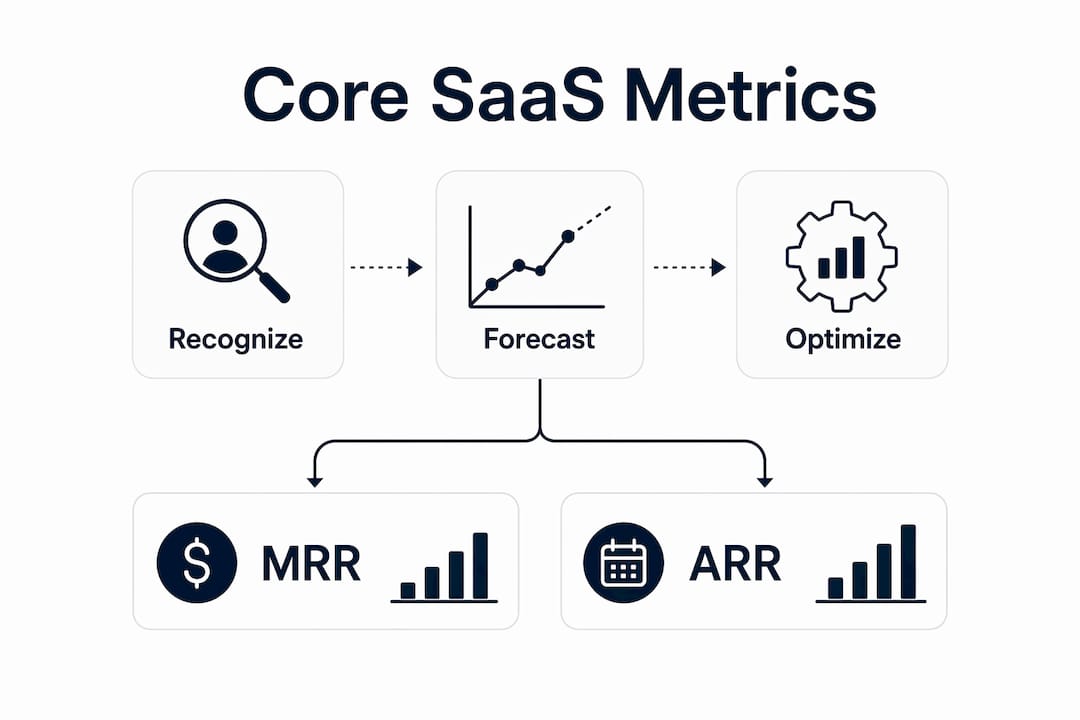
- What are the core SaaS revenue metrics and formulas?
- How do you forecast SaaS revenue accurately?
- Why does your pricing design determine your revenue ceiling?
- What mistakes do founders make about SaaS revenue?
- Worked example: $120,000 annual prepayment to recognized revenue
- What documents do auditors and investors actually want?
- Key Takeaways
- Revenue analysis should drive product prioritization
- SaaS LaunchPad turns revenue analysis into a product roadmap
- Useful sources and further reading
- FAQ
What does SaaS revenue actually include?
Recognized revenue is accrual-based: it hits your P&L when you deliver the service, regardless of when the customer paid. Here's what counts and what doesn't:
| Revenue Type | Counts Toward Recognized Revenue? | Notes |
|---|---|---|
| Monthly subscription fees | Yes | Core recurring revenue |
| Annual subscription (ratably recognized) | Yes | $1,200/yr = $100/month recognized |
| Usage overages | Yes, when usage occurs | Recognize in the period consumed |
| Professional services (delivered) | Yes, when earned | Recognize as milestones are met |
| One-time setup fees | Conditional | Only when the setup obligation is fulfilled |
| Unapplied discounts / credits | No | Reduce transaction price; not revenue |
| Refunds | No | Reverse previously recognized revenue |
For recurring revenue metrics (MRR, ARR), the scope is narrower: normalize subscription fees to monthly amounts and exclude one-time fees entirely. A $1,200 annual plan contributes $100 MRR, not $1,200.
How does ASC 606 apply to SaaS subscriptions?
The five-step model is the operational framework every SaaS finance and product team must apply:
- Identify the contract — signed agreement with enforceable rights and payment terms.
- Identify performance obligations — each distinct service the customer is entitled to (platform access, implementation, premium support).
- Determine the transaction price — total consideration, net of discounts and variable elements.
- Allocate the price — split across obligations using standalone selling prices.
- Recognize revenue — as each obligation is satisfied (over time for subscriptions; at a point in time for one-time deliverables).
Operational checklist for your team:
- Document renewal and termination clauses — they affect whether a contract modification resets or modifies the original obligation.
- Define usage measurement rules in writing before billing goes live.
- Log every contract modification with a dated memo explaining the accounting treatment.
- For bundled arrangements (e.g., platform + onboarding + support), allocate consideration to each element using standalone selling prices.
Journal entry examples:
Annual prepay at invoice (January 1):
- Dr. Cash $12,000 / Cr. Deferred Revenue $12,000
Monthly recognition (January 31):
- Dr. Deferred Revenue $1,000 / Cr. Revenue $1,000
Usage overage recognized when consumed:
- Dr. Accounts Receivable $500 / Cr. Revenue $500
Pro Tip: Maintain an ASC 606 memo that maps each contract clause to a specific performance obligation. Auditors and investors will ask for it — having it ready before a Series B or audit saves weeks of scrambling.
What are the core SaaS revenue metrics and formulas?
Net Revenue Retention is the single metric that integrates expansion, contraction, and churn — and it often reveals product-market fit more clearly than new ARR alone. Here are the formulas every product leader needs:

| Metric | Formula |
|---|---|
| MRR | Sum of all normalized monthly subscription fees |
| ARR | MRR × 12 |
| New MRR | MRR from new customers in the period |
| Expansion MRR | Additional MRR from upgrades/upsells to existing customers |
| Contraction MRR | MRR lost from downgrades |
| Churned MRR | MRR lost from cancellations |
| Net MRR Change | New MRR + Expansion MRR − Contraction MRR − Churned MRR |
| NRR | (Beginning MRR + Expansion − Contraction − Churn) ÷ Beginning MRR × 100 |
An NRR above 100% means your existing customer base is growing on its own — new sales become acceleration, not survival.
One-time fees and professional services belong in a separate revenue line. Mixing them into MRR inflates your recurring baseline and masks real churn trends.
Pro Tip: For enterprise accounts with multi-seat changes, calculate ARPA (Average Revenue Per Account) at the account level, not the seat level. A 50-seat account that drops to 45 seats is a contraction event, not churn — and it should flow through Contraction MRR, not Churned MRR.
How do you forecast SaaS revenue accurately?
Accurate forecasting requires integrating billing, CRM, and product-usage analytics — omitting any of these inputs causes systematic forecast bias.
Required inputs:
- Billing schedule and deferred revenue ledger
- CRM contract start/end dates and renewal probabilities
- Usage telemetry by account (for usage-based components)
- Historical churn and contraction rates by cohort
- Planned expansion motions (upsell pipeline, pricing changes)
- Discount schedules and promotional commitments
Model components to build:
- Cohort-based MRR bridge — start with current MRR, add new and expansion, subtract contraction and churn.
- Subscription-level revenue schedules — one row per active contract, showing monthly recognition through term end.
- Deferred revenue amortization schedule — reconciles balance sheet to P&L each period.
- Scenario assumptions — best/base/worse churn and expansion rates.
Common error modes to avoid:
- Treating signed bookings as recognized revenue in the same period.
- Omitting contraction MRR from the model (downgrades are quiet killers).
- Failing to reconcile product usage data with invoiced amounts before closing the books.
Reforecast monthly for early-stage companies; quarterly once you hit predictable cohort behavior. The SaaS RevOps guide covers the operational alignment between billing systems, CRM, and product analytics in more detail.
Why does your pricing design determine your revenue ceiling?
The value metric — what the customer actually pays for as they grow — matters more than the model label you put on your pricing page. Choosing the wrong unit of charge means expansion revenue doesn't flow automatically, even when customers are getting more value.
| Pricing Category | Recognition Pattern | Expansion Mechanic |
|---|---|---|
| Seat-based | Ratable over term; seats × price/month | Seat additions = Expansion MRR events |
| Usage-based | Recognized when usage occurs | Organic growth as consumption rises |
| Outcome-based | Milestone or period recognition | Tied to measurable customer outcomes |
A decision checklist for product teams testing value-metric alignment:
- Does the pricing unit grow when the customer gets more value from the product?
- Can your billing system measure and invoice that unit accurately?
- Does the unit create an incentive to increase usage rather than throttle it?
- Is the unit intuitive enough that customers can forecast their own costs?
For A/B or cohort experiments, measure Expansion MRR rate and self-serve upgrade rate as the primary signals. If expansion MRR is near zero after a pricing change, the upgrade path isn't working. Healthcare SaaS teams face additional complexity here — the healthcare SaaS revenue model evaluation guide covers value-metric choices in regulated verticals.
What mistakes do founders make about SaaS revenue?
- Treating bookings as revenue. A signed $120,000 annual contract is a liability until you deliver the service. Spending against it immediately risks burning cash that's still on your balance sheet as deferred revenue.
- Mixing one-time fees into MRR. Implementation fees recognized in month one inflate MRR artificially, then vanish — making churn look worse than it is the following month. Fix: create a separate non-recurring revenue line and exclude it from all MRR calculations.
- Ignoring contract modifications. A mid-term upgrade or downgrade is a modification event under ASC 606 and may require reallocation of the transaction price. Undocumented modifications are the most common audit finding in SaaS.
- Misclassifying discounts. A promotional discount reduces the transaction price and therefore recognized revenue — it's not a marketing expense. Fix: ensure your billing system passes net amounts to the revenue ledger, not gross with a separate discount line.
These errors compound fast in investor reporting. Overstated MRR inflates ARR, which inflates implied valuation multiples, which creates a painful restatement conversation at due diligence. The enterprise audit checklist covers the documentation investors will request.
Worked example: $120,000 annual prepayment to recognized revenue
A customer signs a $120,000 annual contract on January 1 and pays upfront.
Journal entries:
| Date | Entry | Debit | Credit |
|---|---|---|---|
| Jan 1 | Cash | $120,000 | |
| Jan 1 | Deferred Revenue | $120,000 | |
| Jan 31 | Deferred Revenue | $10,000 | |
| Jan 31 | Revenue | $10,000 |
Quarterly P&L impact: $30,000 recognized per quarter.
MRR bridge impact (January):
- Beginning MRR: $0 (new customer)
- New MRR added: +$10,000
- Ending MRR: $10,000
- Implied ARR: $120,000
If the customer cancels after month 3, you reverse the remaining $90,000 of deferred revenue — you do not recognize it. That's the operational reality of treating prepayments as liabilities first.
What documents do auditors and investors actually want?
Finance ownership:
- Deferred revenue schedule (opening balance, additions, recognized amounts, closing balance by contract)
- Contract repository with signed agreements and modification logs
- ASC 606 accounting memo mapping contract clauses to performance obligations
- Sample invoices reconciled to recognized revenue entries
Product ownership:
- Feature usage logs showing service delivery by account and period
- Entitlement reconciliation reports confirming customers received contracted access
- Usage measurement methodology documentation for any consumption-based billing
Both teams:
- Contract modification log with accounting treatment for each event
- Discount and refund register reconciled to the revenue ledger
Auditors flag gaps between what the contract promises and what usage logs confirm was delivered. Product teams that instrument entitlements and usage from day one make this reconciliation straightforward rather than a fire drill.
Key Takeaways
SaaS revenue is earned income recognized ratably over the service period under ASC 606 — not cash collected, not bookings, and never a number you can inflate by mixing in one-time fees.
| Point | Details |
|---|---|
| Recognition vs. cash | Recognized revenue hits the P&L when service is delivered; prepayments are deferred revenue on the balance sheet until earned. |
| Track NRR as the health signal | NRR integrates expansion, contraction, and churn — an NRR above 100% means existing customers grow your revenue without new sales. |
| Normalize MRR correctly | Divide annual plans by 12; exclude one-time and professional services fees to avoid inflating recurring metrics. |
| Maintain an ASC 606 memo | Document every contract clause mapped to a performance obligation — auditors and investors will request it at due diligence. |
| SaaS LaunchPad revenue audit | SaaS LaunchPad's 21-stage product analysis covers revenue optimization, entitlement reconciliation, and pricing alignment across your platform. |
Revenue analysis should drive product prioritization
The most underused insight in SaaS product work is that recognized revenue data tells you which features are actually delivering value — not which ones users click on. When we look at a product through the lens of NRR drivers, the picture is almost always different from what the roadmap assumed.
Entitlement gaps are a recurring finding: customers are paying for capabilities they never activated, which means expansion conversations stall because the baseline value was never delivered. Usage instrumentation — knowing exactly which features drove a seat expansion or triggered a contraction event — is the evidence that connects product decisions to revenue outcomes. Without it, pricing experiments are guesses.
The other pattern worth naming: founders who treat pricing as a one-time decision consistently underperform on NRR. Pricing alignment with the value metric is a living calibration, not a launch artifact. Mature teams run a cross-functional pricing review on a regular cadence, pulling ARPU trends, expansion signals, and churn cohort data together before making any tier or packaging change. That discipline is what separates companies that grow through their existing base from those that need constant new-logo acquisition to offset silent contraction.
SaaS LaunchPad turns revenue analysis into a product roadmap
Most product teams know their MRR. Far fewer know why it's growing or contracting at the feature level. SaaS LaunchPad closes that gap with a 21-stage product analysis that covers revenue optimization, entitlement reconciliation, pricing alignment, and usage instrumentation — delivered as a Product Excellence Blueprint and a copy-paste-ready Master Transformation Prompt you can act on immediately.
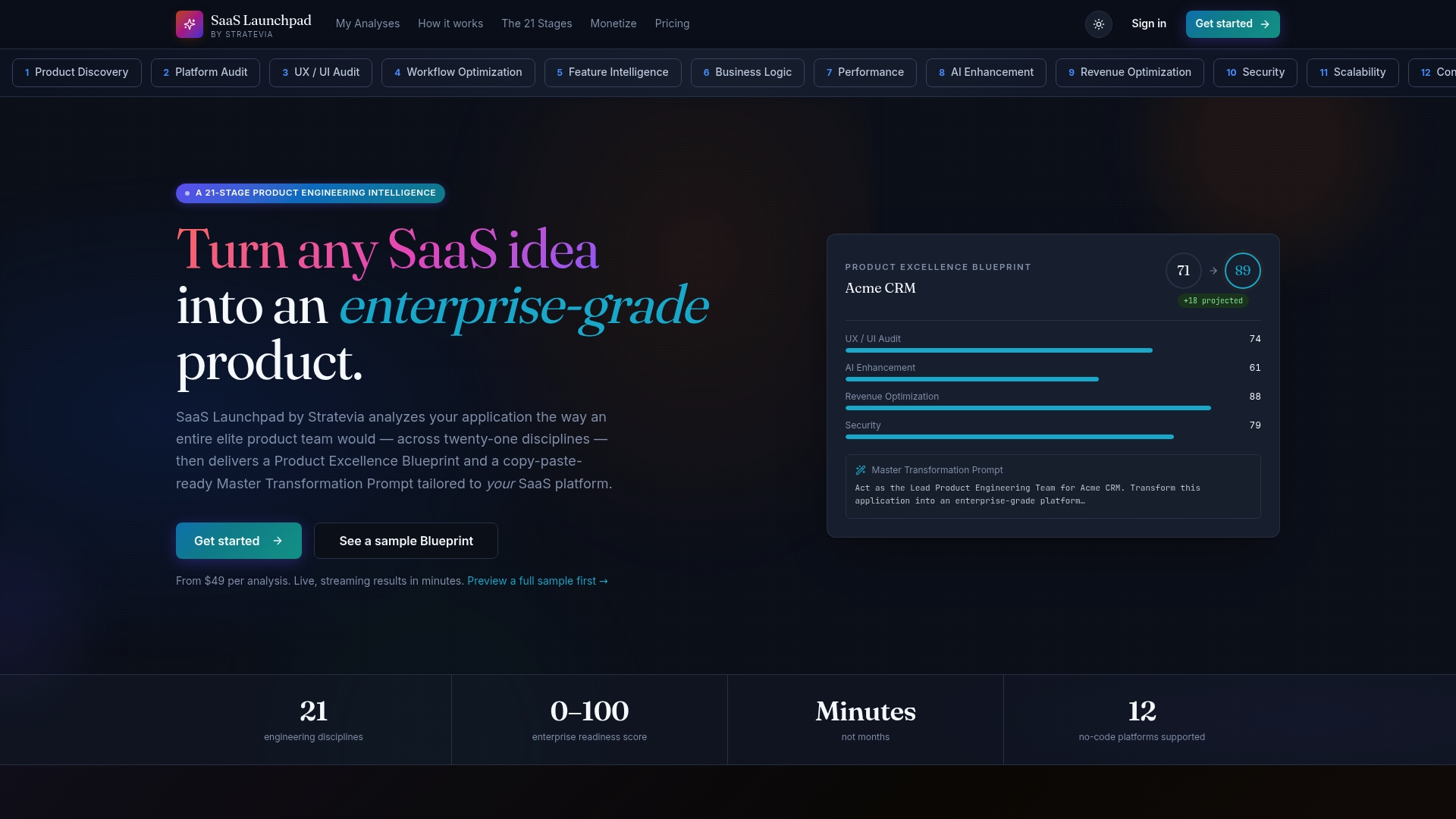
No subscription required. Purchase credits, run the analysis, and get a prioritized roadmap tied to recognized revenue impact.
- Revenue optimization audit: identifies pricing misalignment, entitlement gaps, and expansion blockers.
- Prioritized improvement roadmap: ranks product changes by revenue and retention impact.
- Master Transformation Prompt: copy-paste-ready for your no-code or development platform.
Run your product analysis and see exactly where recognized revenue is being left on the table.
Useful sources and further reading
- KPMG Handbook: Revenue for Software and SaaS — the definitive ASC 606 reference for SaaS contract treatment, bundling, and modifications.
- Chargebee SaaS Revenue Recognition Guide — practical walkthrough of bookings-to-recognized-revenue conversion with documentation guidance.
- Paddle: SaaS Revenue Recognition Examples — prepayment and deferred revenue treatment with journal entry examples.
- Stripe: Net Revenue Retention — NRR definition, formula, and benchmarks for high-growth SaaS.
- Baremetrics: How to Calculate MRR — normalization rules and MRR component definitions.
- SaaS LaunchPad RevOps Guide — aligning billing, CRM, and product analytics for accurate revenue forecasting.
- SaaS LaunchPad Enterprise Audit Checklist — documentation and evidence requirements for investor diligence.
FAQ
What is SaaS revenue vs. bookings?
SaaS revenue is income earned by delivering contracted services during a period; bookings are the total value of contracts signed, regardless of when service is delivered or revenue recognized.
How do you calculate MRR for an annual plan?
Divide the annual contract value by 12. A $1,200 annual plan contributes $100 MRR — never $1,200 in the month of signing.
What is a good NRR for a SaaS company?
An NRR above 100% means existing customers are expanding faster than they churn or contract. Usage-based companies with strong product-market fit often reach 120% NRR.
When is deferred revenue recognized as SaaS revenue?
Deferred revenue is recognized ratably as the service is delivered — typically monthly over the subscription term. A $12,000 annual prepayment becomes $1,000 of recognized revenue each month.
How does SaaS LaunchPad help with revenue optimization?
SaaS LaunchPad's 21-stage product analysis covers entitlement reconciliation, pricing alignment, and usage instrumentation — the product-layer inputs that directly affect recognized revenue and NRR.