
Finding a consulting agency that can deliver SaaS productization with real automation and compliance coverage is harder than it should be. Most listings focus only on advisory reports or generic subscription software instead of platform-specific audits, ownership guarantees, or legal integration for regulated fields. This comparison lets founders, agencies, and studios pick a consulting team with audit, automation, and compliance fit for their next SaaS launch.
Table of Contents
SaaS Launchpad by Stratevia
At a Glance
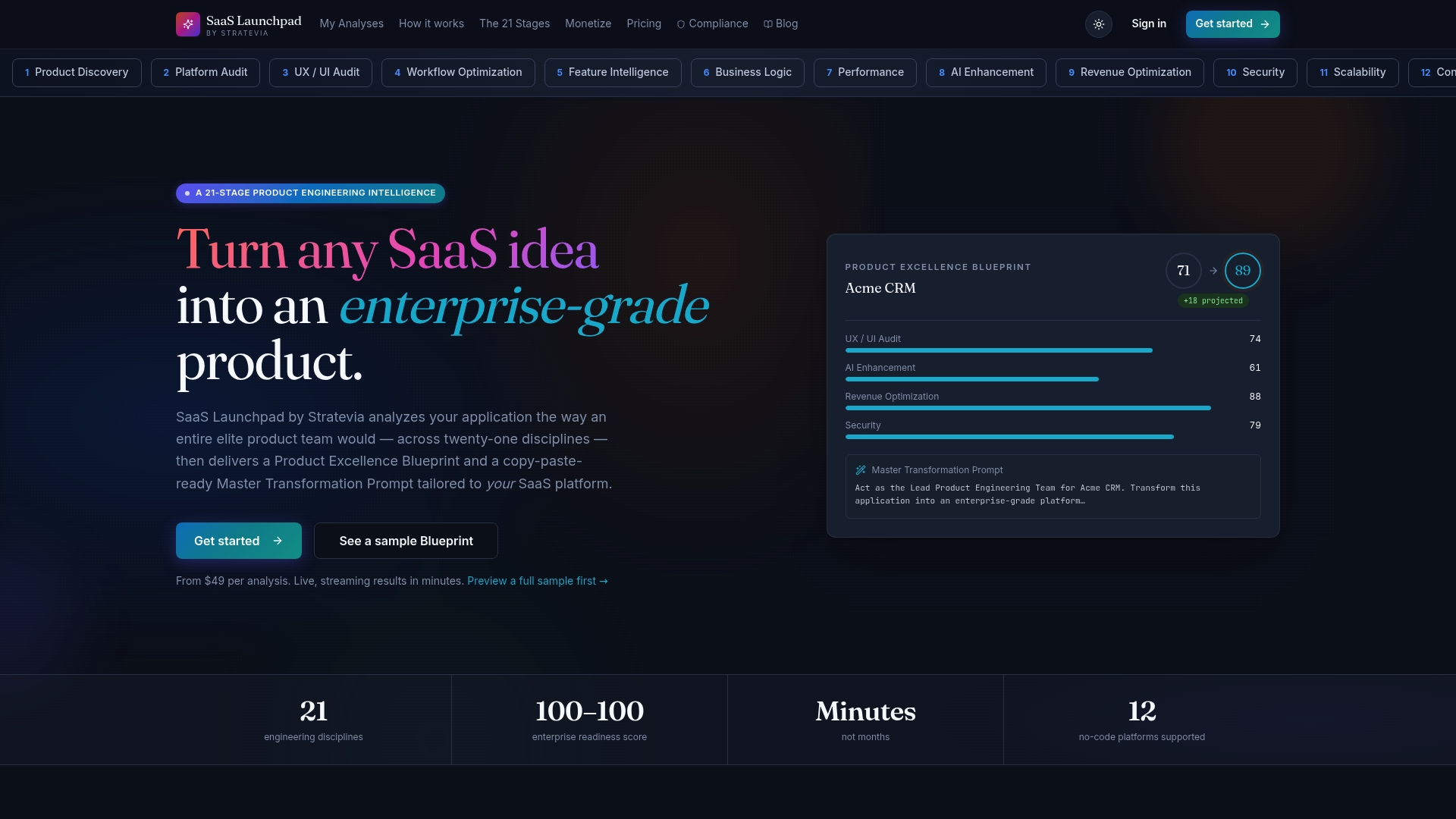
According to the company, the service produces a Product Excellence Blueprint and a tailored Master Transformation Prompt through minutes long streaming analysis. That streaming claim means you can see staged recommendations while the tool analyzes your app. The approach targets no code SaaS builds and focuses on practical, implementable next steps.
Core Features
SaaS Launchpad runs a 21 stage product engineering analysis and streams the findings in real time so you can watch issues and recommendations appear. The output includes a Product Excellence Blueprint report and a copy and paste ready Master Transformation Prompt tailored to your platform and stack. The workflow supports multiple no code platforms such as Bubble, Webflow, Manus, and Lovable with platform specific prompts.
Key Differentiator
The key differentiator is the combination of a broad multi disciplinary analysis and a live streaming interface that emits a rebuild prompt tuned to your stack. That live analysis claim lets teams iterate while they review instead of waiting for a static report. The result imitates what a full product team would produce in a short session, giving prioritized tasks and platform specific instructions.
Pros
The analysis covers twenty one product disciplines, which gives a broad audit comparable to a larger product team. The streaming results show recommendations as they are discovered, so you can triage issues immediately rather than parsing a long static file. Pricing is pay per analysis with no subscription, which suits irregular audits and one off pre launch reviews. Support for many no code platforms means the prompts are tailored rather than generic, and the output is a ready to implement plan and prompt for rebuilds or fixes.
Cons
- Focused on no code SaaS products; less suitable for code heavy applications or teams that need deep custom engineering analysis.
Who It's For
Founders, product studios, and agencies that build or iterate SaaS products on no code tools will get the most value. Teams that need a quick pre launch audit or a platform specific rebuild prompt can act on the recommendations without hiring a full product team. Organizations with mostly custom code bases will find the fit narrower.
Unique Value Proposition
From $49 per analysis, you buy a single targeted audit with no subscription commitment. That single fee model makes short cycle testing and audit for multiple projects feasible. For agencies and studios this translates to lower upfront cost to validate product direction and generate a copy and paste rebuild prompt for rapid execution.
Real World Use Case
A startup built on Bubble runs an analysis, watches the streaming output, and receives the Product Excellence Blueprint plus a rebuild prompt. The team prioritizes the top fixes from the streamed recommendations and applies platform specific changes the same week. The audit converts into concrete tasks and code free rebuild steps for faster iteration.
Pricing
Pricing starts from $49 per analysis and uses a pay per analysis model with no subscription required. The vendor lists support for live streaming results and platform specific prompts as part of the analysis package.
Website: https://saaslaunchpad.org
Chronexa
At a Glance
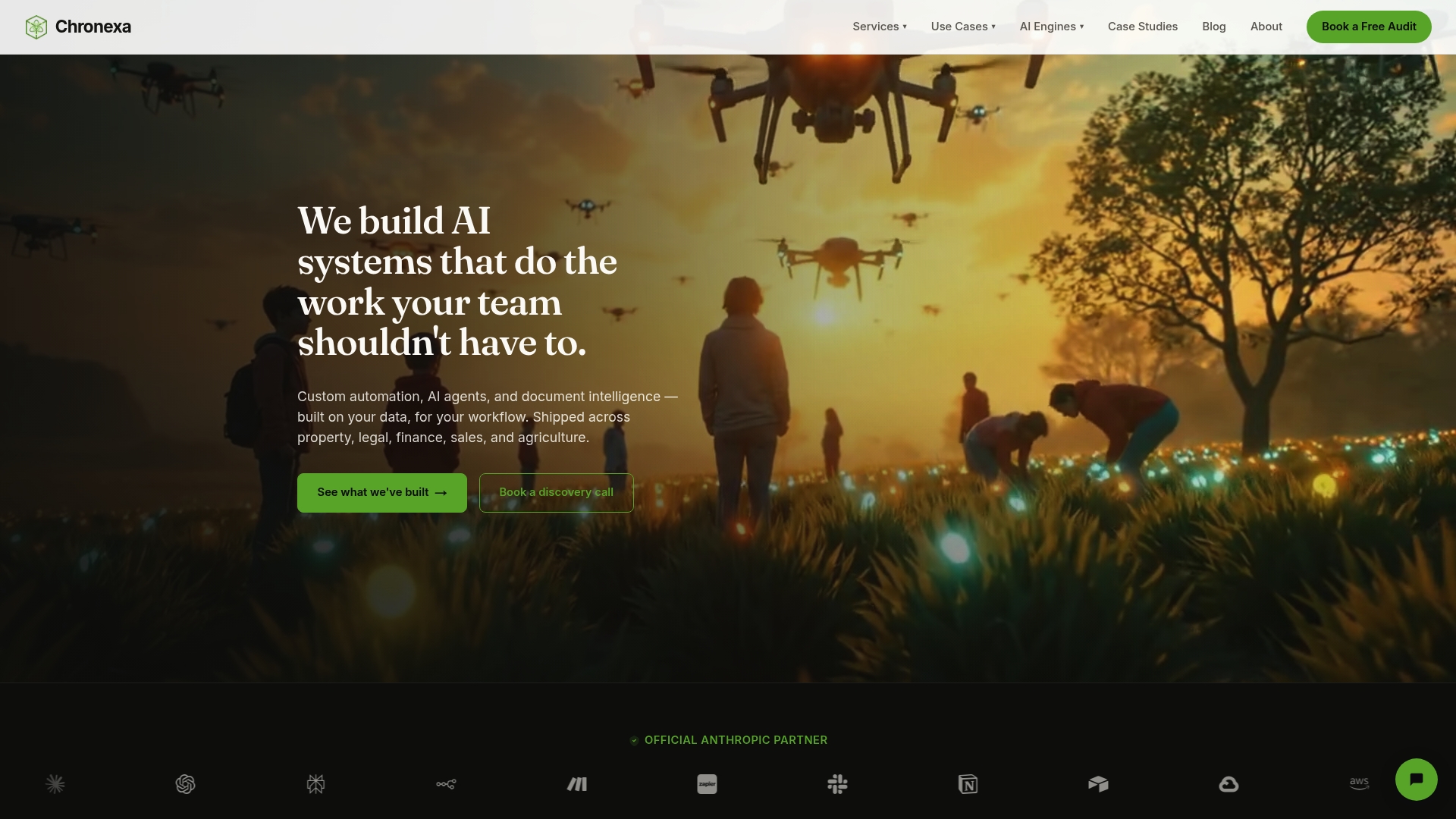
Chronexa reports an 80% reduction in manual processing and claims it unlocked more than $12 million in client revenue. The company builds custom AI systems that run inside client infrastructure rather than through public hosted subscriptions. That approach targets compliance-driven firms that need asset ownership and strict data controls.
Core Features
Chronexa delivers custom AI systems integrated into client environments, including private deployment on customer cloud or on-prem infrastructure. It automates document processing and data extraction and supplies AI agents that handle multi-step workflows. The platform also offers knowledge engines with citation tracking and permission controls for governed access.
Key Differentiator
The core distinction is built-in ownership of AI assets deployed in client-controlled environments, which shifts data custody and governance to the buyer. That model reduces reliance on third-party hosted models for teams that must keep data inside their legal or corporate perimeter.
Pros
Chronexa gives firms tailored enterprise AI with asset ownership and deployment under customer control, which lowers exposure to external data handling. Its start-to-finish project method covers auditing, scoping, building, and ongoing support, so clients receive a managed program rather than an off-the-shelf license. The vendor emphasizes experience in regulated fields such as legal, finance, and insurance, and those results are presented as measurable ROI and time savings.
Cons
-
Complex deployment: Custom projects typically take longer to implement than prebuilt tools. This extends time to value for smaller teams.
-
Higher upfront cost: Projects require significant scoping and initial investment before delivery. That makes Chronexa less attractive for low-budget pilots.
-
Sparse independent reviews: Third-party user feedback about integration ease and day-to-day UX is limited. That gap increases procurement risk for organizations that require peer validation.
When It May Not Fit
If you need a quick proof of concept with minimal budget, Chronexa is likely a poor match. Organizations seeking monthly subscription software and turn-key setup will find the model heavy on initial scoping. The product is best when your workflows involve strict regulatory controls and long-term ownership of automation assets.
Notable Integrations
Chronexa lists connectors and integrations for common enterprise systems used in regulated workflows. Primary integrations include:
- iManage
- NetDocuments
- Relativity
- Salesforce
- QuickBooks
- Xero
Who It's For
Chronexa suits enterprise legal, accounting, and financial firms that require custom AI automation inside their environments. Choose it if your compliance rules demand data custody and audited knowledge sources. It also fits teams prepared to commit to a scoped project and longer implementation.
Real World Use Case
A law firm used Chronexa to automate regulatory compliance monitoring and document review. The deployment moved document processing into the firm’s private cloud and reduced manual review hours while keeping citations and permissions under firm control.
Pricing
Pricing is not publicly listed. Chronexa typically scopes projects and charges a fixed price after an initial audit, and the vendor advertises a 90-day ROI guarantee for scoped engagements. Budget planning should account for higher initial costs relative to subscription tools.
Website: https://chronexa.io
n8n Developers
At a Glance
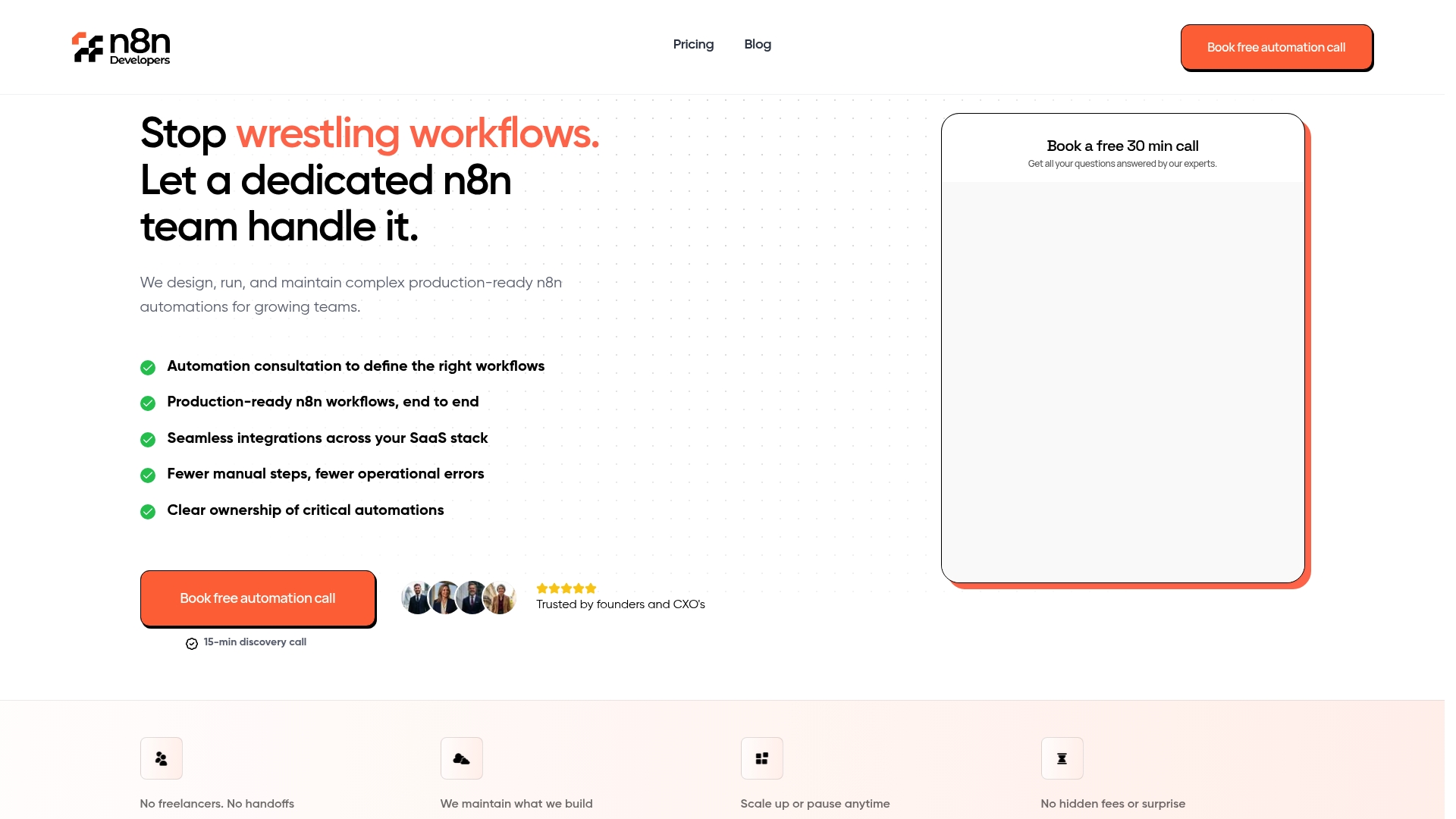
Transparent hourly billing starts at $30/hour, with larger hourly blocks offered at higher rates. The vendor advertises high client satisfaction and a proven track record. The offering targets production ready n8n workflow delivery plus ongoing monitoring and support.
Core Features
n8n Developers provides automation consultation to define workflows, builds production ready n8n workflows end to end, and connects those workflows to a company SaaS stack for data movement and API orchestration. Work focuses on reducing manual steps and operational errors while assigning clear ownership for critical automations. Ongoing monitoring and maintenance handle error detection and runbook updates.
Key Differentiator
A dedicated automation team model sets this offering apart. Clients get an automation manager who owns delivery and ongoing support, plus flexible engagement models and transparent hourly billing. That structure fits teams that want an external group to run and evolve automations rather than hand off singular scripts.
Pros
Dedicated staffing means one party takes responsibility for design, deployment, and ongoing fixes, which reduces internal coordination overhead. Flexible engagement models include hourly work, volume blocks, and retainer style agreements that let teams scale up or down. Transparent pricing beginning at $30/hour makes budgeting predictable, and the team claims real experience scaling n8n automations for mid sized and larger workflows.
Cons
- Pricing may be higher than in house development for very small projects or simple automations. This can make the service uneconomical for one off tasks.
- Focus on complex, production ready automations may be more than needed for minimal integrations or one page tasks. Teams with single simple flows will pay for unused capabilities.
- Public information lacks detail on any proprietary tooling or specialist automation methodology, which makes technical evaluation harder for engineering teams.
When It May Not Fit
Teams with single, simple automations or one time connector needs will likely find the engagement model and rates excessive. Companies that want only short term experiments without maintenance will pay more than a developer contractor. Very small firms with strict budgets may prefer internal hires or lower cost freelance help for tiny projects.
Who It's For
Growing product teams and operations teams that need reliable, production ready n8n automation and do not want to staff a full internal automation team. This fits organizations that value ongoing monitoring, clear ownership, and predictable billable hours. It also fits teams that plan to expand automation work over months.
Real World Use Case
A mid sized tech company hires n8n Developers to build customer data integration workflows. The vendor built end to end connectors, scheduled batch jobs, and added monitoring that reduced manual data entry and errors. The internal team reclaimed engineering time to focus on product features.
Pricing
Pricing starts at $30 per hour for transparent hourly billing. Other packages include hourly blocks priced at $60 to $75 per hour, sold in 10, 50, or 100 hour blocks with discounts for larger commitments.
Website: https://n8ndevelopers.com
QuickFlows
At a Glance
QuickFlows' marketing materials state a focus on GDPR and EU AI Act compliance for German businesses. The agency pairs legal alignment with tailored automation pipelines that target sales, customer engagement, and document processing. The vendor advertises real-world results with systems running in production.
Core Features
They run tool audits, deliver AI upskilling, build workflow demos, and provide ongoing support for live operations. Deliverables include CRM automation, WhatsApp assistants, browser scraping, and AI document processing with OCR and semantic search. Projects mix custom AI agents with rule based automations and integration work to move solutions into production.
Key Differentiator
That compliance focus targets teams that must meet EU regulations while deploying automation pipelines. QuickFlows ties legal and privacy requirements to custom execution, not only advisory reports. This alignment suits German clients who handle sensitive customer data and must document safeguards.
Pros
QuickFlows offers end to end services from tool audits and training through development and post launch support, leaving one vendor accountable for delivery. That compliance orientation reduces friction for teams that require EU alignment during deployment. They automate sales workflows, customer messaging, and large document processing, with the vendor reporting production deployments.
Cons
- Buyer suitability is narrow. The agency works with firms prepared to adopt automation and AI rather than exploratory pilots.
- Some projects need existing technical infrastructure and integration capacity, which small teams may lack.
- Pricing details are sparse. Packages often require custom scoping and may vary by project.
When It May Not Fit
If your team lacks engineering resources, integration work may stall during implementation. Clients without a clear automation use case may face long scoping and higher costs. Complex customizations often require outside developers or extended timelines.
Who It's For
Small and medium businesses seeking compliant AI automation for sales, support, or document workflows will find this agency relevant. German or EU companies with strict data protection needs benefit most from their legal alignment. Organizations that prefer a single vendor for audit, build, and support will get clearer ownership.
Real World Use Case
A B2B technology company automated deal proposals by integrating Pipedrive with custom proposal generation. Auto service shops use WhatsApp agents for appointment reminders and follow up messages. Teams also run browser scraping projects to extract data where APIs do not exist.
Pricing
Pricing is not publicly listed. QuickFlows reportedly issues custom quotes based on project scope, deliverables, and compliance requirements. Request a proposal to get a breakdown covering audit, build, and ongoing support phases.
Website: https://quickflows.de
Comparison of alternatives
SaaS Launchpad introduces a distinctive approach by offering streaming, real-time product analyses coupled with no-code rebuild prompts tailored to platforms, enabling immediate modifications during the review process. Traditional offerings, such as scoped projects or hourly automation support, cater differently to various needs, creating clear trade-offs between regular and project-based services.
Expertise Areas and Applications
Chronexa excels in environments requiring custom AI deployment within private infrastructures. This model provides strict data custody and governance suited for regulated sectors. n8n Developers focuses on production-grade automation workflows, with transparent hourly billing starting from $30/hour. QuickFlows addresses compliance-aligned automation for EU companies, integrating workflows with GDPR adherence. Each service targets a specific niche, showing diversity in use-case emphasis.
Pricing and Accessibility
SaaS Launchpad operates on a pay-per-analysis pricing model starting at $49, avoiding subscription commitments and suiting sporadic audits. n8n Developers offer flexible payment packages tied to task volume, catering to scaled automation work. Chronexa and QuickFlows follow scoped pricing, often requiring higher initial budgets but delivering tailored solutions. These financial structures impact adoption decisions depending on team needs and project frequency.
Best fit
- No-code SaaS developers seeking platform-tailored rebuild prompts without subscription obligations benefit most from SaaS Launchpad’s streamed analysis method.
- Firms in regulated industries needing custom AI within compliant infrastructures find Chronexa appealing for its ownership-first deployment model.
- Teams requiring long-term supervision and production-ready automation workflows lean towards n8n Developers for scalability and transparent contracts.
- European businesses needing automation within GDPR guidelines and legal alignment see value in QuickFlows’ compliance-first focus.
Our pick
SaaS Launchpad emerges as the preferred option for no-code teams demanding rapid, output through real-time analysis and rebuild prompts tailored to supported platforms. It enables immediate recommendation cycles conducive to independent audits without recurring subscriptions, ensuring flexibility in product iteration workflows that are difficult to replicate through other services.
For those seeking a service that delivers tailored and effective automation solutions for niche needs, here is a comparison of some options:
| Product | Key Differentiator | Best For | Pricing | Limitation |
|---|---|---|---|---|
| SaaS LaunchPad | Live-streamed 21-stage analysis with rebuild prompts | Founders utilizing no-code tools | From $49 per analysis | Best for SaaS; limited for heavy custom-code applications |
| Chronexa | Custom AI assets with client data ownership | Regulated industries requiring compliance | Price not published | High upfront cost, limited user reviews |
| n8n Developers | Dedicated automation team offering transparent hourly billing | Teams scaling complex automations | From $30/hour | Not suitable for small or minimal automation projects |
| QuickFlows | Tailored automation with GDPR and EU AI Act compliance | EU businesses with strict data protection | Price not published | Requires technical infrastructure; less suitable for small teams |
Challenges Teams Face When Searching for Zapier Alternatives on Reddit
Many founders, product studios, and agencies find selecting an automation platform harder than expected. They want clear, actionable improvements without waiting for lengthy reports or drowning in generic advice. SaaS LaunchPad offers a different approach by analyzing your no-code SaaS app like a full expert product team. It delivers a prioritized Product Excellence Blueprint along with a copy-paste-ready Master Transformation Prompt tailored to platforms like Bubble and Webflow.
Key benefits include:
- Real-time streaming analysis so you address issues as they arise
- Multi-disciplinary review covering 21 product areas
- No subscription fees — just pay per audit
Explore how SaaS LaunchPad can improve your SaaS application and get a clear, prioritized plan to refine your workflow automations and product features today.
Visit SaaS LaunchPad to start your one-time audit and receive actionable next steps crafted for your stack.
FAQ
What makes SaaS LaunchPad ideal for no-code product audits?
SaaS LaunchPad generates real-time product engineering analysis tailored for no-code platforms. It runs a 21-stage product engineering analysis and streams findings live, helping teams watch issues and recommendations appear immediately. Start using SaaS LaunchPad to streamline your no-code product audits.
How does SaaS LaunchPad compare to Chronexa for regulatory needs?
Chronexa provides custom AI systems for tight regulatory control, making it ideal for firms needing custom automation in highly regulated environments. SaaS LaunchPad, in contrast, is better suited for no-code product assessments, particularly for those looking for quick pre-launch audits without extensive custom setups. Assess your specific needs to choose the best option.
Which platforms does SaaS LaunchPad support for tailored prompts?
SaaS LaunchPad supports multiple no-code platforms like Bubble, Webflow, Manus, and Lovable. The tailored prompts cater specifically to the platform and stack you utilize, making your workflow more efficient. Consider using SaaS LaunchPad for effective system alignment based on your no-code stack.
Can teams use SaaS LaunchPad for rapid iteration during audits?
Yes, teams can leverage SaaS LaunchPad's live streaming analysis to iterate while reviewing their product assessments. The service offers prioritized tasks in real-time, allowing for immediate improvements and adaptations. This feature enhances overall productivity when preparing for product launches.
What is SaaS LaunchPad's pricing structure?
SaaS LaunchPad pricing starts at $49 per analysis, using a pay-per-analysis model with no subscription required. This allows teams to conduct audits without a long-term commitment. Consider this lower upfront cost for flexible testing and auditing across multiple projects.