Reddit's most-discussed no-code app builders for enterprise SaaS in 2026 are Bubble and Lovable, with Bubble leading for complex, production-grade applications and Lovable gaining ground for full-stack speed. Discury's analysis of r/NoCode and r/SaaS threads confirms that Bubble and Lovable dominate community recommendations, though for very different reasons.
Here is what Reddit builders and 2026 expert reviews actually recommend:
- Bubble: Best for complex SaaS with multi-user roles, relational databases, and deep workflow logic. Steep learning curve, but production-proven and no code export is the main trade-off.
- Lovable: Best for fast full-stack MVPs. Native Supabase integration, GitHub sync, and exportable code give it a real escape hatch from vendor lock-in.
- Discury's verdict: Speed-to-MVP tools like Lovable and Bolt hit a "complexity wall" past 15–20 components, triggering fix-and-break loops that burn credits.
- Minimum Code's take: Bubble suits founders building products that need to last; Lovable suits those validating ideas before committing to a full build.
Table of Contents
- Speed-to-MVP vs. logic-deep: which type do you actually need?
- What 2026 expert reviews get wrong about AI in no-code
- What enterprise readiness actually means for no-code platforms
- How SaaS LaunchPad and Gregory Cornelius approach no-code tool selection
- Pros and cons of top no-code builders, per Reddit
- Integration capabilities with other tools and APIs
- Security concerns and data privacy in no-code platforms
- Cost considerations and pricing models
- Key Takeaways
- FAQ
Speed-to-MVP vs. logic-deep: which type do you actually need?
No-code platforms split cleanly into two categories, and picking the wrong one costs you weeks of rework.
Speed-to-MVP builders (Lovable, Bolt) generate working prototypes from natural language prompts in minutes. They excel at CRUD-heavy apps, simple dashboards, and idea validation. The catch: context loss after 15–20 components triggers iterative loops where fixing one thing breaks another, and credit costs climb fast.
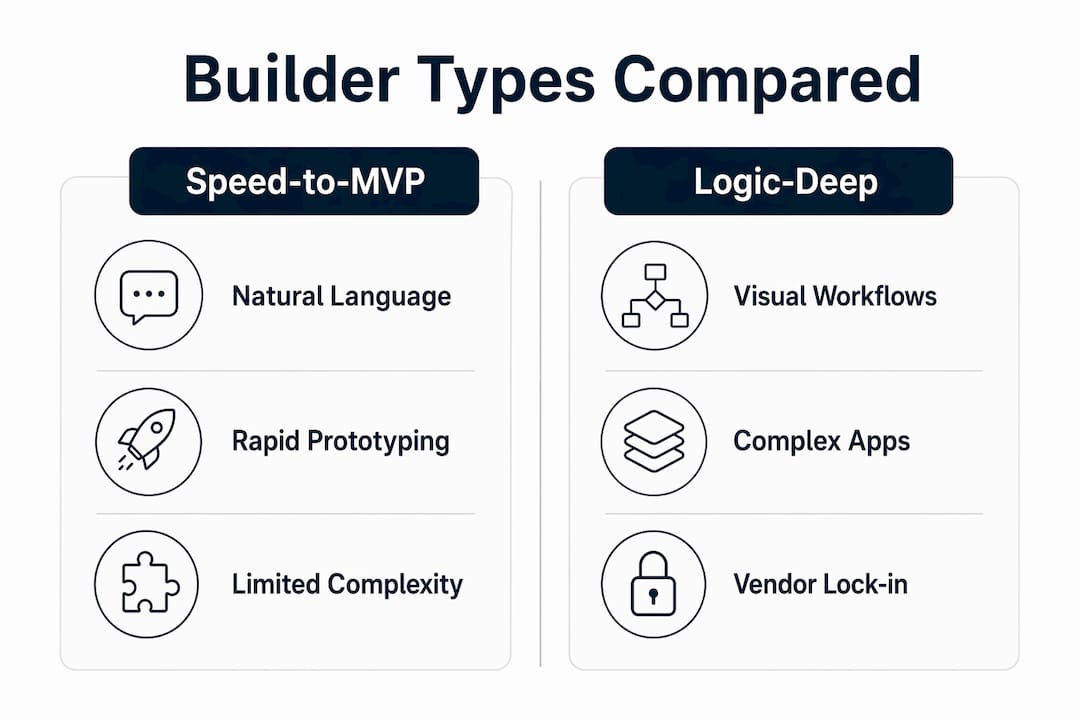
Logic-deep platforms (Bubble) force you to model database relationships, define privacy rules, and build workflows visually. That friction is the point. You see exactly what happens when a user clicks a button, which makes debugging and scaling far more predictable.
The "complexity wall" is the deciding factor. If your SaaS needs multi-step workflows, complex relational data, or advanced role systems, a speed-to-MVP tool will eventually demand a full rewrite.
- Speed-to-MVP tools: fast first demo, credit-burning iteration, limited complexity
- Logic-deep tools: higher upfront investment, lower long-term technical debt
- Hybrid approach: use Lovable or Bolt to validate, then migrate core logic to Bubble
Pro Tip: Before choosing a platform, map your app's data relationships on paper. If you have more than three related tables with conditional access rules, start on a logic-deep platform from day one.
What 2026 expert reviews get wrong about AI in no-code
The biggest misconception is that AI replaces the need to understand your app's architecture. It does not.
Bubble's visual editor forces explicit database relationships and privacy rules. AI-first tools abstract these details, which feels faster until a security misconfiguration surfaces in production. Raw code generation tools like Lovable and Bolt produce React/TypeScript codebases that create a software maintenance obligation most non-technical founders are not prepared for.
- AI generates a solid starting structure, but ongoing development still requires platform knowledge
- Abstracted database controls in AI builders can produce security gaps that visual workflow editors prevent
- Bubble's AI generates an MVP in 5–7 minutes but then hands control back to the user, unlike Lovable's conversational sidebar
- "Hallucinations" in AI builders (referencing non-existent database columns) require manual debugging that burns tokens and time
- For business apps, pre-built component composition handles auth, permissions, and routing more reliably than raw code generation
The practical takeaway: AI in no-code is a scaffolding accelerator, not a logic replacement. Treat it as the 80% that handles boilerplate, and plan to own the remaining 20% yourself.
What enterprise readiness actually means for no-code platforms
Enterprise readiness is not a checkbox. It is whether authentication, payments, file storage, and role management are first-class features or fragile add-ons.
Lovable's 2026 version ships with native Supabase integration covering auth, database, row-level security, and edge functions out of the box. Stripe and email integrations work on the first attempt. That is the bar. Platforms that treat these as plugins introduce maintenance risk at exactly the wrong moment.
- Authentication: Must be native, not a third-party plugin requiring manual configuration
- Payments: Stripe integration should handle webhooks and subscription states without custom code
- Data portability: GitHub sync (Lovable) or mature API layers (Bubble) prevent full vendor lock-in
- Maintainability: Visual workflows (Bubble) are easier to audit than generated code; exportable code (Lovable) lets a developer take over
- Scalability: Bubble's infrastructure is production-proven at scale; Lovable Cloud is newer but growing fast
Vendor lock-in deserves a direct mention. Most no-code platforms offer no code or database export. Lovable's GitHub sync and Supabase backend are the clearest escape hatch in the current market.
How SaaS LaunchPad and Gregory Cornelius approach no-code tool selection
The question SaaS product teams get wrong most often is not "which tool is best?" It is "which tool fits this specific product's complexity and growth trajectory?"
Gregory Cornelius and the SaaS LaunchPad team apply a 21-discipline product analysis framework to exactly this problem. Instead of defaulting to the trendiest AI builder, the approach maps product complexity, data architecture, integration requirements, and security posture before recommending a platform. That analysis prevents the most expensive mistake in no-code: building six months of product on a tool that cannot support month seven.
- Match tool capability to product complexity before writing a single prompt
- Audit integration requirements early: payment flows, third-party APIs, and role systems determine platform fit
- Use AI builders for validation, then run a full architecture review before committing to production
- Hybrid stacks (Lovable for frontend speed, Supabase for backend, Bubble for complex logic) often outperform single-platform bets
- Security and scalability reviews should happen at the MVP stage, not after launch
SaaS LaunchPad's 21-stage product analysis covers platform audit, UX, workflow optimization, security, and enterprise readiness scoring, then delivers a Master Transformation Prompt tailored to your specific no-code platform. For teams building on Bubble or Lovable, that prompt is copy-paste-ready.
Pros and cons of top no-code builders, per Reddit
Bubble
Pros: Unmatched depth for complex web apps; visual workflows make logic auditable; strong security posture with explicit privacy rules; large plugin ecosystem; production-proven across SaaS and marketplaces.

Cons: No code export; genuine vendor lock-in; learning curve that rewards sustained investment; performance scores lower than simpler tools; pricing becomes unpredictable at scale.
Reddit sentiment on Bubble is mixed precisely because it rewards experienced builders and frustrates beginners. The community on r/NoCode consistently rates it highest for complex apps while warning newcomers about the time investment.
Lovable
Pros: Full-stack generation from natural language; GitHub sync means you own the code; Supabase integration handles auth and database properly; clean, deployable output from day one; active development team.
Cons: Complexity ceiling hits at moderately complex SaaS; credit costs escalate with heavy iteration; React/Vite only (no Vue, Svelte, or Next.js); occasional AI hallucinations require manual fixes; no native mobile output.
For founders exploring no-code app builder alternatives, the Bubble vs. Lovable decision usually comes down to one question: do you need to own the code?
Integration capabilities with other tools and APIs
Bubble connects to external services through its API Connector, which wires POST and GET calls directly into visual workflows. Connecting to OpenAI, Stripe, or a custom REST API produces a workflow you can read and modify without touching code. That visual layer is what separates Bubble from code-generation tools that leave you debugging JSON responses manually.
Lovable's integrations are narrower but deeper where they count. Supabase handles database, auth, file storage, and edge functions natively. Stripe and email integrations work out of the box. For teams building on Lovable, the Bubble no-code approach to API integration offers a useful comparison when evaluating which platform handles your specific third-party stack.
Both platforms support Zapier and webhook-based connections for tools outside their native ecosystems. The practical limit is complexity: multi-step API chains with conditional logic are far more manageable in Bubble's visual workflow editor than in generated code.
Security concerns and data privacy in no-code platforms
Security in no-code is where abstraction becomes a liability. AI-first builders that generate raw code often produce database access rules that look correct but contain gaps, particularly around row-level security and role-based permissions.
Bubble's model forces you to define privacy rules explicitly for every data type. That friction produces more secure apps by default. Lovable's Supabase integration applies row-level security policies automatically, which works well for standard patterns but requires manual review for complex multi-tenant architectures.
For enterprise SaaS teams, the key questions are: Who controls the database? Where does data reside? Can you audit access rules without reading generated code? Platforms with strong GDPR posture and explicit permission modeling (Bubble) tend to score better on enterprise security reviews than prompt-to-app generators. For teams evaluating production-grade features like authentication and secure file storage, verifying that these are native platform features rather than third-party plugins is the first step.
Cost considerations and pricing models
Credit-based pricing in AI builders is the biggest hidden cost in no-code. Heavy iteration and AI hallucinations burn tokens fast, and costs escalate before you realize it. Lovable's Pro plan starts at $25/month, but complex builds with frequent prompt revisions can push costs well beyond that.
Bubble's pricing is workload-based and becomes unpredictable at scale, which Reddit threads flag consistently. The free tier is useful for learning; production apps require paid plans that scale with usage.
The practical strategy: validate on a free or entry-level plan, then run a cost projection before committing to production. Disciplined prompt engineering (specific, scoped prompts rather than open-ended requests) reduces token consumption in AI builders by a meaningful margin.
Key Takeaways
Bubble and Lovable lead Reddit's no-code recommendations for enterprise SaaS in 2026, with platform choice hinging on whether you need exportable code and speed or deep visual logic control and production-proven infrastructure.
| Point | Details |
|---|---|
| Platform type determines ceiling | Speed-to-MVP tools hit complexity walls past 15–20 components; logic-deep platforms scale further. |
| AI does not replace architecture | Visual workflow editors provide better security and data integrity than raw code generation tools. |
| Enterprise readiness has a clear bar | Auth, payments, and file storage must be native features, not plugins, for production SaaS. |
| Vendor lock-in is manageable | Lovable's GitHub sync and Supabase backend offer the clearest data portability in the current market. |
| Credit costs require discipline | Vague prompts and heavy iteration escalate AI builder costs; scoped prompts reduce token burn. |
FAQ
Which no-code app builder does Reddit recommend most for SaaS?
Bubble and Lovable are the most frequently recommended platforms across r/NoCode and r/SaaS for SaaS applications, with Bubble favored for complex logic and Lovable for fast full-stack MVPs.
What is the complexity wall in no-code development?
The complexity wall is the point where AI-native builders lose context across components, triggering iterative fix-and-break loops that burn credits and stall development. It typically appears beyond a moderate number of components.
Does Lovable allow you to export your code?
Yes. Lovable syncs every project to a GitHub repository with one click, giving you full ownership of a readable React/TypeScript codebase you can take to any development environment.
Is Bubble good for enterprise SaaS security?
Bubble's explicit privacy rule system and visual workflow editor make it stronger for enterprise security than AI code-generation tools, which can produce database access gaps that require manual auditing to catch.
How does SaaS LaunchPad help teams choosing a no-code platform?
SaaS LaunchPad runs a 21-discipline product analysis that covers platform audit, security, scalability, and enterprise readiness, then delivers a copy-paste-ready Master Transformation Prompt tailored to your specific no-code stack.