TL;DR:
- Enterprise SaaS platforms are cloud-native, multi-tenant systems designed to deliver operational guarantees, extensibility, and security controls. Key features include SSO, RBAC, audit logs, compliance certifications, and no-code or low-code customization tools that persist through upgrades. Successful enterprise SaaS architecture relies on API-first design, unified data models, microservices, and governance controls, with AI embedded in workflows to automate routine tasks efficiently.
Enterprise SaaS are cloud-native, multi-tenant platforms built to run mission-critical business functions at scale, with contractual SLAs, enterprise security controls, and extensibility that lets organizations adapt the software without forking the codebase. The canonical categories span CRM (Salesforce), ERP (Oracle NetSuite, Workday), collaboration and work management (Slack Enterprise Grid, Asana, monday.com), data and analytics (Snowflake), observability (Datadog), identity (Okta), and billing/FinOps (Stripe, Zuora). If you are a product team benchmarking your own platform, three questions cut through the noise fast:
- Does your product offer SSO, RBAC, and audit logs out of the box?
- Can customers extend it without touching your core codebase?
- Do you publish a contractual uptime SLA and a compliance certification roadmap?
If any answer is "not yet," the sections below show you exactly where to focus.
Table of Contents
- What actually makes a SaaS product enterprise-grade?
- Enterprise SaaS categories and the US platforms that define them
- How modern enterprise SaaS is actually built
- How product teams should use these examples to audit their own platform
- Where AI fits in enterprise SaaS in 2026
- Why enterprise migrations fail and how to design around it
- Key Takeaways
- What a 21-discipline audit reveals that feature reviews miss
- What SaaS LaunchPad delivers for enterprise-ready product teams
- Useful sources
- FAQ
What actually makes a SaaS product enterprise-grade?
Enterprise SaaS is defined by operational guarantees and platform capabilities, not by price point or customer size. The traits procurement teams check are consistent across industries.
Multi-tenancy keeps customer data isolated while sharing infrastructure, which is what makes per-seat economics work at scale. Contractual SLAs (typically 99.9% or higher uptime) give buyers a legal backstop. SSO and RBAC let IT control who sees what without managing individual accounts. Audit logs satisfy compliance teams and regulators. Compliance certifications (SOC 2 Type II, ISO 27001, HIPAA, FedRAMP depending on vertical) are table stakes for procurement sign-off in regulated industries.

Extensibility is where most mid-market SaaS products fall short. NetSuite's SuiteCloud is a useful reference: it uses standards-based, no-code/low-code extension tools specifically so customizations survive version upgrades. That design choice keeps total cost of ownership low because customers don't pay engineers to re-implement changes after every release.
Pro Tip: Choose no-code/low-code extension frameworks over custom code embedded in core. Native extension layers are carried forward during upgrades; custom core modifications break on update and create expensive maintenance cycles.
Enterprise SaaS categories and the US platforms that define them
The table below maps each category to its primary use case, scale profile, key enterprise features, integration approach, and typical verticals. No vendor ranking is implied.
| Category | Primary use case | Scale & scope | Key enterprise features | Integration & extensibility | Typical verticals |
|---|---|---|---|---|---|
| CRM | Sales, service, marketing pipeline | Team to global enterprise | SSO, RBAC, AI agents, audit logs | REST APIs, AppExchange/marketplace | All industries |
| ERP | Finance, supply chain, HR, operations | Mid-market to global | Multi-tenant data core, role-based access, compliance | SuiteCloud, REST, CSV, ODBC | Manufacturing, retail, services |
| Collaboration/Work Mgmt | Project tracking, async comms, workflows | Team to enterprise-wide | SSO, Enterprise Grid, admin controls | Webhooks, native integrations, APIs | Tech, media, professional services |
| Data & Analytics | Data warehousing, BI, ML pipelines | Department to enterprise | Fine-grained access control, data governance | Native connectors, partner ecosystem | Finance, healthcare, tech |
| Observability | Infrastructure and app monitoring | Engineering teams to global ops | Alerting, SLA dashboards, audit trails | Agent-based, API, 400+ integrations | Tech, e-commerce, financial services |
| Identity | Auth, SSO, MFA, lifecycle management | Org-wide | Zero-trust, SCIM, SAML, OIDC | Pre-built connectors, SDKs | All regulated industries |
| Billing/FinOps | Subscription billing, revenue recognition | Growth to enterprise | Dunning, metered billing, compliance | REST APIs, ERP connectors | SaaS, marketplaces, telco |
Categories that most often require custom extensibility: CRM (complex sales processes), ERP (industry-specific workflows), and data platforms (custom ML pipelines). Collaboration and identity tools typically work well with out-of-the-box configuration.
A few platform notes worth knowing:
- Salesforce embeds agentic AI across Sales Cloud, Service Cloud, and Marketing Cloud, with MuleSoft handling cross-system integration.
- Workday runs on a single multi-tenant data core covering finance and HR, with continuous updates that don't require customer-managed upgrades.
- Oracle NetSuite serves 43,000-plus customers with an AI-powered suite connecting ERP, CRM, and e-commerce on one platform.
- Slack Enterprise Grid adds org-wide admin controls, data loss prevention, and cross-workspace channels on top of the standard product.
- Snowflake separates compute from storage, which lets analytics teams scale query performance independently of data volume.
- Datadog aggregates logs, metrics, and traces across 400-plus integrations, making it the de facto observability layer for cloud-native stacks.
- Okta handles identity for both workforce and customer-facing apps, with SCIM provisioning that syncs user lifecycle events across connected systems.
How modern enterprise SaaS is actually built
The architecture patterns below aren't academic. They're what separates platforms that scale gracefully from ones that buckle under enterprise load.
| Pattern | Why it matters | Signals to look for in your product |
|---|---|---|
| API-first design | Every feature is accessible programmatically; enables integrations without UI workarounds | Public REST/GraphQL docs, versioned endpoints, webhook support |
| Unified data model | Single source of truth across modules; prevents siloed failures | Cross-module reporting without ETL, real-time dashboards |
| Multi-tenant architecture | Shared infrastructure with isolated data; enables continuous updates | No per-customer upgrade windows, instant feature rollouts |
| Microservices | Independent deployment of services; limits blast radius of failures | Service-level SLAs, independent scaling per function |
| Event-driven design | Async processing for high-throughput workflows; decouples producers from consumers | Message queues, webhooks, stream processing (Kafka, Kinesis) |
Oracle Fusion Applications demonstrate the unified data model at suite scale, connecting finance, HCM, supply chain, and CX so workflows cross domain boundaries without manual data transfer. Workday's continuous update model shows what multi-tenancy enables in practice: every customer gets the same release simultaneously, with no downtime windows.
Understanding how APIs drive AI integration in modern enterprise stacks is worth studying before you commit to an architecture pattern. API-first design is the prerequisite for everything else, including agentic AI.
Pro Tip: Never embed custom logic directly into a platform's core services. Use the vendor's native extension framework (SuiteCloud, Salesforce Flow, Workday Studio) so your customizations survive upgrades. Custom core code is the single biggest source of upgrade paralysis in enterprise SaaS.
How product teams should use these examples to audit their own platform
Run a focused, time-boxed audit across five domains: product, data, security, operations, and integrations. Then prioritize changes that reduce customer friction and integration debt, not the ones that look impressive in a roadmap presentation.
A practical sequence:
- Map your current state. Document every integration point, data model, and extension your product uses today. Flag anything that touches core code.
- Score against enterprise criteria. Check SSO, RBAC, audit logs, SLA documentation, and compliance certifications. Use the SaaS audit checklist as your baseline.
- Identify integration debt. List every connector that relies on brittle workarounds (screen scraping, manual CSV exports, undocumented internal APIs).
- Prioritize by customer friction. Rank gaps by how often they appear in sales objections, support tickets, or renewal conversations.
- Estimate effort and assign ownership. Separate no-code/low-code fixes (days to weeks) from engineering work (weeks to quarters). Assign a DRI for each.
- Set acceptance criteria. Define measurable targets: time-to-onboard under 30 days, API latency under 200ms at p99, SSO success rate above 99.5%, integration lead time under two weeks.
- Build a phased roadmap. Sprint 1 covers security and compliance gaps. Sprint 2 addresses integration debt. Sprint 3 introduces extensibility improvements and AI readiness.
The enterprise software vs. SaaS distinction matters here: if your product still relies on per-customer deployments or manual upgrade processes, that's the first architectural debt to retire.
Where AI fits in enterprise SaaS in 2026
The highest-value AI in enterprise SaaS isn't a dashboard or a report generator. It's agentic AI embedded in workflows that automates routine tasks and surfaces decisions to humans at the right moment. Salesforce's Agentforce, Workday's AI-assisted anomaly detection, and monday.com's workflow automation all follow this pattern.
Three integration patterns worth knowing:
- Embedded agents sit inside existing workflows (approval queues, deal stages, ticket routing) and act without requiring users to switch context.
- Model orchestration routes tasks to the right model based on cost, latency, and capability, which matters when you're running inference at enterprise volume.
- Governed data pipelines separate training data from inference data, so customer data used for personalization never leaks into shared model weights.
The risks product teams underestimate: model drift (outputs degrade silently over time), permissioned access violations (AI agents that can read data the user shouldn't see), and auditability gaps (no log of what the agent decided and why). Managed AI services handle much of the infrastructure complexity, but governance controls still need to be designed at the product level.
Pro Tip: Before adding AI to your product, map every data flow the agent will touch and verify it respects your existing RBAC rules. An AI agent that bypasses row-level security is a compliance incident waiting to happen.
Why enterprise migrations fail and how to design around it
Most enterprise migrations don't fail because of feature gaps. They fail because of data silos and brittle integrations that nobody fully mapped before the project started. Oracle's unified data model guidance makes this explicit: siloed databases are the primary failure mode in cross-domain workflows.
Practical mitigation strategies:
- Define a canonical data model before writing a single migration script.
- Use phased migration with parallel-run periods so the old system stays live until the new one is validated.
- Build rollback procedures for every migration phase, not just the final cutover.
- Treat connectors as first-class product features with their own test suites and SLAs.
- Require executive sponsorship with a named change-management owner on the customer side.
Pro Tip: Run a parallel-run period of at least two weeks for any mission-critical data migration. Compare outputs from both systems daily. If discrepancies exceed your acceptance threshold, pause and investigate before cutting over. Rollback after cutover is far more expensive than a delayed go-live.
Key Takeaways
Enterprise SaaS readiness comes down to five disciplines: unified data architecture, standards-based extensibility, embedded AI governance, connector strategy, and phased migration design.
| Point | Details |
|---|---|
| Audit extensibility first | Check whether customizations use native extension frameworks or core code before any other gap analysis. |
| Unified data model is foundational | Cross-module reporting and AI agents both depend on a single source of truth; siloed data kills both. |
| AI value is workflow-embedded | Agentic AI in approval queues and routing workflows delivers more value than standalone analytics features. |
| Migration risk lives in connectors | Treat every integration point as a first-class product feature with its own test suite and rollback plan. |
| SaaS LaunchPad audits all 21 disciplines | The Product Excellence Blueprint covers architecture, AI readiness, integrations, security, and migration in one engagement. |
What a 21-discipline audit reveals that feature reviews miss
The standard product review asks "does the feature exist?" A 21-discipline audit asks "does the feature work reliably at enterprise scale, integrate cleanly with adjacent systems, and survive an upgrade?" Those are different questions, and the gap between them is where enterprise deals stall.
SaaS LaunchPad's audit maps directly to the patterns covered here: architecture review surfaces API-first gaps and multi-tenancy risks; AI readiness scoring checks agent governance and data pipeline separation; integration analysis quantifies connector debt; migration planning identifies rollback gaps before they become incidents. The output is a Product Excellence Blueprint with a prioritized roadmap and a copy-paste-ready Master Transformation Prompt, so the findings translate directly into sprint tickets.
What SaaS LaunchPad delivers for enterprise-ready product teams
Most product teams know their platform has gaps. The hard part is knowing which gaps cost you enterprise deals and in what order to fix them. SaaS LaunchPad's 21-discipline product analysis gives you that answer in one engagement, without a consulting retainer or a six-week discovery phase.
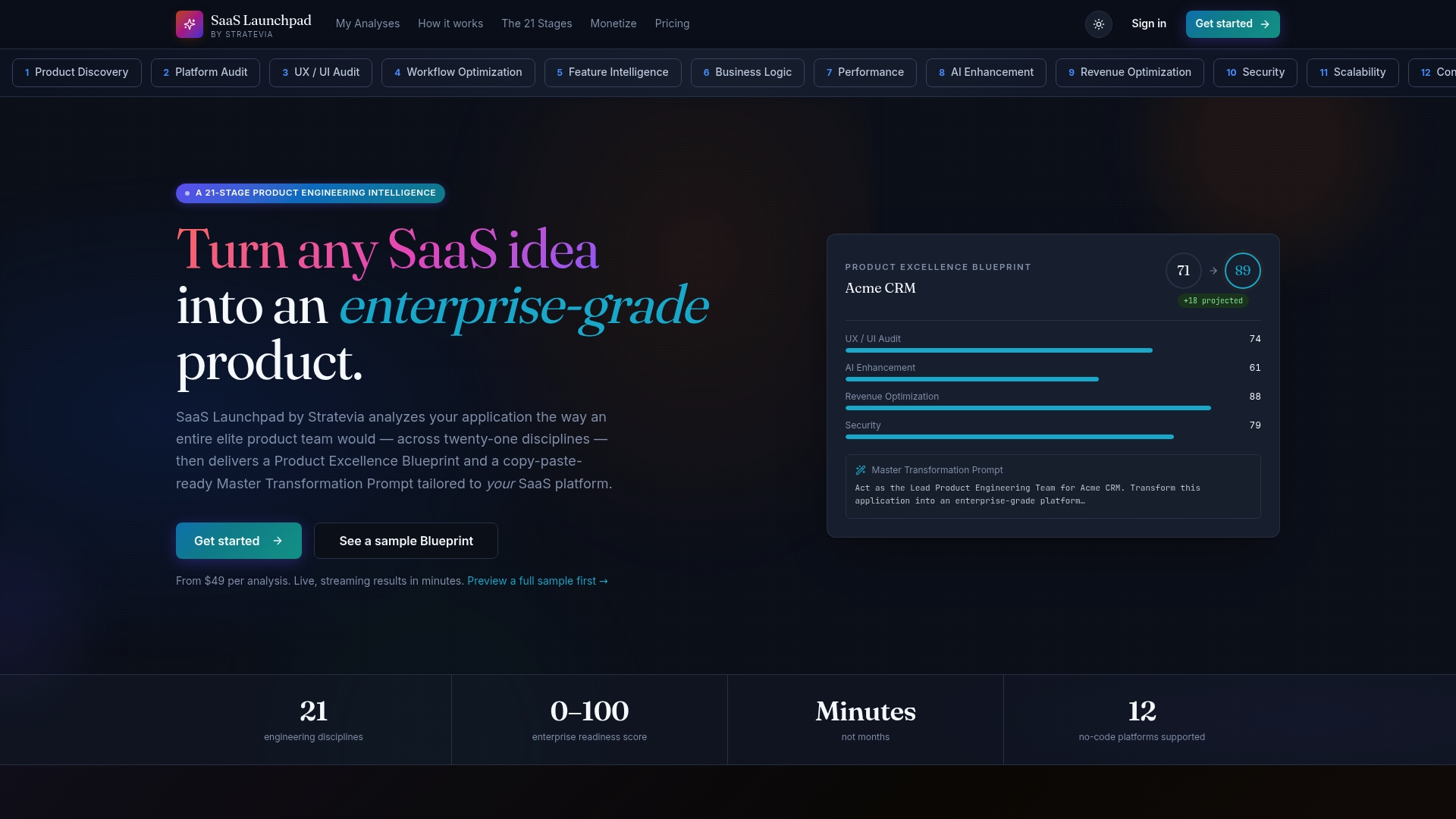
The analysis covers product discovery, UX/UI audit, workflow optimization, feature evaluation, business logic verification, performance analysis, AI enhancement, security, scalability, enterprise readiness scoring, and more. You get a Product Excellence Blueprint, a prioritized improvement roadmap, a phased execution plan, and a Master Transformation Prompt tailored to your platform. Pay per analysis, no subscription required, credits never expire.
If your product is targeting enterprise accounts and you want a clear picture of what's blocking deals, run your audit and have a prioritized roadmap in hand before your next sales cycle.
Useful sources
- NetSuite SuiteCloud Platform: Primary documentation on standards-based extensibility, no-code/low-code tools, and upgrade-safe customization patterns.
- Salesforce CRM and Agentforce: Salesforce's documentation on agentic AI integration across Sales, Service, and Marketing Cloud.
- Workday Enterprise Resource Planning: Workday's explanation of its multi-tenant data core, continuous updates, and embedded AI approach.
- Oracle Fusion Cloud Applications: Oracle's documentation on unified data models, embedded AI agents, and cross-domain workflow design.
- SaaS Audit Checklist: What Enterprise Clients Actually Check: Practical checklist aligned with the 21-discipline audit methodology.
- Enterprise Software vs. SaaS: 2026 Guide: Explains architectural trade-offs between traditional enterprise software and multi-tenant SaaS.
- SaaS RevOps: The Complete 2026 Strategy Guide: Context on revenue operations processes that intersect with enterprise SaaS billing, renewals, and SLAs.
FAQ
What are the best enterprise SaaS examples for product teams to benchmark against?
Salesforce (CRM), Workday (ERP/HCM), Oracle NetSuite (ERP), Snowflake (data), Datadog (observability), and Okta (identity) are the most-cited benchmarks because each represents a category-defining approach to multi-tenancy, extensibility, and enterprise security.
What features separate enterprise SaaS from standard SaaS?
Enterprise SaaS requires SSO, RBAC, audit logs, contractual SLAs (typically 99.9% or higher), compliance certifications (SOC 2 Type II, ISO 27001), and standards-based extensibility that survives version upgrades.
How should a product team start an enterprise readiness audit?
Map every integration point and data model first, then score the product against SSO, RBAC, audit log, SLA, and compliance criteria. SaaS LaunchPad's 21-discipline audit covers all of these in a single structured engagement.
Where does AI deliver the most value in enterprise SaaS?
Agentic AI embedded in existing workflows (approval queues, ticket routing, deal stage automation) delivers more measurable value than standalone analytics dashboards, because it reduces manual steps without requiring users to change context.
Why do enterprise SaaS migrations fail most often?
Data silos and brittle integrations are the primary failure modes. Successful migrations define a canonical data model upfront, run parallel systems during transition, and treat every connector as a first-class product feature with its own rollback plan.