TL;DR:
- Choosing the right SaaS automation platform depends on data security, AI capabilities, and scalable pricing models. AI orchestration tools like Gumloop and Lindy are reshaping automation by handling unstructured data and language-based reasoning. SaaS LaunchPad provides a strategic blueprint to identify automation gaps and optimize workflow decisions before investing.
Which IFTTT and Zapier alternatives should SaaS teams use in 2026?
The strongest workflow automation software options for SaaS platforms right now go well beyond simple trigger-action connectors. Here is the short version:
- Make — many integrations with a visual scenario builder; best for teams that need complex data mapping and readable debugging
- n8n — Open-source, self-hostable, supports custom JavaScript and Python; best for technical teams requiring full data sovereignty
- Microsoft Power Automate — a large number of prebuilt connectors with deep Microsoft 365 integration; best for organizations already in the Microsoft ecosystem
- Gumloop — AI-first platform that converts text prompts into working workflows; best for teams building autonomous AI agents
- Lindy — No-code AI agents built for email, scheduling, and CRM; best for professional communication automation with reasoning
- Tines — Enterprise-grade security with AI-enabled workflow customization; best for teams running high-security automation at scale
- SaaS LaunchPad by Stratevia — 21-stage SaaS product analysis that maps your automation gaps and delivers a copy-paste-ready Master Transformation Prompt for no-code platforms; best for product teams that need a blueprint before they build
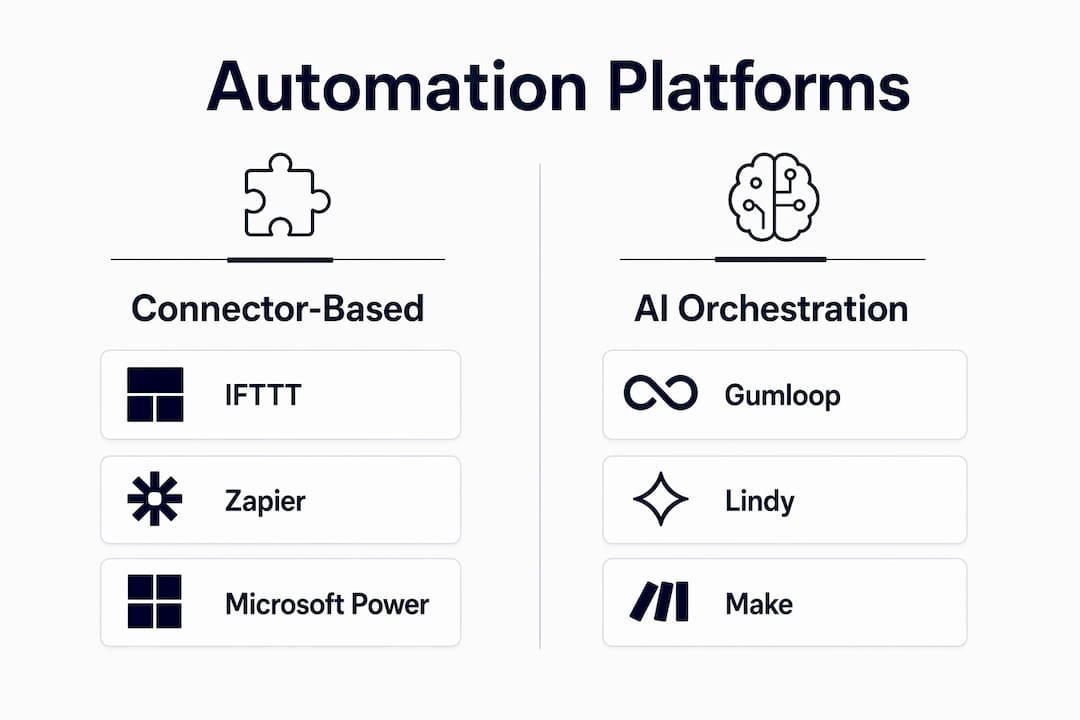
The market is shifting away from connector-only automation toward AI orchestration tools that can reason, decide, and act. Choosing the wrong platform now means rebuilding later.
Table of Contents
- How do the top IFTTT and Zapier alternatives actually compare?
- How do you choose the right automation platform for your SaaS?
- How these platforms were evaluated
- What SaaS LaunchPad offers that no automation tool does
- FAQ
- Key Takeaways
How do the top IFTTT and Zapier alternatives actually compare?
| Tool | Best For | Integrations | Data Handling | Hosting Model | AI Orchestration | Ease of Use | Pricing Model |
|---|---|---|---|---|---|---|---|
| Make | Complex visual workflows | 2,500+ | Strong data mapping and transformation | Cloud | Limited | Moderate | Operations-based |
| n8n | Developer control and data sovereignty | — | Full control via code | Self-hosted or cloud | Growing | Technical | Per-workflow or self-hosted |
| Microsoft Power Automate | Microsoft 365 organizations | 1,400+ | Enterprise-grade | Cloud (Azure) | Moderate | Moderate | Per-user or per-flow |
| Gumloop | AI-native autonomous agents | Growing | Unstructured data via LLMs | Cloud | Native | Low to moderate | Usage-based |
| Lindy | Email, scheduling, CRM with AI | — | Language-based reasoning | Cloud | Low | Subscription | |
| Tines | High-security enterprise automation | Extensive via API | Audit logs, version control | Cloud | Strong | Moderate to high | Custom/enterprise |
| SaaS LaunchPad | SaaS automation strategy and blueprinting | Platform-agnostic | 21-stage product audit | On-demand analysis | Master Transformation Prompt | Low (done-for-you) | Pay-per-analysis |
What actually separates these platforms
Make stands out for visual debugging. You can see data flowing through each node in real time, which matters when a multi-step workflow fails at step seven and you need to know exactly why. The operations-based pricing is predictable at low volume but can surprise teams that underestimate task counts.

n8n is the right call when your legal or compliance team will not allow customer data to leave your own infrastructure. Self-hosting takes real setup effort, and no-code platforms still require significant maintenance as automations grow in complexity. That said, the ability to drop custom JavaScript or Python into any node is something Make and Power Automate cannot match.
Microsoft Power Automate is genuinely strong inside the Microsoft stack. Connecting SharePoint, Teams, Dynamics 365, and Outlook in a single flow is almost frictionless. Outside that ecosystem, it loses its edge fast. Enterprise automation platforms at this tier prioritize version control, collaboration permissions, and secure audit logs over simple trigger-action models, and Power Automate delivers on all three for Microsoft shops.
Gumloop and Lindy represent the clearest signal of where automation is heading: away from rigid connectors and toward agents that interpret context. Gumloop converts a plain-text description into a working workflow using LLMs. Lindy handles inbox triage, meeting prep, and CRM updates by reasoning about language, not just routing data. Neither replaces a data pipeline tool, but both eliminate entire categories of manual work that rule-based tools cannot touch.
Tines targets security-conscious teams. Its workflow editor is more technical than Make's, but it ships with audit logs, version control, and role-based access controls that enterprise compliance teams expect.
Key factors to weigh across all of them:
- Task-based pricing can cause exponential cost increases if multi-step workflows are not carefully planned before you commit to a plan
- No-code does not mean zero maintenance. API changes, schema updates, and growing workflow complexity all demand ongoing attention
- AI orchestration support is now a first-class criterion, not a bonus feature, for any SaaS team planning 18 months ahead
Pro Tip: Before signing any annual contract, map your highest-volume workflow end-to-end and count every operation or task it consumes. Run that number against the platform's pricing calculator at 3x your current volume. The result tells you more than any feature comparison.
How do you choose the right automation platform for your SaaS?
The best automation platform for a SaaS team is defined more by data handling and workflow governance than by raw integration count. Here is how to work through the decision:
Start with your data requirements. If your workflows touch PII, financial records, or health data, self-hosted options like n8n give you control that cloud-only platforms cannot. If your data is less sensitive and speed matters more, cloud platforms win on setup time.
Map your integration surface. A platform with 2,500 integrations is only valuable if your specific stack is covered. Check the connectors for your CRM, data warehouse, and support tools before anything else. Make covers most enterprise stacks; Microsoft Power Automate provides over 1,400 prebuilt connectors and is strong inside the Microsoft ecosystem. n8n covers fewer natively but lets you build custom nodes.
Assess your AI automation needs honestly. If your workflows involve classifying emails, summarizing documents, or making decisions based on unstructured input, a connector-only tool will not get you there. Gumloop and Lindy are built for exactly this. For AI-driven automation that goes beyond data routing, these platforms are worth a serious look.
Factor in your team's technical depth. n8n and Tines reward technical users. Make and Lindy are accessible to non-engineers. Mismatching platform complexity to team capability is one of the most common reasons automation projects stall.
Pressure-test the pricing model. Simulate your expected monthly task volume at current scale, then at 2x and 5x. Task-based pricing volatility is a real pitfall when scaling. Some teams find that a self-hosted n8n instance at a fixed server cost beats a cloud platform's per-task bill by a wide margin at volume.
Security and compliance deserve their own checklist: SSO, SAML, LDAP, encrypted secret stores, RBAC permissions, and audit logs. n8n's self-hosted deployment covers all of these. Tines builds them in at the platform level. Growing SaaS teams prioritize platforms that support secure collaboration and auditability at scale, not just entry-level no-code convenience.
For a deeper look at cost-effective automation options and how pricing models compare across platforms, the tradeoffs between task-based and flat-rate billing are worth understanding before you commit.
How these platforms were evaluated
Every platform in this comparison was assessed against a consistent set of criteria drawn from 2026 industry benchmarks and real SaaS deployment patterns. The evaluation covered integration breadth and quality, data handling capabilities including support for unstructured data and custom logic, hosting model flexibility, AI orchestration maturity, ease of setup for non-technical users, maintenance demands as workflow complexity grows, and pricing structure at multiple volume tiers.
Platforms were also assessed on enterprise readiness: version control, audit logging, role-based permissions, and compliance posture. Community size and documentation quality factored in as proxies for long-term support. No platform received credit for features listed on a roadmap but not yet generally available. The goal was a comparison that holds up when a SaaS product manager is making a real purchasing decision, not a feature-count exercise.
What SaaS LaunchPad offers that no automation tool does
Every platform above automates tasks. None of them tells you which tasks to automate, where your current product is losing revenue, or how to sequence improvements for maximum impact.
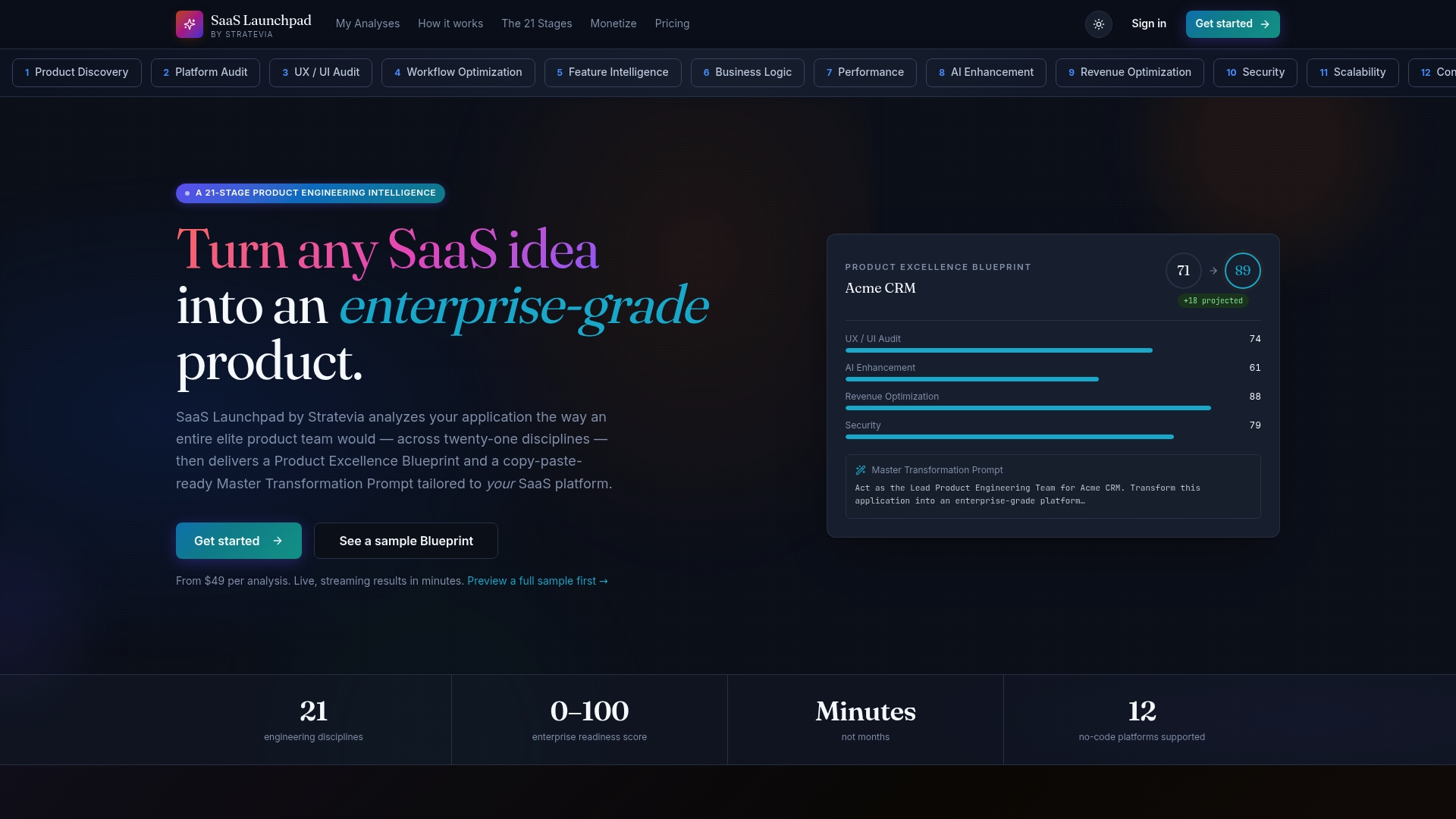
SaaS LaunchPad by Stratevia runs a 21-stage product analysis across your entire SaaS platform, covering workflow optimization, feature evaluation, UX audit, AI enhancement opportunities, revenue gaps, and competitive positioning. The output is a Product Excellence Blueprint and a Master Transformation Prompt you can paste directly into Make, n8n, Power Automate, or any other platform you choose. No subscription, no retainer. Credits never expire, and volume packs are available. If you are about to invest in a new automation stack, running a SaaS LaunchPad analysis first means you build the right workflows from day one. Start your product analysis and get a blueprint your team can act on immediately.
FAQ
What is the best free IFTTT or Zapier alternative for SaaS teams?
n8n is the strongest free option for technical teams willing to self-host, offering full workflow control and custom scripting with no per-task charges. Make offers a limited free tier suitable for low-volume testing.
Which automation platform handles AI agents best in 2026?
Gumloop and Lindy lead on AI orchestration: Gumloop converts text prompts into workflows using LLMs, while Lindy handles language-based tasks like email triage and scheduling with autonomous reasoning.
Is no-code automation really maintenance-free?
No. No-code platforms still require ongoing maintenance as APIs change, data schemas evolve, and workflow complexity grows. The "no-code" label describes setup, not long-term upkeep.
How does SaaS LaunchPad fit into an automation platform decision?
SaaS LaunchPad runs a 21-stage audit of your SaaS product and delivers a Master Transformation Prompt tailored to your chosen no-code platform, so you know exactly what to automate before you build.
When does self-hosting make more sense than a cloud automation platform?
Self-hosting with n8n makes sense when data sovereignty, compliance requirements, or high task volume make cloud per-task pricing impractical. It requires more technical setup but removes vendor lock-in and data residency concerns.
Key Takeaways
The right IFTTT or Zapier alternative for a SaaS platform depends on data control, AI orchestration needs, and pricing structure at scale, not integration count alone.
| Point | Details |
|---|---|
| AI orchestration is now standard | Gumloop and Lindy handle reasoning and unstructured data that rule-based connectors cannot process. |
| Self-hosting trades setup for control | n8n gives full data sovereignty and eliminates per-task costs, but requires technical maintenance. |
| Task-based pricing scales dangerously | Simulate workflow volume at 2x and 5x current load before committing to any operations-based plan. |
| Enterprise readiness goes beyond integrations | Version control, audit logs, and RBAC permissions are non-negotiable for SaaS compliance at scale. |
| SaaS LaunchPad maps what to automate first | A 21-stage product analysis delivers a Master Transformation Prompt before you invest in any platform. |