Choosing open source workflow automation tools with strong governance and deployment flexibility is harder than it should be for technical teams and agencies. Many Zapier alternatives either limit code-level customization, lack deep self-hosting support, or require ongoing subscriptions that do not fit project-based consulting needs. This comparison details features, pricing, and unique values of four Zapier substitutes so technical teams and agencies can pick the best fit for their deployment and audit needs.
Table of Contents
SaaS Launchpad by Stratevia
At a Glance
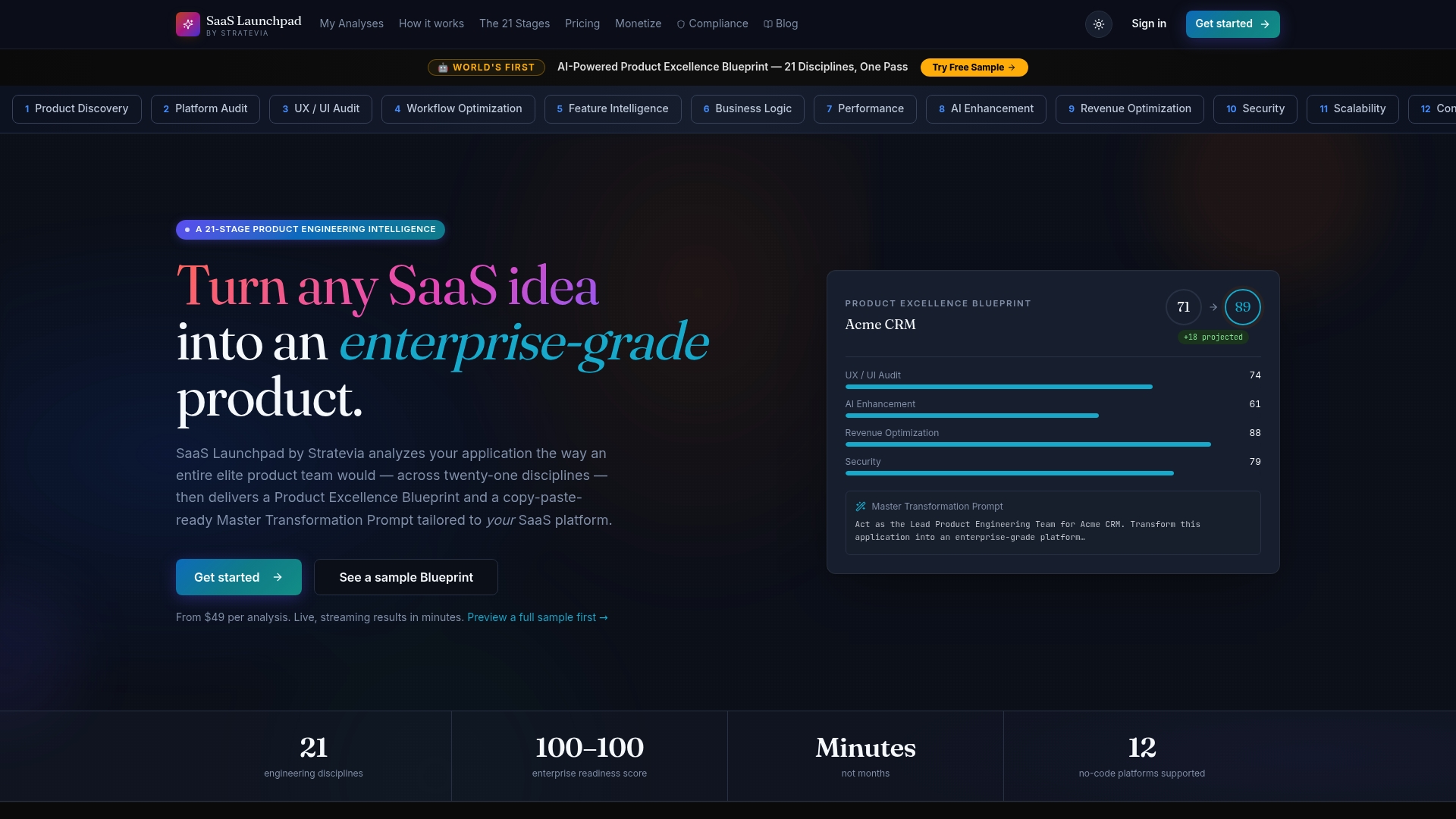
According to the company, it delivers a Product Excellence Blueprint and a copy and paste transformation prompt in minutes. The audit covers 21 disciplines including architecture, UX, security, and monetization. Founders and agencies get a prioritized roadmap they can act on immediately.
Core Features
A 21 stage AI audit evaluates architecture, UX, UI, security, performance, scalability, and monetization and produces objective health scores on a 0 to 100 scale. It generates a detailed Product Excellence Blueprint report and creates customized transformation prompts for no code platforms such as Bubble, Webflow, and Manus. The platform also provides enterprise readiness scoring and benchmarking outputs for comparison.
Key Differentiator
The single differentiator is the audit's breadth and speed. It combines a 21 discipline checklist with enterprise readiness scoring to produce a prioritized blueprint. That output includes a ready to use prompt tailored to a specified no code platform.
Pros
The analysis mirrors the work of a high value product team by inspecting technical and product disciplines in one run. That breadth, plus benchmarking reports and step by step roadmaps, makes the recommendations executable for founders and agencies. That speed supports rapid validation and investor pitch preparation.
Cons
- Dependent on the accuracy and completeness of inputs, so the audit may miss niche or context specific details.
Who It's For
Product managers, founders, and agencies who need a fast, evidence based assessment of a SaaS product will get the most value. Teams preparing investor materials or validating enterprise readiness benefit from the prioritized roadmap and benchmarking outputs. No code builders and studios will value the copy and paste transformation prompts for Bubble, Webflow, and Manus.
Unique Value Proposition
Starting at $49 per analysis, the pay per use model removes subscription friction for occasional audits. That model lets startups and agencies buy one deep product audit when needed rather than commit to a monthly fee. Combined with platform specific prompts, that approach reduces time and cost to test product redesigns on no code platforms.
Real World Use Case
A founder runs a 21 discipline audit on a newly built app to identify gaps before fundraising. They receive a blueprint and a platform specific transformation prompt to rebuild key flows on Bubble. The roadmap helps prioritize fixes in security and scalability so the team can launch with clearer enterprise readiness.
Pricing
Pricing starts at $49 per analysis on a pay per use basis. Discounts are available for packs of 3 or 10 analyses. No subscription required.
Website: https://saaslaunchpad.org
n8n
At a Glance
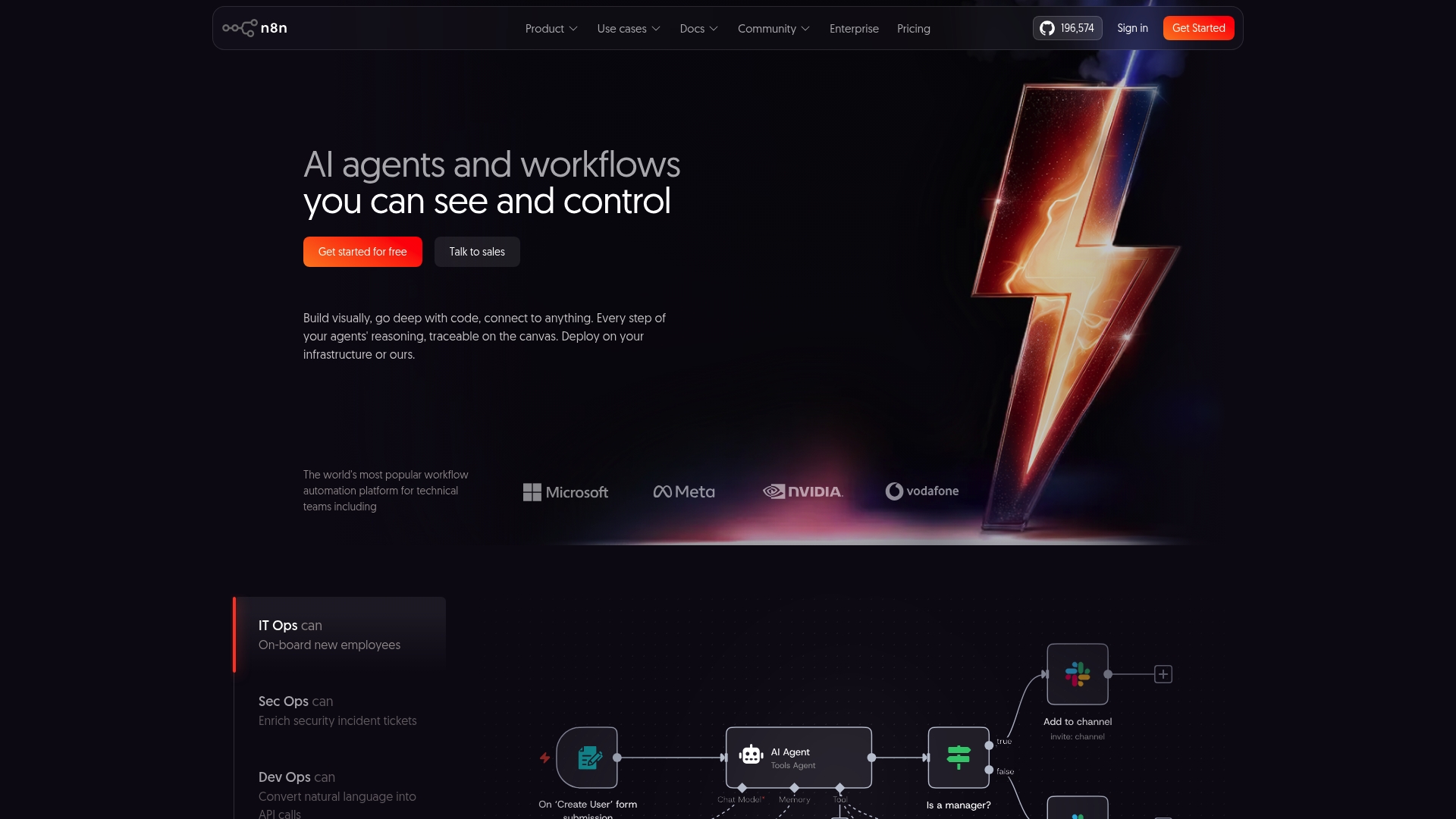
The vendor reports Vodafone saved £2.2 million using n8n for threat intelligence automation. That case appears in vendor materials and highlights automation replacing manual playbooks. The example signals n8n can handle operational workflows with tangible cost impact.
Core Features
n8n provides a visual node based workflow builder and lets you insert custom JavaScript or Python where a node cannot handle logic. According to the company, n8n supports over 900 integrations, including APIs, AI models, and common SaaS tools. The platform's security stack includes SSO, LDAP, encrypted secrets, and the vendor advertises SOC 2 compliance, with options to run self hosted or use the cloud offering.
Key Differentiator
n8n is open source and built for code first teams that need customization beyond drag and drop. The platform pairs a visual builder with code fallback so developers can inject scripts at any step. That combination makes it possible to model complex branches, loops, and data transforms without leaving a single workflow canvas.
Pros
n8n shines when you need full control over automation logic and infrastructure. It supports advanced flow constructs such as loops, merges, filters, and data transformations while letting developers add inline code. Self hosting reduces vendor lock in and lowers ongoing costs for teams that can run containers. The community delivers templates and connector contributions that shorten common automation builds, and enterprise controls give teams more oversight of security and access.
Cons
- Steep learning curve for newcomers. Getting fluent with nodes, credentials, and code can take time.
- Documentation can be scattered or terse at times. That raises the support burden for complex workflows.
- Some connectors lack deep feature parity with vendor APIs. You may need to extend them with custom HTTP requests.
- Self hosting can be resource intensive. Running scalable workflows requires appropriate infrastructure and monitoring.
When It May Not Fit
If your team has no developer capacity, n8n will likely feel heavy and slow adoption. If you need turnkey connectors with vendor level parity out of the box, this tool may force custom work. If you cannot provision containers or clusters, the self hosted option will be difficult to maintain.
Notable Integrations
- Google Sheets
- OpenAI
- Gmail
- Slack
- Microsoft Excel 365
- Notion
- Supabase
Who It's For
Technical teams, developers, and IT professionals who build custom workflows and AI-driven automations will get the most value. Platform engineers who want control over hosting and security will prefer it over closed SaaS offerings. Small teams without ops support may struggle unless they commit to learning the system.
Real World Use Case
The vendor reports Huel saved 1,000 hours and Deda.Tech automated ITSM workflows in 30 minutes with n8n. Use cases include threat intelligence pipelines, automated onboarding, and AI agent orchestration that blends API calls, data transforms, and notifications in one workflow.
Pricing
n8n offers a free community edition for self hosting and paid hosted plans. Paid plans start at €20/month for Starter, $50/month for Pro, and €667/month for Business, with custom pricing for Enterprise and self hosted deployment options.
Website: https://n8n.io
Activepieces
At a Glance
Activepieces reports over 756 integrations in its library, covering common business apps and developer APIs. That breadth lets teams link Gmail, Slack, Notion, HubSpot, and OpenAI without custom connectors. The vendor advertises both cloud and self-hosted deployment, and the cloud offering lists GDPR and SOC 2 Type II compliance.
Core Features
Activepieces combines a drag-and-drop workflow builder with AI-powered agents and ready-made automation templates to speed development. The platform includes role-based access control, audit logs, single sign-on, and observability tools for monitoring and troubleshooting. Teams can run the same flows in the cloud or on self-hosted infrastructure.
Key Differentiator
The project pairs an open source architecture with enterprise security and governance controls. That mix lets technical teams modify code, audit behavior, and host automations behind internal firewalls. The model suits organizations that want to avoid vendor lock-in while keeping corporate access controls and compliance tooling in place.
Pros
The interface makes common automations fast to assemble, and the visual builder lowers the amount of custom code. Flexible deployment supports on-premises or cloud hosting, which gives IT teams control over data residency. The integration catalog already covers major business tools, so many typical workflows require little extra development. Strong observability and audit logs help compliance reviews and postmortems.
Cons
- Learning curve for non-technical users. New adopters may need time or developer support to configure complex flows.
- Integration library is maturing. Some niche apps and advanced features remain under development.
- Recent pricing changes caused dissatisfaction among some long-term users.
When It May Not Fit
Organizations without developer resources may struggle with initial setup and customization. Teams that rely on obscure or industry-specific apps may still need to build custom connectors. Buyers wanting a plug-and-play commercial catalog may find the prebuilt offering smaller than some proprietary competitors.
Notable Integrations
Gmail
OpenAI
Slack
Notion
HubSpot
Who It's For
Technical teams and engineering-led product groups that want open source flexibility and strong governance. Security-minded IT organizations that must host automations on-premises or inside private networks. Startups and midmarket teams that want lower cost per automation and are comfortable managing deployments.
Real World Use Case
The vendor reports Funding Societies automated onboarding, ticket routing, and report generation with Activepieces. That work reduced manual effort and freed a portion of operations time previously spent on repetitive tasks. The case shows how event-driven flows and templates speed process cutover.
Pricing
A free plan includes 10 active flows, unlimited runs, and access to AI agents. Paid plans start at $5 per active flow per month for extra features and enterprise options.
Website: https://activepieces.com
Automatisch
At a Glance
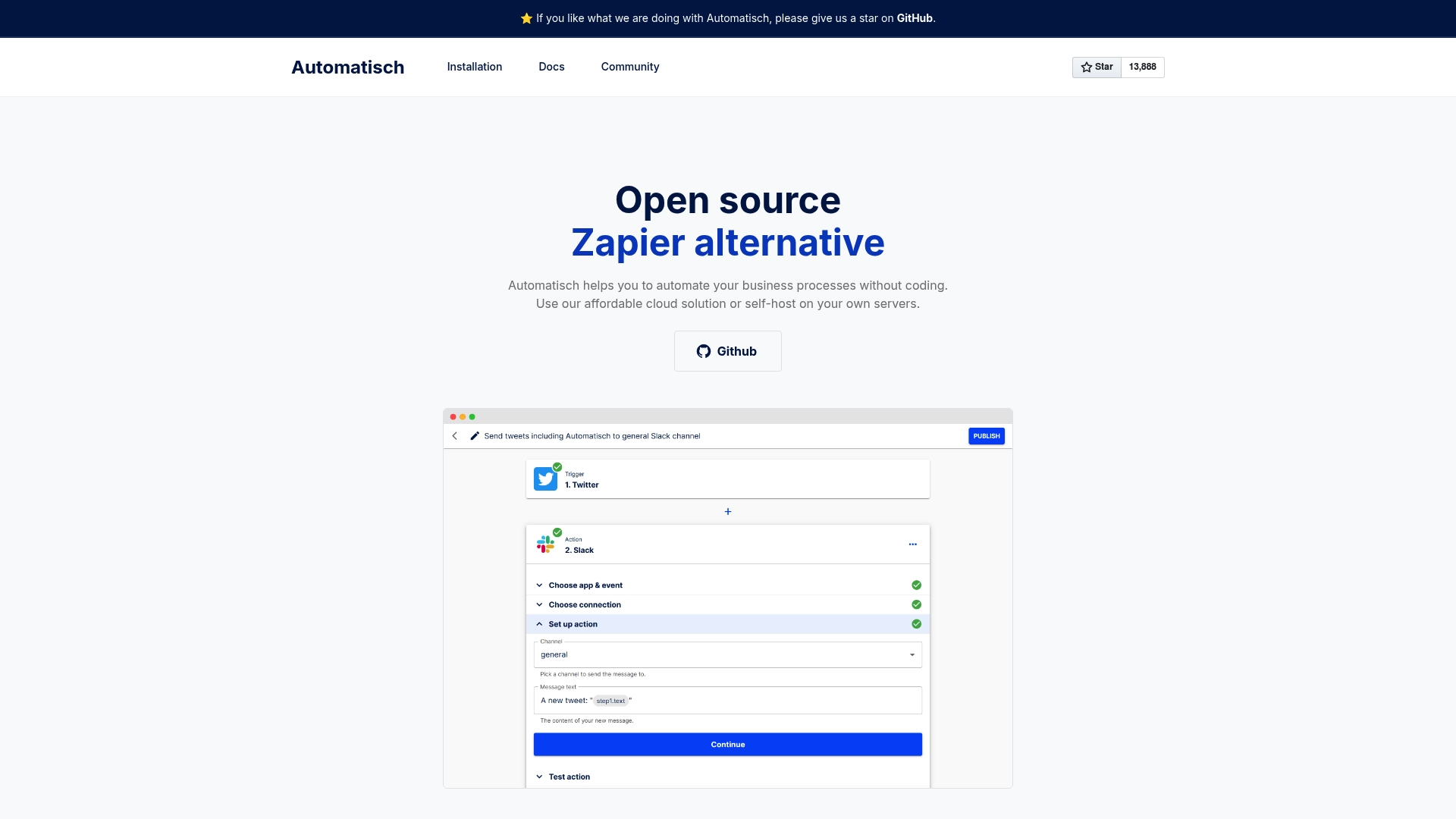
You can store automation data on your own servers to meet GDPR and other privacy requirements. Automatisch offers an open source automation engine with both cloud and self hosted deployment options. The product targets businesses that handle sensitive records, particularly in healthcare and finance. No third party reviews are publicly available yet.
Core Features
Automatisch runs on an open source architecture that accepts community contributions and supports many popular services. It can operate from the vendor cloud or be deployed on your own servers so you keep control of where data lives. The platform emphasizes data privacy, avoids vendor lock in, and provides a broad set of connectors for building workflows.
Key Differentiator
The single distinguishing claim is that Automatisch combines open source development with the ability to store workflow data on personal servers. That model removes vendor lock in and gives you direct control over compliance and retention. For teams subject to strict data rules, that hosting choice is the practical difference.
Pros
Automatisch benefits from community driven development and the transparency that open source brings. The self hosted option and cloud alternative let you pick a deployment that matches your compliance needs. The product lists many integrations, so you can compose complex automations without custom adapters. The vendor also positions the offering as a privacy forward choice that helps avoid vendor lock in.
Cons
- Limited external feedback: there are no substantive third party reviews yet, so real world stability and edge case behavior are unclear.
- Technical barrier: deploying on your own servers requires ops skills and time for configuration and maintenance.
- Contributor expectation: extending or customizing the code base assumes familiarity with open source workflows and code review.
When It May Not Fit
If your team lacks server administration skills, self hosted deployment will add operational overhead and risk. Organizations wanting an out of the box, fully managed low touch experience may prefer a commercial automation service. If community maturity or public user reports matter to procurement, the current lack of third party reviews may be a blocker.
Notable Integrations
- Slack
- Firebase
- GitHub
- PostgreSQL
- Twilio
- Typeform
- Twitch
Who It's For
Automatisch fits tech savvy businesses and engineering teams that need customizable workflow automation and strict control over data location. Security minded organizations in regulated industries will value the self hosted option. The product is aimed at teams comfortable with open source contribution or running production services.
Real World Use Case
A healthcare provider deploys Automatisch on private infrastructure to integrate appointment systems, secure messaging, and reporting tools while keeping patient data inside its network to meet GDPR obligations.
Website: https://automatisch.io
Comparison of alternatives
SaaS Launchpad leads in providing and rapid SaaS product assessments through its detailed audit capabilities. However, competing platforms such as n8n, Activepieces, and Automatisch offer distinct advantages, including hosting flexibility and customization support, allowing them to cater to varying user needs. Choosing among these options depends on individual requirements and technical environments.
Audit comprehensiveness versus customization flexibility
SaaS Launchpad distinguishes itself through its Product Excellence Blueprint. It evaluates a complete range of technical, UX, and business disciplines and provides, prioritized blueprints. By contrast, n8n and Activepieces allow developers to create deeply customized workflows, supporting script insertion and unique automation designs. These platforms excel in scenarios requiring high-level personalization of workflows.
Deployment options and compliance requirements
Comparatively, Automatisch offers unique appeal for businesses prioritizing data location control. Its self-hosting option ensures compliance with industry standards like GDPR. Meanwhile, Activepieces balances workflow accessibility with governance controls suitable for organizations focused on maintaining enhanced compliance measures.
Best fit
- For teams seeking a straightforward, in-depth assessment of their SaaS products, paired with immediate prompts for no-code platforms such as Bubble: SaaS Launchpad provides exceptional support.
- For developers who require customizable process flows and advanced integrations: n8n offers flexible node-based workflows with an extensive library of APIs and the ability to incorporate custom scripts.
- For organizations that must maintain data privacy by hosting automation tools on private or on-premise infrastructure: Automatisch provides an open-source solution designed with compliance considerations in regulated environments.
Our pick
While each platform has its strengths, SaaS Launchpad emerges as the top choice for product managers and startup founders due to its detailed, rapid SaaS audits and insights that directly enhance their product development initiatives. However, for individuals engaging in highly customized technical projects who may also need open-source integrations, n8n serves as a alternative.
For teams seeking efficient SaaS product evaluation and no-code implementation tools, compare these platforms based on their key features and offerings.
| Product | Core Feature | Key Differentiator | Best For | Pricing | Notable Limitation |
|---|---|---|---|---|---|
| SaaS LaunchPad | Comprehensive 21-discipline SaaS product audit tool | Rapid analysis with a tailored transformation prompt | Founders, no-code developers, agencies | Starting at $49 per analysis | Dependent on input accuracy for niche details |
| n8n | Open-source workflow automation platform | Visual workflows combined with custom coding | Developers and technical teams | Free and paid plans from €20/month | Steep learning curve for non-technical users |
| Activepieces | Drag-and-drop automation builder | Open-source with enterprise-level governance controls | IT and engineering-focused organizations | Free and paid plans from $5/active flow/month | Integration library expansion still in progress |
| Automatisch | Privacy-focused open-source automation tool | Deployment flexibility with private data control | Tech-savvy teams in regulated industries | Price not published | Limited external feedback for platform behavior |
How Can SaaS LaunchPad Help You Evaluate Zapier Alternatives Open Source?
Finding the right automation platform means balancing technical depth and ease of use. The article highlights challenges like complex setup and limited integration coverage from open source tools. SaaS LaunchPad offers a fast, evidence-based review of your SaaS product with a detailed Product Excellence Blueprint covering 21 key areas. This helps founders, product managers, and agencies identify gaps and plan improvements with clear, prioritized actions.
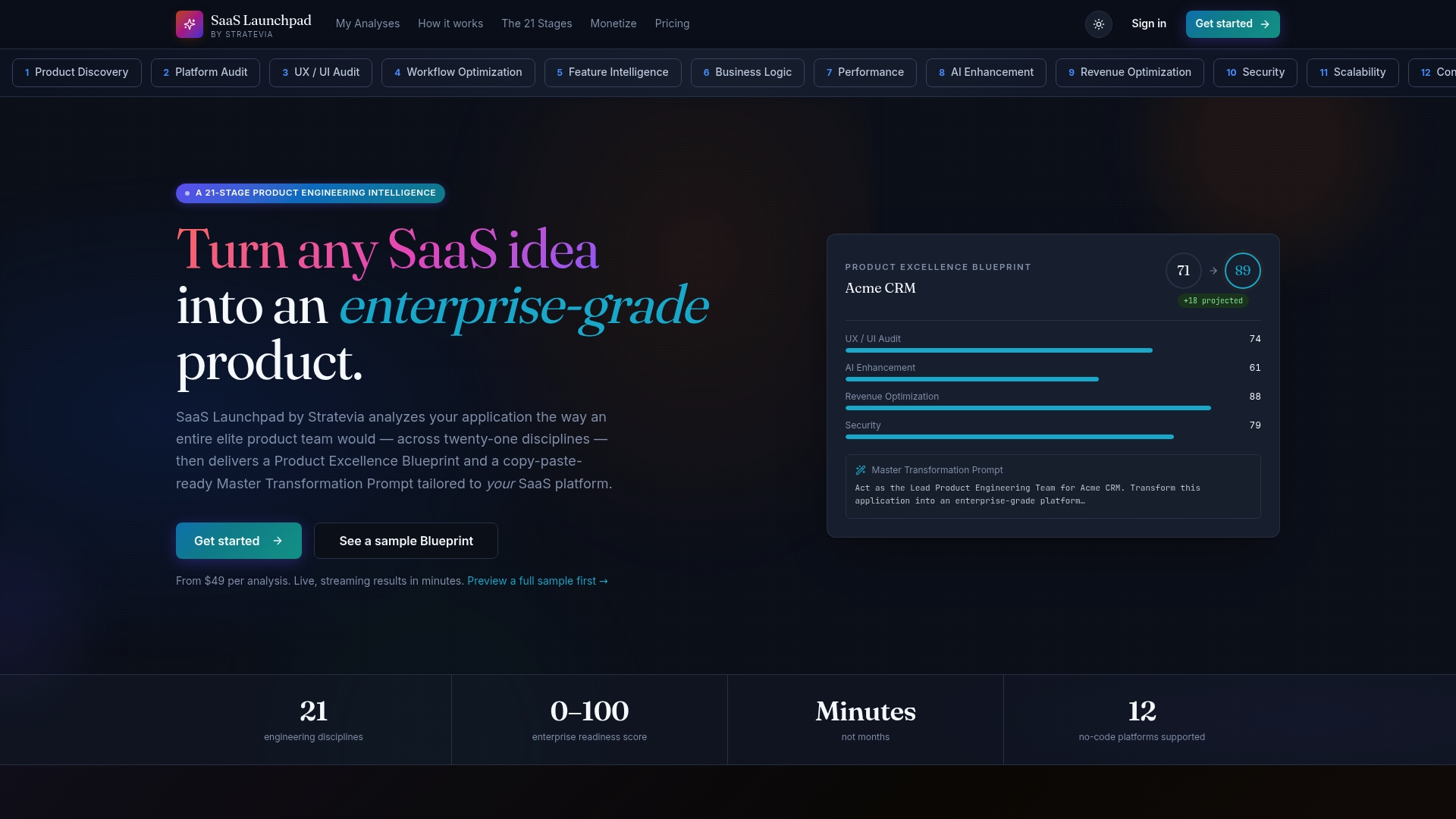
Explore how SaaS LaunchPad evaluates your app’s architecture, user experience, and security. Get a copy-paste-ready prompt tailored to your no code platform so you can rebuild and innovate faster. Visit SaaS LaunchPad to start your analysis and receive actionable next steps for your automation needs.
FAQ
What is the cost of using SaaS LaunchPad for an analysis?
SaaS LaunchPad starts at $49 per analysis on a pay-per-use basis. This model allows startups and agencies to purchase one deep product audit when needed instead of committing to a monthly fee.
How does the auditing speed of SaaS LaunchPad compare to n8n?
n8n excels with its open-source and customizable approach, appealing to technical teams needing full control over their automations. SaaS LaunchPad, on the other hand, offers a rapid 21-stage AI audit that produces actionable insights in minutes, making it suitable for founders looking for speed.
Can I use SaaS LaunchPad for no-code platforms?
Yes, SaaS LaunchPad generates customized transformation prompts for no-code platforms like Bubble, Webflow, and Manus, allowing you to implement changes easily. This appeals to teams needing quick and practical suggestions tailored for no-code solutions.
What are the benefits of the rapid validation feature in SaaS LaunchPad?
The rapid validation feature of SaaS LaunchPad supports quick assessments that help founders prepare for investor pitches with a prioritized roadmap. This functionality is vital for teams needing fast feedback to refine their offerings before seeking funding.
How does SaaS LaunchPad ensure accuracy during audits?
SaaS LaunchPad's audits depend on input accuracy and completeness, which can affect the findings. Users should ensure their data is thorough to get the most reliable results from the analysis.