Your product is ready to launch when four conditions hold: feature-complete with zero P0 bugs, staging matches production, analytics events are firing and verified, and support/sales teams have signed off on their materials. If any of those four are missing, the launch date moves.
Here's the compact version: Product ready if feature-complete, zero open P0s, staging parity confirmed, analytics baseline captured, and CS/sales trained. That's the bar. Everything below breaks that bar into owners, deadlines, and evidence you can defend in a go/no-go meeting.
- Copy the checklist template into Notion, Confluence, Google Sheets, or Jira today.
- Assign one accountable owner per line item, not a team.
- Set T-72h sign-offs so nothing surfaces as a surprise on launch morning.
Pro Tip: Don't let "mostly done" pass as done. A checklist item is either checked with evidence attached or it's a named risk with a mitigation plan. There's no third state.
Key Takeaways
A launch is ready when every critical item has a named owner, documented evidence, and a T-72h sign-off, and the runbook defines numeric rollback triggers in advance.
| Point | Details |
|---|---|
| Set the four-part bar | Confirm feature-complete status, zero P0s, staging parity, and trained support before setting a launch date. |
| Run T-72h sign-offs | Require every functional owner to sign off 72 hours before launch so hidden risks surface early. |
| Make rollback triggers numeric | Define triggers as an error rate ratio, latency delta, or a P0 ticket, not a judgment call. |
| Tier your launches | Match checklist depth to blast radius; small updates don't need the full enterprise checklist. |
| Extend into a full audit | SaaS LaunchPad's 21-discipline analysis builds on the checklist to assess security, scalability, and enterprise readiness in depth. |
Table of Contents
- Quick Launch Readiness Checklist You Can Copy Today
- Pre-Launch Product Readiness: Scope, Bugs, Beta, Accessibility
- Technical Readiness: Staging Parity, Flags, and Rollback Plans
- What Analytics and Monitoring Need to Be Launch Ready?
- Marketing and Launch Communications Checklist
- Sales and Support Enablement Before Launch
- Legal, Billing, and Operations Preflight
- Launch Day Runbook: Go/No-Go Through Canary Ramp
- Post-Launch Monitoring and the Retro Template
- How to Adapt This Checklist to Your Tool and Launch Tier
- Enterprise Readiness: Security, SLAs, and the Evidence Pack
- Where Most Launches Actually Fall Apart
- Turn This Checklist Into a Full Product Audit
- Sources
- FAQ
Quick Launch Readiness Checklist You Can Copy Today
Paste this into whatever tool your team already lives in. The columns matter more than the platform: Item, Owner, Due date (T-72h / T-24h / T-0), Status, and OK criteria. That last column is the one most teams skip, and it's the one that prevents "I thought it was ready" arguments during the go/no-go call.
Here are the top items to seed your own launch preparation guide:
- Feature-complete build merged to main, no P0/P1 bugs open
- Staging environment matches production configuration
- Feature flag created, default state confirmed at 0%
- Load test run at 2x expected peak traffic
- Rollback plan documented and dry-run tested
- Core events instrumented and firing in a test environment
- Dashboards built and baseline metrics captured pre-launch
- Landing page and pricing page match actual product behavior
- Sales battlecard and demo recorded
- Support macros and help articles published
- Legal/privacy review completed for new data flows
- Billing test order completed (correct tax, correct invoice)
- Go/No-Go meeting scheduled at T-72h with named approvers
- On-call rotation confirmed for launch week
| Item | Owner | Due | Status | OK Criteria |
|---|---|---|---|---|
| Feature complete | Eng lead | T-72h | Done | Zero P0/P1 open |
| Analytics live | Analytics lead | T-24h | Risk | Events verified in prod |
| Support trained | Support lead | T-24h | Done | Macros published, escalation path set |
Confluence and Notion both handle the narrative fields well; Google Sheets or Jira tend to work better once you have more than 30 items and need filtering by owner or status.
Pre-Launch Product Readiness: Scope, Bugs, Beta, Accessibility
Product readiness starts with a scope freeze. Write the release scope in one sentence, share it with every function touching the launch, and stop accepting "just one more thing" the week before ship. Scope creep at T-10 days is the single most common reason launch dates slip.

Feature-complete means every P0 flow works end-to-end and every P1 has a documented workaround or an accepted-risk sign-off from the PM. Don't let "we'll fix it post-launch" apply to anything that blocks a core user journey. A useful acceptance test: can a new user complete the primary job-to-be-done without hitting support? If not, you're not feature-complete, you're feature-adjacent.
Beta validation needs a number attached, not a vibe. Set a minimum beta cohort size, a usage threshold (say, three completed sessions per user), and a requirement for qualitative feedback, not just usage logs. A beta that ran for a week with five users clicking through once each tells you almost nothing about real readiness.
Accessibility gets skipped more than any other item on a product launch checklist, largely because it rarely blocks a demo. Check keyboard navigation, screen reader labels on primary flows, color contrast on your core CTAs, and focus order on modals. Assign a single owner to sign off. Skipping this doesn't just create legal exposure. It quietly locks out a chunk of your addressable market on day one.
Pro Tip: Keep an "accepted known issues" list separate from your bug tracker. It's the difference between a launch team that looks organized and one that looks like it's hiding problems.
Technical Readiness: Staging Parity, Flags, and Rollback Plans
Engineering readiness fails quietly. Nobody notices staging drift until launch day, when a config difference between staging and production turns a routine release into an incident. Four things need to be true before you touch the flag.
- Staging parity confirmed. Feature flags, environment configs, and database schema all match production. Run a full rehearsal, not a spot check.
- Feature flag strategy set. Start at 0%, define your canary cohort (internal team, then 1 to 5% of traffic), and name who owns the kill switch. That person needs to be reachable, not just listed.
- Load testing complete. Run traffic at roughly double the expected peak before you call performance "verified." A test at expected load tells you nothing about what happen when the launch actually works.
- Rollback plan documented and tested. Write the exact trigger conditions, the exact steps, and the exact owner. Then run the rollback once in staging before launch week, not after an incident forces you to improvise it.
Rollback triggers work best when they're numeric, not judgment calls. Defining a trigger as an error rate ratio, a p95 latency delta, or a P0 ticket from a paying customer removes the debate at 2 a.m. about whether things are "bad enough" to roll back.
Pro Tip: Assign the rollback decision to one named person before launch, not "engineering" as a group. Groups hesitate. People with the authority to act don't.
What Analytics and Monitoring Need to Be Launch Ready?
You can't tell if a launch worked without a baseline captured before it happened. Instrument these before launch day, not during it:
- Activation events for the primary user journey (signup to first value)
- Error rate and latency by endpoint, tracked against a pre-launch baseline
- Feature adoption events for the specific capability you're shipping
- Drop-off points in any new onboarding flow
Dashboards need owners and access confirmed in advance. Bookmark them, share the links in your launch channel, and capture a snapshot of normal traffic patterns 48 hours before launch so you have something to compare against once traffic starts moving.
Checklist frameworks that treat instrumentation as a launch blocker, not a nice-to-have, tend to hold up better under real pressure. A structured checklist reduces preventable errors in multi-step, cross-functional processes in particular because it forces teams to define what "watching the launch" actually means before anyone is staring at a dashboard in a panic.

Alerting rules should tie to the same numeric thresholds you set for rollback triggers. If your error rate ratio crosses the line that triggers a rollback conversation, the alert should fire automatically, not depend on someone noticing a graph.
Marketing and Launch Communications Checklist
Message-to-experience mismatch kills more launches than bad product work does. If the landing page promises something the product doesn't quite deliver yet, support tickets spike and trust erodes before anyone even gets to the feature itself.
- Landing page and pricing page reviewed against actual current product behavior
- Screenshots and demo GIFs match the shipped UI, not an earlier design
- Campaign schedule set: blog post, email sequence, social cadence, and a post-launch follow-up wave
- PR or analyst briefings scheduled with a clear approval workflow for anything public-facing
Timing matters more than most PMs plan for. Broader promotion and GTM work typically starts six to eight weeks before public launch for the marketing and sales enablement work to land with any real weight. A landing page thrown together three days before ship reads that way to prospects, too.
Grounding your messaging in the actual job the customer is hiring your product to do, rather than a feature list, tends to close the gap between what marketing promises and what the product delivers.
Sales and Support Enablement Before Launch
Your support team gets the questions your marketing team didn't anticipate, usually within the first hour. Prepare them accordingly.
- Sales battlecard covering positioning, pricing, and the three most likely objections
- Recorded demo available for reps who haven't touched the feature yet
- Help-center articles published and linked from the product UI itself
- Canned responses and macros loaded into your support tool for the top five anticipated questions
- Escalation channel confirmed and staffed for launch week, with extra coverage if the launch is large
Customer Success has its own short list: notify top accounts before the public announcement, update CSM playbooks with the new feature's talking points, and flag any onboarding flow changes that affect existing customers mid-journey.
Pro Tip: Have support test the actual feature themselves before launch, not just read the documentation about it. The gap between "documented" and "understood" shows up fast on a live call.
Legal, Billing, and Operations Preflight
Legal and ops issues don't announce themselves until they've already caused a problem, usually a refund request or a compliance letter. Clear these before launch day, not after.
- Terms of service and privacy policy updated for any new data collection or processing
- Data Processing Agreement reviewed if the feature touches customer data in a new way
- Regional restrictions checked and enforced where the feature isn't yet compliant everywhere
- Billing test order run end-to-end: correct pricing, correct tax handling, correct invoice output
- Coupon and promo code logic tested against the new SKU or plan
- Domain, SSL, forms, and third-party integrations spot-checked in production
None of this is glamorous. All of it blocks a launch faster than a missing feature does when it goes wrong.
Launch Day Runbook: Go/No-Go Through Canary Ramp
The Go/No-Go meeting happens at T-72h, not the morning of launch. Requiring each functional lead to sign off 72 hours before launch surfaces hidden assumptions while there's still time to fix them, rather than an hour before the button gets pushed.
- T-72h: Go/No-Go meeting. Every functional owner reports status against the checklist. Any unchecked critical item gets closed or formally accepted as a risk with a documented mitigation plan.
- T-24h: Final checks. Re-verify staging parity, confirm on-call coverage, and re-run the dashboard baseline capture.
- T-0: Canary ramp. Flip the flag to 1 to 5% of traffic. Hold and watch your monitoring windows for 30 to 60 minutes before ramping further.
- Ramp to 25%, then 100%. Each step gets its own hold period and its own explicit sign-off from the owner watching dashboards.
Running the checklist on a T-5 / T-2 / launch-day cadence works well here: engineering and QA should be green by T-5, and marketing and sales enablement green by T-2. Any red item at T-2 is a launch blocker, full stop, not a "we'll catch it during the ramp" item.
Rollback triggers stay numeric: error rate ratio crosses your threshold, p95 latency jumps past its delta, or a P0 ticket comes in from a paying account. The person who owns the kill switch executes without needing a committee vote.
Pro Tip: Write the canary hold times into the runbook itself, not just in someone's head. On launch day, nobody remembers to wait the full 45 minutes unless it's on the page in front of them.
Post-Launch Monitoring and the Retro Template
Assign specific people to specific dashboards for the first 72 hours, and name the escalation path for anything that looks like a P0 or P1 before it becomes one.
- T+0 to T+72h: named owner watches error rates, latency, and adoption events on a fixed schedule, not "whenever they check Slack"
- T+7: review adoption numbers against the pre-launch baseline and flag any gap between expected and actual usage
- T+30: full retro, written up and shared, with each follow-up action assigned an owner and a due date
Incident communication needs a template ready before you need it: what gets said internally, what gets said to customers, and who approves both. Waiting to draft this during an actual incident wastes the exact time you don't have.
Pro Tip: Schedule the T+30 retro on the calendar the same day you schedule the launch. It gets skipped constantly when it's not booked in advance.
How to Adapt This Checklist to Your Tool and Launch Tier
Format choice depends on team size and how detailed you need the evidence trail to be. Confluence handles narrative context (why a decision was made) better than Notion or Sheets. Notion works well for smaller teams that want speed and flexibility without heavy structure. Google Sheets is the fastest way to get a working table live today, and it filters well once you're past 30 rows. Jira ties naturally to engineering tickets when your rollback steps or P1 fixes need their own tracked issues, and it keeps checklist items connected to the actual roadmap and approval chain.
| Tool | Best For | Trade-off |
|---|---|---|
| Confluence | Detailed evidence and sign-off narrative | Slower to set up than a spreadsheet |
| Notion | Small teams, fast iteration | Less structured for large cross-functional launches |
| Google Sheets | Quick setup, easy filtering by owner/status | Weak on narrative context and version history |
| Jira | Linking checklist items to engineering tickets | Overkill for marketing-only launch items |
Assign one accountable owner per critical item, never a team name. Tiering your launches also cuts overhead fast: a Tier 3 minor update might need five checklist items, while a Tier 1 launch with new billing or data flows needs the full set, including legal and enterprise checks.
Enterprise Readiness: Security, SLAs, and the Evidence Pack
Selling to enterprise accounts adds a layer most consumer-facing launches skip entirely. Before you pitch a large customer, confirm SSO/SAML support, review your SOC 2 or GDPR posture depending on where your customers sit, and check that contractual SLA language matches what your infrastructure can actually deliver. If FedRAMP applies to your buyer base, start that readiness work well before the sales conversation, not after a procurement team asks for it.
Build an evidence pack ahead of time: load test results, security sign-offs, audit log samples, and relevant runbook excerpts. Enterprise buyers ask for this during procurement, and scrambling to assemble it after the request comes in signals exactly the kind of readiness gap you're trying to avoid.
- SSO/SAML configured and tested with at least one enterprise identity provider
- Audit logs verified for completeness on core actions
- SLA language reviewed against actual infrastructure capability
- Security sign-off documented and dated
Not every enterprise check needs to pass before public launch. Some, like a full SOC 2 Type II report, can reasonably stage post-launch. Security sign-offs and SSO support generally can't wait, since they block the first serious enterprise deal conversation. A structured audit checklist for enterprise product review helps separate the two categories.
Pro Tip: Build the evidence pack once and update it quarterly. Rebuilding it from scratch every time a large account asks is where most of the wasted hours go.
Where Most Launches Actually Fall Apart
The most common failure isn't a missing feature. It's over-coordination on a minor release that didn't need a full Go/No-Go meeting, paired with under-coordination on the one launch that actually carried risk. Fix: tier your launches and match rigor to blast radius, not to habit.
The second mistake is vague ownership. "Engineering will handle it" isn't an owner. A name is an owner. The third is treating analytics as an afterthought, then discovering three days post-launch that nobody can say whether the feature worked because nobody captured a baseline.
A common real-world pattern: a team ships a well-tested feature, skips the rollback dry run because "we probably won't need it," then spends four hours improvising a rollback under pressure when a P0 surfaces. The fix isn't more caution across the board. It's running the rollback test once for anything above Tier 2, so the four hours never happens.
Turn This Checklist Into a Full Product Audit
The checklist above catches process gaps: missing owners, untested rollbacks, skipped sign-offs. It won't tell you whether your actual product architecture, security posture, or conversion flow can hold up against enterprise scrutiny once you're past launch day.
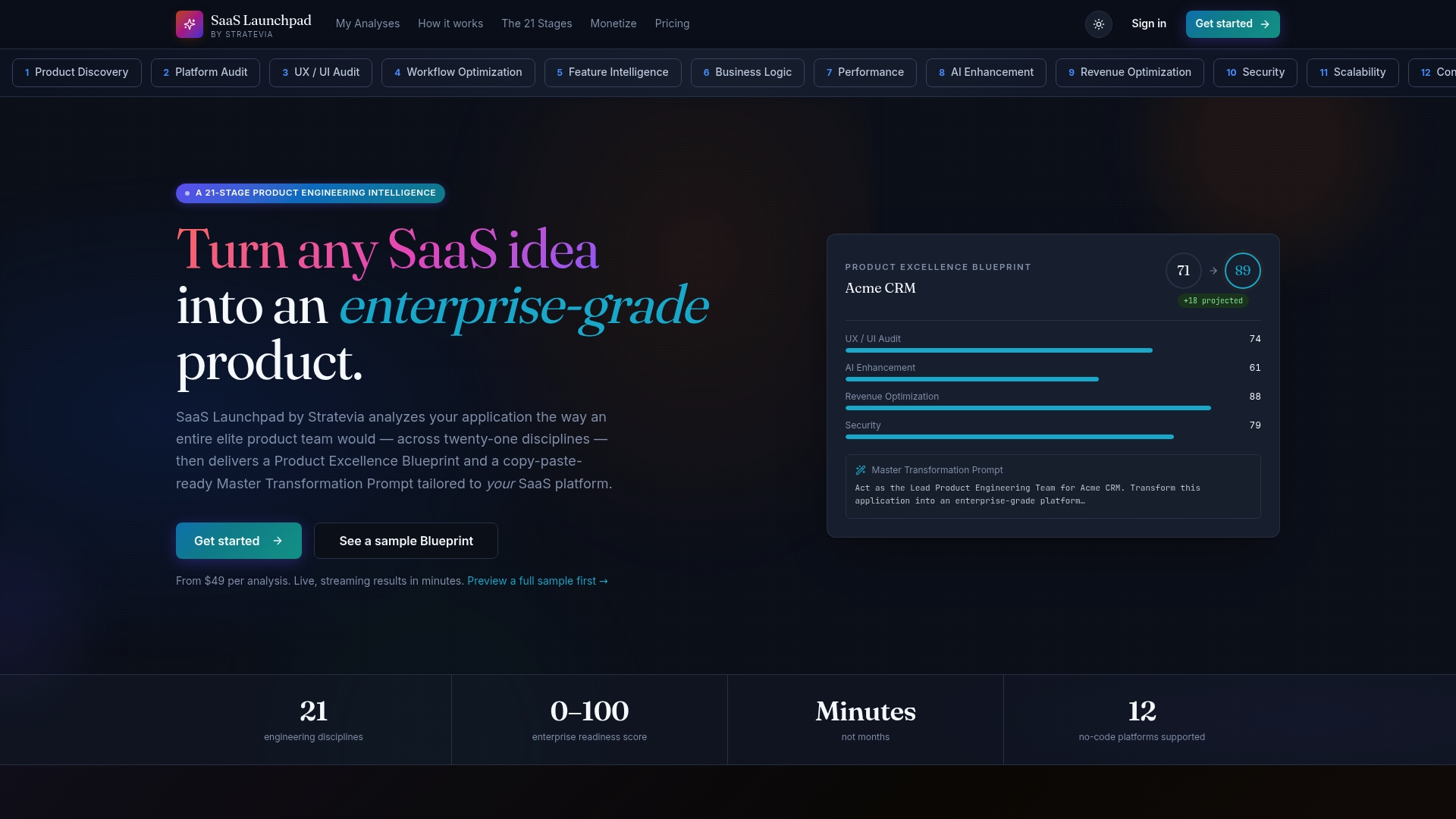
That's the gap SaaS LaunchPad closes. The 21-discipline product audit runs your platform through the same categories an entire enterprise product team would check, including security, scalability, and enterprise readiness scoring, then hands you a Product Excellence Blueprint and a copy-paste-ready Master Transformation Prompt built for your specific platform. Where your launch checklist flags a risk (thin evidence on security, no audit logs, an untested SLA claim), the audit gives you the prioritized roadmap to actually fix it before a big account asks. If you're prepping for a launch that needs to hold up under enterprise-level scrutiny, start a product analysis and see exactly where your platform stands against that bar.
Sources
- Launch Readiness Checklist — Free Template
- Free Product Launch Checklist for Product Managers | PMRead
- Launch Readiness Checklist — Free 24-Item PDF | MindBacklog
- Step-by-step product launch checklist | Atlassian
FAQ
What Is the Launch Readiness Process?
It's the structured review of product, technical, analytics, marketing, sales, and legal checkpoints before a launch, typically run on a T-72h or T-5/T-2 cadence with named owners and a documented go/no-go decision.
What Is a Release Readiness Checklist?
It's a focused subset of launch readiness centered on the engineering side: staging parity, feature flags, load testing, and a tested rollback plan, usually owned by engineering and SRE leads rather than the full launch team.
What Is a Project Readiness Checklist?
It's a broader planning tool covering scope, resources, timeline, and risk before any project (not just a product launch) begins; a product launch checklist is one specific application of that idea, tuned for shipping features to customers.
What Are the Four Things to Consider Before Launching a Product?
Feature completeness with zero critical bugs, technical readiness including a tested rollback plan, analytics instrumentation with a captured baseline, and enablement of sales and support teams. Skipping any one of these tends to be where launches go sideways.
Can SaaS LaunchPad Help After I've Run This Checklist?
Yes. Once the checklist confirms process readiness, SaaS LaunchPad's 21-discipline audit evaluates the underlying product itself, including security, scalability, and enterprise readiness, and delivers a prioritized roadmap for what to fix next.