What are the best no-code AI SaaS builders in 2026?
The strongest no-code AI SaaS builder platforms for 2026 are Bubble, Webflow, Backendless, OutSystems, and WeWeb for teams that need depth and control, while Glide, Softr, Base44, and Launchpad.io suit founders who want to ship fast on existing data. Emergent and Zite lead for AI-first product launches with integrated billing and backend setup baked in from day one.
Picking the wrong platform costs more than time. You can build a working MVP in a weekend on the wrong tool and spend months trying to scale it. The table below maps all 22 platforms against the dimensions that actually matter for 2026 product launches.
| Platform | Best For | Starting Price | Key Strengths | Pros | Cons |
|---|---|---|---|---|---|
| Zite | Custom business software | Not publicly listed | AI UI generation, integrated billing | Full-stack out of the box, fast setup | Newer platform, smaller community |
| Emergent | Fast AI SaaS launch | Not publicly listed | AI automation, data source integration | Rapid deployment, workflow-ready | Limited customization depth |
| Bubble | Customizable AI apps | Free tier; paid plan available | Visual builder, complex logic support | Highly flexible, large community | Steeper learning curve |
| FlutterFlow | Mobile-first AI SaaS | Free tier; paid plan available | Mobile and web, scalable backend | Strong mobile output, AI workflow support | Less suited for complex web-only apps |
| Figma Make | UI/UX-focused AI SaaS | Bundled with Figma plans | Design-to-app AI automation | Tight design integration | Limited backend capabilities |
| Adalo | Native mobile AI apps | Free tier; paid plan available | Native publishing, AI workflow automation | Easy mobile publishing | Scalability ceiling on complex apps |
| Beefree SDK | AI email and content apps | Not publicly listed | AI content automation, SDK flexibility | Modular, developer-friendly | Narrow use case focus |
| Webflow | Web AI SaaS products | Free tier; paid from $14/mo | Design quality, hosting, AI features | Strong design control, SaaS-ready | Requires logic layer for complex apps |
| Airtable | Data-driven AI backends | Free tier; paid plan available | Relational data model, AI automation | Powerful data layer, wide integrations | Not a full app builder on its own |
| Zapier | AI workflow automation | Free tier; paid plan available | Extensive integrations, AI triggers | Connects almost anything | Not a UI builder |
| OutSystems | Enterprise AI SaaS | Contact for pricing | Scalability, compliance, complex workflows | Enterprise-grade, full lifecycle | High cost, complex onboarding |
| Glide | Spreadsheet-based AI apps | Free tier; paid plan available | AI automation on spreadsheet backends | Fast deployment, AI-powered automation | Limited for complex data models |
| Appy Pie | Simple AI app creation | Free tier; paid plan available | Drag-and-drop, beginner-friendly | Very low barrier to entry | Limited scalability and customization |
| Stacker | Data-connected AI workflows | Paid from $59/mo | Integration depth, automation | Strong data connectivity | Narrower design flexibility |
| Softr | Airtable-based AI SaaS | Free tier; paid plan available | AI workflow automation, data management | Fast Airtable-to-app pipeline | Dependent on Airtable as backend |
| DrapCode | Complex logic AI SaaS | Paid plans available | Scalable backend, AI integration | Handles complex logic well | Smaller ecosystem |
| Launchpad.io | Rapid MVP AI SaaS | Not publicly listed | Quick deployment, AI automations | MVP-ready fast | Less suited for long-term scaling |
| Atoms | Visual AI SaaS building | Not publicly listed | Visual builder combined with AI workflows | All-in-one approach | Newer, limited track record |
| WeWeb | Dynamic responsive AI apps | Free tier; paid plan available | Rich UI, AI integration | Strong frontend, pairs with any backend | Requires separate backend setup |
| Backendless | Full-stack AI SaaS | Free tier; paid plans available | Real-time data, AI-powered backend | True full-stack no-code | More complex setup than simpler tools |
| Base44 | Rapid deployment AI SaaS | Not publicly listed | Pre-built AI components, integrations | Fast to launch, component-rich | Limited public documentation |
| ToolJet | Open-source AI workflows | Free (open-source); cloud plans available | Flexible customization, extensibility | Self-hostable, highly extensible | Requires more technical setup |

Pro Tip: If your pricing model is still evolving, pick a platform with a free tier and no per-seat pricing. Bubble, Glide, and WeWeb all let you build and test without committing to a paid plan until you have paying users.
How do these platforms compare on features, pricing, and real use cases?
Bubble, WeWeb, and Backendless: depth for complex products
Bubble remains the most flexible visual builder for founders who need custom logic, multi-role user systems, and third-party AI integrations. A team building a B2B analytics SaaS with custom dashboards and role-based access will hit Bubble's ceiling much later than they would with simpler tools. WeWeb takes a different approach: it handles the frontend beautifully and connects to any backend via REST API or Supabase, which gives you design freedom without locking your data layer. Backendless covers the full stack natively, including real-time database features and a visual logic builder, making it a genuine alternative to hiring a backend developer for early-stage products.

Glide and Softr: the fastest path from data to app
Both Glide and Softr turn existing data sources into working apps faster than almost anything else on this list. Glide connects to Google Sheets and Airtable and embeds AI automation directly into workflows, so a founder can build an internal operations tool in a day. Softr is purpose-built for Airtable backends and adds AI-driven data extraction on top. The trade-off is in ceiling: neither platform suits a product that will eventually need complex relational logic or custom authentication flows beyond what the backend data source supports.
Zapier and Airtable: the automation and data backbone
Zapier is not an app builder. It is the connective tissue between your app and every other tool in your stack, with AI triggers that can fire workflows based on content, not just events. Pairing Zapier with a front-end builder like WeWeb or Bubble is a common pattern for founders who want no-code automation solutions without writing custom API code. Airtable plays a similar supporting role as a backend: its relational data model and AI automation interface make it the preferred data layer for Softr, Stacker, and several other builders on this list.
OutSystems and ToolJet: enterprise and open-source ends of the spectrum
OutSystems sits at the top of the market for compliance-heavy, enterprise-grade AI SaaS products. It supports complex AI workflows, audit logging, and role-based access control at a scale that consumer-grade tools cannot match. The cost and onboarding complexity reflect that positioning. ToolJet occupies the opposite end: it is open-source, self-hostable, and built for internal tools and AI workflows where a technical team wants full control over the codebase. For a startup that wants to avoid vendor lock-in entirely, ToolJet's self-hosted option is one of the few genuine exits from platform dependency.
FlutterFlow, Adalo, and Appy Pie: mobile-first and beginner-friendly
FlutterFlow generates Flutter code, which means your app runs natively on iOS and Android with a scalable backend underneath. Adalo handles native mobile publishing with AI workflow automation and is genuinely accessible to non-technical founders. Appy Pie is the most beginner-friendly option on the list: drag-and-drop, fast to launch, and limited in what it can grow into. For a simple AI-enhanced mobile app with a clear, narrow use case, Appy Pie gets you live quickly. For anything that needs to scale past a few hundred users with complex data, FlutterFlow is the stronger foundation.
Zite, Emergent, Base44, and Launchpad.io: the AI-native newcomers
These four platforms are built around AI-first product creation rather than retrofitting AI onto a visual builder. Zite generates UI from natural language and includes integrated billing, which removes two of the biggest setup bottlenecks for new SaaS products. Emergent focuses on rapid launch with automation and data source integration already wired in. Base44 ships pre-built AI components that snap together quickly. Launchpad.io targets MVP launches specifically, with infrastructure ready to go on day one. All four are newer with smaller communities, so you trade ecosystem depth for speed.
Figma Make, Beefree SDK, Stacker, and Atoms
Figma Make is the right choice when your product starts as a Figma design and you want to push it directly into a working app with AI automation. It is not a standalone backend solution. Beefree SDK is narrow by design: it powers AI-assisted email and content creation apps and gives developers an SDK they can embed in a larger product. Stacker connects data sources to AI-powered workflows and suits operations teams building internal tools on top of existing databases. Atoms combines a visual builder with AI workflows in an all-in-one package, though its track record is still developing.
How do you choose the right no-code AI SaaS builder for your startup?
The platform that ships your MVP fastest is not always the one that scales your product. Getting this decision right upfront saves months of painful migration work later.
Core evaluation criteria
- AI capabilities: Does the platform offer native AI features (content generation, workflow triggers, data extraction) or does it rely entirely on third-party integrations? Native AI is faster to set up; integrations give you more flexibility.
- Customization depth: Can you implement custom business logic, multi-role user systems, and conditional workflows? Platforms like Bubble and Backendless score high here; Appy Pie and Glide do not.
- Scalability: Check whether the platform uses component assembly or code generation. Component-assembling builders build from pre-tested blocks, which reduces technical debt as your product grows.
- Security and compliance: For any product targeting enterprise clients, audit logs and role-based access control are required. Microsoft's governance framework for no-code automation sets the standard most enterprise buyers expect.
- Export and migration options: Can you export your data as CSV or SQL? Can you access your app's underlying code? Platforms that lock your data in proprietary formats create serious long-term risk.
- Integration ecosystem: Count the native connectors and check for REST API support. A platform with 500+ integrations, like those built on Zapier or Albato, covers most SaaS stacks without custom development.
Questions to ask vendors before you commit
- What happens to my data if I cancel my subscription?
- Can I export my app's logic or source code?
- Does your platform support role-based access control and audit logging?
- What is your uptime SLA, and where are your servers hosted?
- How do you handle AI model updates without breaking existing workflows?
Red flags to watch for
- No data export option or vague answers about data portability.
- Pricing that scales by the number of app users rather than by features, which can make a successful product expensive fast.
- Platforms that generate raw code from AI prompts without a component layer. Code-generating tools introduce new bugs with every build; component assemblers do not.
- No active community forum or documentation updated within the last six months.
- Vendor contracts that require annual commitments before you have validated your product.
Pro Tip: Test your chosen platform's database design capabilities before you build the UI. A flawed data model is the most common reason no-code SaaS products hit a scaling wall at 500–1,000 users.
What exactly is a no-code AI SaaS builder?
A no-code AI SaaS builder is a platform that lets you create, deploy, and monetize a software-as-a-service product without writing code, with AI features built into the product itself or the building process. The "no-code" part means you use visual interfaces, drag-and-drop editors, and pre-built components instead of programming languages. The "AI" part means the platform either helps you build faster through AI-assisted generation, or it lets you embed AI features (chatbots, content automation, intelligent workflows) directly into your product.
The practical result is that a non-technical founder can build a product that would have required a full engineering team three years ago. Typical products built on these platforms include internal operations tools, customer portals, AI-powered content apps, data dashboards, and workflow automation SaaS.
Key components you will find across most platforms:
- Visual UI builder: drag-and-drop or AI-generated interfaces with responsive layouts
- Backend integration: database setup, user authentication, and API connections, often one-click
- AI agent layer: workflow automation, content generation, or intelligent data processing
- Billing infrastructure: subscription management and payment processing built in
- Deployment and hosting: one-click publish with SSL and custom domain support
The no-code development platform category grew out of the need to put software creation in the hands of domain experts, not just engineers. What changed in 2025 and 2026 is the AI layer: platforms now use AI to generate UI from text prompts, automate data workflows, and even suggest architecture decisions, compressing the build cycle from months to days.
Benefits for founders and startup teams:
- Ship a working product in days, not quarters
- Eliminate the cost of a technical co-founder for early validation
- Iterate on product logic without a developer deployment cycle
- Reduce manual legacy processes with AI automation layers
- Test pricing and positioning before committing to a full engineering build
What trends and expert insights are shaping no-code AI SaaS in 2026?
Hybrid development is becoming the default
The most effective teams in 2026 are not choosing between no-code and code. They are using both. Hybrid development workflows combine visual no-code builders with optional JavaScript or Python for the logic that a visual editor cannot handle cleanly. This approach prevents the scaling bottlenecks that kill pure no-code products at growth stage, while keeping the speed advantage of visual building for everything else. Platforms like Bubble, WeWeb, and ToolJet all support this model explicitly.
Separating AI agent logic from your UI
Zapier's published guidance on AI agent architecture makes this point clearly: when your AI logic lives inside your UI components, every model update risks breaking the user experience. The better pattern is to treat AI agents as a separate service layer that the UI calls, not something embedded in the interface itself. Platforms that enforce this separation by design give you a more maintainable product over time.
Component assembly beats code generation for reliability
There is a meaningful difference between platforms that generate raw code from AI prompts and platforms that assemble pre-tested components. Code generators can introduce new bugs with every build. Component assemblers, by contrast, wire together blocks that have already been tested in production. For a startup that cannot afford a QA team, that distinction has real consequences. The component assembly approach reduces build errors and technical debt, which is why platforms like Bubble, Backendless, and Knack have moved in this direction.
Database structure knowledge still matters
No-code tools have not made relational database design irrelevant. Founders who understand how to model data relationships build products that scale; those who treat the database as an afterthought hit walls at a few hundred records. Sound database practices remain a success factor even when the platform abstracts the SQL layer entirely. If you are building on Airtable, Softr, or Glide, spend time on your data model before you touch the UI.
The platform trap is real
Vendor lock-in in no-code SaaS is not a hypothetical risk. Platforms that do not allow export of app code or data can leave you stranded if they raise prices, change terms, or shut down. Before committing to any platform, verify that you can export your data as CSV or SQL, and check whether the platform provides access to underlying code or logic. ToolJet's open-source model and Meku's GitHub export are two of the cleaner exits available in 2026.
SaaS LaunchPad gives your no-code product an enterprise-grade foundation
Building on a no-code platform gets you to launch fast. What it does not automatically give you is a product that holds up under enterprise scrutiny, investor review, or serious user growth.
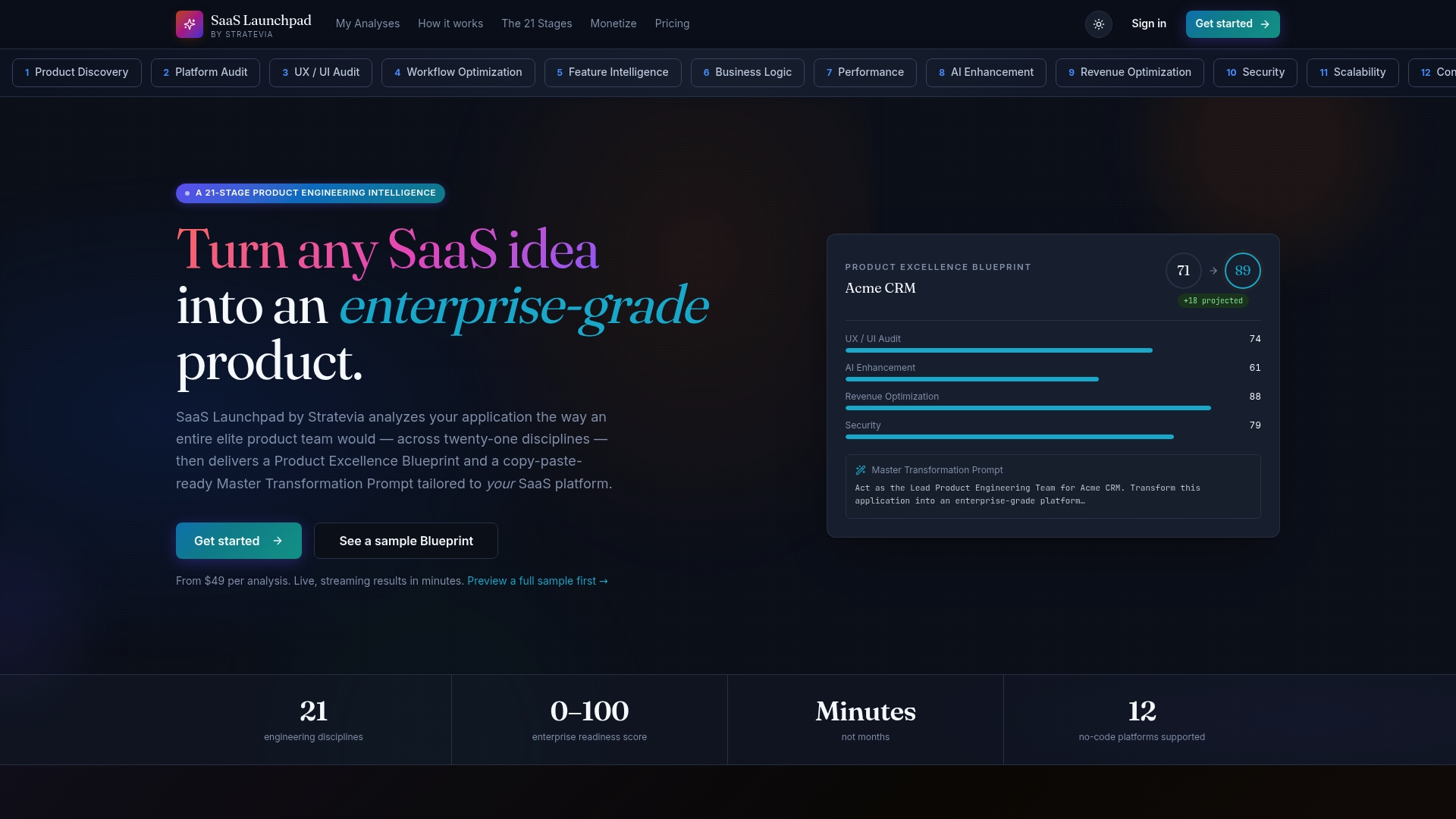
SaaS LaunchPad by Stratevia takes a different approach to the same problem. Instead of being another builder, it analyzes your existing SaaS product across 21 disciplines, from UX and business logic to security, scalability, and revenue optimization, then delivers a Product Excellence Blueprint and a copy-paste-ready Master Transformation Prompt tailored to your specific platform. Whether you built on Bubble, Webflow, or Backendless, the output tells you exactly what to fix and in what order. No subscription, no retainer. You purchase credits, run the analysis, and get a blueprint you can act on immediately at SaaS LaunchPad.
FAQ
What is the best no-code AI SaaS builder for beginners?
Glide and Appy Pie offer the lowest barrier to entry, with drag-and-drop interfaces and AI automation that require no technical background. Softr is also beginner-friendly if your data already lives in Airtable.
Can you build a real, scalable SaaS product without coding?
Yes, though scalability depends heavily on your platform choice and data model design. Platforms like Bubble, Backendless, and OutSystems support complex logic and large user bases; simpler tools like Glide work best for narrower, data-driven products.
How do I avoid vendor lock-in with no-code platforms?
Check for data export options (CSV, SQL) and code access before committing. ToolJet's open-source, self-hosted option and platforms that allow GitHub export give you the most migration freedom.
What AI features should a no-code SaaS builder include?
Look for native AI workflow automation, AI-assisted UI generation, and the ability to connect external AI models via API. Separating AI agent logic from your UI layer, as Zapier recommends for AI agent builds, keeps your product maintainable as models evolve.
How much does it cost to build a SaaS app with a no-code platform?
Most platforms offer free tiers for early development. Paid plans typically start between $14/mo and $59/mo for consumer-grade tools, while enterprise platforms like OutSystems require custom pricing. Factor in per-user fees, which can scale unexpectedly as your product grows.
Key Takeaways
The right no-code AI SaaS builder depends on your product's complexity, data model, and growth stage, not on which platform has the most features.
| Point | Details |
|---|---|
| Match platform to complexity | Simple data-driven apps suit Glide or Softr; complex multi-role SaaS needs Bubble, Backendless, or OutSystems. |
| Component assembly beats code generation | Platforms that assemble pre-tested blocks reduce bugs and technical debt compared to raw AI code generators. |
| Database design still determines scalability | A flawed data model will limit your product regardless of which platform you build on. |
| Verify export options before committing | Platforms without CSV, SQL, or code export options create long-term migration risk and vendor dependency. |
| SaaS LaunchPad audits what you build | After launching on any no-code platform, SaaS LaunchPad's 21-stage analysis identifies what to fix to reach enterprise-grade quality. |