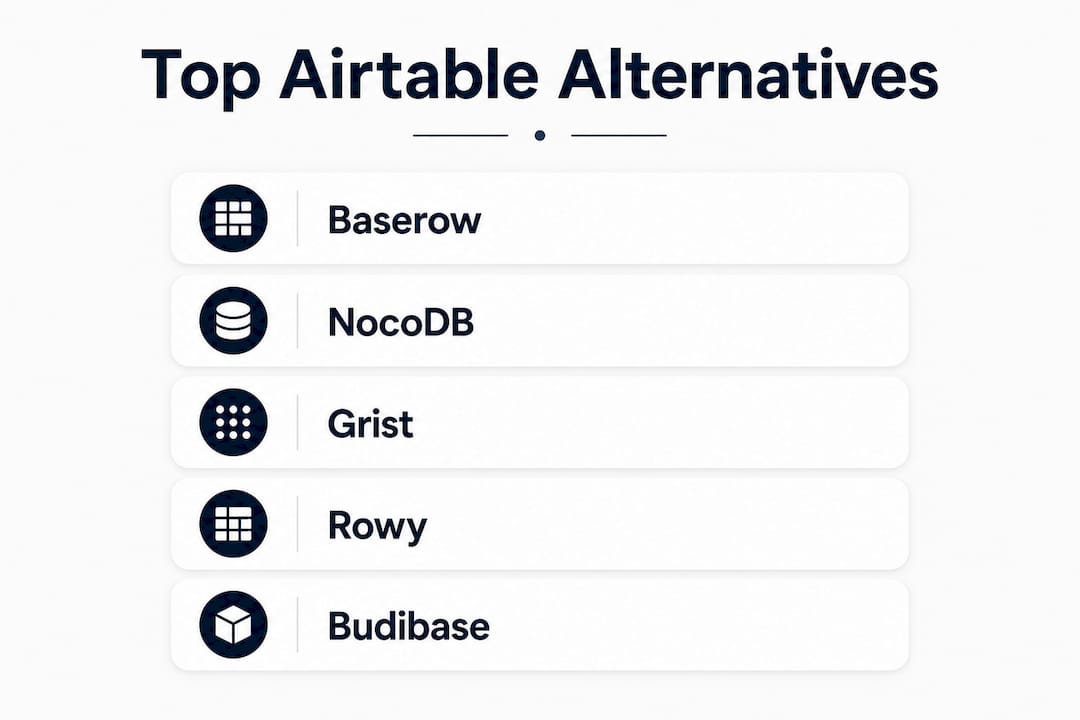
The strongest open source Airtable alternatives available today are Baserow, NocoDB, Grist, Undb, Nextcloud Tables, APITable, Rowy, NocoBase, AITable.ai, and Budibase. Each one lets you self-host your data, skip vendor lock-in, and extend the platform with code when no-code hits its ceiling. Here is what separates them at a glance:
- Baserow — Cloud and self-hosted; GDPR, HIPAA, SOC 2 compliant; built-in AI assistant; 150,000+ users
- NocoDB — Self-hosted; REST and GraphQL APIs over existing databases; a large active community
- Grist — Self-hosted and cloud; spreadsheet-database hybrid; powerful formula engine
- Undb — Self-hosted; lightweight; easiest cold-start for small teams
- Nextcloud Tables — Integrated into Nextcloud; best for teams already on that stack
- APITable — Cloud and self-hosted; intuitive UI; basic automation built in
- Rowy — Firebase-backed; spreadsheet UI for Firestore data
- NocoBase — Self-hosted; advanced role-based access control (RBAC); plugin architecture
- AITable.ai — Cloud and self-hosted; AI-driven workflow automation
- Budibase — Self-hosted; low-code app builder layered on open databases
All ten are free to self-host in their community editions. Deployment complexity, compliance depth, and API maturity vary considerably, and those differences are what actually drive the right choice for your team.
What are the best open source Airtable alternatives?
Each tool below earns its spot on a specific strength, not just the fact that it exists.
Baserow is the most compliance-ready option on this list. Its MIT-licensed core covers GDPR, HIPAA, and SOC 2 Type II, which matters the moment a US enterprise client asks for your security documentation. The built-in AI assistant lets teams create databases and automations in plain language, and the API-first architecture means developers can extend anything the no-code layer cannot reach. Self-hosting runs on Docker with PostgreSQL underneath.

NocoDB takes a different angle: it connects to databases you already own (PostgreSQL, MySQL, MariaDB, SQLite) and exposes REST and GraphQL APIs on top of them. That makes it genuinely useful for teams that have existing data they want to surface in a spreadsheet UI without migrating anything. With over 63,000 GitHub stars and 340 contributors, the community is one of the most active in this space.

Grist sits between a spreadsheet and a relational database. Its formula engine handles complex cross-table calculations that would require a developer in most no-code tools. Teams migrating from Excel-heavy workflows tend to adapt quickly because the mental model stays familiar. Self-hosting is straightforward via Docker.
Undb is the lightest option here. If your team needs a shared, structured data store and wants to be running in under an hour, Undb delivers that without the configuration overhead of larger platforms.
Nextcloud Tables only makes sense if your organization already runs Nextcloud. The integration is tight, the privacy story is consistent with the rest of the Nextcloud ecosystem, and you avoid managing a separate service. Outside that context, the other options on this list offer more.
APITable gives teams a familiar Airtable-like grid interface with built-in automation and collaboration, available as both a cloud service and a self-hosted deployment. The UI is polished enough that non-technical teammates adapt without training.
Rowy is purpose-built for Firebase users. It wraps Firestore in a spreadsheet UI and adds cloud functions directly from the interface, which cuts the feedback loop for developers building Firebase-backed apps. If your stack does not include Firebase, Rowy is not the right fit.
NocoBase stands out on permissions. Its RBAC system is granular enough for multi-department enterprise deployments, and the plugin architecture lets developers add custom functionality without forking the core. It targets teams that need enterprise-grade access control without paying for a proprietary platform.
AITable.ai embeds AI workflows natively, letting teams automate data enrichment and record updates through AI-driven triggers. It runs on cloud or self-hosted infrastructure, though the AI features lean toward the cloud deployment.
Budibase is less a database tool and more an app builder that happens to support open databases as its backend. Teams that need internal tools (approval workflows, dashboards, admin panels) built fast will find it more useful than teams primarily managing structured data.
Pro Tip: Run NocoDB against your existing PostgreSQL instance before committing to a migration. You get the spreadsheet UI immediately, with zero data movement, and can evaluate fit before touching your schema.
How to choose the right self-hosted database tool
The decision comes down to four questions. Answer them honestly before you spin up a demo instance.
What compliance level do you need? If your US-based team handles healthcare data or signs enterprise contracts with security questionnaires, only Baserow's documented GDPR, HIPAA, and SOC 2 Type II coverage gives you something to hand an auditor. The others offer self-hosting (which helps with data sovereignty) but do not publish equivalent compliance certifications.
How much of your workflow lives outside no-code? No-code features handle most data entry and simple automation. Complex business logic, multi-system integrations, and custom reporting eventually need an API. Platforms like Baserow and NocoDB are API-first by design, meaning the API is not an afterthought bolted on later. That distinction matters when your developers need to build on top of the platform.
What is your real total cost of ownership? Many of these tools use open-core licensing, where the free edition lacks features like LDAP, SSO, or audit logs. Those features often appear only in paid enterprise tiers. Audit your actual requirements against each tool's free edition before assuming "open source" means free at scale.
How active is the community? A project with hundreds of contributors and frequent releases is far less likely to stall than one maintained by a handful of developers. NocoDB's 340 contributors and Baserow's consistent release cadence are concrete signals of long-term platform viability.
| Tool | Deployment | Compliance | API/Extensibility | Best For |
|---|---|---|---|---|
| Baserow | Cloud + self-hosted | GDPR, HIPAA, SOC 2 | REST API, AI assistant | Enterprise compliance |
| NocoDB | Self-hosted | Self-managed | REST + GraphQL | Developer-first teams |
| Grist | Cloud + self-hosted | Self-managed | Python formulas, API | Complex data models |
| Undb | Self-hosted | Self-managed | Basic API | Small teams, fast setup |
| Nextcloud Tables | Self-hosted (Nextcloud) | Self-managed | Nextcloud ecosystem | Nextcloud organizations |
| APITable | Cloud + self-hosted | Self-managed | REST API, automation | UI-focused teams |
| Rowy | Cloud (Firebase) | Self-managed | Firebase, cloud functions | Firebase developers |
| NocoBase | Self-hosted | Self-managed | Plugin API, RBAC | Enterprise permissions |
| AITable.ai | Cloud + self-hosted | Self-managed | AI workflows, REST | AI-driven automation |
| Budibase | Cloud + self-hosted | Self-managed | REST API, app builder | Internal tool builders |
Watch for these common pitfalls: assuming self-hosting eliminates all costs (infrastructure, maintenance, and backup tooling add up), treating open-core free tiers as production-ready for enterprise use, and picking a tool based on UI alone without testing its API surface.
Enterprise and technical considerations for self-hosting
Data sovereignty is the primary driver for US teams choosing self-hosted over cloud SaaS, not cost. When your database runs on your infrastructure, you control where data lives, who can access it, and what audit trail exists. That matters for HIPAA-covered entities, defense contractors, and any team subject to state-level data privacy laws.
Self-hosting production workloads requires more than a Docker Compose file. PostgreSQL, which underpins Baserow, NocoDB, and several others, needs a real backup strategy. Tools like pgBackRest handle point-in-time recovery and are worth configuring before you go live, not after your first incident. High availability means running redundant containers behind a load balancer, not a single instance on a shared VM.
"Long-running or complex business workflows should decouple workflow engines from the database platform for scalability and reliability. Pairing a tool like NocoDB or Baserow with Apache Airflow for orchestration keeps each system doing what it does best." — Workflow orchestration best practices
One technical trap that catches teams early: these platforms abstract PostgreSQL behind their own schema management layer. Making direct schema changes in the database bypasses that abstraction and causes conflicts. Always manage schema through the platform's native API or UI, not through psql directly.
Open-core licensing deserves a hard look before you commit. Features like SSO, LDAP integration, and audit logs are often gated behind paid tiers even in projects that call themselves open source. Map your security requirements to each tool's free edition before your team builds on it.
Pro Tip: Check each project's GitHub release frequency before committing. A project with monthly releases and an active issue tracker is a healthier long-term bet than one with a polished landing page and a stale commit history.
Emerging self-hosted database tools worth watching
The ten tools above cover most use cases, but a few newer projects are gaining traction and deserve attention if the mainstream options do not fit your stack.
- Teable — A no-code Postgres-native spreadsheet with a strong GitHub community. It handles millions of rows without performance degradation, which puts it ahead of most alternatives on raw data scale. Community Edition is free under AGPL.
- Mathesar — A web-based interface for PostgreSQL that stays close to the database's native structure. Useful for teams that want a UI over raw Postgres without the abstraction overhead of a full no-code platform.
- Airtable-like forks and community projects — Several smaller projects on GitHub target specific gaps (offline-first, mobile-native, or edge-deployed databases). Worth monitoring on GitHub's trending page if your requirements are unusual.
Evaluate these alongside the established tools, especially if your primary constraint is data volume or you need a closer relationship with the underlying database engine.
How teams are using these tools in practice
Teams replacing Airtable with self-hosted alternatives consistently cite two motivations: eliminating the per-seat cost at scale and regaining control over where their data lives. A software agency managing client project data across dozens of workspaces, for example, finds NocoDB's ability to connect to an existing PostgreSQL instance far more practical than migrating everything into a new data store. The spreadsheet UI goes live in minutes; the underlying data never moves.
Compliance-driven teams tell a different story. A US healthcare startup building an internal patient intake tracker needs HIPAA documentation it can show an auditor, not just a self-hosted deployment. Baserow's published compliance certifications make it the practical choice there, even if NocoDB or Grist would handle the data model equally well.
User feedback across these platforms consistently highlights one benefit above others: the ability to leave a proprietary SaaS tool without losing the spreadsheet-style interface their non-technical teammates rely on. That combination of data control and familiar UX is what drives adoption, not feature count.
How to migrate from Airtable to an open source alternative
Migration is less painful than most teams expect, provided you follow a clear sequence.
- Export your Airtable data. Use Airtable's CSV export for each base. For complex bases with attachments, use the Airtable API to pull records programmatically before your subscription lapses.
- Map your schema. Document every field type, linked record relationship, and formula in your current Airtable base. Most open source tools support equivalent field types, but the mapping is rarely one-to-one.
- Set up your self-hosted instance. Deploy via Docker Compose on your chosen infrastructure. Configure your database backend (PostgreSQL is the most common) and run the platform's initial setup.
- Import your data. Baserow and NocoDB both support CSV import with field-type detection. For linked records and complex relationships, use the platform's API to load data in the correct order (parent records before child records).
- Rebuild automations. Airtable automations do not export. Recreate them natively in your new platform, or connect to an external automation tool for more complex workflows. For Zapier-style triggers, see cheaper Zapier alternatives that integrate with open source databases.
- Test with a subset of users. Run both systems in parallel for two to four weeks before cutting over fully. Identify gaps in formula support or view types before your team depends on the new platform.
- Decommission Airtable. Cancel after confirming all data, automations, and integrations are stable in the new environment.
The most common failure point is step two. Teams that skip the schema mapping phase discover mid-migration that their linked records or rollup fields do not translate cleanly.
How these tools connect to third-party services
Every major tool on this list exposes a REST API, which means any service that can make an HTTP request can integrate with it. That covers Zapier, Make (formerly Integromat), n8n, and direct webhook connections from services like Stripe, GitHub, or Slack.
NocoDB and Baserow go further with GraphQL support, which lets you fetch exactly the fields you need in a single request rather than over-fetching and filtering client-side. For teams building internal dashboards or feeding data into BI tools like Metabase or Grafana, that efficiency adds up.
Rowy's Firebase integration is the most specialized: it exposes Firestore collections as spreadsheet rows and lets you trigger Google Cloud Functions directly from the UI. For teams already on Google Cloud, that cuts out a significant layer of custom glue code.
For no-code app builders that need a database backend, Budibase and NocoBase both support connecting to external data sources alongside their internal databases, which means you can use them as a front-end layer over an existing PostgreSQL or MySQL instance.
Limitations and challenges for US-based teams
Self-hosting is not free. Infrastructure costs, maintenance time, and the engineering hours required to configure backups, SSL, and high availability all have real price tags. A small team that spends 10 hours a month on database infrastructure maintenance is paying for that in opportunity cost, even if the software license is $0.
Support is the other gap. Airtable has a paid support tier with response time guarantees. Open source projects offer community forums, GitHub issues, and, for paid tiers, email support. For US teams in regulated industries that need a vendor with a signed Business Associate Agreement (BAA) for HIPAA, only Baserow currently publishes that level of compliance documentation among the self-hosted options.
Open-core licensing creates a hidden cost ceiling. Features that enterprise procurement teams expect (SSO, LDAP, audit logs, advanced permissions) often sit behind paid tiers. A team that discovers this after building on the free edition faces either paying for the enterprise tier or rebuilding on a different platform.
Finally, formula and view parity with Airtable is incomplete across all these tools. Airtable's gallery view, timeline view, and some formula functions do not have direct equivalents in every alternative. Test your specific use cases before committing.
SaaS LaunchPad: a different kind of analysis for your platform
If you are building or refining a SaaS product on top of any of these open source databases, the tools above handle your data layer. What they do not handle is whether your product itself is architected, positioned, and built to enterprise-grade standards.
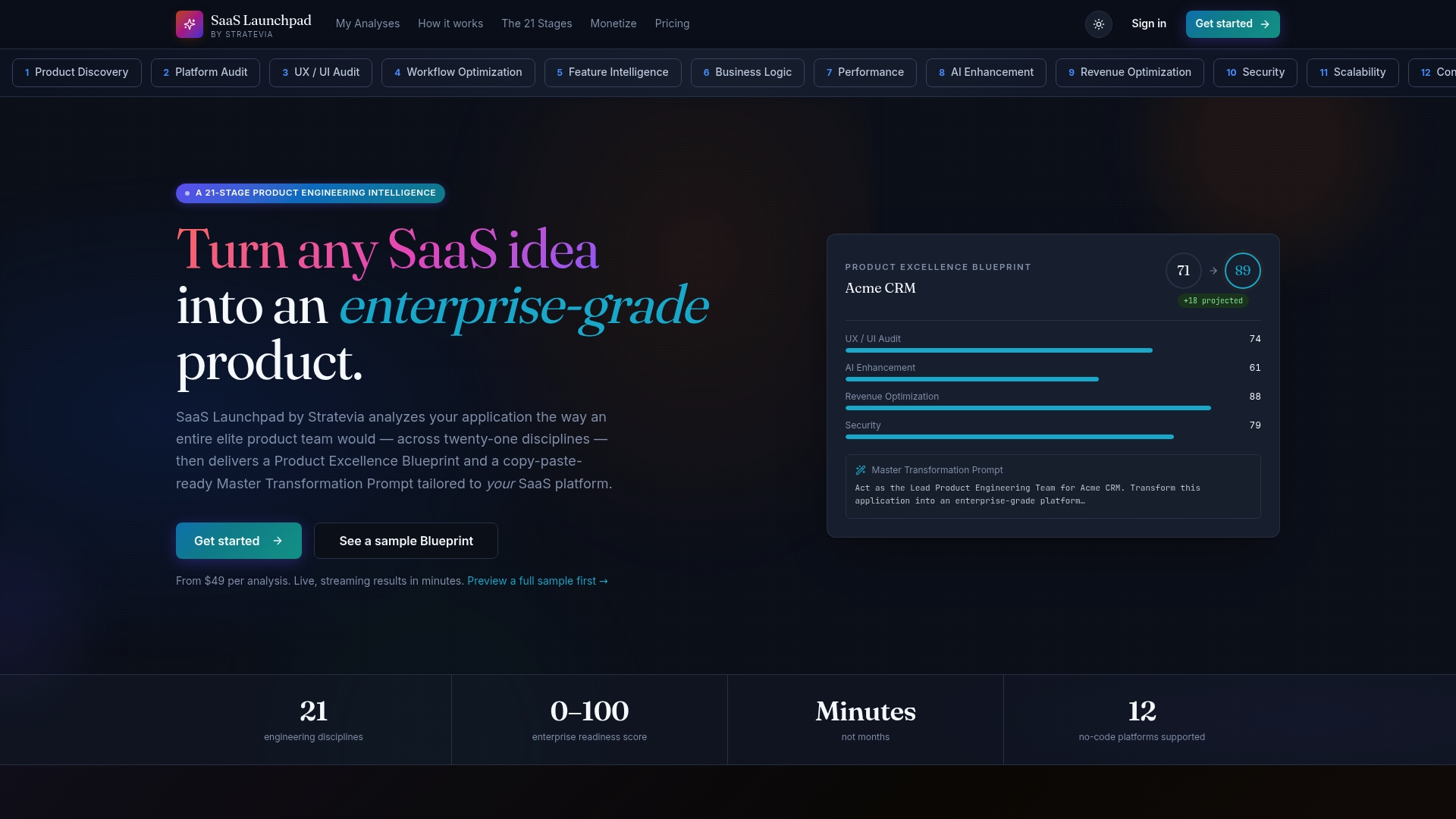
SaaS LaunchPad by Stratevia takes a different approach. Instead of giving you another database or app builder, it analyzes your SaaS platform across 21 disciplines, from UX and security to revenue optimization and enterprise readiness, then delivers a Product Excellence Blueprint and a copy-paste-ready Master Transformation Prompt you can act on immediately. No subscription, no retainer. You purchase credits, run your analysis, and get a concrete improvement roadmap. If you are evaluating whether your product is ready for the enterprise clients who will ask about compliance, scalability, and API design, start your product analysis before those conversations happen.
FAQ
What is the most compliant open source Airtable alternative?
Baserow is the only option on this list with published GDPR, HIPAA, and SOC 2 Type II compliance, making it the strongest choice for US teams in regulated industries.
Can I migrate from Airtable to an open source tool without losing my data?
Yes. Export your Airtable bases as CSV files, then import them into Baserow or NocoDB using their built-in import tools. Complex linked records require API-based migration in the correct record order.
Do open source Airtable alternatives support Zapier or Make integrations?
Most do, through their REST APIs. Baserow and NocoDB also support GraphQL, and both connect directly to automation platforms like Zapier, Make, and n8n via webhooks or native connectors.
What is the hidden cost of self-hosting these tools?
Infrastructure, maintenance, backup configuration, and SSL management all carry real costs. Enterprise features like SSO and audit logs are often locked behind paid tiers in open-core projects, which affects total cost of ownership.
Which tool is best for developers who need API access?
NocoDB and Baserow are the strongest choices. Both expose REST and GraphQL APIs by design, and NocoDB can layer its API directly over an existing PostgreSQL or MySQL database without requiring a data migration.
Key Takeaways
Baserow is the only self-hosted Airtable alternative with documented GDPR, HIPAA, and SOC 2 Type II compliance, making it the default choice for US teams in regulated industries.
| Point | Details |
|---|---|
| Compliance matters most | Only Baserow publishes GDPR, HIPAA, and SOC 2 Type II certifications among self-hosted options. |
| API-first beats no-code-only | NocoDB and Baserow expose REST and GraphQL APIs, enabling developer customization beyond no-code limits. |
| Open-core costs are real | Enterprise features like SSO and audit logs often require paid tiers, affecting total cost of ownership. |
| Migration follows a clear sequence | Export CSV from Airtable, map your schema, import via API, rebuild automations, then run parallel for 2–4 weeks. |
| SaaS LaunchPad adds product depth | For teams building SaaS on these databases, SaaS LaunchPad's 21-discipline analysis covers what the database layer cannot. |