A journey map shows how an experience feels to the customer; a process map shows the internal steps that make that experience happen. Run the journey map first to find where things break down, then use the process map to fix the operational cause. Most teams need both, aligned to the same timeline, not one instead of the other.
TL;DR:
- Mapping the breakdowns in customer experience with journey maps highlights feelings, but fixing them requires aligning operational process maps that detail internal steps.
- Process maps focus on decision points, cycle times, and responsibilities within internal workflows, while journey maps capture customer emotions, touchpoints, and pain points across stages.
- Both maps should be owned by different teams but collaborated on regularly; combining them through a service blueprint clarifies operational gaps affecting the customer experience.
- Building process maps involves observing real work, measuring cycle times, and validating with frontline staff, whereas journey maps depend on customer interviews and behavioral data.
- Integrating findings into the product roadmap and using structured external analysis enhances the chances of actual improvement rather than creating disconnected reports.
Table of Contents
- Process Mapping vs Journey Mapping: What a Process Map Actually Shows
- Process Mapping vs Journey Mapping: What a Journey Map Reveals
- Journey Mapping vs Process Mapping: A Side-by-Side Comparison
- When Should You Run a Journey Map vs a Process Map?
- How to Build Each Map, Step by Step
- Aligning the Two Maps With a Service Blueprint
- Mistakes That Waste a Mapping Exercise
- Two Quick Case Sketches
- Where Mapping Fits Into a Product Roadmap
- Where an Integrated Audit Beats Running Two Separate Mapping Projects
- Sources
- FAQ
Process Mapping vs Journey Mapping: What a Process Map Actually Shows
A process map is a visual breakdown of a business process. It shows steps, decision points, roles, and handoffs, and it's built for people who own the internal machinery: operations leads, process-improvement teams, engineers. The goal isn't empathy, it's precision. A process map documents exactly what happens, in what order, and who's responsible for each step.
Notation depends on the audience. Flowcharts work for a quick team walkthrough. Swim lanes clarify handoffs between departments. BPMN (Business Process Model and Notation) gives large organizations a shared, unambiguous language that helps teams spot bottlenecks and standardize work across stakeholders. The data comes from SOPs, but SOPs alone lie about reality more often than teams expect.
- Decision points and branching logic, not just a linear sequence
- Named owners for each step, not departments
- Cycle times per step, measured, not estimated
- Handoff points where work crosses a team boundary
Process Mapping vs Journey Mapping: What a Journey Map Reveals
A journey map diagrams a person's experience over time. It's built for CX teams, product managers, and marketers who need to understand what a customer, user, or employee actually feels while moving through an experience. Journey maps chart stages, touchpoints, emotions, and metrics, built from voice-of-customer data like interviews and analytics, not from internal documentation.
The strongest journey maps combine a defined persona with a specific goal, then layer in real customer language at each stage. That's the difference between a map that gets used and one that gets filed away.
- Stages: awareness, consideration, onboarding, use, renewal (or whatever fits the product)
- Persona and their stated goal at each stage
- Touchpoints: every interaction with the product, support, or marketing
- Emotional arc: where confidence rises and where frustration spikes
- Deliverables: prioritized pain points and named opportunity areas
Journey Mapping vs Process Mapping: A Side-by-Side Comparison
The two artifacts overlap in one place: both trace a sequence of events over time. Everything else diverges. A journey map is written in the customer's language; a process map is written in company shorthand. Mixing the two without translating causes exactly the kind of stakeholder confusion that derails cross-functional projects.
| Dimension | Process Map | Journey Map |
|---|---|---|
| Focus/perspective | Internal operations and workflow | Customer or user experience |
| Primary audience | Operations, engineering, process-improvement leads | CX, product, marketing teams |
| Notation/visual form | Flowcharts, swim lanes, BPMN | Timeline with stages, touchpoints, emotion curve |
| Typical outputs | Decision points, owners, cycle times | Pain points, opportunities, emotional highs/lows |
| Primary data sources | SOPs, system logs, direct observation | Interviews, surveys, behavioral analytics |
| Typical KPIs | Cycle time, error rate, handoff delay | CSAT, NPS, drop-off rate, effort score |
A few working guidelines fall out of that table:
- CX or product leads should own the journey map; operations or process-improvement leads should own the process map.
- Both owners need a seat in each other's workshop, or the two artifacts never reconcile.
- Standardized BPMN matters when a map circulates across many teams; a simpler swim-lane sketch often works better for a fast, cross-functional workshop.
When Should You Run a Journey Map vs a Process Map?
Ask these questions before you book the workshop:
- Is the complaint about a feeling (confusing, slow, frustrating) or a mechanism (a step failed, a handoff dropped)? Feelings point to a journey map first.
- Do you already know where the breakdown happens, or are you still hunting for it? If you know the process step, map the process directly.
- Will more than one department need to act on the findings? If yes, plan for both maps from the start.
- Is this a one-time investigation or an ongoing process you'll revisit? Recurring processes justify the effort of formal BPMN notation.
Two quick scenarios make the pattern concrete. Checkout abandonment usually starts as a journey-mapping question, because the symptom shows up as a drop in a funnel chart. Support SLA misses usually start as a process-mapping question, because the complaint is about response time, not sentiment. Scale the effort to the stakes: a two-hour whiteboard session suffices for a single-team fix, while a customer-wide onboarding redesign justifies formal interviews and BPMN diagrams.
How to Build Each Map, Step by Step
Process mapping, five steps:
- Scope the process. Pick one start point and one end point. Resist mapping the entire department at once.
- Observe the real work. Watch people do the job; don't just read the SOP.
- Draft the map with decision points, owners, and handoffs marked.
- Validate with the people who do the work, not just their managers.
- Measure cycle time and error rate at each step before calling it done.
Journey mapping, five steps:
- Define the persona and their goal at this stage of the relationship.
- Collect voice-of-customer data through interviews, support tickets, and analytics.
- Map the stages, touchpoints, and emotional arc together, not in separate exercises.
- Validate the draft with real customers, not internal assumptions about what they feel.
- Prioritize the pain points by impact and effort, then hand the top ones to whoever owns the related process.
Pro Tip: Skip the SOP-only shortcut. Direct observation and timing catch undocumented exceptions that determine realistic SLA targets — the gap between what's written down and what actually happens is where most process maps go wrong.
Aligning the Two Maps With a Service Blueprint
A service blueprint solves the coordination problem directly. It places the journey stages on top and the backstage process steps underneath, split by a "line of visibility" that separates what the customer sees from what the operation does to deliver it. Synchronizing the two timelines on one document reveals exactly where an operational fix will move the customer-facing needle.
The practical sequence: walk the journey stage by stage, time the process steps sitting behind each stage, then lay both timelines side by side. Gaps jump out fast, usually as a stall behind a stage the customer already flagged as frustrating.
- Journey stage on top, process steps below, one shared timeline
- Time-stamp each backstage step so delays are visible, not assumed
- Turn each visible gap into one prioritized ops ticket, not a vague "improve this" note
Pro Tip: This is also how you turn journey insight into engineering work. Service blueprinting converts a fuzzy journey moment into a specific, prioritized ops or engineering task instead of a slide nobody acts on.
Mistakes That Waste a Mapping Exercise
- Redesigning a journey without checking whether operations can actually deliver it. Journey maps that ignore the backstage process are just wishlists.
- Trusting the SOP instead of watching the real work. Documented steps and actual steps diverge more than teams admit.
- Choosing notation for the wrong audience. Full BPMN in a customer-facing workshop confuses more than it clarifies.
- Skipping ownership. A map with no assigned owner and no success metric gets filed and forgotten within a quarter.
Two Quick Case Sketches
Checkout abandonment. The journey map flagged a spike in drop-off at payment. The process map traced it to a manual handoff between the payment gateway and order confirmation, a system integration gap invisible from the customer side. Automating that handoff cut the manual step entirely.
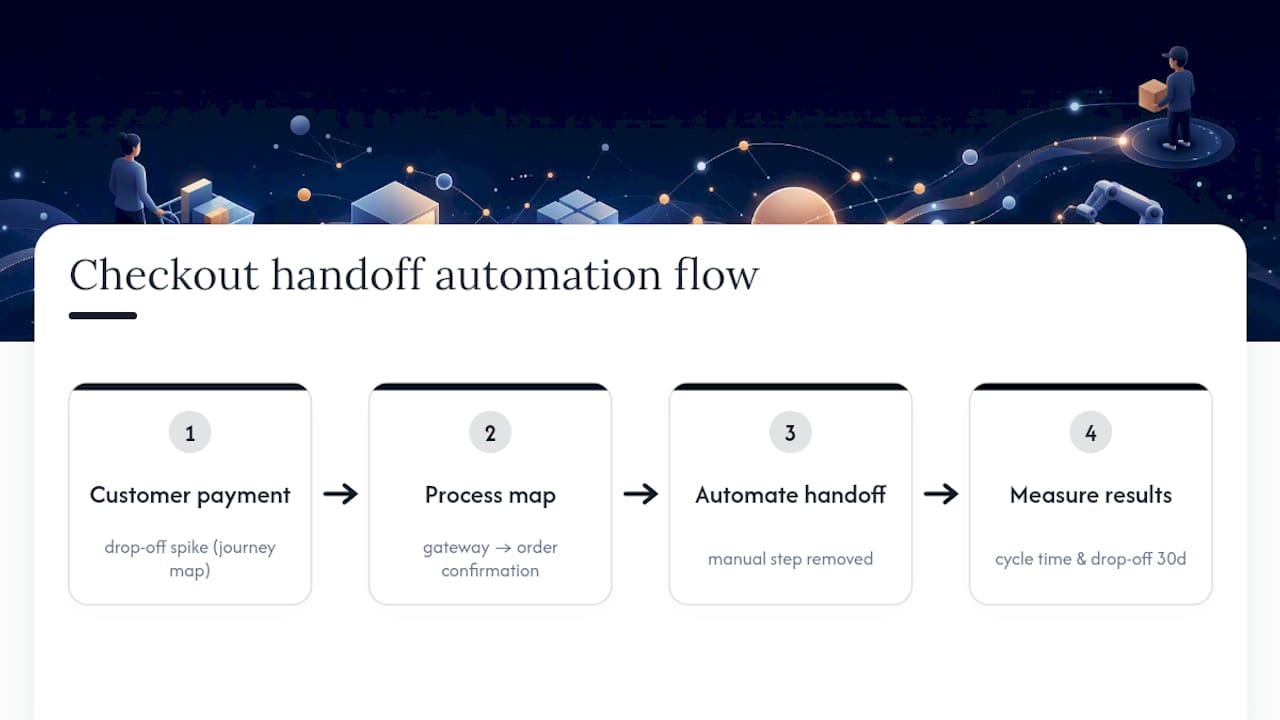
Support SLA misses. Customers reported slow responses in journey interviews. The process map showed a ticket routing delay between two support tiers, matching the pain point almost exactly. Fixing the routing rule closed most of the gap. In both cases, the team measured cycle time and drop-off rate again 30 days after the fix, not just once at launch.
Where Mapping Fits Into a Product Roadmap
Bring in outside analysis when your team lacks bandwidth or objectivity, not as a default. In-house mapping works fine for a single funnel or one support queue. What matters more than who runs it is whether findings get folded into the actual roadmap, with an adoption metric attached, and whether operations has a named owner in the room before anyone commits engineering time.
— Gregory Cornelius
Where an Integrated Audit Beats Running Two Separate Mapping Projects
Running a journey map and a process map as two disconnected projects is the most common way teams lose momentum. SaaS LaunchPad closes that gap in one pass. Its 21-discipline Product Excellence Blueprint covers customer journey mapping and workflow optimization together, alongside UX audit, business logic verification, and enterprise readiness scoring, so the journey pain points and their process-level causes surface in the same analysis instead of two reports that never talk to each other.
That matters most for teams that don't have a dedicated CX researcher and a process-improvement lead sitting in the same room. An external, structured pass finds the misalignments faster than sequential in-house workshops, and it ends with a copy-paste-ready Master Transformation Prompt built for your platform, not a slide deck that needs translation into engineering tickets. If your product has a known friction point but no clear owner for the fix, run a full analysis through SaaS Launchpad and get the roadmap in one pass.
Sources
For deeper reference: the service blueprint and line-of-visibility method, BPMN notation background, and a hands-on journey-mapping workshop playbook for teams running their first collaborative session.
- Connecting process maps to journey maps: a CX leader's guide
- Process Map vs. Journey Map: Key Differences
- Customer Journey Map vs. Process Map: What's the Difference?
- Customer Journey Map vs. Process Map: Key Differences
FAQ
What Is Process Mapping Mainly Used For?
Process mapping is mainly used to document internal workflow steps, decision points, and handoffs so operations teams can find bottlenecks and standardize how work gets done.
What Is Journey Mapping?
Journey mapping is a visual diagram of a customer's or user's experience over time, showing stages, touchpoints, emotions, and metrics built from interviews, surveys, and analytics.
What Are Common Mistakes in Journey Mapping?
The biggest ones are designing a redesigned journey without checking whether operations can deliver it, and building the map from internal assumptions instead of real customer interviews.
What Are the Stages of the Customer Journey?
Definitions vary by industry, but a common version includes awareness, consideration, decision, onboarding, and retention or loyalty, with touchpoints and emotions mapped at each stage.
How Do Process Maps and Journey Maps Work Together?
Journey maps find where customers experience pain; process maps identify the operational cause behind it. Aligning both prevents a redesign from reverting once operations can't deliver the promised experience.