Identity controls stop the majority of SaaS breaches. Enforce MFA everywhere, centralize identity with SSO and SCIM, apply least-privilege RBAC, run continuous logging and monitoring, and govern every API and OAuth integration. Those five controls, prioritized in that order, are where product teams should spend the first 90 days.
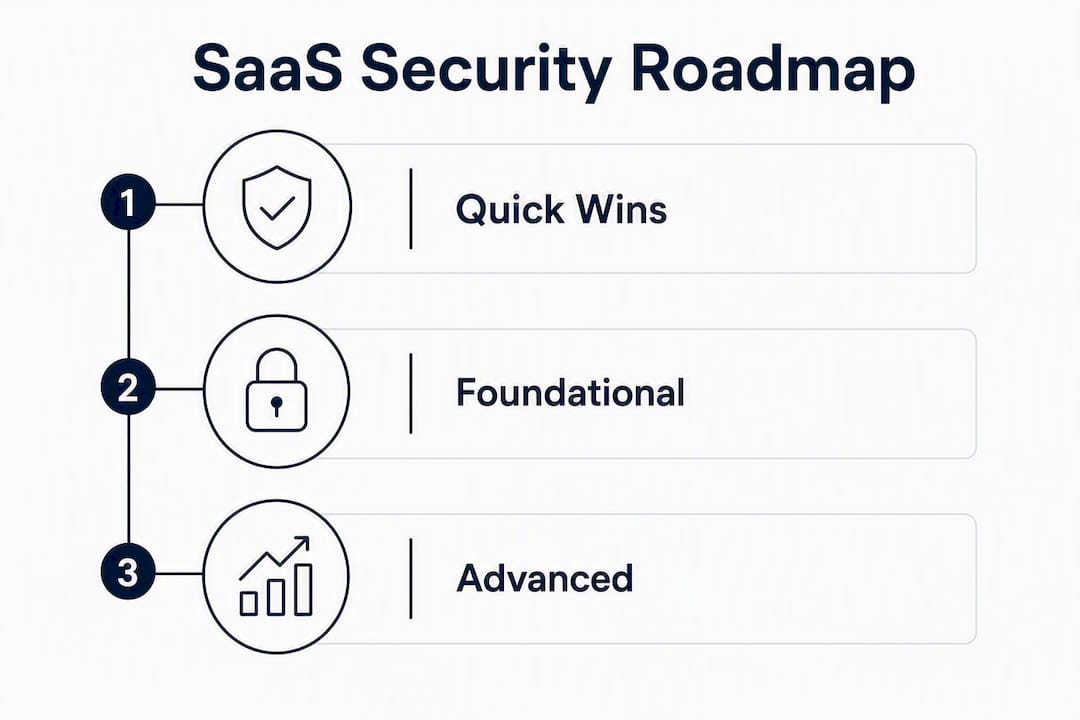
Quick wins (0–14 days): Enable MFA for all users; audit OAuth grants in your IdP; disable shared/service accounts.
Foundational (15–60 days): Deploy SSO with SCIM provisioning; implement RBAC with quarterly admin reviews; centralize logging with 12-month retention; classify data and verify TLS 1.3 and AES-256 encryption.
Advanced (60+ days): Shift-left CI/CD security (SAST, secret scanning, dependency scanning); adopt the Cloud Security Alliance SSCF for vendor assessments; complete SOC 2 Type II readiness; run annual penetration tests.

NIST SP 800-63B and the Cloud Security Alliance's SaaS Security Capability Framework (SSCF) are the two standards that enterprise buyers reference most often. HaveIBeenPwned breach detection belongs in your authentication stack from day one.
Table of Contents
- What does a prioritized SaaS security checklist look like?
- Who actually owns what in the shared responsibility model?
- How do you lock down authentication and access control?
- What does solid data protection actually require?
- How do you harden your CI/CD pipeline against security regressions?
- What does a working incident response program look like?
- How do you move vendor risk from ad-hoc to systematic?
- What will enterprise buyers and auditors actually ask for?
- How do you run a full SaaS security audit using a 21-discipline approach?
- What does a 30–90 day remediation roadmap look like?
- Key Takeaways
- The part of SaaS security most product teams get wrong
- Get your SaaS platform enterprise-ready with a full product audit
- Useful sources
- FAQ
What does a prioritized SaaS security checklist look like?
Misconfigurations drive the majority of SaaS breaches, and a scorable checklist maps directly to the attack vectors that matter. Use this as your baseline audit.
Quick wins (0–14 days)
- Enforce MFA for every user account, including service accounts.
- Audit OAuth grants in Google Workspace or Microsoft 365; revoke over-permissive scopes.
- Disable shared credentials and rotate any exposed API keys immediately.
- Inventory all SaaS apps — the average organization runs over 130 SaaS applications, each an attack surface.
Foundational (15–60 days)
- Deploy SSO with SCIM to automate provisioning and deprovisioning.
- Implement RBAC with documented roles; audit admin accounts quarterly.
- Centralize logging with structured JSON logs, 12-month immutable retention.
- Classify data (public / internal / confidential / restricted) before applying encryption controls.
- Verify encryption — TLS 1.3 in transit, AES-256 at rest, encrypted backups.
Advanced (60+ days)
- Add SAST, secret scanning, and dependency scanning to CI/CD; block merges on critical findings.
- Integrate SSPM with your SIEM for continuous misconfiguration detection.
- Adopt SSCF for vendor assessments; replace ad-hoc questionnaires.
- Complete SOC 2 Type II prep and schedule an annual penetration test.
| Control | Impact | Effort |
|---|---|---|
| MFA enforcement | Critical | Low |
| OAuth audit | Critical | Low |
| SSO + SCIM | High | Medium |
| RBAC + least privilege | High | Medium |
| Centralized logging | High | Medium |
| CI/CD security gates | High | High |
| Pen test + SOC 2 | High | High |
Who actually owns what in the shared responsibility model?
The vendor secures the platform and underlying infrastructure. You own configuration, identity, data classification, and every third-party integration you connect. Most SaaS incidents originate in customer-controlled areas: misconfigurations, OAuth sprawl, and credential misuse.
Common customer-owned failures:
- Leaving default admin roles in place after onboarding.
- Granting OAuth access to third-party apps without reviewing scopes.
- No documented offboarding process, leaving former employees with active sessions.
- Storing sensitive data in fields with no encryption or classification.
Pro Tip: Assign a single named owner to every SaaS app in your stack. That owner holds the onboarding checklist, the OAuth grant log, and the deprovisioning runbook. Without a named owner, misconfiguration gaps persist for months undetected.
How do you lock down authentication and access control?
Identity controls deliver the highest ROI of any security investment. Get these settings right before anything else.
MFA: Require it for all users. Prefer phishing-resistant methods — WebAuthn, passkeys, or hardware security keys — over SMS-based OTP, which is vulnerable to SIM-swapping.
SSO + SCIM: Disable local logins once SSO is live. Use SCIM to automate user provisioning and deprovisioning so terminated employees lose access within minutes, not weeks. Enforce conditional access policies (device trust, location, risk score).
Password policy: Follow NIST SP 800-63B — no forced periodic rotation, minimum 12-character length, and breach detection via the HaveIBeenPwned API. Forced rotation produces predictable, weaker passwords; breach detection catches compromised credentials without that friction.
RBAC and JIT access:
- Define roles by job function, not by individual.
- Audit privileged accounts quarterly; remove stale admin grants.
- Implement just-in-time elevation for sensitive operations so elevated access expires automatically.
Pro Tip: Check your IdP's sign-in logs for accounts that haven't authenticated in 90 days. Dormant accounts are a favorite lateral-movement target — suspend them before an attacker finds them first.
What does solid data protection actually require?
Classify data first. Controls applied without classification are either over-engineered for low-sensitivity data or dangerously thin for high-sensitivity data.
- In transit: TLS 1.3 preferred; TLS 1.2 minimum. Verify every internal service-to-service call, not just the public API.
- At rest: AES-256 for databases, object storage, and backups. Confirm backup encryption separately — it's the most commonly missed gap.
- Field-level encryption: Apply to PII, PHI, and payment data. Database-level encryption alone doesn't protect against application-layer access.
- Key management: Decide between provider-managed keys and customer-managed keys (BYOK/CMK) based on your compliance tier. Rotate keys on a documented schedule; store keys separately from the data they protect.
- Data lifecycle: Document retention periods, automated deletion schedules, and data export capabilities. GDPR and CCPA both require demonstrable deletion and portability — "we can do it manually" won't satisfy an enterprise legal team.
How do you harden your CI/CD pipeline against security regressions?
Shift left. Automated checks in CI catch vulnerabilities before they reach production and cost a fraction of post-release remediation.
Mandatory CI gates:
- Dependency scanning (e.g., Dependabot, Snyk) — flag known CVEs in third-party packages.
- Secret scanning (e.g., GitGuardian, GitHub Advanced Security) — block commits containing API keys, tokens, or credentials.
- SAST — static analysis on every pull request; block merges on critical findings.
Infrastructure security:
- Lint IaC templates (Terraform, CloudFormation) with tools like Checkov or tfsec before deployment.
- Apply policy-as-code to enforce least-privilege cloud IAM configs at the infrastructure layer.
Release controls: Sign build artifacts, use immutable artifact registries, and deploy via staged rollouts with canary monitoring so a misconfigured release affects a small percentage of traffic before full promotion.
What does a working incident response program look like?
You can't fix what you can't see. Centralized logging with real-time alerting is the foundation everything else depends on.
Logging standards: Structured JSON logs capturing who, what, when, where, and why. Retain in immutable storage for at least 12 months to satisfy SOC 2 and HIPAA audit windows.
Detection: Integrate SSPM outputs into your SIEM and alert on anomalous bulk exports, admin role changes, and new OAuth grant events. These three event types cover the majority of insider and account-takeover scenarios.
IR lifecycle: Detect → triage → contain → eradicate → recover → notify → post-mortem. Run quarterly tabletop exercises against your top two or three threat scenarios.
Pro Tip: Keep a pre-approved customer and regulator notification template in your runbook. When an incident hits at 2 AM, the last thing you want is a legal review holding up a breach disclosure that has a 72-hour GDPR clock running.
How do you move vendor risk from ad-hoc to systematic?
Replace manual questionnaires with a standardized framework. The Cloud Security Alliance's SSCF provides a structured control set for evaluating SaaS vendors consistently across procurement and recurring reviews.
Operationalizing vendor risk:
- Classify vendors by data sensitivity and access level (read-only vs. write access to production data).
- Map SSPM findings to SSCF controls to accelerate procurement reviews.
- Require SOC 2 Type II reports, penetration test summaries, and incident notification SLAs in every vendor contract.
- Set automated re-assessment triggers: any vendor with access to sensitive data gets reviewed annually or after a major incident.
The Cloud Security Alliance recommends moving from ad-hoc questionnaires to standardized frameworks like the SSCF to make vendor assessments repeatable, comparable, and auditable — not just a one-time checkbox exercise before signing a contract.
What will enterprise buyers and auditors actually ask for?
Enterprise procurement teams look for evidence, not promises. The SaaS audit checklist enterprise clients rely on maps directly to these artifacts.
Evidence package:
- Policy documents (access control, incident response, data retention, acceptable use).
- Configuration snapshots showing MFA enforcement, SSO settings, and RBAC role definitions.
- Audit logs with retention proof.
- Most recent penetration test report and remediation status.
- Vendor contracts with security SLAs.
- Security training completion records.
- Runbook snapshots for your top incident scenarios.
Timing: Start SOC 2 Type II prep at least six months before a major sales milestone. Auditors need a minimum observation period, and gaps found late in the process delay deals.
Pen test cadence: Annual full-scope test plus a targeted test after any major release. Triage findings by CVSS score: critical findings within 24 hours, high within 7 days, medium within 30 days.
How do you run a full SaaS security audit using a 21-discipline approach?
A scorable audit converts subjective impressions into a prioritized remediation backlog. The SaaS LaunchPad 21-discipline audit maps security across identity, data, infrastructure, CI/CD, integrations, and monitoring.
- Inventory — list every SaaS app, integration, and OAuth grant in your environment.
- Configuration review — score each control (Done / In Progress / Not Started) against the checklist above.
- Integration and OAuth audit — pull grant logs from your IdP; flag scopes broader than the integration requires.
- Artifact collection — gather policy docs, log samples, encryption configs, and pentest reports.
- Roadmap — convert Not Started and In Progress items into sprint tickets, ordered by risk and buyer priority.
| Discipline | Owner | Cadence |
|---|---|---|
| Identity and access | Product + Engineering | Quarterly |
| Data classification | Product + Legal | Annually |
| CI/CD security gates | Engineering | Per release |
| OAuth and integration audit | Engineering | Quarterly |
| Monitoring and alerting | Engineering + SecOps | Monthly |
| Vendor risk | Product + Legal | Annually |
| Pen test and compliance | Engineering + Legal | Annually |
Involve the product owner, engineering lead, security lead, and legal/compliance from the start. Reassess quarterly for high-risk controls and annually for the full scope.
What does a 30–90 day remediation roadmap look like?
| Weeks | Tasks | Owner | Expected Outcome |
|---|---|---|---|
| 1–2 | Enforce MFA; audit and revoke OAuth grants; disable shared accounts | Engineering | Credential attack surface reduced |
| 3–4 | Deploy SSO; configure SCIM provisioning; document RBAC roles | Engineering + Product | Automated provisioning live |
| 5–6 | Centralize logging; configure SIEM alerts for admin changes and bulk exports | Engineering | Detection baseline established |
| 7–8 | Classify data; verify TLS 1.3 and AES-256; encrypt backups | Engineering | Encryption gaps closed |
| 9–10 | Add SAST, secret scanning, dependency scanning to CI/CD | Engineering | Pipeline security gates live |
| 11–12 | SSCF vendor assessment; update contracts; schedule pen test | Product + Legal | Vendor risk documented |
Remediation SLAs: Critical findings within 24 hours, high within 7 days, medium within 30 days. Groom a dedicated security backlog in each sprint so fixes don't compete with feature work.
Key Takeaways
Enforcing MFA, SSO with SCIM, and least-privilege RBAC stops the majority of SaaS breaches — do those three things before anything else.
| Point | Details |
|---|---|
| Identity controls first | MFA, SSO, and least-privilege RBAC are the highest-impact controls; prioritize them in weeks 1–4. |
| Shared responsibility gap | Vendors secure infrastructure; you own configuration, identity, and integrations — most breaches happen in your zone. |
| Classify before encrypting | Apply TLS 1.3, AES-256, and field-level encryption proportional to data sensitivity, not uniformly. |
| Audit evidence matters | Enterprise buyers want policy docs, configuration snapshots, pentest reports, and training records — not verbal assurances. |
| SaaS LaunchPad audit | The 21-discipline Product Excellence Blueprint maps security gaps to a prioritized roadmap you can hand to engineering and legal. |
The part of SaaS security most product teams get wrong
The conventional wisdom says "add more tools." Buy an SSPM, plug in a SIEM, run a pen test, check the boxes. What that advice misses is that tooling without ownership is just expensive noise.
The real failure mode is organizational, not technical. A team can have MFA enforced in their primary IdP and still have 40 OAuth-connected apps with admin-level scopes that nobody reviews because there's no named owner, no quarterly cadence, and no one whose job it is to care. The SSCF and NIST SP 800-63B give you the right controls. The 21-discipline audit gives you the scoring structure. But neither does anything unless a specific person owns each control and has a calendar reminder to check it.
Product teams building toward enterprise deals tend to underestimate how much of the procurement conversation is about evidence of process, not just the presence of controls. A SOC 2 Type II report is valuable not because it proves you're secure, but because it proves you've been consistently operating controls over time. That's what a CISO at a Fortune 500 is actually buying: predictability and accountability, not a snapshot.
Start with the 30–90 day roadmap. Assign owners. Build the evidence as you go. The audit artifacts you collect during remediation become the procurement package that closes enterprise deals.
Get your SaaS platform enterprise-ready with a full product audit
Security gaps don't just create risk — they stall deals. Enterprise buyers run procurement checklists that cover identity, encryption, logging, incident response, and vendor risk before they sign. If your platform can't produce the evidence, the deal waits.
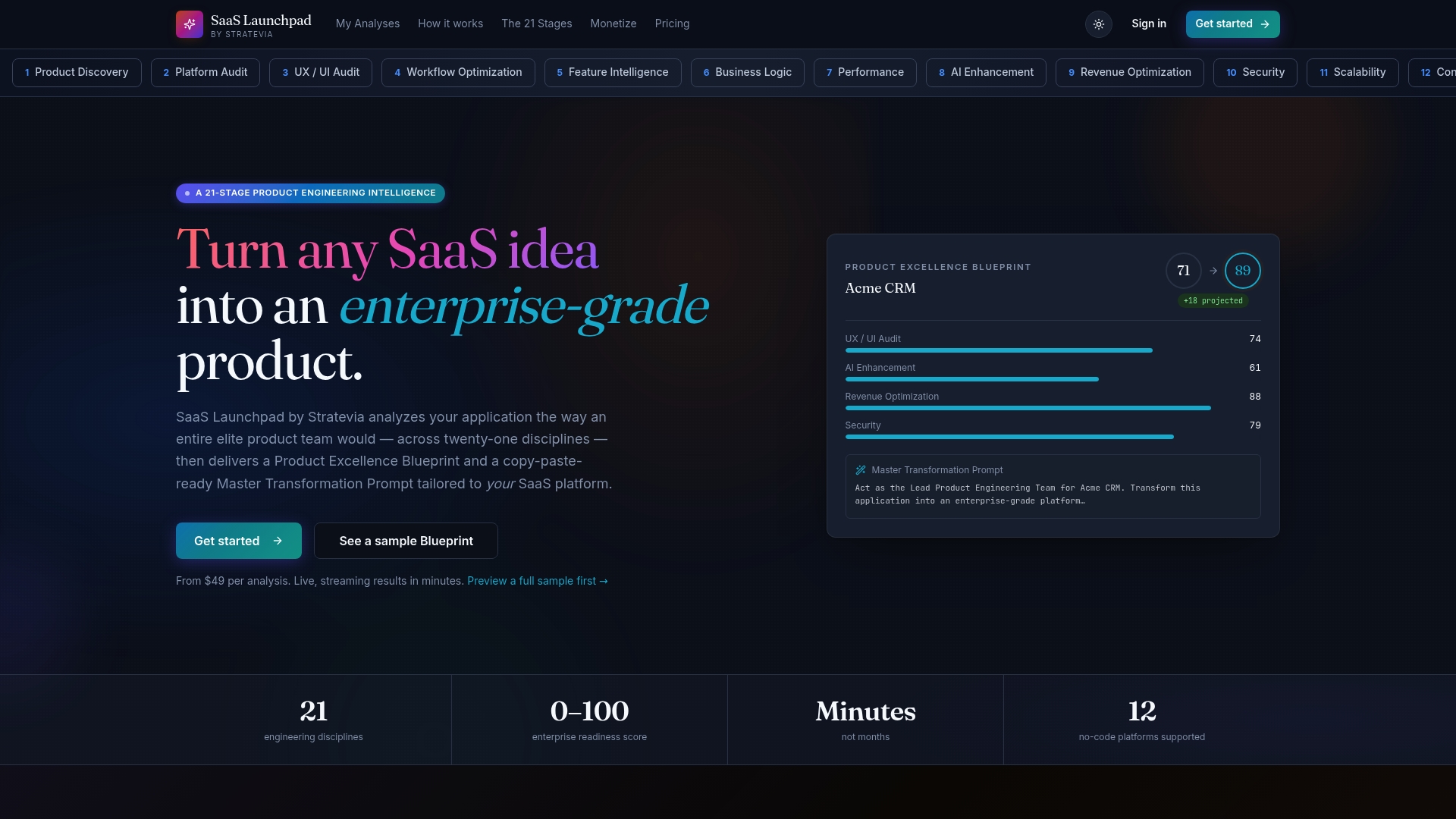
SaaS LaunchPad's 21-discipline product audit analyzes your platform the way an elite product team would — including a dedicated security and enterprise-readiness review. You get a Product Excellence Blueprint with scored findings, a prioritized remediation roadmap, and a copy-paste-ready Master Transformation Prompt you can hand directly to your engineering team. No retainer, no long engagement. Purchase an audit credit, submit your platform, and get a blueprint built for your specific stack. See how it works and check pricing to get started.
Useful sources
- Cloud Security Alliance — SaaS Security Capability Framework (SSCF): The standard framework for vendor assessments and internal benchmarking; use it to replace ad-hoc questionnaires.
- Cloud Security Alliance — 7 Essential SaaS Security Best Practices: High-level practitioner guidance from CSA covering the controls enterprise buyers expect.
- Orca Security — What is SaaS Security?: Practical explanation of the shared responsibility model and SSPM integration with SIEM.
FAQ
What are the most critical SaaS security controls to implement first?
MFA, SSO with SCIM, and least-privilege RBAC are the three highest-impact controls. Identity-based protections prevent the majority of SaaS breaches and should be enforced before any other investment.
How often should a SaaS product team run a security audit?
Run a full audit annually, with quarterly reviews of high-risk controls like OAuth grants, admin roles, and logging configurations. Schedule a targeted security review after every major product release.
What is the shared responsibility model in SaaS security?
The vendor secures the underlying infrastructure; the customer is responsible for configuration, identity management, data classification, and third-party integrations. Most SaaS breaches originate in customer-controlled areas.
What evidence do enterprise buyers request during security reviews?
Buyers typically ask for MFA and SSO configuration proof, RBAC role documentation, audit logs with retention records, a recent penetration test report, vendor contracts with security SLAs, and incident response runbooks.
How does SaaS LaunchPad help with security and enterprise readiness?
SaaS LaunchPad's 21-discipline audit includes a dedicated security and enterprise-readiness review, delivering a scored Product Excellence Blueprint and a prioritized remediation roadmap your team can act on immediately.