
A technical debt audit is a time-boxed, evidence-based review that delivers a prioritized, costed remediation queue and remediation triggers, not a pile of static-analysis warnings nobody reads. If your last audit produced a 400-item spreadsheet and zero funded fixes, the audit itself was the failure, not the debt.
Commission or run one properly and you get three things:
- A short, prioritized repair queue where every item has an owner and an effort estimate.
- Carrying costs and business metrics attached to each finding, so finance and product can weigh it against a feature.
- A living technical debt register with remediation triggers that force action instead of debate.
If you have neither the time nor appetite to build this from scratch, a scoped two-week mini-audit on your one or two riskiest systems will tell you more than another quarter of guessing.
Table of Contents
- Where Technical Debt Hides Beyond Your Source Code
- Why a Focused Audit Beats an Exhaustive One
- The Five-Pass Audit Workflow You Can Run in Weeks
- The Metrics That Turn Code Problems Into Finance Problems
- Building a Technical Debt Register That Actually Changes Decisions
- Tools, Automation, and the Human Check They Still Need
- From Audit Findings to a Funded Remediation Plan
- How SaaS LaunchPad Applies This Audit Approach
- Why This Framework Works and What to Try Next
- The Uncomfortable Truth About Most Technical Debt Audits
- Get a Structured Audit Without Building the Framework Yourself
- Sources
- FAQ
Where Technical Debt Hides Beyond Your Source Code
Most audits stop at code quality and miss the reservoirs that actually cost the most money. Six categories deserve equal billing in your scope:
- Architecture — tight coupling, missing service boundaries, single points of failure.
- Code — duplication, dead branches, functions nobody wants to touch.
- Tests — flaky suites, missing coverage on critical paths, tests that pass but verify nothing.
- Dependencies — outdated libraries, unpatched vulnerabilities, abandoned packages.
- Infrastructure and config — manual deploy steps, undocumented environment drift, scaling bottlenecks.
- Documentation and process — tribal knowledge, stale runbooks, onboarding that takes months.
A code-only audit routinely undercounts total carrying cost, because infrastructure drift and process debt often produce more incident hours than messy functions ever do.
Why a Focused Audit Beats an Exhaustive One
Executives don't fund inventories. They fund plans that promise fewer incidents, faster cycle time, and delivery capacity coming back online. A full audit workflow built around costed, prioritized findings does exactly that, while a raw tool dump does not.
Aim for the 70% solution: fixing the handful of items that concentrate most of the carrying cost beats chasing every warning a linter throws. Common failure modes include tool-only reports with no human review, uncosted lists with no ranking, and findings with no assigned owner.

Pro Tip: If a finding doesn't have a dollar figure or a name attached to it within a week of the audit closing, it will die in the backlog. Assign both before you present anything.
The Five-Pass Audit Workflow You Can Run in Weeks
A bounded scope, one to three systems, can move through a full audit in a few weeks once you commit to a repeatable sequence rather than an open-ended investigation.
- Orient. Map service boundaries, pull delivery data (deploy frequency, lead time), and identify which systems actually touch revenue.
- Hypothesis collection. Gather telemetry, APM traces, test coverage reports, and dependency manifests. This is where you form guesses about where the pain lives.
- Tooling sweep. Run static analysis, dependency scanners, bundle analyzers, and git churn maps across the scoped systems.
- Reconciliation. This is the pass most teams skip, and it's the one that separates a credible audit from a noisy one. Every tool finding gets human validation, a file and line citation, and a note if it's actually intentional rather than broken. One audit methodology on GitHub explicitly treats tool output as a hypothesis, reserving a "looks bad but is fine" category to keep false positives out of the final report.
- Costing and triage. Estimate remediation effort, calculate carrying cost, and sort every surviving item into fix now, schedule, or accept.
Skip reconciliation and you'll hand stakeholders a report full of items an engineer could explain away in thirty seconds, which torches the credibility of everything else in it.
The Metrics That Turn Code Problems Into Finance Problems
Numbers travel further in a board meeting than adjectives do. Pull these before you write a single recommendation:
- P99 latency on critical paths. A checkout or search flow creeping past a couple of seconds at the 99th percentile is a revenue problem, not just an engineering annoyance.
- Churn times complexity hotspots. Files edited constantly and structurally messy are where bugs breed fastest.
- Suppressed type errors and duplication percentage. Both quietly compound review time.
- Critical-path test coverage and change-failure rate. Low coverage on the paths that generate revenue predicts your next incident.
- Time-to-detect for incidents. Slow detection almost always traces back to observability debt, not bad luck.
- Dependency upgrade lag. Packages more than two major versions behind are a rough proxy for both security exposure and future migration pain.
A simple normalized tech debt score that blends these signals into a single trackable number gives stakeholders something to watch quarter over quarter, the same way they already watch churn or NPS. It won't replace a costed remediation queue, but it makes debt visible between audits instead of invisible until the next one.
Building a Technical Debt Register That Actually Changes Decisions
A register that just lists complaints is a backlog graveyard. A register built to inform decisions needs a specific set of fields and a cadence that keeps it alive:
- ID, description, and category (one of the six from earlier).
- Owner and severity, so nobody has to ask who's responsible.
- Effort estimate in hours or story points, plus a carrying-cost figure using a simple interest-rate approach.
- A remediation trigger, the measurable condition that forces action rather than opinion.
- Status and a short history of what's already been tried.
Review it weekly in a five-minute check with the engineering lead, and quarterly in a longer session with product leadership where priorities actually shift. Keep the register lean; a list capped near twenty active items retains far more signal than a five-hundred-row spreadsheet nobody opens.
Pro Tip: Write the remediation trigger as a condition, not a deadline. "Fix when P99 exceeds 800ms on this endpoint" survives reprioritization; "fix by Q3" does not.
Tools, Automation, and the Human Check They Still Need
Run automated tools across six categories: static analysis, dependency scanners, APM and observability platforms, bundle analyzers, churn and heatmap generators, and coverage tools. Each surfaces a different slice of the six debt categories above.
None of them produce a final answer on their own. Treat every automated finding as a hypothesis that needs a human to confirm it against the actual code, not just the report. For a large monorepo, scan in chunks by service boundary rather than the whole repository at once. Scanning a large codebase all at once can overwhelm important findings with a high volume of less relevant data.
A partner resource worth reading if you're building out your own checklist discipline is this web3 development security checklist, which covers a parallel audit approach across a different technical domain.
From Audit Findings to a Funded Remediation Plan
Translate every surviving finding into language finance already speaks: extra hours per feature, incident cost, or revenue lost to slow pages. Multiple costing methods presented together read as more credible than a single number pulled from nowhere.
Score and rank with a simple formula: carrying cost divided by effort, with ties broken by blast radius, how many teams or customers a fix touches.
- Pick a delivery pattern: a fixed percentage of sprint capacity, dedicated debt sprints, or fixes bundled alongside adjacent feature work.
- Set governance: re-run the audit quarterly, verify each fix actually cleared its trigger, and report the trend, not just the snapshot.
- One-off audits rarely shift roadmap policy on their own; the trend line across repeated audits is what convinces a skeptical VP.
How SaaS LaunchPad Applies This Audit Approach
SaaS LaunchPad runs this same logic at product scale. Its 21-discipline audit covers platform architecture, code and workflow quality, security, performance, and scalability, then delivers a Product Excellence Blueprint alongside a Master Transformation Prompt built for your specific platform.
- Findings arrive prioritized and mapped to implementation sprints, not as a raw list.
- The enterprise readiness scoring mirrors the carrying-cost logic covered above, translated into a phased execution plan.
Why This Framework Works and What to Try Next
A SaaS security best practices review is one place to start if dependency debt is your biggest unknown right now.
A technical debt audit only earns its cost when it produces costed, owned, triggered findings instead of an uncosted inventory.
| Point | Details |
|---|---|
| Scope beyond code | Include architecture, tests, dependencies, infrastructure, and docs; code-only audits undercount total carrying cost. |
| Run multiple distinct passes | Orient, collect hypotheses, sweep with tools, reconcile with humans, then cost and triage into fix now, schedule, or accept. |
| Reconcile every finding | Cite tool output against real files and reject false positives before presenting anything to stakeholders. |
| Keep the register lean | Cap active items near twenty, and attach a remediation trigger, owner, and carrying cost to each one. |
| Consider a structured audit | SaaS LaunchPad's 21-discipline review delivers a prioritized, costed roadmap and a Master Transformation Prompt built for your platform. |
The Uncomfortable Truth About Most Technical Debt Audits
Most audits fail before the first line of code gets reviewed, because the team confuses thoroughness with usefulness. A four-hundred-item report feels rigorous. It's actually a way of avoiding the harder work: deciding which twenty items matter and putting a dollar figure on each one.
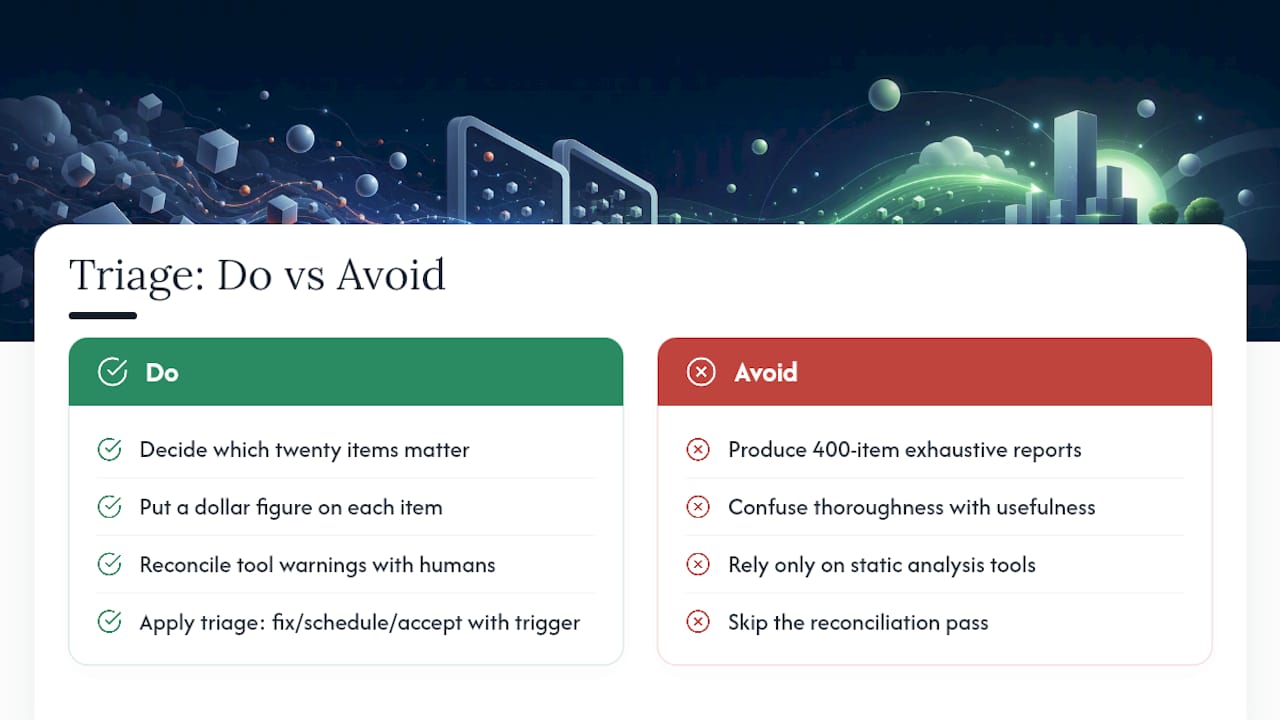
The conventional advice tells you to buy better static-analysis tooling. That's rarely the bottleneck. The bottleneck is almost always the reconciliation pass, the unglamorous step where a human checks whether the tool's warning means anything in context. Skip it, and you'll hand leadership a report riddled with items an engineer can dismiss in a sentence, which quietly discredits every legitimate finding sitting next to it.
If you take one thing from this, take the triage discipline: fix now, schedule, or accept, applied ruthlessly, with a remediation trigger on everything that isn't fixed today. Debt concentration is real. A handful of hotspots usually account for most of the carrying cost, and finding them matters more than counting everything else.
— Gregory Cornelius
Get a Structured Audit Without Building the Framework Yourself
Running the five-pass workflow above internally takes real engineering time you may not have spare, especially if you're doing it for the first time. SaaS LaunchPad exists for exactly that gap: instead of assembling your own tooling stack and reconciliation process from scratch, you get a 21-discipline analysis, spanning platform architecture, code quality, security, performance, and scalability, delivered as a Product Excellence Blueprint with a copy-paste-ready Master Transformation Prompt built for your platform.

Where a DIY audit can take weeks of internal time before you see a single prioritized finding, SaaS LaunchPad compresses that into a paid analysis you commission on demand, no subscription, no expiring credits. You buy credits, run the analysis, and walk away with a costed, prioritized roadmap you can hand straight to engineering leadership. If your platform is carrying enough debt that you're not sure where to start, start with SaaS LaunchPad's full audit and see what a 21-discipline review surfaces before your next planning cycle.
Sources
- How to Audit Technical Debt in a SaaS Codebase — Jagatjeet
- How to use a technical debt register — LogRocket Blog
- Technical Debt Audit: Essential Guide to Avoid Costly Risk — Progressive Robot
- Techdebt
FAQ
What Are the Four Types of Technical Debt?
Debt is commonly grouped into architecture, code, testing, and infrastructure or process debt, though a thorough audit also tracks dependency debt and documentation debt as separate categories worth scoping.
How Much Technical Debt Is Acceptable?
There's no universal ceiling; the more useful question is whether each item has a remediation trigger and a carrying cost attached, so leadership can decide what to accept deliberately rather than by default.
How Do You Assess Technical Debt?
Run a multi-pass audit: orient with delivery data, collect hypotheses from telemetry and tooling, reconcile findings with human review and file citations, then cost and triage each item into fix now, schedule, or accept.
What Is an Example of Technical Debt?
A checkout flow with P99 latency creeping past acceptable thresholds, or a high-traffic database table missing an index it needed months ago, are both concrete, costable examples that a technical debt audit should surface and prioritize.
Can a Structured Audit Replace an Internal Review?
A structured, board-ready audit like SaaS LaunchPad's 21-discipline analysis can accelerate the process significantly, delivering prioritized findings and an implementation roadmap without your team building the audit framework from zero.