
TL;DR:
- Choosing the correct API versioning strategy depends on your consumers, CDN presence, and migration costs. URL path versioning is safest for public APIs, while header or query schemes suit controlled internal clients, but require careful CDN configuration. Regular governance, clear deprecation timelines, and comprehensive testing are essential to manage versions safely and avoid silent errors.
Pick the strategy that matches your consumers and CDN: URL path versioning for public APIs, header or media-type versioning for internal APIs with controlled clients, and date-based versioning for massive public platforms with thousands of consumers. The single biggest operational trade-off to watch is the CDN caching tax: non-URL schemes require Vary header configuration, and misconfiguration causes cache poisoning where clients receive the wrong version silently.
| API Context | Preferred Approach | Rationale |
|---|---|---|
| Public / CDN-backed | URL path (/v1/, /v2/) | Caches cleanly, no extra CDN config, debug-friendly |
| Internal / controlled clients | Header or media-type | Clean URLs, teams control both producer and consumer |
| Massive public platform | Date-based (YYYY-MM-DD) | Decouples behavior from integer versions, scales with many consumers |
Table of Contents
- What is API versioning and why does it matter?
- When should you create a new API version?
- What are the common API versioning methods?
- How do you choose the right versioning strategy?
- How to implement, deploy, and deprecate API versions safely
- What testing and tooling do you need for versioned APIs?
- Real-world examples and migration patterns
- Best practices every engineering team should follow
- How should your organization govern API versioning?
- Key Takeaways
- The versioning discipline gap no one talks about
- What a product engineering audit gives your API migration
- Useful sources and references
- FAQ
What is API versioning and why does it matter?
API versioning is the practice of assigning a stable, explicit identifier to a specific state of your API's contract so that consumers can depend on consistent behavior even as the underlying service evolves. A "versioned change" is any modification to the public contract: field names, data types, HTTP methods, authentication schemes, response shapes, or endpoint paths. Adding an optional field is not a versioned change. Removing a field is.
The concrete benefits are worth naming directly:
- Predictable upgrades. Consumers know exactly when behavior will change and can schedule their migration.
- Safer breaking changes. Teams can ship breaking changes without forcing an immediate flag day across all clients.
- Better documentation and tooling. Tools like OpenAPI and Postman can generate version-specific docs, mock servers, and test suites automatically.
- Defined support windows. Consumers get a published sunset date rather than discovering a breakage in production.
A quick example clarifies the line between additive and breaking changes. Adding a middle_name field to a user response is additive: existing clients ignore it. Renaming user_id to userId is breaking: every client that reads that field stops working. The first change belongs inside the current version. The second triggers a new one.
Postman's API lifecycle guidance frames versioning and retirement as first-class stages in the API lifecycle, not afterthoughts. That framing matters because teams that treat versioning as a lifecycle discipline rather than a one-off task ship migrations with far fewer incidents.
When should you create a new API version?
The short answer: create a new version only when a change would break an existing, correctly implemented client. Everything else belongs in the current version.
Breaking changes that require a new version:
- Removing or renaming an endpoint, field, or parameter
- Changing a field's data type (string to integer, nullable to required)
- Altering authentication or authorization requirements
- Changing the semantics of an existing field (e.g.,
status: "active"now means something different) - Removing enum values a client might be sending or reading
Acceptable in-version changes (no version bump needed):
- Bug fixes that restore documented behavior
- Adding optional request fields with sensible defaults
- Adding new optional response fields
- Adding new endpoints
- Performance improvements with no contract change
IBM's API lifecycle documentation recommends supporting parallel versions while communicating clearly about deprecation and sunset timing. That means the moment you publish v2, you should also publish the sunset date for v1.
Timeline and migration-window considerations. A minimum notice period of 90 days is a reasonable floor for internal APIs; public APIs with large consumer bases typically need several months of parallel-run time. The parallel-run window is the period when both versions are live and supported. The sunset window is the final warning period before the old version returns HTTP 410. Plan all three before you cut the new version.
Decision checklist before bumping the major version:
Before incrementing the major version, confirm: (1) the change breaks at least one correctly implemented client, (2) no backward-compatible workaround exists, (3) you have a migration guide ready, (4) you have a published sunset date for the current version, and (5) your monitoring can distinguish traffic by version. If any of these are missing, the version bump is premature.
What are the common API versioning methods?
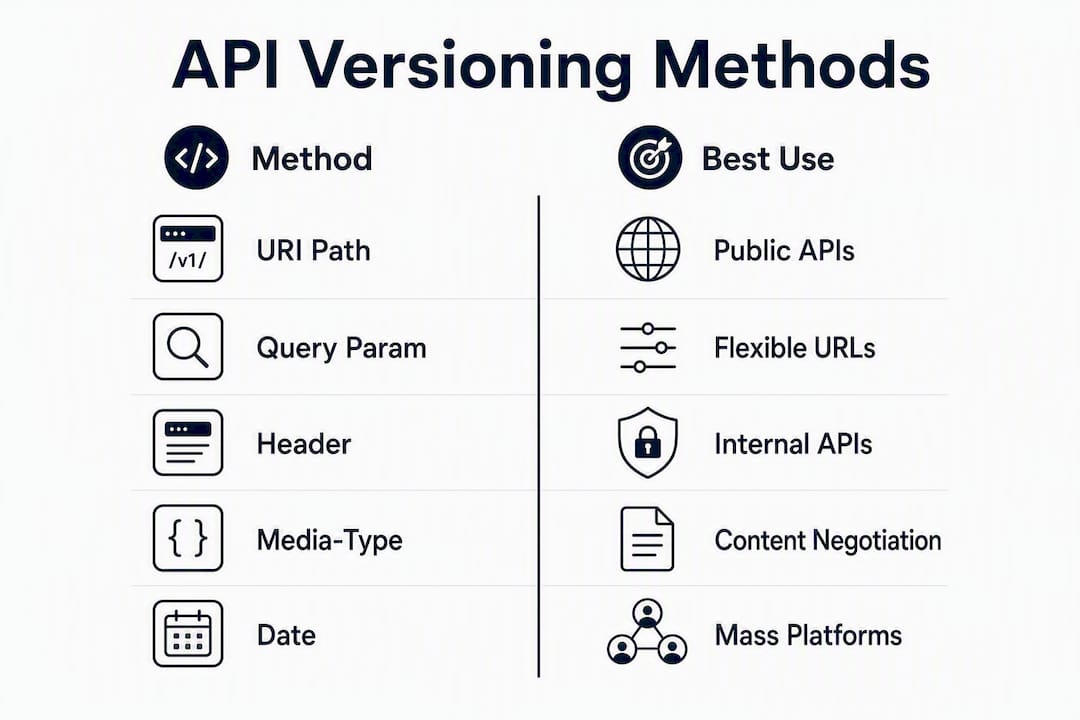
Five approaches cover the vast majority of real-world implementations. Each has a distinct mechanism, caching profile, and client impact.
URI path versioning
The version identifier sits directly in the URL: /v1/users, /v2/users. Every HTTP client, proxy, CDN, and load balancer treats different versions as different resources by default. No special configuration required.

URI path versioning is the most widely adopted strategy for public APIs because it is debug-friendly, highly cacheable, and requires no special client configuration. GitHub uses date-based headers for its REST API, but its older v3 path structure (/v3/) illustrates the pattern well. Stripe's older versioning also used path prefixes before moving to account-pinned date versioning.
Query parameter versioning
The version appears as a query string: /users?api-version=2. URLs stay structurally clean, and the version is visible in logs. The downside is that most CDNs do not cache query-parameterized URLs by default, or they require explicit cache-key configuration to include the parameter. Clients that strip query strings (some proxies do) can silently route to the wrong version.
Header versioning
The version travels in a custom request header: X-API-Version: 2. URLs remain completely stable across versions, which appeals to teams that want clean, permanent resource identifiers. The cost is the Vary header requirement.

Header-based versioning keeps URLs clean but requires setting the Vary header and is best for internal APIs where teams control both producer and consumer. A misconfigured Vary header causes cache poisoning: a CDN node caches the v1 response and serves it to v2 clients, or vice versa. This failure mode is silent and hard to debug in production.
Media-type / content negotiation versioning
The version is encoded in the Accept header: Accept: application/vnd.myapi.v2+json. This is the most HTTP-semantically correct approach and aligns with how content negotiation was designed to work. It also carries the same Vary header requirement as custom header versioning, plus higher implementation complexity: clients must set the Accept header correctly, and many HTTP libraries default to application/json without a version qualifier.
Date-based versioning
The version is a calendar date: X-API-Version: 2024-01-15. Date-based versioning scales well for massive public platforms because it decouples behavior from integer major versions, but it increases transformation complexity and testing burden. Stripe uses an account-pinned date model: each API key is pinned to the API version active at the time the key was created, and the account owner explicitly upgrades. This means Stripe runs transformer chains that translate the current internal model into the shape each date-version expects.
Method comparison
| Method | How it works | Pros | Cons | Best for | Cacheability | Tooling & client impact | Complexity |
|---|---|---|---|---|---|---|---|
| URI path | /v1/resource | Debug-friendly, zero CDN config | URL proliferation, router duplication | Public / CDN-backed | Excellent | Minimal: clients change base URL | Low |
| Query param | ?api-version=1 | Visible in logs, easy to test | CDN cache-key config needed | Internal or low-traffic public | Moderate | Minimal: clients add param | Low–Medium |
| Header | X-API-Version: 2 | Clean URLs, stable resource IDs | Vary header required, CDN risk | Internal / controlled clients | Requires Vary config | Medium: clients must set header | Medium |
| Media-type | Accept: vnd.api.v2+json | HTTP-semantically correct | Complex client setup, Vary required | Internal, API-first teams | Requires Vary config | High: custom Accept header | High |
| Date-based | YYYY-MM-DD header or pin | Scales for many consumers | Transformer chains, heavy testing | Massive public platforms | Requires Vary config | High: SDK pinning critical | High |
URL path versioning is the safest default for public REST APIs because it caches cleanly at the CDN with no extra configuration. Header and query schemes buy URL stability at the price of a caching tax.
How do you choose the right versioning strategy?
A decision-tree approach helps teams pick a versioning strategy by asking who consumes the API, how many clients exist, breaking change frequency, and cacheability needs. Run through these questions before committing to a method.
Pre-selection questions:
- Is this a public API or an internal one? Public APIs need discoverability and CDN compatibility. Internal APIs can trade those for URL cleanliness.
- Do you control all consumers? If yes, header or media-type versioning is viable. If no, URL path is safer.
- How many active clients do you have? Dozens vs. thousands changes the migration cost calculation significantly.
- Do you have a CDN or reverse proxy in front of the API? If yes, non-URL schemes require explicit cache-key and
Varyheader configuration. - Can you update all SDKs and client libraries when you version? If not, date-based or URL path versioning with long support windows is safer.
- Do you need per-resource versioning granularity, or is service-level versioning sufficient?
- What is your team's HTTP expertise? Media-type content negotiation requires solid understanding of HTTP caching semantics.
Decision matrix:
| Scenario | Recommended method | Key constraint |
|---|---|---|
| Public REST API, CDN-backed | URI path | Zero CDN config needed |
| Internal microservices, team controls clients | Header or media-type | Must configure Vary header |
| Public API, thousands of consumers, long support windows | Date-based | Transformer chains required |
| Low-traffic internal API, simple clients | Query parameter | Verify CDN cache-key config |
| API-first team, strict HTTP semantics | Media-type | High client setup cost |
Non-functional constraints often decide the outcome before the functional ones do. If your observability stack cannot tag requests by version, you cannot measure migration progress. If your CI pipeline has no contract testing, you cannot safely run parallel versions. If your team has no one who understands Vary header semantics, header-based versioning will cause a production incident. Pick the method your team can actually operate, not the one that looks cleanest on paper.
How to implement, deploy, and deprecate API versions safely
A safe rollout follows a nine-step sequence. Skipping steps, especially documentation and notification, is where most migration failures originate.
- Choose the versioning method using the decision matrix above.
- Confirm the change is genuinely breaking. If it is not, ship it in the current version.
- Implement the new version in a feature branch. Keep the old version's code path intact.
- Update OpenAPI specs for both versions. Tag the old version as deprecated in the spec.
- Publish documentation for the new version before it goes live. Consumers need the migration guide before they need the new endpoint.
- Notify consumers via changelog, email, and
DeprecationandSunsetresponse headers on the old version. - Deploy gradually. Use a blue/green or canary deployment to route a small percentage of traffic to the new version first.
- Monitor error rates and latency per version. Watch for clients that are not migrating.
- Deprecate and sunset. After the sunset date, return HTTP 410 Gone from the old version's endpoints.
Deprecation notice template:
HTTP/1.1 200 OK
Deprecation: Sat, 01 Mar 2025 00:00:00 GMT
Sunset: Mon, 01 Sep 2025 00:00:00 GMT
Link: <https://api.example.com/v2/users>; rel="successor-version"

{
  "data": { ... },
  "_deprecation_notice": "This endpoint will be removed on 2025-09-01. Migrate to /v2/users."
}
Suggested timeline template:
- Day 0: Publish v2 and deprecation notice for v1. Start
DeprecationandSunsetheaders on the old version's responses. - Begin a parallel-run window where both versions operate simultaneously.
- Send a final reminder before sunsetting.
- After the sunset date, return HTTP 410 Gone from deprecated endpoints. Remove v1 route from gateway.
IBM's guidance and Postman's lifecycle documentation both recommend this parallel-run model with machine-readable Sunset headers so that automated clients can detect the upcoming retirement without relying on humans reading changelogs.
Route-level vs. service-level deployments. Route-level versioning (versioning individual endpoints) gives finer control but multiplies the maintenance surface. Service-level versioning (versioning the entire API) is simpler to operate. For most teams, service-level versioning with a clear deprecation policy is the right default.
Pro Tip: Pin SDKs to the API version at install time. Publish a compatibility matrix in your SDK changelog so consumers know which SDK version supports which API version. This prevents silent drift when a consumer upgrades their SDK without reading the migration guide.
What testing and tooling do you need for versioned APIs?
Testing versioned APIs is not just running your existing test suite twice. Each version needs its own contract, and the contracts need to be tested against each other to catch regressions.
Tool roles:
- OpenAPI (Swagger): Define the contract for each version as a separate spec file or using the
info.versionfield. Use spec diffing tools to catch breaking changes before they ship. - Postman: Build a collection per API version. Use Postman's environment variables to switch between version base URLs. Run collections in CI via Newman.
- Contract testing frameworks (Pact, Dredd): Verify that the provider still satisfies the consumer's expectations after a change. Consumer-driven contract tests are the most reliable way to catch breaking changes before deployment.
- API gateways (AWS API Gateway, Azure API Management, Kong): Handle version routing, header injection, and
Varyheader configuration at the infrastructure layer. Azure API Management supports versioning natively with path, header, and query-string schemes. - SDK generators (OpenAPI Generator, Kiota): Generate client SDKs directly from the OpenAPI spec. Regenerate on every version bump to keep client code aligned with the contract.
Testing checklist per version:
- Backward-compatibility tests: confirm v2 does not break any v1 consumer contract
- Contract tests: verify the OpenAPI spec matches actual API behavior
- Integration tests: end-to-end flows for each version in a staging environment
- Consumer-driven contract tests: run Pact or equivalent to validate provider against consumer expectations
- Smoke tests for edge-cache validation: confirm CDN serves the correct version for each cache key
OpenAPI version tagging example:
openapi: 3.1.0
info:
  title: Example API
  version: "2.0.0"
  x-deprecated-version: "1.0.0"
  x-sunset-date: "2025-09-01"
paths:
  /v2/users:
    get:
      summary: List users
Gateway routing pseudoconfig (URL path):
route /v1/* -> upstream: api-v1-service
route /v2/* -> upstream: api-v2-service
Header-based dispatcher pseudoconfig:
if header("X-API-Version") == "2":
    route -> upstream: api-v2-service
    set header Vary: X-API-Version
else:
    route -> upstream: api-v1-service
    set header Vary: X-API-Version
For CDN cache validation, send test requests with each version identifier and confirm the response body and Vary header are correct. A cache-poisoning incident shows up as version A clients receiving version B responses. Set up a synthetic monitor that checks the response shape for each version on a 5-minute interval.
Pro Tip: Add a contract test step to your CI pipeline that runs the OpenAPI spec diff between the current branch and main. If the diff contains a breaking change, fail the build. This catches accidental breaking changes before they reach code review.
Real-world examples and migration patterns
Three platforms illustrate the full range of versioning approaches, and each one teaches a different lesson.
GitHub. GitHub's REST API uses date-based versioning via the X-GitHub-Api-Version header. Clients that do not send the header receive the oldest supported version. GitHub returns Deprecation and Sunset headers on responses for versions approaching retirement, giving automated clients a machine-readable signal to act on. The lesson: machine-readable retirement headers are worth the implementation cost. They let tooling surface migration warnings without requiring humans to monitor a changelog.
Twilio. Twilio's REST APIs use URL path versioning (/2010-04-01/ as a date-based path prefix). The version is baked into the base URL, which means CDN caching works without any special configuration. Twilio maintains long support windows, often years, because its consumer base includes small businesses that cannot migrate quickly. The lesson: if your consumers are small teams or individuals, plan for multi-year support windows and build your deprecation timeline around their capacity, not yours.
Stripe. Stripe uses an account-pinned date model. Each API key is pinned to the API version active when the key was created. Stripe's backend runs transformer chains that translate the current internal data model into the shape each date-version expects. This means Stripe can evolve its internal model freely without forcing consumers to migrate. The cost is significant: every new version adds a transformer layer, and the testing burden grows with each one. The lesson: date-pinned models are powerful for consumer experience but expensive to operate. Reserve them for platforms where consumer migration friction is the dominant cost.
Migration recipes:
- Small-client migration: Notify all clients directly, provide a migration script or SDK update, set a 90-day sunset window, and monitor until traffic drops to zero on the old version.
- Large-client phased migration: Segment clients by traffic volume. Migrate high-traffic clients first with dedicated support. Use the
Sunsetheader to automate warnings for long-tail clients. - SDK-driven migration: Publish a new major SDK version that targets the new API version. Deprecate the old SDK version simultaneously. Pin the old SDK to the old API version so clients that do not upgrade continue to work until the sunset date.
- Back-compat wrappers/transformers: For date-based models, write a transformer that maps the new internal response shape to the old version's shape. Test the transformer with the old version's contract tests.
Sample router config for URL path versioning (Express.js pseudocode):
app.use('/v1', require('./routes/v1'));
app.use('/v2', require('./routes/v2'));
Header-based dispatcher (Express.js pseudocode):
app.use((req, res, next) => {
  const version = req.headers['x-api-version'] || '1';
  req.apiVersion = version;
  res.set('Vary', 'X-API-Version');
  next();
});
Best practices every engineering team should follow
This checklist is designed to be posted in your internal docs and referenced on every version release.
Before shipping a new version:
- Confirm the change is genuinely breaking before bumping the major version
- Write the migration guide before the new version goes live
- Update the OpenAPI spec for both versions
- Add the new version to your contract test suite
- Configure
DeprecationandSunsetheaders on the old version - Notify consumers via changelog, email, and in-API headers
During the parallel-run window:
- Monitor error rates, latency, and client usage distribution per version
- Track migration progress: what percentage of traffic has moved to the new version
- Send reminder notifications at 30 days and 7 days before sunset
At sunset:
- Return HTTP 410 Gone from deprecated endpoints
- Remove the old version's routes from the gateway
- Archive the old version's OpenAPI spec (do not delete it; consumers may need it for debugging)
- Publish a post-migration changelog entry
Metrics to collect per version:
- Error rate (4xx and 5xx) per version
- P50/P95 latency per version
- Client usage distribution (how many unique clients are on each version)
- Migration progress rate (weekly percentage of traffic migrating from old to new)
A SaaS audit checklist can serve as a useful companion when validating that your versioning policy meets enterprise readiness standards. Export this checklist as a single-page doc in your internal wiki and link it from your API governance policy.
How should your organization govern API versioning?
Governance is what separates teams that manage versioning well from teams that accumulate technical debt across a dozen half-deprecated API versions. The MuleSoft full lifecycle API management guidance frames APIs as products with governance, visibility, and tooling as core requirements, not optional add-ons.
- Assign ownership. Every API needs a named owner: an API product manager or platform engineer who is accountable for the versioning policy, deprecation timeline, and consumer communication. Without a named owner, deprecation notices get skipped and sunset dates slip.
- Define a version policy. Write down the rules: what counts as a breaking change, minimum notice periods, parallel-run window length, and sunset process. Publish it in your developer portal.
- Establish a governance board for breaking decisions. For APIs with many consumers, require a review before any breaking change ships. The board should include the API owner, a consumer representative, and a platform engineer.
- Integrate versioning into the full API lifecycle. Design: document the versioning strategy in the API design review. Implementation: enforce the strategy in code review. Testing: run contract tests in CI. Deployment: configure the gateway. Retirement: follow the deprecation checklist.
- Define SDK versioning policy. Pin SDKs to API versions at install time and version SDKs alongside the API to prevent client drift and unexpected behavior during migrations. Publish a compatibility matrix: SDK version X supports API versions Y through Z. Align SDK deprecation windows with API sunset dates.
- Automate version detection and routing. Use your API gateway to route requests by version identifier automatically. Log the version on every request so your observability stack can break down metrics by version without manual tagging.
- Security considerations. Older API versions accumulate security debt. Each active version is a surface you must patch. Set a maximum supported version count (two or three concurrent versions is a reasonable ceiling) and enforce it. Audit authentication and authorization logic separately for each version: a security fix in v2 does not automatically apply to v1.
Pro Tip: Treat your API versioning policy as a living document. Review it quarterly and update it when your consumer base, CDN configuration, or breaking-change cadence changes. A policy written for 10 internal clients does not scale to 10,000 public ones.
For teams building SaaS product management practices around their APIs, integrating versioning governance into the product roadmap process prevents the most common failure: shipping a breaking change without a migration plan because no one owned the decision.
Key Takeaways
The right API versioning strategy is determined by three factors: who consumes your API, whether a CDN sits in front of it, and how much migration cost your consumers can absorb.
| Point | Details |
|---|---|
| URL path is the public API default | It caches cleanly at the CDN with no extra configuration and requires no special client setup. |
| Non-URL schemes carry a CDN tax | Header and query-param versioning require Vary header configuration; misconfiguration causes silent cache poisoning. |
| Version only on genuine breaking changes | Reserve major version bumps for changes that break a correctly implemented client; additive changes stay in the current version. |
Publish Deprecation and Sunset headers | Machine-readable retirement signals let automated clients detect upcoming changes without relying on changelog monitoring. |
| SaaS LaunchPad for migration readiness | SaaS LaunchPad's 21-discipline audit covers API lifecycle, migration readiness, and generates an executable sprint plan for versioning rollouts. |
The versioning discipline gap no one talks about
Most articles on API versioning spend 80% of their words on the mechanics: URL path vs. header, how to set a Vary header, what HTTP 410 means. That is the easy part. The hard part is organizational, and it is where most teams actually fail.
The failure mode I see most often is not a wrong technical choice. It is a team that picked URL path versioning correctly, shipped v2 cleanly, and then let v1 run for three years past its sunset date because no one owned the deprecation. The Sunset header was set. The migration guide was published. But no one was accountable for actually pulling the plug, so v1 kept running, accumulating security patches, and consuming infrastructure budget.
The second most common failure is eager versioning: bumping the major version for changes that were not actually breaking. This trains consumers to ignore version notices because they have been burned before by "breaking" changes that turned out to be harmless. When a genuinely breaking change arrives, consumers do not migrate in time because they have learned not to take the notices seriously.
The fix for both problems is the same: assign a named owner to every API, write down the version policy, and enforce it. Not as a bureaucratic exercise, but as a product discipline. APIs are products. Products have owners. Owners make decisions and are accountable for outcomes.
One more thing worth saying plainly: there is no single right way to version an API. The teams that operate versioning well are not the ones that picked the "correct" method. They are the ones that picked a method, documented it, and enforced it consistently. Consistency beats correctness every time.
What a product engineering audit gives your API migration
If your team is staring at a versioning decision with real stakes, such as a public API with thousands of consumers, a migration from a legacy v1 that has been running for years, or a platform that needs to hit enterprise readiness standards, the decision matrix in this article gets you to the right method. Executing the migration safely is a different problem.
SaaS LaunchPad runs a 21-discipline product engineering audit that covers API lifecycle readiness, migration planning, and deprecation timeline design as part of a full platform review. You get a Product Excellence Blueprint that maps your current API versioning state, a prioritized migration roadmap with concrete sprint tasks, a deprecation timeline template calibrated to your consumer base, and a copy-paste-ready Master Transformation Prompt you can use immediately.
The audit is pay-per-analysis with no subscription and no retainer. Credits never expire. To get started, visit saaslaunchpad.org and run your platform through the analysis. Prepare your current API spec, a list of active versions, and your consumer count. The output gives your team a concrete next step within hours, not weeks.
Useful sources and references
- The API lifecycle (Postman) — Postman's official lifecycle documentation covering version and retire stages, parallel-version support, and sunset communication.
- What Is the API Lifecycle? (IBM) — IBM's guidance on versioning for breaking changes and deprecation best practices.
- What Is Full Lifecycle API Management? (MuleSoft) — Covers governance, visibility, and tooling as core API program requirements.
- Architecture decisions: versioning trade-offs (Cracking Walnuts) — Explains the transformer chain cost of date-based versioning and the case for reserving major version bumps for true breaking changes.
- OpenAPI Specification (openapis.org) — The primary reference for OpenAPI contract definition and version tagging.
- Semantic Versioning (semver.org) — The canonical specification for semantic version numbering, relevant to API and SDK versioning policy.
- Azure API Management (Microsoft) — Microsoft's gateway documentation covering native versioning support for path, header, and query-string schemes.
FAQ
What is the best API versioning strategy for a public REST API?
URL path versioning (/v1/, /v2/) is the best default for public REST APIs. It caches cleanly at the CDN without extra configuration and requires no special client setup.
When does a change require a new API version?
A change requires a new version when it breaks a correctly implemented client: removing or renaming a field, changing a data type, or altering authentication requirements. Adding optional fields or new endpoints does not require a version bump.
How long should you support an old API version before sunsetting it?
Internal APIs can use a minimum notice period of several weeks to months. Public APIs with large consumer bases typically need several months of parallel-run time before the old version is retired with an HTTP 410 response.
How do you prevent cache poisoning with header-based versioning?
Set the Vary: X-API-Version response header on every versioned response and configure your CDN to use the version header as part of the cache key. Without this, a CDN node may serve a cached response from one version to a client requesting another.
How can SaaS LaunchPad help with API versioning and migration?
SaaS LaunchPad's 21-discipline product audit covers API lifecycle readiness and migration planning, delivering a prioritized roadmap, a deprecation timeline template, and an executable sprint plan tailored to your platform.