TL;DR:
- The best no code SaaS examples are custom CRMs, internal hubs, partner portals, resource libraries, and small marketplaces. Teams that validate data portability early and externalize enterprise services achieve faster, scalable launches. Choosing the right builder depends on your complexity, speed needs, and compliance requirements.
The highest-ROI no code SaaS examples are custom CRMs, internal team hubs, partner and referral portals, resource libraries, monetizable curated directories, and small vertical marketplaces. For most of these, Bubble covers complex logic, Softr and Glide handle data-driven portals and mobile-first apps fast, and Airtable or Google Sheets serve as the backend. ServiceNow App Engine and Salesforce Platform step in when enterprise governance is non-negotiable.
- Custom CRM: Bubble or Softr + Airtable
- Internal team hub: Softr + Airtable (days to launch)
- Partner/referral portal: Softr + Airtable or HubSpot
- Resource library: Softr or Glide + Airtable
- Monetizable directory: Softr + Airtable + Stripe
- Small marketplace: Bubble + proprietary DB
Pro Tip: Before committing to any visual builder, confirm it exports your full database schema and records in a portable format — skipping this check is the single most common cause of costly rebuilds later.
Table of Contents
- Six no code SaaS examples that show what's actually possible
- Which no code builder actually fits your SaaS use-case?
- Enterprise-ready architecture patterns for production no code SaaS
- How generative app building works and where it still needs you
- Realistic MVP timelines and cost buckets for U.S. teams
- When no code is the wrong choice
- Key Takeaways
- The part most product teams get wrong about visual development
- What SaaS LaunchPad can do for your no code product
- Useful sources
- FAQ
Six no code SaaS examples that show what's actually possible
These real-world cases show the pattern: a concrete problem, a builder choice, a backend, and a measurable result.
- Custom CRM (Vimeo): Vimeo's customer experience team was juggling several separate platforms. They built numerous custom internal apps on Airtable via Softr, unifying sales, product, and billing for a business generating significant ARR. Builder: Softr. Backend: Airtable. Time to MVP: weeks.
- Internal team hub (Celonis): Celonis replaced a sprawling Google Slides GTM deck with a searchable knowledge base for 1,500+ team members, pulling from Airtable. GTM reps find pitch materials in seconds. Time to MVP: under five days.
- Partner/referral portal (Virtuous): Virtuous launched a full partner relationship management system in five hours using Softr, routing referrals directly to HubSpot and saving $30,000 in software costs.
- Resource library (Frontier): Frontier built an interactive carbon-removal knowledge database on Airtable. Within four weeks of launch, it captured 50+ new expert submissions and drew interest from Google for research funding.
- Monetizable directory (LetterHunt): Akhil BVS built a searchable directory of 10,000 newsletters in 15 minutes using Airtable and Softr. It hit #1 Product of the Day on Product Hunt and generated $4,000 in sales. Alex Friedman's Founder Gigs directory scaled to $5,000 MRR before selling for six figures.
- Small vertical marketplace (Glitter): Morgan Berman and Tim LaRosee built a street-cleaning funding platform where a single Softr template page dynamically serves profiles for 1,000+ city blocks, with Stripe handling pledge payments.
| Builder | Backend | Time to MVP | Primary KPI |
|---|---|---|---|
| Softr | Airtable | Under 5 days | $30K cost savings (Virtuous) |
| Softr | Airtable | 15 minutes | $4K sales (LetterHunt) |
| Softr | Airtable + HubSpot | 4 weeks | 50+ submissions (Frontier) |
| Bubble | Proprietary DB | 4 weeks | Marketplace scale |
| Glide | Google Sheets | 1–2 weeks | Mobile adoption |
The pattern is consistent: the teams that ship fastest pick the narrowest possible data backend first, validate with real users, then layer in complexity. Trying to design the perfect schema before launch is the most reliable way to never launch.
Which no code builder actually fits your SaaS use-case?
The choice comes down to three variables: how much custom logic you need, how fast you need to ship, and whether enterprise compliance is a gate.

| Use-Case | Recommended Builder | Control / Power | Speed to Market | Mobile UX | Enterprise-Ready | Extensibility | Pricing Model |
|---|---|---|---|---|---|---|---|
| Data-driven portals | Softr | Medium | Very fast | Good PWA | Basic SSO | Airtable, Google Sheets, HubSpot | Per-user SaaS |
| Mobile-first apps | Glide | Medium | Fast | Native-feel | Limited | Sheets, SQL, APIs | Per-user SaaS |
| Complex web apps / marketplaces | Bubble | High | Moderate | Good | Growing | Plugins, REST APIs | Capacity-based |
| Enterprise internal tools | ServiceNow App Engine | Very high | Slower | Moderate | Full (SSO, audit logs) | Deep enterprise stack | Enterprise license |
| Enterprise CRM / workflow | Salesforce Platform | Very high | Moderate | Good | Full (SOC 2, SSO) | AppExchange ecosystem | Per-user enterprise |
Salesforce Platform holds a 4.5/5 rating across nearly 2,000 reviews on G2, which reflects its depth for teams that need compliance and governance baked in from day one.
When to pick power over speed: Choose Bubble or an enterprise platform when your SaaS requires complex multi-step workflows, custom role-based access, or monetization logic. Choose Softr or Glide when you need a working product in front of users this week. A hybrid is often the right call: Softr or Glide for the UI layer, with Stripe or a managed API handling payments and heavy data.
- Softr and Glide are best for teams validating an idea before investing in infrastructure.
- Bubble suits founders who need a production-grade app but want to avoid a full engineering team.
- ServiceNow App Engine and Salesforce Platform are the right call when your enterprise customer's security review is the actual launch gate.
Enterprise-ready architecture patterns for production no code SaaS
Moving from MVP to production means answering five questions before you flip the switch.
Must-validate before production:
| Checkpoint | What to Verify |
|---|---|
| Multi-tenancy | Data isolation between tenants enforced at the query level |
| SSO / Auth | SAML supported; role mapping to app permissions |
| Data residency | Builder hosts data in the required U.S. region (or supports BYOD) |
| Audit logs | User actions logged and exportable for compliance review |
| Export / migration | Full DB export available; schema documented and portable |
Implementation pattern:
- Data model: Establish a single source of truth early. Denormalize only for read performance, never for convenience.
- Auth strategy: Use the builder's native SSO connector where it exists; externalize to Auth0 or a similar provider when it does not.
- API/integration layer: Route payments through Stripe or Chargebee via webhook. Never build billing logic inside the visual canvas.
- Automation and monitoring: Use the builder's native automation for simple triggers; route long-running jobs to an external queue (Zapier, Make, or a managed cloud function).
Hybrid architectures that externalize high-volume services to managed APIs are the standard recommendation from cloud providers for scaling no code SaaS safely.
Pro Tip: Set up a database export and run a test migration to a staging environment before your first enterprise customer signs. Discovering a lock-in problem after a contract is signed is a different kind of problem entirely.
How generative app building works and where it still needs you
Generative app building lets you describe functional requirements in plain language and receive a working UI, data schema, and basic CRUD logic in minutes. The 2026 shift is that platforms now automate infrastructure steps like Dockerfile configuration and deployment pipelines that previously required a DevOps engineer.
What generative building automates reliably:
- UI scaffolding from a text prompt
- Data schema generation (tables, fields, relationships)
- Basic create/read/update/delete logic
- Deployment and hosting provisioning
What still needs manual work:
- Performance optimization under real load
- Custom third-party integrations with non-standard APIs
- Complex data migrations from legacy systems
- Edge-case business logic and multi-step conditional flows
Sample Master Transformation Prompt (copy-paste ready):
You are building a no-code SaaS MVP. The product is: [describe your product in one sentence].
Target users: [user role]. Core workflow: [describe the 3 main user actions].
Data entities needed: [list 3–5 main objects, e.g. User, Project, Invoice].
Integrations required: [e.g. Stripe for payments, SendGrid for email].
Auth: [SSO / email-password / magic link].
Generate: UI screens for each workflow step, a data schema with field types and relationships,
basic CRUD logic for each entity, and a deployment checklist.
Flag any workflow step that requires custom code or an external API.
Prompt to production workflow:
- Write the Master Transformation Prompt above with your product specifics.
- Run it in your chosen builder's AI scaffold tool.
- Refine the generated UI and data model against real user feedback.
- Replace scaffolded logic with custom modules for any flagged edge cases.
- Run the enterprise checklist before opening to production traffic.
Realistic MVP timelines and cost buckets for U.S. teams
Development times for no code SaaS applications can be reduced from months to weeks or days. Here is what that looks like in practice.
- 1–2 day prototype: A clickable proof of concept using a template and a Google Sheets backend. Zero cost beyond platform subscription.
- 2–4 week feature MVP: A working product with auth, core workflows, and one integration. Typical cost: $500–$3,000 in platform fees, designer hours, and integration setup.
- 6–12 week hardened MVP: Production-ready for early enterprise customers. Adds SSO, audit logs, billing integration, and QA. Typical cost: $5,000–$25,000 depending on enterprise connector complexity.
| Phase | Duration | Primary Cost Drivers |
|---|---|---|
| Prototype | 1–2 days | Platform subscription |
| Feature MVP | 2–4 weeks | Designer hours, integration setup |
| Enterprise-hardened MVP | 6–12 weeks | SSO, compliance review, QA, monitoring |
Pro Tip: Budget a separate line item for third-party API usage costs. Stripe, SendGrid, and enterprise connectors charge per transaction or per call — these fees are invisible at prototype stage and can surprise you at scale.
When no code is the wrong choice
Not every SaaS problem fits a visual builder. Recognize these red flags early.
- High-throughput transactional workloads: If your app processes thousands of concurrent writes per second, a visual builder's managed infrastructure will hit limits before your growth does.
- Bespoke security requirements: Regulated industries (healthcare, fintech, defense) often require custom encryption, specific audit trails, or data handling that no visual builder currently supports natively.
- Extreme real-time logic: Live collaborative editing, sub-100ms latency requirements, or complex event-driven architectures need hand-coded infrastructure.
- Large-scale multi-tenancy with strict isolation: Tenant data isolation enforced at the database level, not the query filter level, is difficult to guarantee on most visual builders.
Hybrid mitigation checklist:
- Use the no code layer for UI, forms, and standard workflows.
- Externalize any service that hits a red flag above to a purpose-built API or managed cloud service.
- Document your data model and export schema from day one so migration is a planned step, not an emergency.
- When a component needs to move to code, migrate the data layer first, then the logic, then the UI last.
Key Takeaways
The most effective no code SaaS strategy pairs the right builder to the use-case, validates data portability before committing, and externalizes enterprise-critical services to managed APIs from the start.
| Point | Details |
|---|---|
| Match builder to use-case | Softr and Glide for speed; Bubble for power; enterprise platforms for compliance gates. |
| Validate exports first | Confirm full DB export and schema portability before any long-term platform commitment. |
| Externalize critical services | Route payments, auth, and heavy compute to managed APIs, not the visual canvas. |
| Timeline expectations | Prototypes in 1–2 days; enterprise-hardened MVPs in 6–12 weeks. |
| SaaS LaunchPad | Run a 21-discipline Product Excellence Blueprint to map your no code SaaS to the right architecture and generate a tailored Master Transformation Prompt. |
The part most product teams get wrong about visual development
The framing of "no code" sets the wrong expectation. What these platforms actually do is generate code blocks for you through a visual interface. That reframe matters because it changes how you scope risk. A team that treats Bubble or Softr as "not really software" skips the architecture decisions that bite them at scale: data model design, tenant isolation, export strategy, and integration contracts.
The teams that get the most out of visual development are the ones who treat it as visual-first engineering, not a shortcut past engineering. They use the scaffold to move fast on the 80% of features that are standard, then invest real engineering attention on the 20% that differentiates their product. The Virtuous partner portal launched in five hours because the team had already thought through the data model and integration contract with HubSpot. The speed came from preparation, not from the platform being magic.
The other thing most guides understate: template dependency is a real drag on product differentiation. If your SaaS looks and behaves like every other Softr app, users notice. The right move is to use AI-assisted scaffolding to bootstrap, then immediately invest time customizing the visual canvas and data model before you accumulate users on a generic foundation.
What SaaS LaunchPad can do for your no code product
Most no code SaaS projects stall not because the builder is wrong, but because the product architecture was never mapped against enterprise requirements, the data model was never stress-tested, and the Master Transformation Prompt was never written for the specific platform.
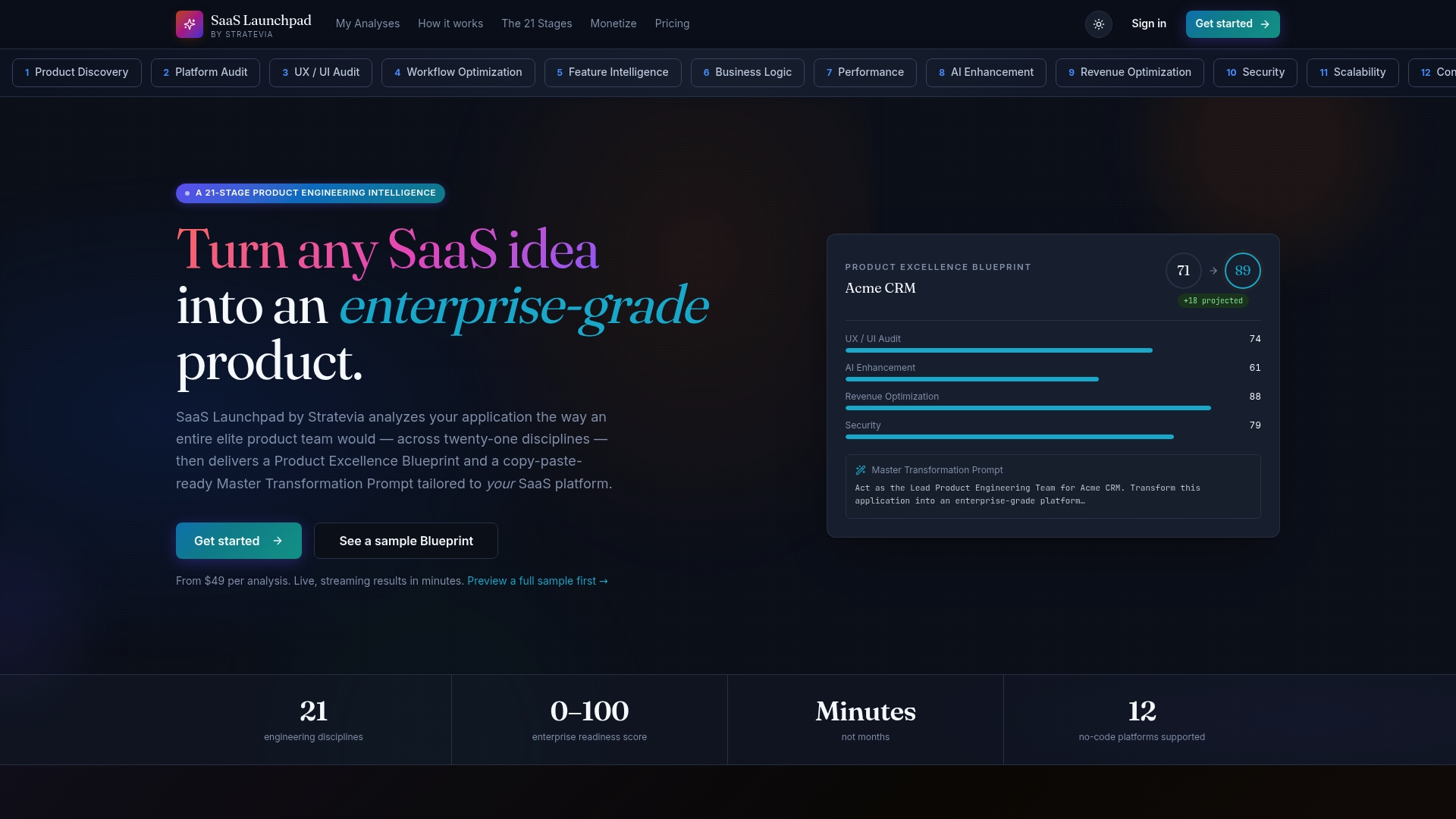
SaaS LaunchPad by Stratevia runs your SaaS through a 21-discipline product analysis covering platform audit, UX/UI review, workflow optimization, security, scalability, and enterprise readiness scoring. You get a Product Excellence Blueprint and a copy-paste-ready Master Transformation Prompt tailored to your builder and use-case. No subscription required; credits never expire. Start your Product Excellence Blueprint today and get a clear architecture map and a prompt you can use immediately.
Useful sources
- Softr — 10 real-world no-code examples: The most concrete source for real-world no code SaaS case studies with named companies and metrics. Read first for use-case inspiration.
- Zapier — Best no-code app builders: Broad platform comparison with time-to-market context. Read second for platform mapping.
- Google Cloud — What is no-code?: Authoritative framing of generative app building and hybrid architecture patterns. Read third for architecture guidance.
- G2 — No-code development platforms: Salesforce Platform holds a 4.5/5 rating across nearly 2,000 reviews. Use for enterprise platform validation and peer review data.
- Bubble: Primary source for Bubble's visual editing, hosting, and production-readiness claims.
- Glide: Primary source for spreadsheet-to-app capabilities and AI-assisted generation features.
- SaaS LaunchPad — Product Excellence Blueprint: The 21-discipline analysis framework and Master Transformation Prompt generation service referenced throughout this article.
Further reading priority: Start with the Softr case studies for use-case patterns, move to the Google Cloud architecture guide for production planning, then use the Bubble and Glide product pages to evaluate builder-specific capabilities for your chosen use-case.
FAQ
What are the most common no code SaaS examples?
Custom CRMs, internal team hubs, partner portals, resource libraries, and monetizable directories are the most common types. Real examples include Vimeo's internal Airtable apps and LetterHunt's 10,000-newsletter directory built in 15 minutes.
Which no code platform is best for an enterprise SaaS MVP?
Salesforce Platform and ServiceNow App Engine are the primary options when compliance, SSO, and audit logging are requirements. Salesforce Platform holds a 4.5/5 rating on G2 across nearly 2,000 reviews.
How long does it take to build a no code SaaS MVP?
Prototypes take 1–2 days; feature MVPs typically take 2–4 weeks; enterprise-hardened MVPs run 6–12 weeks depending on SSO, compliance, and integration complexity.
What is a Master Transformation Prompt for no code SaaS?
It is a structured plain-language prompt that describes your product's entities, workflows, integrations, and auth requirements so an AI builder can scaffold the UI, schema, and core logic automatically. SaaS LaunchPad generates one tailored to your specific platform as part of its Product Excellence Blueprint.
When should you avoid no code for a SaaS product?
Avoid visual builders for high-throughput transactional workloads, bespoke regulated-industry security requirements, sub-100ms real-time logic, or large-scale multi-tenancy with strict database-level tenant isolation.