A product excellence framework is a repeatable system that turns continuous user insight into a clear strategy and an outcomes-focused roadmap so teams ship products people actually adopt. It rests on three pillars: deep user insight, clear product strategy, and a coherent roadmap.
- Deep user insight: ongoing research, not one-off interviews
- Clear product strategy: objectives tied to outcomes, not output
- Coherent roadmap: themes and evidence, not date promises
Teams that run all three well tend to see faster time-to-value, stronger adoption, and less wasted engineering effort. Skip one pillar and the other two start compensating, usually badly.
Key Takeaways
A product excellence framework succeeds when continuous user insight, an outcomes-based strategy, and a coherent roadmap operate as one connected system rather than three separate initiatives.
| Point | Details |
|---|---|
| Three pillars, not three projects | Deep user insight, clear strategy, and a coherent roadmap only work when connected to each other. |
| Maturity is a ladder, not a switch | Progress moves through five stages from intuition-driven to thriving; assess honestly before setting goals. |
| Stage the rollout | Use a 30-day audit, 90-day pilot, and 180-day roadmap alignment instead of a big-bang launch. |
| Pair outcomes with leading indicators | Metrics like retention need an early-warning signal, such as week-one workflow completion. |
| SaaS LaunchPad offers a ready blueprint | Its 21-discipline Product Excellence Blueprint and Master Transformation Prompt map directly onto the framework's three pillars. |
Table of Contents
- Product Excellence Framework vs. Delivery-Focused Agile
- How Do You Build Deep, Continuous User Insight?
- How Do You Turn Insight Into Product Strategy?
- What Makes a Product Roadmap Coherent?
- What Are the Five Levels of Product Excellence Maturity?
- How Do You Implement a Product Excellence Framework?
- Which Metrics Actually Measure Product Excellence?
- Common Pitfalls That Undermine Product Excellence
- How SaaS LaunchPad Applies the 21-Discipline Blueprint
- Why Cross-Functional Collaboration Determines Whether the Framework Sticks
- What Role Does Leadership Play in Sustaining Excellence?
- What Do Real Product Excellence Programs Look Like in Practice?
- Which Tools Support a Product Excellence Framework?
- How Does Continuous Improvement Work Inside This Framework?
- An Editorial Take on Making Product Excellence Actionable
- Get the Product Excellence Blueprint Built for Your Platform
- Sources
- FAQ
Product Excellence Framework vs. Delivery-Focused Agile
Shipping fast is not the same as building well. A team can hit every sprint commitment and still ship a product nobody wants. That gap is exactly what a product excellence framework is designed to close.
Delivery-focused Agile treats velocity as the scoreboard. Story points closed, sprints completed, features shipped. Product excellence uses different scoreboard entirely: whether users adopt what you built and whether it moves a business outcome. That distinction shows up in three ways:
- Continuous discovery replaces the assumption that a backlog groomed once a quarter is "research"
- Human-centered design decisions get made with evidence, not the loudest stakeholder's opinion
- Business outcomes (retention, expansion revenue, reduced support load) become the unit of success, not ticket count
ProductPlan's research frames this as routine, repeatable discovery paired with a customer-focused build process, which is a fundamentally different operating model than a delivery pipeline optimized for throughput.
How Do You Build Deep, Continuous User Insight?
Most teams treat user research as an event: a round of interviews before a big launch, then silence for six months. Product excellence treats it as infrastructure that runs whether or not a launch is coming.
Here's how to build that infrastructure:
- Run continuous discovery on a fixed cadence. Combine qualitative interviews with quantitative usage data so you're not relying on anecdotes or dashboards alone.
- Centralize the output. A single insight repository, tagged and searchable, beats insights scattered across Slack threads and forgotten Google Docs.
- Standardize frontline intake. Sales, support, and customer success hear signal daily. Give them one simple template to log what they're hearing, so it flows into the same system as formal research.
- Use sampling heuristics, not perfectionism. Somewhere between 3 and 15 interviews on a specific question is usually enough to spot a real pattern. Waiting for statistical certainty on a qualitative question just delays the decision.
- Triangulate before you act. One customer complaint is an anecdote. The same complaint showing up in support tickets, churn interviews, and usage drop-off is a signal worth prioritizing.
Strong customer relationships and continuous insight predict sustainable product success more reliably than brand strength does, which is a hard thing to internalize when marketing has the bigger budget.
Pro Tip: Give every insight in your repository an "owner" and a "decision it's supposed to influence." Insights nobody has to act on quietly stop getting collected.
How Do You Turn Insight Into Product Strategy?
Insight without strategy is just an interesting document. The second pillar is where you decide what to actually do about what you've learned.
Start with outcome-focused objectives rather than feature lists. A North Star metric (something like activation rate or weekly retained accounts) forces every team conversation back to impact instead of output. From there:
- Score competing initiatives against value, confidence, and effort, all measured against your stated objectives rather than gut feel
- Weigh functional and emotional benefits against what customers are willing to pay, a useful mental model when two initiatives look equally compelling on paper
- Build a standard way to communicate trade-offs upward, so executives hear "we chose X over Y because of Z evidence," not a shrug
- Make opinionated calls when the data is thin. A strategy that tries to please every stakeholder equally isn't a strategy
Prioritization frameworks are easy to describe and hard to enforce once a VP wants their pet feature moved up. The SaaS product management discipline exists largely to hold that line.
What Makes a Product Roadmap Coherent?
A coherent roadmap communicates outcomes, not dates. Dates create false certainty and turn every delay into a broken promise.
Effective roadmaps tend to share a few traits:
- Organized by theme or a now/next/later structure, not a quarter-by-quarter feature list
- Every roadmap item traces back to a strategic objective, so stakeholders can see why it's there
- The evidence behind each roadmap bet gets documented alongside it, not buried in a separate research repository
- Stakeholders get the right altitude of context. Executives need the "why," engineering needs the "what," and neither needs the other's level of detail
- Engineering still plans sprints with real specificity internally. The roadmap being outcome-focused externally doesn't mean the team is flying blind internally
This is the pillar most teams get wrong first, usually because a date-driven roadmap is easier to explain in a single slide. It's also the fastest way to lose stakeholder trust the first time a "committed" date slips.
What Are the Five Levels of Product Excellence Maturity?
Most teams aren't starting from zero, and they aren't at the top either. Productboard's maturity model breaks the progression into five recognizable stages:
- Intuition-driven. Decisions ride on the loudest opinion in the room. No repository, no shared metric.
- Process-driven. Some structure exists (a backlog, a template) but it's inconsistently followed and rarely tied to outcomes.
- Listening. Continuous discovery has started. Insight gets collected, though it's not always centralized or acted on quickly.
- Aligned. Strategy, roadmap, and insight visibly connect. Teams can explain why a roadmap item exists in one sentence.
- Thriving. Product excellence is embedded in culture. Cross-functional teams, leadership, and metrics all reinforce the same outcomes.
Observable signs separate the stages more than stated intentions do. A centralized insight repository people actually search is a Level 3 marker. Shared objectives that engineering, design, and sales can all recite unprompted is a Level 4 marker.
If you're not sure which level you're at, pick the objective closest to your team right now: build the repository if you're pre Level 3, or connect roadmap items to objectives explicitly if you're stuck between 3 and 4. Moving one level at a time beats trying to leap to "thriving" in a single quarter.
How Do You Implement a Product Excellence Framework?
Implementation fails most often when a team tries to build all three pillars simultaneously with no clear owner. Assign governance first: someone owns discovery cadence, someone owns strategy documentation, someone owns roadmap communication. On a small team this might be one person wearing three hats; on a larger org it's usually split across a head of research, a VP of product, and a product ops lead.
From there, a staged rollout works better than a big-bang launch:
- Days 1 to 30: Audit and baseline. Run a quick audit of existing research, interview five to eight users on a single pressing question, and inventory what insight already exists versus what's assumed.
- Days 31 to 90: Prioritized pilots. Pick one product area, apply the value/confidence/effort scoring, and run a small pilot that ties a roadmap decision directly to the insight you just gathered.
- Days 91 to 180: Roadmap alignment. Roll the outcome-based roadmap format out across the full product line, document the evidence behind each theme, and set the recurring research cadence that keeps insight flowing after the pilot ends.
Build lightweight templates early: a one-page research summary format, a roadmap template with an "evidence" field, and a shared objectives doc everyone can access. The rhythm matters more than the tool. A weekly quick research or is often better than the sixty-page competitive report nobody reads.
Pro Tip: Resist the urge to audit every product area at once during the 30-day phase. One area done well builds more organizational trust than five areas done shallow.
The most common scaling trap: leadership loves the pilot results and demands rollout to every team next month, before the templates and cadence have been stress-tested. Slow down by one phase and it holds.
Which Metrics Actually Measure Product Excellence?
Feature adoption rate, time-to-value, retention or churn, Net Promoter Score, and support ticket volume form the core measurement set most teams should track. None of these are new metrics. What changes under a product excellence framework is pairing each outcome metric with a leading indicator that gives you warning before the outcome moves.
- Outcome metric: 90-day retention → Leading indicator: percentage of new users completing a key workflow in week one
- Outcome metric: expansion revenue → Leading indicator: feature adoption depth among existing accounts
- Outcome metric: support cost → Leading indicator: repeat ticket rate on the same issue
An objective like "reduce onboarding drop-off" pairs naturally with a completion-rate KPI and a time-to-first-value KPI, with a leading indicator like day-three login rate flagging trouble weeks before the churn number confirms it. Applied without governance, this same approach can generate more dashboards than decisions, so instrument consistently and retire any metric nobody has acted on in a quarter.
Common Pitfalls That Undermine Product Excellence
Too much data creates its own failure mode: teams collect insight faster than they can act on it, and analysis paralysis sets in. Four traps show up repeatedly:
- Treating every customer request as equally urgent instead of filtering through strategic objectives
- Letting feature requests crowd out the unglamorous work of fixing quality and technical debt
- Rewarding ship velocity in performance reviews while talking about "outcomes" in all-hands meetings
- Building an insight repository nobody actually queries before making decisions
Weak validation of customer need is one of the most common threads behind failed products, which is exactly what continuous discovery is meant to prevent.
How SaaS LaunchPad Applies the 21-Discipline Blueprint
SaaS LaunchPad, built by Stratevia, gives product teams a concrete instantiation of this exact framework. Rather than leaving user insight, strategy, and roadmap work as abstract advice, it runs a SaaS platform through 21 disciplines that map directly onto the three pillars: product discovery and customer journey mapping feed the insight pillar, business logic verification and competitive intelligence inform strategy, and the prioritized improvement roadmap with phased execution strategy delivers the third.
The engagement, authored under Gregory Cornelius's product methodology, produces two concrete deliverables:
- A Product Excellence Blueprint covering UX/UI audit, performance analysis, security, scalability, conversion optimization, and enterprise readiness scoring
- A copy-paste-ready Master Transformation Prompt tailored to your specific platform, built for direct use in major no-code environments
Teams typically drop the Blueprint straight into the 30/90/180 rollout described earlier: the 30-day audit phase gets replaced by the Blueprint's discovery and platform audit stages, and the prioritized roadmap slots directly into the 90 to 180-day alignment window.
| What you get | How it's used |
|---|---|
| Product Excellence Blueprint | Baseline audit across 21 disciplines, feeding the 30-day phase |
| Master Transformation Prompt | Copy-paste implementation guide for your no-code platform |
| Prioritized improvement roadmap | Slots into the 90 to 180-day alignment stage |
Why Cross-Functional Collaboration Determines Whether the Framework Sticks
A product excellence framework fails quietly when it lives only inside the product team. Engineering, design, sales, and customer success all touch the same user, and each holds a piece of insight the product team doesn't have on its own. Support knows exactly which bug reports repeat weekly. Sales knows which objection kills a deal in the final call. Design knows which flow users abandon mid-task, even when the analytics dashboard says the feature is "working."

The fix isn't another all-hands meeting. It's giving each function a defined channel into the insight repository and a defined role in strategy conversations. Engineering should have a seat when prioritization happens, not just a ticket queue to execute against, because technical debt and architecture constraints change what "high value, low effort" actually means. Design should own usability findings inside the same repository research uses, not a separate design-only file nobody else opens. Sales and customer success need a lightweight way to flag patterns, the standardized intake template mentioned earlier in the insight pillar does exactly this job.
Where this breaks down most often is at the strategy layer. Product sets objectives, hands a roadmap to engineering, and treats sales and marketing as downstream recipients of a launch date. That sequencing guarantees friction later, because go-to-market realities (positioning, pricing, competitive moves) should shape the strategy, not react to it after the fact. Building competitive intelligence into the strategy conversation early, rather than treating it as a separate marketing exercise, is one of the simplest ways to close that gap. Teams that run planning sessions with engineering, design, and go-to-market in the same room, working from the same insight repository, ship fewer surprises to each other.
What Role Does Leadership Play in Sustaining Excellence?
Product excellence survives past the pilot stage only if leadership rewards the behaviors it requires, not just the outputs it produces. A VP who praises a team for shipping ten features in a quarter, while ignoring that adoption on eight of them is near zero, is training the org to optimize for the wrong number. Incentives set the ceiling on how far any framework goes.
McKinsey's research points to operational discipline and structure as the levers that let product excellence scale past a single high-performing team. That's a less glamorous answer than "hire great product managers," but it's the more accurate one. A single strong PM can run continuous discovery through sheer personal effort. An organization sustains it only when governance, cadence, and reporting structures make the behavior the default, not the exception.
Culture shows up in smaller signals too. Does leadership ask "what did we learn" in a roadmap review, or only "are we on track"? Does a missed date get treated as a broken promise or as expected friction in an outcomes-based process? Teams that have internalized product excellence tend to celebrate a canceled feature that user research killed early, because it saved months of wasted build time. Teams still stuck in a delivery mindset treat that same cancellation as a failure to ship.
Leadership's clearest job is protecting the unglamorous parts, discovery cadence, technical debt work, and repository maintenance, from getting cut the moment a deadline gets tight. Those are exactly the things that erode first under pressure, and exactly the things that separate a Level 4 team from a Level 2 one a year later.
What Do Real Product Excellence Programs Look Like in Practice?
Applied product excellence usually looks less dramatic than the frameworks suggest. It shows up as a support team's ticket tags flowing into the same repository as user interviews, so a spike in "can't find X" tickets triggers a design review instead of sitting in a queue. It shows up as a roadmap review where someone points to a specific evidence document instead of arguing from opinion. It shows up as a canceled initiative, because three weeks of discovery interviews showed the assumed demand didn't actually exist.
The pattern across teams that sustain excellence rather than experience it briefly during a good quarter is repeatability. ProductPlan's framing of routine, repeatable discovery is the through-line: a single great research sprint doesn't move an organization from Level 2 to Level 4, but eighteen months of consistent smaller research cycles does.
The reverse pattern is just as instructive. Products fail more often from skipped validation than from bad execution, according to CB Insights' analysis of corporate innovation failures, and weak validation is rarely a one-time mistake. It's usually a structural absence: no repository, no cadence, no owner for discovery. The teams that recover from that state don't do it by hiring a research team and waiting. They do it by picking one product area, running the 30/90/180 staged approach, and using that pilot's credibility to fund the next one.
An enterprise SaaS team applying this staged approach to a legacy platform, for example, often finds the audit phase alone surfaces enough quick fixes (a confusing onboarding step, an underused feature buried three clicks deep) to justify the program before the roadmap work even begins. That early win is usually what unlocks leadership buy-in for the full 180-day rollout.
Which Tools Support a Product Excellence Framework?
Tooling matters less than discipline, but the right tools remove friction from each pillar. For the insight pillar, a searchable repository beats scattered documents. Practical tooling examples for product teams typically fall into a few categories: qualitative research repositories, product analytics platforms for usage data, and lightweight intake forms for frontline teams.
For strategy, most teams need less software than they think. A shared objectives document, a simple scoring spreadsheet for value/confidence/effort, and a place to log the evidence behind each decision cover most of what's required. The temptation to buy an expensive prioritization platform before the underlying discipline exists is a common and expensive mistake.
For the roadmap pillar, dedicated roadmapping software helps communicate themes to stakeholders without exposing internal sprint detail, and demand for this category reflects how many teams have moved away from spreadsheet roadmaps. Whatever you choose, the tool should reinforce the outcome-based format rather than default back to a date-driven Gantt chart.
Understanding what these tool categories actually do before purchasing prevents the common failure mode of buying a platform, then reshaping the team's process around the software's default workflow instead of the other way around. The tool should serve the framework, not define it.
How Does Continuous Improvement Work Inside This Framework?
Product excellence isn't a project with an end date. It's a loop: insight informs strategy, strategy shapes the roadmap, the roadmap ships something, and the results feed back into insight. Teams that treat any single pass through that loop as "done" tend to slide backward on the maturity ladder within a year.

The practical mechanism for continuous improvement is a recurring review cadence, not a single retrospective. A quarterly strategy review that checks whether objectives still match what continuous discovery is surfacing catches drift before it becomes a full misalignment. A monthly roadmap review that checks whether shipped items actually moved the KPIs they were tied to, closes the loop between the strategy pillar and the measurement work covered earlier.
Metric hygiene matters here too. A dashboard nobody has changed in six months is a sign the underlying product hasn't been re-examined, not a sign of stability. Retiring stale metrics and replacing them with ones tied to current objectives keeps the loop honest.
The maturity model itself is the clearest continuous-improvement tool available. Revisiting where the team sits on that five-level ladder every two quarters, rather than assuming progress is permanent, catches the regression that happens when a reorg, a new leader, or a crunch period quietly erodes the discovery cadence that took months to build.
An Editorial Take on Making Product Excellence Actionable
The conventional advice on product excellence stops at the three pillars and leaves teams to figure out execution alone. That's the gap worth naming. Knowing that insight, strategy, and roadmap matter has never been the hard part. Sequencing them under real organizational pressure is.
What the research here actually supports is narrower and more useful than most frameworks admit: start with governance, not tooling. A repository nobody owns decays within a quarter. A prioritization framework with no executive sponsor gets overridden by the loudest voice in the room the first time it produces an uncomfortable answer. The maturity model matters less as a diagnostic and more as permission. It gives a team language to say "we are at Level 2, and that's fine, here is the one thing we're doing to get to Level 3" instead of pretending to be further along than they are.
If there's one place I'd push back on standard advice, it's the instinct to build all three pillars simultaneously. Sequencing beats parallelizing here. Fix insight first. Strategy and roadmap quality follow almost automatically once the insight underneath them is real.
Get the Product Excellence Blueprint Built for Your Platform
Reading about the three pillars is one thing. Getting a specific, prioritized answer for your own SaaS product is another. SaaS LaunchPad exists for teams who don't want to spend a quarter building an insight repository and a scoring rubric from scratch before they can act. It runs your platform through 21 disciplines, covering everything from UX audit to security to enterprise readiness scoring, and hands you a Product Excellence Blueprint that already reflects the pillar structure this article describes.
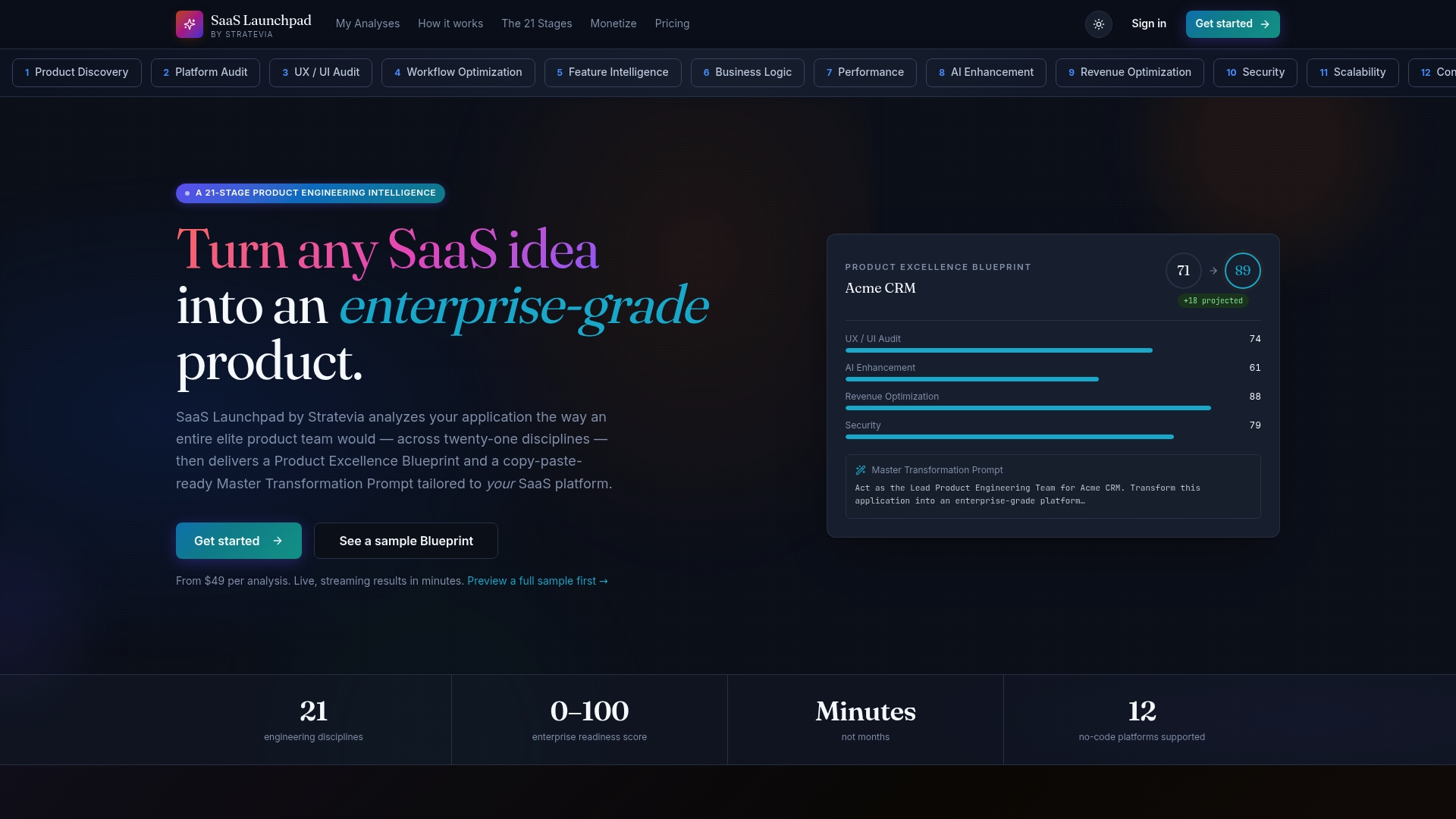
You don't need a subscription to start. Credits are purchased per analysis, never expire, and volume packs bring the per-analysis cost down for teams planning to audit multiple products or run repeat assessments as the platform evolves. Alongside the Blueprint, you get a copy-paste-ready Master Transformation Prompt built for your specific no-code platform, ready to drop into the 90-day pilot phase covered earlier in this piece. If you're building or scaling a SaaS product and want the audit phase done for you, start with the Product Excellence Blueprint and see where your platform actually sits on the maturity ladder.
Sources
- Product Excellence | Productboard
- Product Excellence | Glossary | ProductPlan
- What is Product Excellence? | airfocus
FAQ
What Are the Three Pillars of a Product Excellence Framework?
Deep user insight, clear product strategy, and a coherent roadmap. Productboard's research frames these as the shared practices among teams that consistently build products people adopt.
What Are the Five Levels of Product Excellence Maturity?
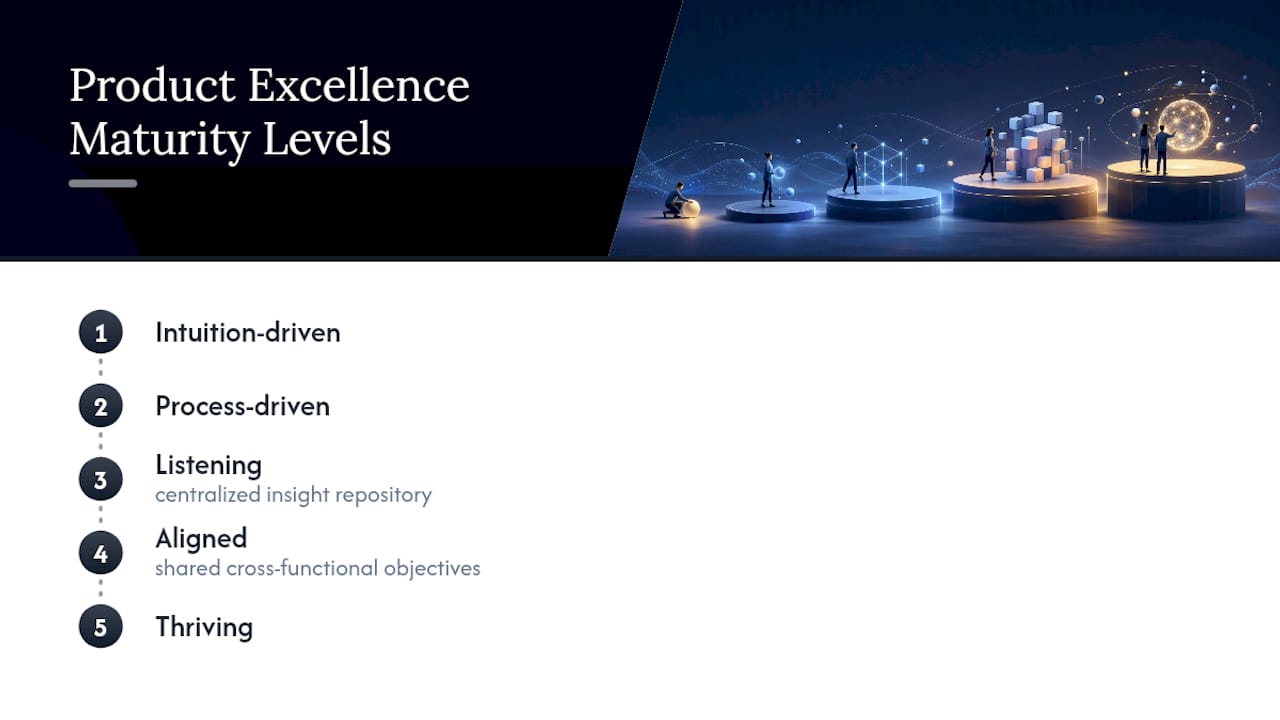
Intuition-driven, process-driven, listening, aligned, and thriving. Each level has observable markers, like a centralized insight repository at Level 3 or shared cross-functional objectives at Level 4, documented by Productboard.
How Long Does It Take to Implement a Product Excellence Framework?
A staged rollout typically runs 180 days: a 30-day audit and baseline, a 90-day prioritized pilot in one product area, and a 180-day rollout of the outcome-based roadmap across the full product line.
What Metrics Matter Most for Measuring Product Excellence?
Feature adoption, time-to-value, retention or churn, Net Promoter Score, and support ticket volume, each paired with a leading indicator that provides an early warning before the outcome metric moves.
How Does SaaS LaunchPad Help Teams Achieve Product Excellence?
SaaS LaunchPad audits a SaaS platform across 21 disciplines and delivers a Product Excellence Blueprint plus a tailored Master Transformation Prompt, giving teams a ready-made baseline for the 30-day audit phase of implementation.