The right approach: name a single implementation owner, validate everything in a small pilot, expand through phased, feature-flagged waves with numeric go/no-go criteria, and budget 20 to 30% of your implementation effort for the 30/60/90 days after launch. Skip any of those four pieces and you're improvising, not executing a SaaS rollout plan.
TL;DR:
- Assign a single implementation owner with authority to pause or escalate decisions during each rollout wave to prevent delays caused by indecision.
- Track specific KPIs such as time-to-first-value, completion rate, and weekly active users, setting clear thresholds for advancing through rollout phases.
- Conduct a phased rollout using canary, percentage, and limited user rings, combining infrastructure and user adoption testing to catch issues early.
- Build role-based training, support, and operational safety nets, including hypercare teams and operational alerts, before launch to ensure smooth adoption.
- Perform a comprehensive pre-launch audit across 21 disciplines to identify integration gaps, operational risks, and training needs, reducing breakout issues during pilot validation.
Table of Contents
- The SaaS Rollout Plan Checklist You Can Copy Today
- Who Owns the Rollout, and How Decisions Get Made
- What KPIs Should Define Rollout Success?
- How to Handle Integrations, Data Migration, and Cutover
- Canary, Percentage, and Phased Rollout Rings Explained
- Training and Adoption: Getting People to Actually Use It
- Hypercare: Your Operational Safety Net at Launch
- Post-Launch Iteration: Where the Real Work Happens
- Where a 21-Discipline Audit Shortens Pilot Validation
- Turn Your Rollout Plan Into a Prioritized Blueprint
- Sources
- FAQ
The SaaS Rollout Plan Checklist You Can Copy Today
The average organization now runs a growing number of SaaS apps every year, which is exactly why an ad hoc rollout no longer cuts it. You need a repeatable sequence, not a one-off launch event.
Here's the order that works, phase by phase:
- Audit: assess current workflows, data quality, and integration dependencies before you touch configuration.
- Governance: name the implementation owner, steering committee, and escalation path.
- Integrations: map every system that needs to talk to the new platform and assign a migration owner.
- Configuration: build the environment against your defined success criteria, not just default settings.
- Pilot: run a contained test with real users for one to two weeks.
- Waves: expand in scheduled, spaced-out groups with soak time between each.
- General availability: open to the full organization once waves clear their thresholds.
- Iterate: fix, refine, and re-measure for the first quarter.
Pro Tip: Write your business case, success criteria, migration map, training plan, and cutover plan as five separate documents before kickoff. Teams that bundle them into one deck tend to skip the migration map first, and that's the one that causes 2 a.m. calls.
Who Owns the Rollout, and How Decisions Get Made
Every stalled SaaS rollout you've ever seen has the same root cause: nobody had the authority to say "go" or "no go" without a meeting. Fix that before you touch configuration.

Assign one implementation owner with real authority over scope, timeline, and the go/no-go call at each wave. This person isn't a project coordinator collecting status updates. They can pause a rollout, reallocate resources, and answer to the steering committee directly.
Build the governance structure around them:
- Steering committee: department heads or VPs who unblock budget and cross-team conflicts weekly during rollout.
- Functional champions: one power user per department who tests early, flags friction, and trains peers later.
- Vendor or TAM contact: your named point of contact at the SaaS provider, not a generic support queue.
For decision cadence, keep it simple: the owner makes daily calls, the steering committee meets weekly, and anything blocking a wave advancement gets escalated within 24 hours, not held for the next scheduled sync.
What KPIs Should Define Rollout Success?
Vague goals like "improve efficiency" don't tell you when to advance to the next wave. You need numbers attached to every phase.
Track three primary KPIs: time-to-first-value (how fast a new user completes a meaningful action), completion rate (percentage finishing core workflows without abandoning), and weekly active users as a percentage of licensed seats. Pair those with guardrail metrics that catch problems the primary KPIs miss, like support ticket volume per active user and the rate of manual workarounds staff use instead of the new system.
Set numeric thresholds before the pilot starts, not after you see the results. If the pilot misses two of three, you don't advance. You fix the friction and re-test.
Then run the review rhythm every implementation playbook recommends:
- Day 30: adoption trending toward target, critical bugs resolved, support volume stabilizing.
- Day 60: workflow completion rates hit target, champions reporting fewer escalations.
- Day 90: KPIs sustained without hand-holding, ready to shift from hypercare to standard support.
How to Handle Integrations, Data Migration, and Cutover
Start by inventorying every system the new SaaS platform needs to connect to, and name a specific data owner for each one. Don't let "IT will handle it" stand as an answer. Someone needs their name on the reconciliation checklist.

For data migration, build in validation checkpoints at three points: before migration (data quality baseline), immediately after (row counts and field-level spot checks), and one week post-cutover (business users confirming the numbers match what they expect). Define rollback rules in advance to ensure robust SaaS security controls. If reconciliation fails past an agreed error threshold, you revert to the legacy system rather than pushing forward and hoping it self-corrects.
Then choose your cutover strategy based on risk tolerance and system complexity:
- Big bang: switch everyone at once. Fast, but unforgiving if something breaks; reserve this for lower-complexity tools with a small user base.
- Phased cutover: migrate by department or region over weeks. Slower, but contains blast radius and lets you fix issues before the next group.
- Parallel run: operate old and new systems simultaneously for a defined window. Safest option for finance, billing, or compliance-heavy workflows, but doubles the workload temporarily.
Most mid-complexity rollouts do best with phased cutover paired with a short parallel run for the highest-risk workflow, like invoicing or payroll.
Canary, Percentage, and Phased Rollout Rings Explained
Testing a SaaS rollout isn't a single event. It's a sequence of expanding rings, each with its own pass criteria before you open the next one.
Here's a standard ring structure, moving from smallest to largest exposure:
- Dogfood: your own implementation team and IT staff use it internally for a few days, catching obvious breakage before anyone else sees it.
- Private beta: a small group of friendly, engaged users, typically your functional champions, for a short pilot period.
- Limited percentage: expose the feature or platform to a defined slice of your user base, often 10 to 20%, using a feature-flag system that controls exposure by attribute rather than a hard switch.
- Expanded rollout: widen to a larger portion once the limited group clears its metrics, with a longer soak period to catch issues that only surface under real load.
- General availability: open to everyone, with hypercare support still active.
Keep the distinction clear: canary releases are infrastructure-level, watching for server errors, latency spikes, and crash rates. Phased rollout is business and UX level, watching whether people actually complete their workflows and adopt the tool. High-velocity teams run both simultaneously rather than treating them as substitutes, since combining controlled experiments with rollout rings catches regressions neither approach would flag alone.
Pro Tip: *Set your rollback trigger before the ring opens, not during a crisis.
Training and Adoption: Getting People to Actually Use It
A platform nobody uses isn't a rollout success no matter how clean the migration was. Training determines whether adoption sticks or people quietly revert to spreadsheets.

Build role-based learning paths instead of one generic training deck. A sales rep needs a 15-minute module on pipeline entry; a finance admin needs 45 minutes covering approval workflows and audit trails. Keep individual modules under 20 minutes; anything longer gets skipped or half-watched.
Layer in support that meets people where they work:
- Champion networks handle peer questions faster than a ticket to IT ever will.
- In-app tooltips and job aids answer the "how do I do this specific thing" question at the moment of need.
- A shared FAQ doc, updated weekly during hypercare, cuts down repeat questions to champions.
Measure adoption by feature usage per department, not just login counts, and set a firm shutdown date for shadow tools once usage crosses your target threshold. Announce that date early so nobody's caught off guard.
Hypercare: Your Operational Safety Net at Launch
Incomplete planning that skips the operational layer, meaning support documentation, alert triggers, and clear escalation paths, is the single most common reason SaaS implementations fail after go-live. Build this before launch day, not after the first fire.
Staff a dedicated hypercare team for the first two to four weeks, with defined support SLAs (say, one-hour response for critical issues, four hours for standard tickets) and a rotation schedule so nobody burns out covering nights alone.
Instrument the workflows that matter most:
- Alert on integration sync failures within minutes, not after users notice missing data.
- Watch performance metrics against your pre-launch baseline to catch regressions early.
- Track error rates by user segment to isolate whether a problem is systemic or limited to one department.
Define your kill-switch criteria and who can pull it in advance, along with a retirement plan for temporary controls (extra support staff, relaxed permissions, manual workarounds) once metrics stabilize. Our SaaS audit checklist walks through exactly which operational gaps enterprise buyers check for before they'll approve a vendor.
Post-Launch Iteration: Where the Real Work Happens
Launch day is the midpoint of a SaaS rollout, not the finish line. What you do in the following 90 days determines whether adoption sticks or erodes.
Run daily checks through week one: error rates, support ticket themes, and completion rates by department. After that, shift to weekly checks unless a metric breaks its threshold. Triage fixes by impact, not by whoever complained loudest. A blocked core workflow beats a cosmetic UI complaint every time.
Common post-launch priorities, roughly in order:
- Fix anything blocking a core workflow completion.
- Resolve integration sync errors causing data discrepancies.
- Address the top three recurring support themes from champions.
- Refine training materials based on where users actually get stuck.
Budget 20 to 30% of your total implementation effort for this phase. Teams that treat post-launch as a rounding error consistently see adoption plateau below target, then wonder why the tool they paid for never delivered the promised return.
Where a 21-Discipline Audit Shortens Pilot Validation
Most of the failure points covered above, thin integration mapping, missing operational alerts, undocumented training gaps, show up during pilot only after something breaks. A structured audit run before kickoff surfaces them on paper instead.
SaaS LaunchPad's Product Excellence Blueprint maps directly onto this checklist: integration gaps get flagged against the audit's platform and security disciplines, operational readiness gets scored before hypercare even starts, and training gaps surface through the workflow and customer journey analysis rather than mid-pilot support tickets. Running that analysis before your pilot compresses the "find out the hard way" phase into a document you review at your desk.
— Gregory Cornelius
Turn Your Rollout Plan Into a Prioritized Blueprint
If you've read this far, you already know the gap between a rollout checklist and an execution-ready plan is detail. That's where a structured audit earns its keep instead of a generic pre-launch review.
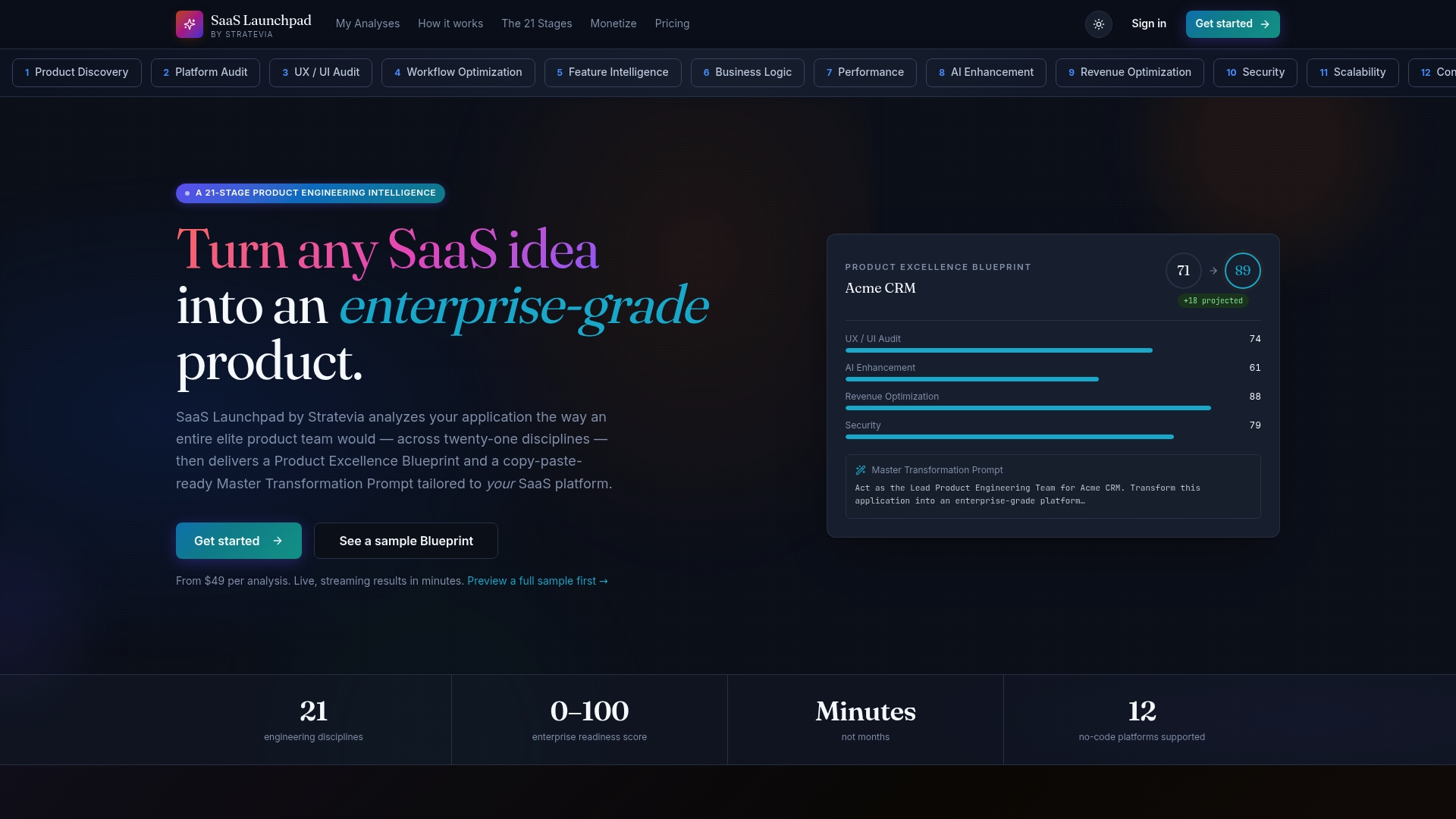
SaaS LaunchPad runs your platform through 21 disciplines, product discovery, integration mapping, security, performance, and more, then hands you a prioritized roadmap and a copy-paste-ready Master Transformation Prompt built for your specific platform. Instead of guessing which gaps will surface during your pilot, you get them ranked before wave one starts. It's built for founders, no-code builders, and product teams who need an execution-ready blueprint, not another generic checklist. Pay per analysis, no subscription, credits that never expire. If you're staring down a rollout timeline right now, start with a full audit and walk into your pilot with the gaps already mapped.
Sources
A few sources worth bookmarking as you build out your own plan:
- How to plan and execute a SaaS implementation | TechTarget
- SaaS implementation best practices: the complete 2026 playbook - Guideflow Blog
- Controlled rollout (safe-velocity) — case study and methods
FAQ
What Should Be Included in a Rollout Plan?
A complete plan needs a named implementation owner, a documented business case, measurable success criteria, an integration and migration map, a phased pilot-to-GA schedule with go/no-go thresholds, a role-based training plan, and a 30/60/90 post-launch review cadence.
Is SaaS Still Profitable Going Into 2026?
SaaS remains a growing category, with organizations running more SaaS applications year over year, though profitability depends heavily on efficient rollouts and adoption, not just new sign-ups. Poorly executed implementations drive churn regardless of how strong the underlying product is.
What Is the Rule of 40 in SaaS?
The Rule of 40 says a healthy SaaS company's growth rate plus profit margin should add up to 40% or higher, used as a quick benchmark for balancing growth against sustainability. It's a company-level financial metric, separate from rollout execution, but weak adoption from bad rollouts can drag growth rate down and hurt that number.
What Does SaaS Stand For?
SaaS stands for Software as a Service, meaning software hosted by a vendor and accessed over the internet rather than installed locally. Rollout planning matters specifically because SaaS tools integrate with existing systems and data, unlike standalone software with no external dependencies.
How Long Should a SaaS Pilot Run Before Expanding?
Most pilots run one to two weeks, long enough to capture a full workflow cycle without dragging out the timeline before you have data to justify wave expansion.